Muscle Cards
 Call Kai
 Learn
 Practice Test
 Spaced Repetition
 Match
 Flashcards
 Knowt Play
1/38

There's no tags or description
Looks like no tags are added yet.
39 Terms
What is the OIIA of the triceps brachii muscle?
O: Long Head = scapula (infraglenoid tubercle)
Medial Head = humerus (posterior aspect of shaft, inferior to radial groove)
Lateral Head = humerus (posterior aspect of shaft, superior to radial groove)
I: ulna (olecranon process via a common triceps tendon)
I: radial nerve (C6-C8)
A: Long Head = moves the ulna and humerus (primary - extension of forearm at elbow joint; secondary - accessory adductor and extensor of humerus at glenohumeral joint)
Medial/Lateral Head = moves the ulna (extension of forearm at elbow joint)

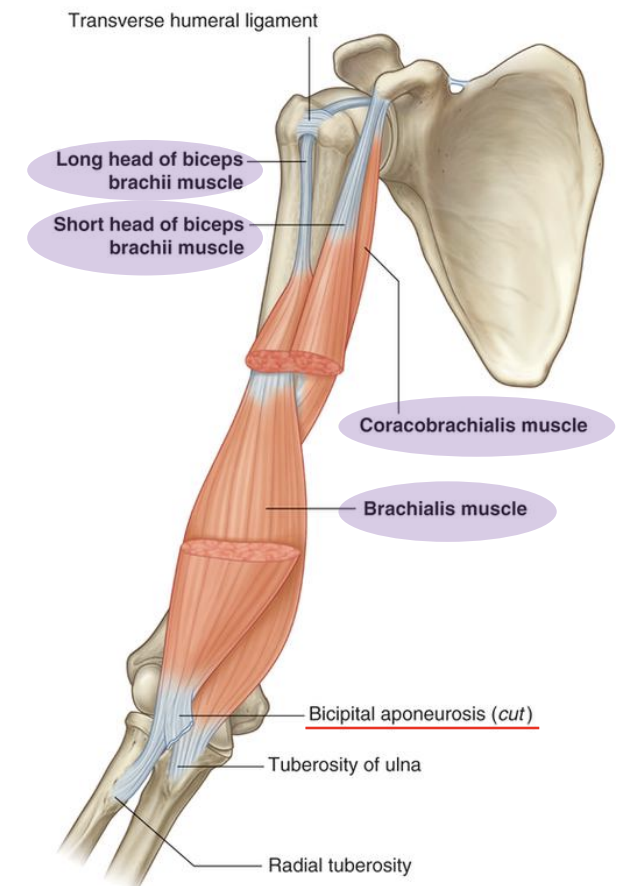
What is the OIIA of the biceps brachii muscle?
O: Long Head = scapula (supraglenoid tubercle)
Short Head = scapula (coracoid process [apex])
I: radius (radial tuberosity)
I: musculocutaneous nerve (C5-C6)
A: moves the humerus and radius (primary - flexion of forearm at elbow joint, supination of forearm; secondary - accessory flexor of humerus at glenohumeral joint)

What is the OIIA of the coracobrachialis muscle?
O: scapular (coracoid process [apex])
I: humerus (midshaft, medial aspect [linear roughening])
I: musculocutaneous nerve (C5-C7)
A: moves the humerus (flexion at glenohumeral joint, adduction at glenohumeral joint)

What is the OIIA of the brachialis muscle?
O: humerus (anterior aspect of shaft [medially and laterally], adjacent intermuscular septa)
I: ulna (ulnar tuberosity)
I: musculocutaneous nerve (C5-C6), radial nerve (C7)
A: moves the ulna (powerful flexion of forearm at elbow joint)
What is the OIIA of flexor carpi ulnaris?
Humeral head = humerus (medial epicondyle)
Ulnar head = ulna (olecranon and posterior ulna)
I: pisiform, hamate (via pisohamate ligament), metacarpal V (base via pisometacarpal ligament)
I: ulnar nerve (C7-T1)
A: moves the wrist (flexion and ulnar deviation

What is the OIIA of palmaris longus?
O: humerus (medial epicondyle)
I: palmar aponeurosis
I: median nerve (C7-C8)
A: moves the wrist (flexion)

What is the OIIA of flexor carpi radialis?
O: humerus (medial epicondyle)
I: metacarpals II and III (bases)
I: median nerve (C6-C7))
A: moves the wrist (flexion and radial deviation)
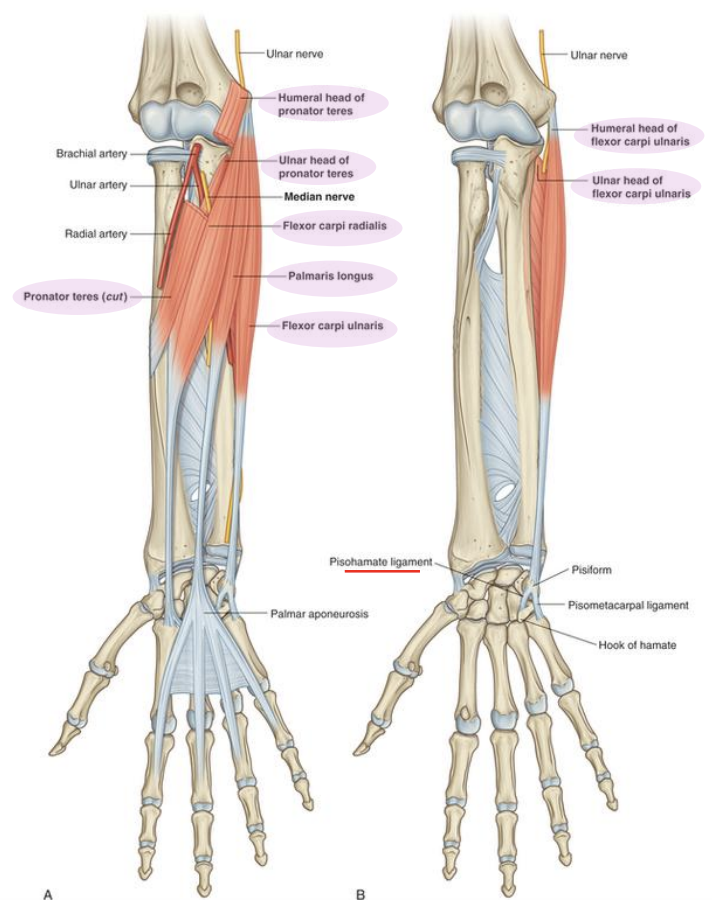
What is the OIIA of pronator teres?
O:
Humeral Head = humerus (medial epicondyle and medial supraepicondylar ridge)
Ulnar Head = ulna (coronoid process)
I: radius (lateral midshaft)
I: median nerve (C6-C7)
A: moves the forearm (pronation)
What is the OIIA of flexor digitorum superficialis?
O:
Humero-ulnar head = humerus (medial epicondyle), ulna (coronoid process)
Radial head = radius (oblique line)
I: digits II-V (middle phalanges [palmar surface] via long tendons)
I: median nerve (C8-T1)
A: moves the fingers (flexion at PIPs)

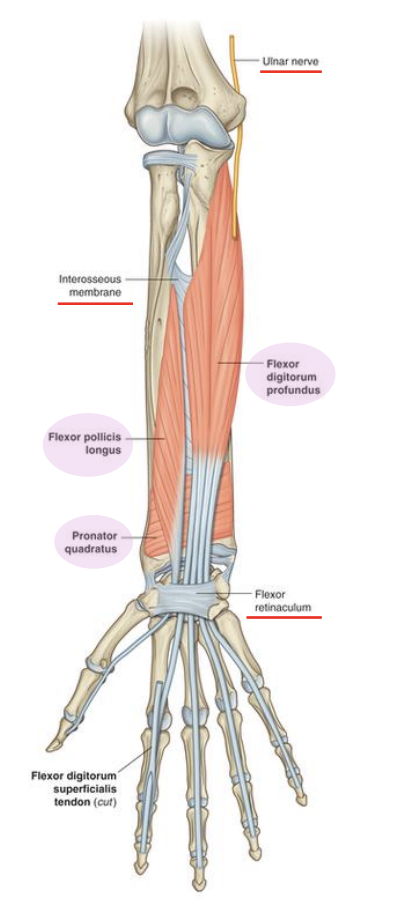
What is the OIIA of flexor digitorum profundus?
O: ulna (anterior and medial surfaces and ulnar half of interosseous membrane)
I: digits II-V (distal phalanges [palmar surface] via long tendons
I:
Lateral half = anterior interosseous nerve (from median nerve, C7-C8)
Medial hald = ulnar nerve (C8-T1)
A: moves the fingers (flexion at DIPs, can also flex metacarpophalangeal joints and wrist)

What is the OIIA of flexor pollicis longus?
O: radius (anterior surface and radial half of interosseous membrane)
I: thumb (distal phalanx [palmar surface, base])
I: anterior interosseous nerve (from median nerve, C7-C8)
A: moves the thumb (flexion at interphalangeal joint, can also flex metacarpophalangeal joint of thumb)
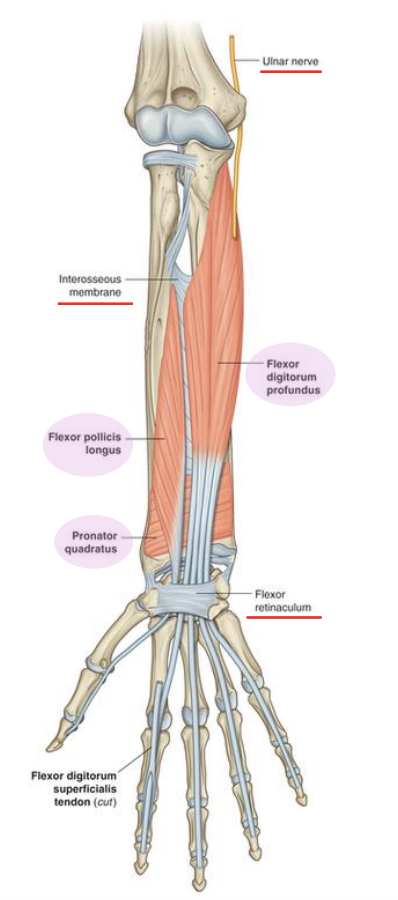
What is the OIIA of pronator quadratus?
O: ulna (distal anterior surface)
I: radius (anterior surface)
I: anterior interosseous nerve (from median nerve, C7-C8)
A: moves the forearm (pronation)
What is the OIIA of palmaris brevis?
O: palm (palmar aponeurosis and flexor retinaculum
I: palm (dermis of skin [medial margin of hand])
I: ulnar nerve (superficial branch, C8-T1)
A: improves grip

What is the OIIA of adductor pollicis?
O:
Transverse head = metacarpal III
Oblique head = capitate, metacarpals II and III (bases)
I: thumb (proximal phalanx, extensor hood)
I: ulnar nerve (deep branch, C8-T1)
A: moves the thumb (adduction)

What is the OIIA of the lumbricals?
O: flexor digitorum profundus (tendons)
I: digits II-V (extensor hoods, lateral sides)
I:
Medial two = ulnar nerve (deep branch, C8-T1)
Lateral two = median nerve (digital branches, C8-T1)
A: moves the digits (flexion of metacarpophalangeal joints while extension of interphalangeal joints)

What is the OIIA of the dorsal interossei?
O: metacarpals (sides)
I: digits II-IV (extensor hoods, proximal phalanges [bases])
I: ulnar nerve (deep branch, C8-T1)
A: moves digits II-IV (abduction at metacarpophalangeal joints)

What is the OIIA of the palmar interossei?
O: metacarpals (sides)
I: digits I/II/IV/V (extensor hoods), digit 1 (proximal phalanx)
I: ulnar nerve (deep branch, C8-T1)
A: moves the digits (adduction at metacarpophalangeal joints)

What is the OIIA of opponens pollicis?
O: trapezium (tubercle), flexor retinaculum)
I: metacarpal I (lateral margin and palmar surface)
I: median nerve (recurrent branch, C8-T1)
A: moves the thumb (medially rotates metacarpal I [opposition])

What is the OIIA of abductor pollicis brevis?
O: scaphoid and trapezium (tubercles), flexor retinaculum
I: thumb (proximal phalanx, extensor hood)
I: median nerve (recurrent branch, C8-T1)
A: moves the thumb (abduction of metacarpophalangeal joint)
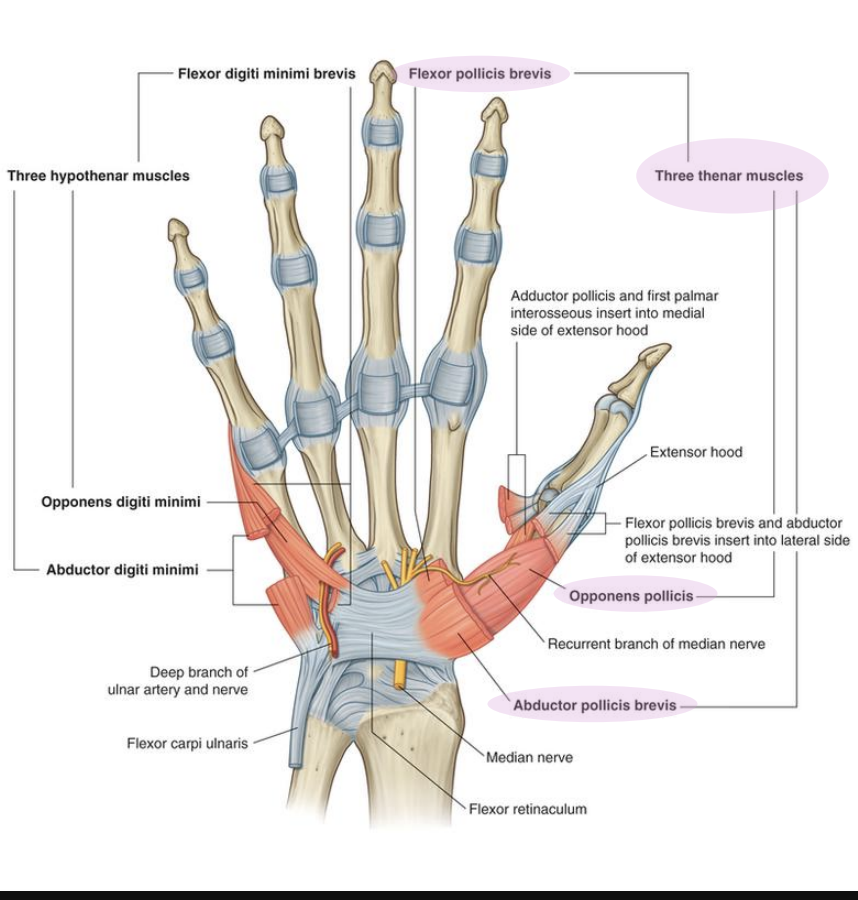
What is the OIIA of flexor pollicis brevis?
O: trapezium (tubercle), flexor retinaculum
I: thumb (proximal phalanx)
I: median nerve (recurrent branch, C8-T1)
A: moves the thumb (flexion of metacarpophalangeal joint)

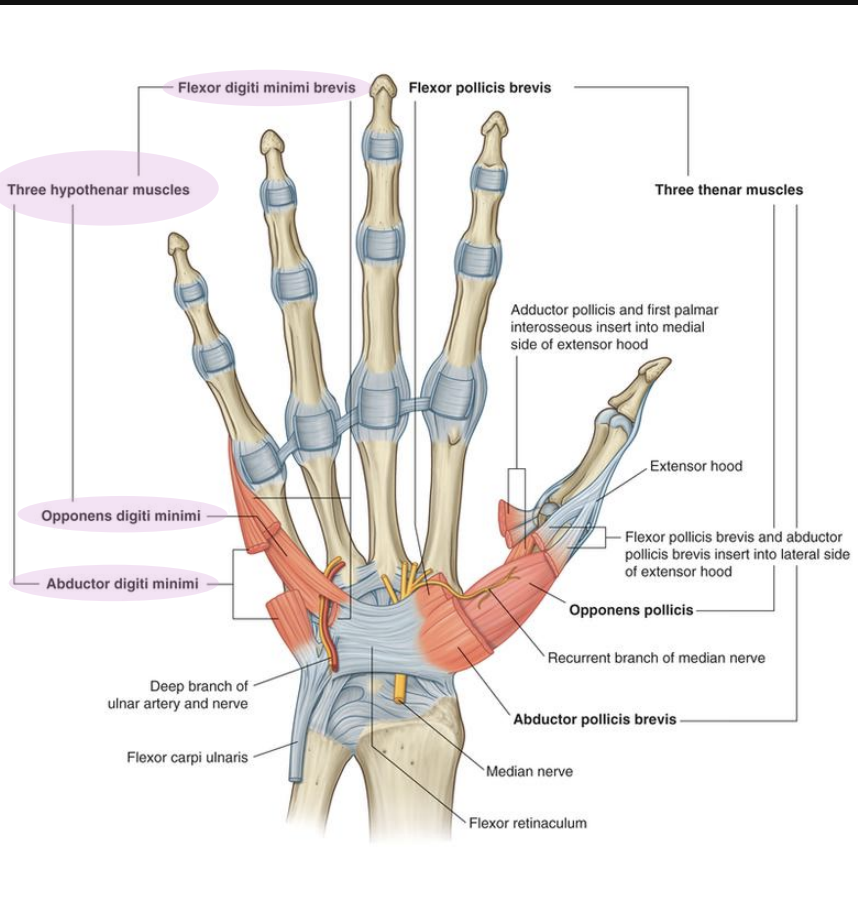
What is the OIIA of opponens digiti minimi?
O: hamate (hook), flexor retinaculum
I: metacarpal V (medial aspect)
I: ulnar nerve (deep branch, C8-T1)
A: moves the pinky (lateral rotation of metacarpal V [opposition])

What is the OIIA of abductor digiti minimi?
O: pisiform, pisohamate ligament flexor carpi ulnaris (tendon)
I: pinky (proximal phalanx)
I: ulnar nerve (deep branch, C8-T1)
A: moves the pinky (abduction at metacarpophalangeal joint)

What if the OIIA of flexor digiti minimi?
O: hamate (hook), flexor retinaculum
I: pinky (proximal phalanx)
I: ulnar nerve (deep branch, C8-T1)
A: moves the pinky (flexion at metacarpophalangeal joint)
What is the OIIA of brachioradialis?
O: humerus (lateral supraepicondylar ridge [proximal part], lateral intermuscular septum)
I: radius (distal end, lateral surface)
I: radial nerve (C5-C6)
A: moves the radius (accessory flexor of midpronated elbow)
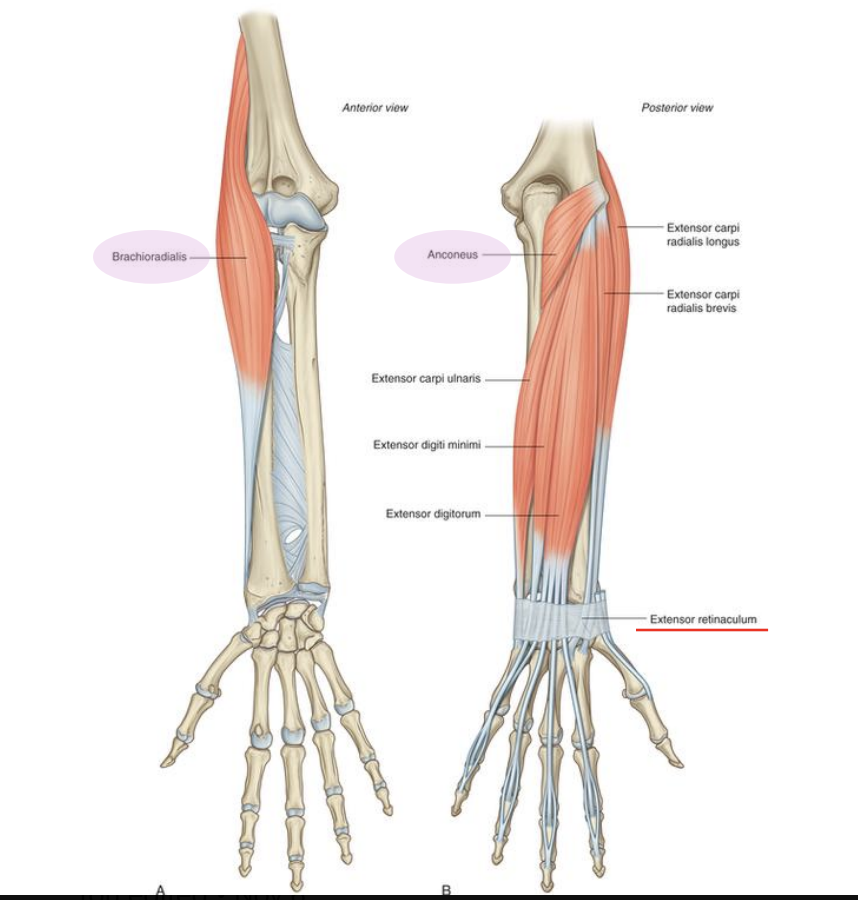
What is the OIIA of the anconeus?
O: humerus (lateral epicondyle)
I: ulna (olecranon and posterior surface)
I: radial nerve (C6-C8)
A: moves the ulna (accessory extension, abduction during pronation)

What is the OIIA of extensor carpi radialis longus?
O: humerus (lateral supraepicondylar ridge [distal part], lateral intermuscular septum)
I: metacarpal II (base, dorsal aspect)
I: radial nerve (C6-C7)
A: moves the wrist (extension and abduction
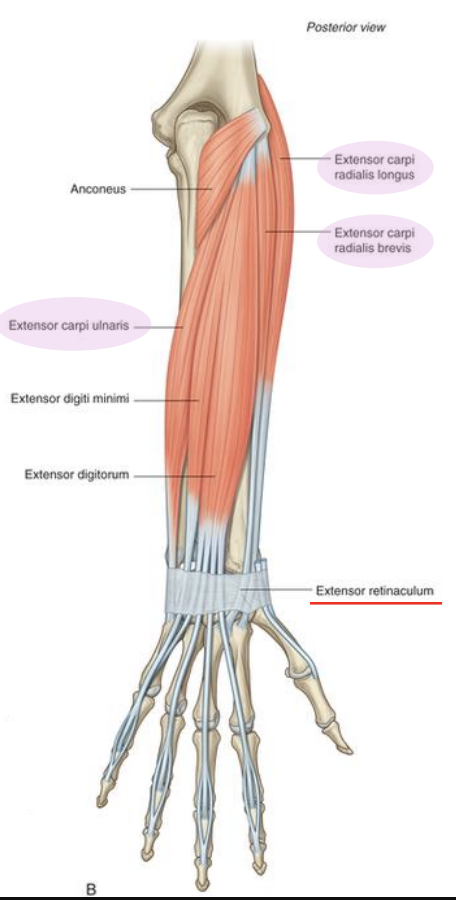
What is the OIIA of extensor carpi radialis brevis?
O: humerus (lateral epicondyle, lateral intermuscular septum)
I: metacarpals II and III (base, dorsal aspect)
I: radial nerve (deep branch, C7-C8)
A: moves the wrist (extension and abduction)

What is the OIIA of extensor carpi ulnaris?
O: humerus (lateral epicondyle), ulna (posterior border)
I: metacarpal V (tubercle [medial side, base])
I: posterior interosseous nerve (C7-C8)
A: moves the wrist (extension and adduction

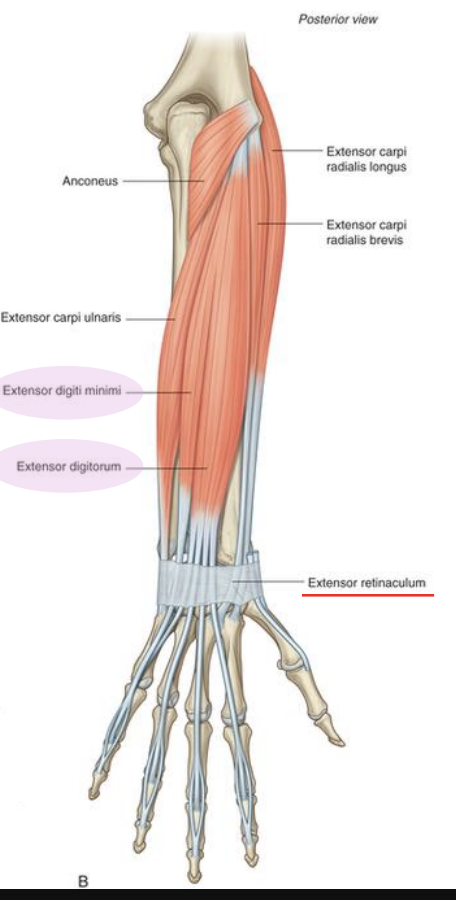
What is the OIIA of extensor digitorum?
O: humerus (lateral epicondyle), lateral intermuscular septum
I: digits II-V (middle and distal phalanges [bases, dorsal aspects])
I: posterior interosseous nerve (C7-C8)
A: moves digits II-V (extension, can also extend wrist)
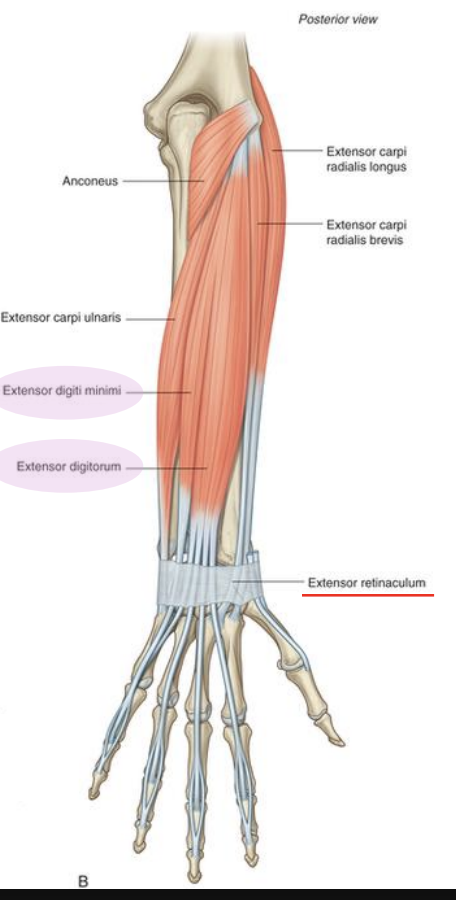
What is the OIIA of extensor digiti minimi?
O: humerus (lateral epicondyle), lateral intermuscular septum
I: pinky (extensor hood)
I: posterior interosseous nerve (C7-C8)
A: moves the pinky (extension)
What is the OIIA of supinator?
O:
Superficial layer = humerus (lateral epicondyle), radial collateral and annular ligaments
Deep layer = ulna (supinator crest)
I: radius (lateral aspect [superior to oblique line])
I: posterior interosseous nerve (C6-C7)
A: moves the forearm (supination)

What is the OIIA of abductor pollicis longus?
O: radius and ulna (posterior surfaces and interosseous membrane [distal to attachments of supinator and anconeus])
I: metacarpal I (base, lateral side)
I: posterior interosseous nerve (C7-C8)
A: moves thumb (abduction of carpometacarpal joint, accessory extension)

What is the OIIA of extensor pollicis brevis?
O: radius (posterior surface and adjacent interosseous membrane [distal to abductor pollicis longus)
I: thumb (proximal phalanx [base, dorsal surface])
I: posterior interosseous nerve (C7-C8)
A: moves thumb (extension of metacarpophalangeal joint, can also extend the carpometacarpal joint)
![<p>O: radius (posterior surface and adjacent interosseous membrane [distal to abductor pollicis longus)</p><p>I: thumb (proximal phalanx [base, dorsal surface])</p><p>I: posterior interosseous nerve (C7-C8)</p><p>A: moves thumb (extension of metacarpophalangeal joint, can also extend the carpometacarpal joint)</p>](https://assets.knowt.com/user-attachments/5d787dec-b6fb-4578-a4b9-e6713897789a.png)
What is the OIIA of extensor pollicis longus?
O: ulna (posterior surface and adjacent interosseous membrane (distal to abductor pollicis longus)
I: thumb (distal phalanx [base, dorsal surface])
I: posterior interosseous nerve (C7-C8)
A: moves thumb (extension of interphalangeal joint, can also extend metacarpophalangeal joint and carpometacarpal joint)

What is the OIIA of extensor indicis?
O: ulna (posterior surface and adjacent interosseous membrane [distal to extensor pollicis longus])
I: digit II (extensor hood)
I: posterior interosseous nerve (C7-C8)
A: moves the index finger (extension)

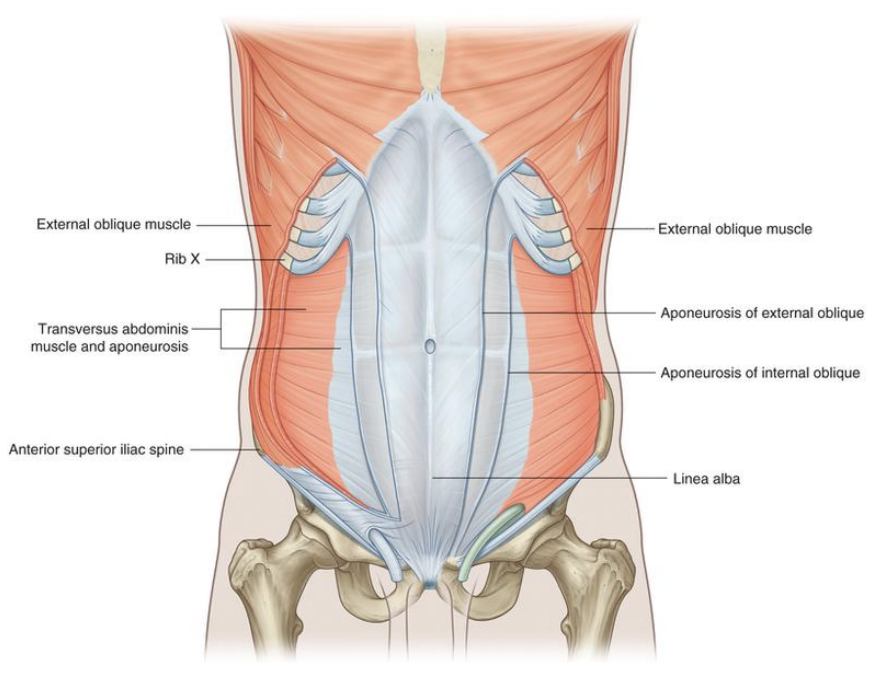
What is the OIIA of rectus abdominis?
O: pubic bone (pubic crest, pubic tubercle, pubic symphysis)
I: ribs 5-7 (costal cartilage), xiphoid process
I: anterior rami (T7-T12)
A: compresses abdominal cavity/contents, tenses the abdominal wall, moves the vertebral column (flexion)

What is the OIIA of extenral oblique?
O: ribs 5-12 (outer edges via muscular slips)
I: ilium (iliac crest, lateral lip), abdominal aponeurosis (ending at linea alba)
I: anterior rami (T7-T12)
A: compresses abdominal cavity/contents
Bilaterally = moves trunk (flexion)
Unilaterally = moves trunk (ipsilateral side flexion, contralateral side flexion)

What is the OIIA of internal oblique?
O: thoracolumbar fascia, ilium (iliac crest between external oblique and transversus abdominis), lateral inguinal ligament
I: ribs 9-12 (inferior borders), abdominal aponeurosis (ending at linea alba), pubic bone (pubic crest, pectineal line)
I: anterior rami (T7-L1)
A: compresses abdominal cavity/contents
Bilaterally = moves trunk (flexion)
Unilaterally = moves trunk (ipsilateral side flexion, ipsilateral rotation)

What is the OIIA of transversus abdominis?
O: thoracolumbar fascia, ilium (iliac crest, medial lip), lateral inguinal ligament, ribs 7-12 (costal cartilages)
I: abdominal aponeurosis (ending at linea alba), pubic bone (pubic crest, pectineal line)
I: anterior rami (T7-L1)
A: compresses abdominal cavity/contents