18: Nitrogen Metabolism
 Call Kai
 Learn
 Practice Test
 Spaced Repetition
 Match
 Flashcards
 Knowt Play
1/163

There's no tags or description
Looks like no tags are added yet.
164 Terms
what are diazotrophs?
nitrogen-fixing organisms
examples of diazotrophs
soybean, clover
diazotrophs make what enzyme?
nitrogenase
Nitrogenase is what kind of protein? containing what kind of centers and what cofactor?
metalloprotein; iron–sulfur centers; FeMo cofactor
how much ATP does biological N2 reduction consume?
16 ATP
why are many nitrogen-fixing bacteria confined to anaerobic habitats?
Oxygen inactivates nitrogenase - allows them to fix nitrogen
or may carry out nitrogen fixation when O2 is low
Biologically useful nitrogen originates from _____, which is naturally present in ____
nitrate (NO3-); water and soils
nitrate reductase catalyzes the two-electron reduction of nitrate to nitrite (NO2-) → next, nitrite reductase converts nitrite to ______, which is typically in what form under physiological conditions?
ammonia
NH4+ (the ammonium ion)
what is nitrification?
production of nitrate through oxidization of NH4+ to NO2- , and then NO3-
what is denitrification?
converting nitrate back to N2
what is earth’s nitrogen cycle?

The enzyme glutamine synthetase is found in all organisms, what does it do?
In microorganisms, it is a metabolic entry point for fixed nitrogen. In animals, it helps mop up excess ammonia, which is toxic
in first step of reaction of nitrogen fixation, ATP donates a phosphoryl group to glutamate. Then ammonia reacts with the reaction intermediate, displacing Pi to produce _____
glutamine
general role of glutamine?
carrier of amino groups
The activity of glutamine synthetase is ____regulated to maintain a supply of ____
tightly; accessible amino groups
In bacteria and plants, the enzyme _____ catalyzes the reaction to produce ____
glutamate synthase; glutamate
the combined action of these two enzymes (glutamine and glutamate synthesis) assimilates fixed nitrogen (NH4+) into an organic compound ________ to produce an amino acid ______
α-ketoglutarate, a citric acid cycle intermediate; glutamate
mammals lack what enzyme?
glutamate synthetase
Because reduced nitrogen is so precious but free ammonia is toxic, what happens with amino groups?
amino groups are transferred from molecule to molecule, with glutamate often serving as an amino-group donor
what do transaminases (also called aminotransferases) do?
catalyzes the transfer of an amino group to an α-keto acid
During such an amino-group transfer reaction, the amino group is transiently attached to a prosthetic group of the enzyme. This group is _____, a derivative of _____
pyridoxal-5ʹ-phosphate (PLP) (a schiff base)
pyridoxine (also known as vitamin B6)
what is ALT, what does its alteration reflect?
alanine transaminase
alteration reflects liver damage
what is AST, when does it increase?
aspartate aminotransferase
increases following heart attack and heart muscle damage.
what are nonessential amino acids
amino acids humans can synthesize
what are essential amino acids
essential because humans cannot synthesize them
The ultimate sources of the essential amino acids are _____, why?
plants and microorganisms; they produce all the enzymes necessary to undertake the synthesis of these compounds
list of essential amino acids
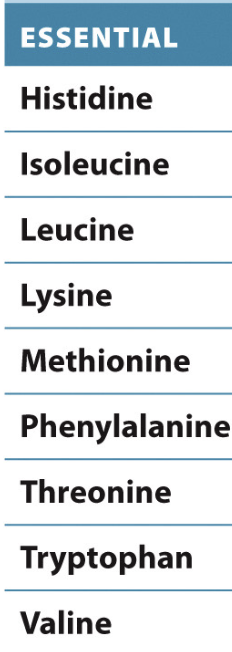
list of nonessential amino acids

alanine is produced from?
pyruvate
aspartate is produced from?
oxaloacetate
glutamate is produced from?
α-ketoglutarate
Glutamine synthetase catalyzes change of what aa to what other aa?
glutamate → glutamine
Asparagine synthetase uses what as an amino acid donor? converts what to what?
glutamine
aspartate → asparagine
which three common metabolic intermediates give rise to which five nonessential amino acids?
pyruvate, oxaloacetate, and α-ketoglutarate
Glutamate, Glutamine, Asparagine, Aspartate, and Alanine
what kinds of reactions convert pyruvate, oxaloacetate, and α-ketoglutarate to Glutamate, Glutamine, Asparagine, Aspartate, and Alanine?
simple transamination and amidation reactions
Slightly longer pathways convert glutamate to
proline and arginine
Serine is derived from the glycolytic intermediate ____ in three steps
3-phosphoglycerate
Serine, a three-carbon amino acid, gives rise to ____ in a reaction catalyzed by ______
2-carbon glycine
serine hydroxymethyltransferase
serine hydroxymethyltransferase uses a _____ mechanism to remove ______; this one-carbon fragment is then transferred to the cofactor _____
PLP-dependent mechanism
the hydroxymethyl (-CH2OH) group attached to the α carbon of serine
tetrahydrofolate
what is the function of tetrahydrofolate?
carrier of one-carbon units in several reactions of amino acid and nucleotide metabolism.
can mammals synthesize folate (oxidized for of tetrahydrofolate)?
no; must obtain it as a vitamin from their diet
when does requirement for folate increase?
during first few weeks of pregnancy, when the fetal nervous system begins to develop
why is supplemental folate necessary during pregnancy?
appears to prevent certain neural tube defects such as spina bifida, in which the spinal cord remains exposed
humans cannot synthesize what kinds of amino acids?
branched-chain amino acids or aromatic amino acids
humans cannot incorporate sulfur into what?
compounds such as methionine
he bacterial pathway for producing sulfur-containing amino acids begins with ____ and uses sulfur that comes from ______
serine; inorganic sulfide
In bacteria, cysteine can then donate its sulfur atom to a four-carbon compound derived from
_____, forming ____
aspartate; the nonstandard amino acid homocysteine
In humans, serine reacts with ____, which is formed during the metabolism of methionine to cysteine, to yield ____
homocysteine; cysteine
why is cysteine considered a nonessential amino acid? caveat?
In humans, serine reacts with homocysteine, which is formed during the metabolism of methionine to cysteine, to yield cysteine
even though its sulfur atom must ultimately come from methionine, an essential amino acid.
High level of homocysteine is correlated with
cardiovascular disease
aspartate is the precursor of what?
methionine, as well as essential aas threonine and lysine
which are the branched chain amino acids?
valine, leucine, and isoleucine
The branched-chain amino acids are synthesized using ___ as the starting substrate. These amino acids require a step catalyzed by a ______ (with ____ as a substrate) to introduce ______
pyruvate
transaminase
glutamate
an amino group
what are the aromatic amino acids?
phenylalanine, tyrosine, and tryptophan
In plants and bacteria, the pathway for synthesizing the aromatic amino acids begins with the condensation of the C3 compound _____ (a glycolytic intermediate) and ______ (a four-carbon intermediate of the pentose phosphate pathway)
phosphoenolpyruvate
erythrose-4-phosphate
The seven-carbon reaction product then cyclizes and undergoes additional modifications, including the addition of three more carbons from phosphoenolpyruvate, before becoming ____
chorismate
Because animals do not synthesize chorismate, this pathway is an obvious target for agents that can inhibit plant metabolism without affecting animals. What is Glyphosate?
????
In humans, tyrosine is generated by hydroxylating ____, which is why tyrosine is/is not? considered an essential amino acid
phenylalanine; is not
The final two reactions of the tryptophan biosynthetic pathway (which has 13 steps altogether) are catalyzed by____
tryptophan synthase
what do tryptophan synthase’s alpha and beta subunits do in tryptophan biosynthetic pathway?
α subunit cleaves indole-3-glycerol phosphate to indole and glyceraldehyde-3-phosphate, then the β subunit adds serine to indole to produce tryptophan
in tryptophan synthase: α subunit cleaves indole-3-glycerol phosphate to ____ and _____, then the β subunit adds ____to indole to produce ____
indole and glyceraldehyde-3-phosphate
serine; tryptophan
how does indole travel between active sites?
diffuses directly from one active site to the other without entering the surrounding solvent
what is channeling? why is it useful?
The movement of a reactant between two active sites; it increases the rate of a metabolic process by preventing the loss of intermediates
All but one of the 20 standard amino acids are synthesized entirely from precursors produced by the main carbohydrate-metabolizing pathways. which one?
histidine
where does histidine get its nitrogens and carbons?
ATP provides one nitrogen and one carbon atom
Glutamate and glutamine donate the other two nitrogen atoms
the remaining five carbons are derived from a phosphorylated monosaccharide, 5 phosphoribosyl pyrophosphate (PRPP):
some amino acids act as precursors to other compounds such as?
neurotransmitters
common aa/aa derivative neurotransmitters include:
glycine, glutamate, γ-aminobutyric acid (GABA) or γ-aminobutyrate.
tyrosine gives rise to which nts? what are they called/why?
dopamine, norepinephrine, and epinephrine - catecholamines, due to resemblance to catechol
what produces Parkinson’s? symptoms?
deficiency of dopamine; tremor, rigidity, and slow movements
tryptophan is the precursor of what nt?
serotonin
low levels of serotonin has been linked to?
depression, aggression, and hyperactivity.
serotonin is the precursor of what?
melotonin
melotonin is often used as?
a cure for sleep disorders and jet lag
Why nitroglycerin is a mainstay care for patients with heart diseases?
patients of angina pectoris, a painful condition caused by obstruction of the coronary blood vessels, can relieve their symptoms by taking nitroglycerin
why does nitroglycerin relieve angina pectoris symptoms?
In vivo, nitroglycerin yields NO, which rapidly stimulates vasodilation, temporarily relieving the symptoms of angina
aas are the major fuel for what kind of cells?
cells lining the small intestine
other organs that catabolize aas?
liver
how are amino acids mobilized when dietary amino acids aren’t available (ie, during long fasts)
through the breakdown of muscle tissue, which accounts for about 40% of the total protein in the body.
what is the pathway of amino acid catabolism?
The amino acids undergo transamination reactions to remove their α-amino groups, and their carbon skeletons then enter the central pathways of energy metabolism (principally the citric acid cycle). The amino acids are partially oxidized to substrates for gluconeogenesis (or ketogenesis). Glucose can then be exported to other tissues or stored as glycogen
classification of amino acids in humans
glucogenic, ketogenic, or both
what are glucogenic aas
giving rise to gluconeogenic precursors such as citric acid cycle intermediates
what are ketogenic aas
giving rise to acetyl-CoA, which can be used for ketogenesis or fatty acid synthesis
which aas are ONLY glucogenic?

which aas are both gluco and ketogenic
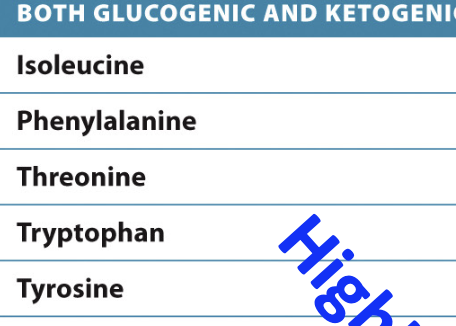
which aas are ONLY ketogenic

Three amino acids are converted to gluconeogenic substrates by simple transamination, what are the reactions?
alanine to pyruvate
aspartate to oxaloacetate
glutamate to α-ketoglutarate
besides alanine/aspartate/glutamate, which other aas can be converted to pyruvate/oxaloacetate/alpha-ketoglutarate
Asparagine, glutamine and serine
Asparagine undergoes a simple hydrolytic deamidation to ____, which is then transaminated to ____
aspartate; oxaloacetate
glutamine is deamidated by a glutaminase to ____, and the glutamate dehydrogenase reaction yields ____
glutamate; alpha-ketoglutarate
serine → pyruvate looks like:

which aas can be catabolized to glutamate? then what does glutamate become?
arginine, proline, histidine; alpha-ketoglutarate
Amino acids of the glutamate “family” include? importance?
arginine, glutamine, histidine, and proline
constitute about 25% of dietary amino acids, so their potential contribution to energy metabolism is significant
cysteine is converted to?
pyruvate
Threonine is both glucogenic and ketogenic because?
it is broken down to acetyl-CoA and glycine
threonine → acetyl CoA is a precursor of?
ketone bodies
threonine → glycine is potentially? If?
gluconeogenic, if first converted to serine
the branched-chain amino acids include:
they undergo transamination to their _____ and are then linked to ____
valine, leucine, and isoleucine
alpha-keto-acid forms; coenzyme A
valine catabolized to what?
succinyl-CoA
isoleucine degraded to what?
succinyl-CoA and acetyl-CoA
The cleavage of the aromatic amino acids (which include?) yields the ketone body _____ as well as a _______
phenylalanine, tyrosine, and tryptophan
acetoacetate
glucogenic compound (alanine or fumarate)