Class 20: Welfare Analysis in Partial Equilibrium
 Call Kai
 Learn
 Practice Test
 Spaced Repetition
 Match
 Flashcards
 Knowt Play
1/11

There's no tags or description
Looks like no tags are added yet.
12 Terms
TOPIC 1) Social Welfare
partial versus general equilibrium
partial equilibrium considers a single market whereas general equilibrium considers all markets together.
Social welfare
consists of societies welfare including consumer welfare, producer welfare, and government revenue.
SW= CS + PS (+GR, if any)
“social surplus”
How we measure social welfare. This is the net benefit or surplus to participants in a market from engaging in that market.
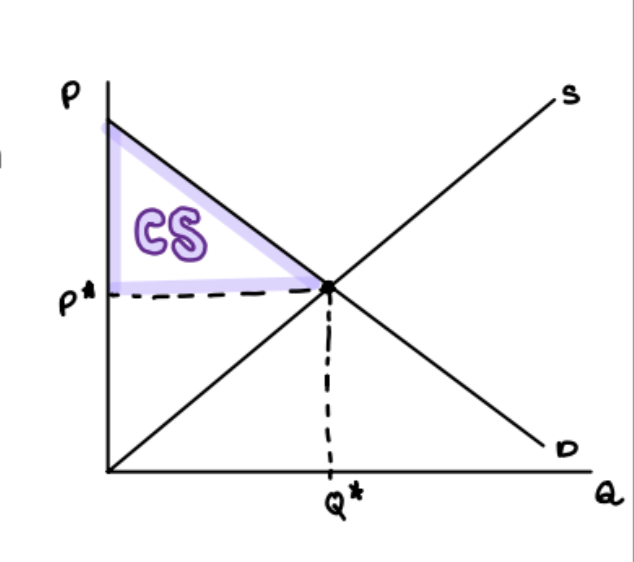
Consumer surplus
surplus a consumer receives for paying less for a good than she would have been willing to pay.
P measures consumer opportunity cost of consuming a good.
Demand curve show willingness to pay for the good.
Producer Surplus
the surplus the producer receives by receiving more of a good than she would have been willing to accept.
P measures the producers benefit from producing a good.
Supply curve shows marginal cost (what the producer would have been willing ti accept for the good.

Does producer surplus show revenue of the firm?
NO! producer surplus is not the same as total revenue!
MC is the derivative of SRTC where fixed cost is constant, therefore marginal cost reflects on variable costs so producer surplus= profits on operation = TR- SRVC

TOPIC 2) Efficiency
efficient market equilibrium
point that maximizes the welfare of participants in the market, that is, an efficient equilibrium leads to the largest amount of CS + PS (+ GR, if any).
The main claim here is that the competitive market equilibrium is efficient; this can be tested by examining price floors and price ceilings.
a) price ceilings
a restriction on maximum price. Binding price ceilings are BELOW equilibrium. EX: rent control

b) Price floors
a restriction on minimum price that is binding above equilibrium. EX: minimum wage, minimum cost for farm products.
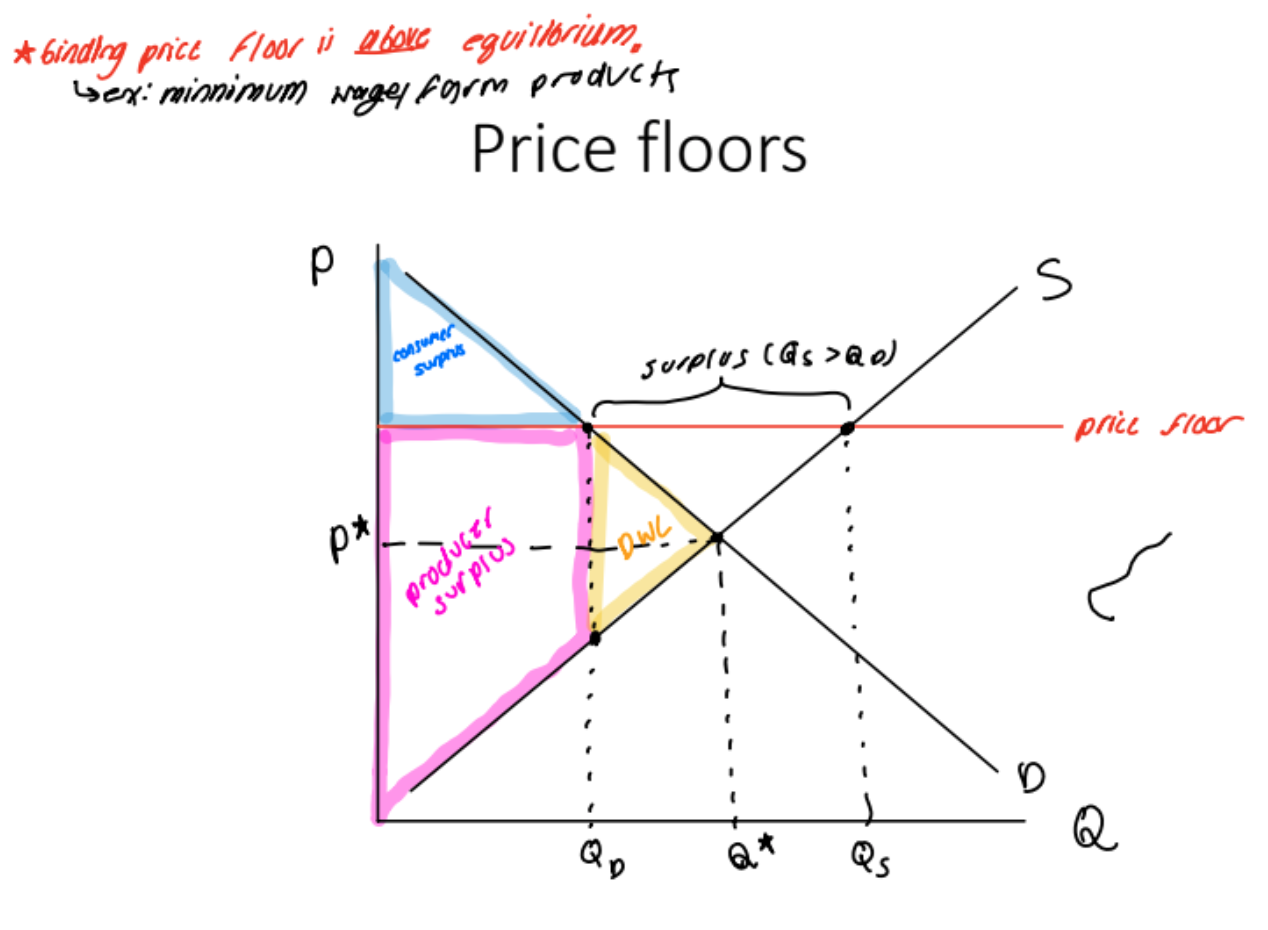
What are the key results exemplified by A (price ceilings) and B (price floors)
Only the competitive equilibrium (P*, Q*) maximizes social welfare in the product market.
Only the competitive equilibrium (P*, Q*) is efficient.
Deadweight loss: the net loss of total surplus (at an inefficient outcome).