Module 2.1: Human Osteology and Bone Biology - ARCL 228
 Call Kai
 Learn
Learn Practice Test
 Spaced Repetition
 Match
Match Flashcards
 Knowt Play
1/31

There's no tags or description
Looks like no tags are added yet.
Name | Mastery | Learn | Test | Matching | Spaced | Call with Kai | Chat |
|---|
No analytics yet
Send a link to your students to track their progress
32 Terms
What are the different sections of the human skeleton?
Axial skeleton → skull and teeth + torso
Appendicular skeleton → shoulder and hip girdles + limbs
What are bones made of?
Calcium and protein cartilage
What are the two bone tissues?
Cortical bone aka compact: dense, hard bone
on the external surface of the bone
Cancellous bone aka spongy bone: soft bone made of trabeculae in a honeycomb structure
on the internal part of the bone, has blood vessels and nerves
Why do bones have different proportions of each cortical and cancellous bone tissue?
Because different bones have different functions
What are the 5 types of bones?
long bones
short bones
flat bones
irregular bones
pneumatized bones + sesamoid bones
What are the long bones? What do they act as? What are the parts of the long bone?
Arms + legs
Act as levers and supports loading
Epiphyses - joint ends
Diaphysis - shaft
medullary cavity - the centre of the bone (bone marrow, blood production)

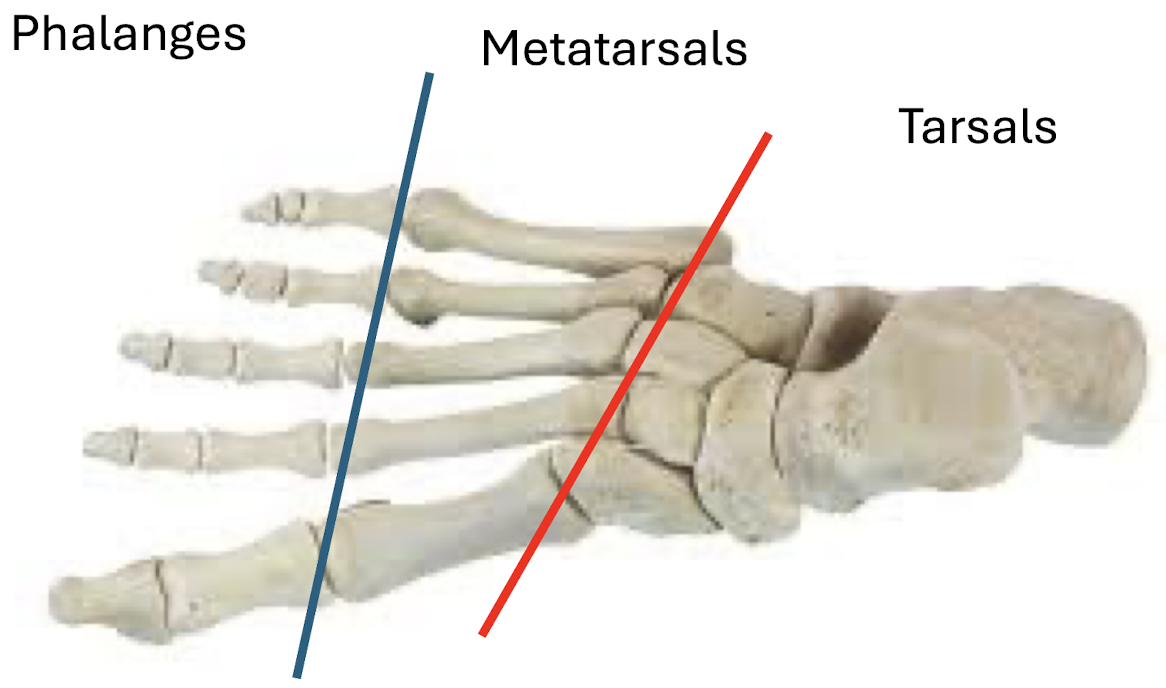
What are the short bones? What are the characteristics of them?
Hands + feet
Phalanges
Metacarpals
Carpals
Compactness, elasticity, limited motion
What are the flat bones? What do they act as?
Cranial bones, scapulae, os coxae
Protection and surface area for bone attachment
What are the irregular bones? What do they act as?
Vertebrae, some hands and feet bones
Complex and specific functions
What are pneumatized bones?
bones with air pockets in them
face bones: eyes, cheeks, nose
What are sesamoid bones?
Small bone that is embedded within a muscle or tendon near a joint (doesn’t touch other bones, floats in soft tissue)
How is a skeleton laid out?
flat on a table
palms up
to keep forearm bones parallel
feet down
What are the planes of the body?
Transverse
Vertical
Frontal
Front + back
Sagittal
Horizontal

What are the directional terms?
Right + left
Cranial (head) + caudal (toe)
Proximal (the part of the body nearest the point of
attachment to the body) + distal (the part of the limb farther away from the point of attachment to the body)
Medial (centre) + lateral (out)
Anterior (front) + posterior (back)
Superior (towards the head) + inferior (towards the feet)
Cortical bone forms what part of the bone?
The less active surface and structural sections (load bearing portion)
Cancellous bone is found where? What does it contain?
In the interior of the bone
Contains bone marrow which produce WBC and RBC
Whole bones are vascularized with what? and for what reason?
Blood vessels to move blood cells out to the rest of the body
new bone cells can replace old ones
What are osteons? What are the types of osteons?
The functional unit of bones
Primary osteons: formed in early development
Secondary osteons: replace primary osteons over a lifetime
What is the bony matrix within osteocytes made of?
Fibrous collagen (protein)
Hydroxy-apatite (calcium mineral)
What are the parts of an osteon that start with “osteo-“
Osteogenic cells: stem cells that derive into the other cells
Osteocytes: bone cell suspended in and maintaining bony matrix
Osteoblasts: lay down new osteons
Osteoclasts: break down old osteons
What are the two other parts of osteons?
Haversian canal: soft tissue that have blood vessels going through
Canaliculi:
What are the two types of bone development?
Initial formation ossification
Intramembranous ossification
How bones of the skull and some axial skeleton form (flat bones)
Endochondral ossification
How the long bones and short bones form
Remodelling
What are the three germ layers during embryonic development?
Ectoderm
Mesoderm
Endoderm
Which germ layer form mesenchymal stem cells which then turn into what?
Mesoderm → mesenchymal stem cells → bone cells (osteogenic cells) & cartilage cells (chondrocytes + chondroblasts)
Explain how intramembranous ossification works
in between membrane bones
two sheets of mesenchymal tissue sandwiched between trabeculae
osteoblasts are laid down
How does endochondral ossification work and how can it approximate age?
In utero
cartilage is formed before bone
cartilage gets a blood supply forming the primary ossification centre
cartilage gets replaced with bone
At birth
the shaft turns into majority bone (diaphysis), the joint ends are mostly cartilage
secondary ossification centres form in the joint end
3-4 years old
Diaphysis is fully formed
Epiphysis is mostly formed
cartilage layer between epiphysis and diaphysis is not yet fused
still in growth phase
Adult
Epiphysis and diaphysis are fused
Explain bone remodeling
cell turnover
secondary osteons replace primary osteons
those secondary osteons will continue to be replaced
What do osteoclasts and osteoblasts do?
Osteoclasts break down old osteons and osteoblasts put down new bone material
making up a basic muticellular unit
What are the two types of bone that make up whole bones?
Cortical bone
Cancellous bone
What are osteoblasts?
Bone producing cells
What are osteoclasts?
Bone destroying cells
Which bones form through intermembranous ossification?
Flat bones of the skull and clavical