Lecture 6: Competition and Facilitation
 Call Kai
 Learn
Learn Practice Test
 Spaced Repetition
 Match
Match Flashcards
 Knowt Play
1/8

There's no tags or description
Looks like no tags are added yet.
Name | Mastery | Learn | Test | Matching | Spaced | Call with Kai | Chat |
|---|
No analytics yet
Send a link to your students to track their progress
9 Terms
Forms of species interactions
Predation
Parasitism
Mutualism (symbiosis)
Commensalism (facilitation)
Competition
What are the different types of facilitation relationships?
Obligatory relationship → dependent species completely relies on the other for survival
Facultative relationship → dependent species does NOT rely on the for survival.
Types of competition
Intraspecific competition → between individuals of the same species for a limited resource
Interspecific competition → between individuals of different species for a limited resource
i. Exploitation → use of resource by one individual makes that resource less available for others
Consumptive (all eaten) vs. pre-emptive (actively taking up the resource)
ii. Interference competition → direct interaction of individualsthrough various types of behaviours. Eg. territoriality.
Conditions for competition
Must have an effect on fitness (reproduction, growth, or survival)
Resources in short supply for species to affect each other
Influence amount of resources available or species ability to obtain the resource
Can have both exploitation and interference competition
Can cause competitive exclusion
Competitive Exclusion and Hypothesis
species can coexist if adaptations arise to effectively partition resources
“Two species cannot live in the same niche, and if they try to, one will be excluded”
Habitat Selection
Theory of optimal foraging → resources not limiting, species should concentrate their feeding on the best type of food or habitat
Theory of habitat selection → resources are limiting, species should contract their niches as a result of interspecific competition
How do we measure competition?
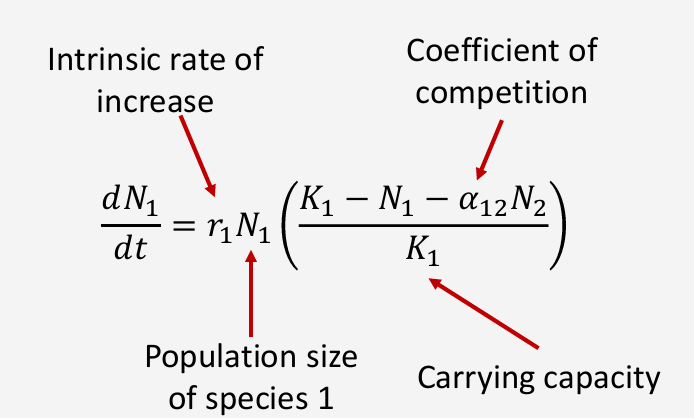
Theoretical/graphical models → coefficient of competition (d), Lotka-Volterra equations
Experiments → manipulative experiments, using deer mouse vs. voles.
Removal Experiment → actively removing one competitor from plot or area and seeing how the other species reacts
Press Experiment → presense/absence experiment, long-term areas (one abundant, one lacking), mainly observing
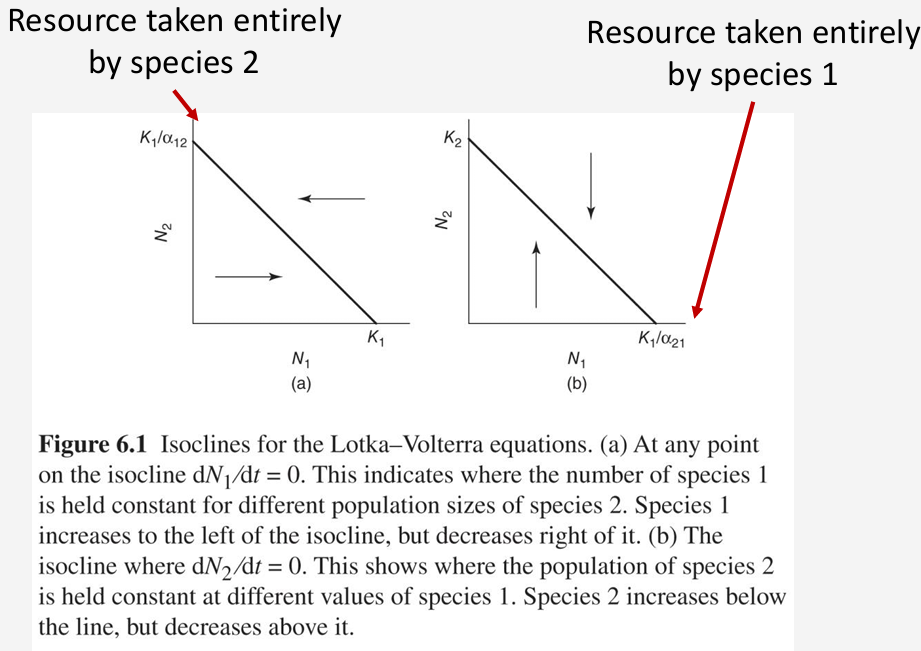
Theoretical/ graphical models
Outcomes/interpretation of the experiments
Outcomes/interpretations:
Indirect competition → when one species is competing with another. An intermediate species
Apparent competition → Changes of population in species 1 affect population of species 2 by influencing predator population