FMI CH2
 Call Kai
 Learn
 Practice Test
 Spaced Repetition
 Match
 Flashcards
 Knowt Play
1/34

There's no tags or description
Looks like no tags are added yet.
35 Terms
What are the 3 types of financial institutions, based on the type of service they provide to the public ?
Institutions that offer a service → act as direct service providers or intermediaries, giving clients access to financial products and markets they could not easily reach on their own (credit institutions, investment companies, collective investment undertakings)
Institutions that use financial assets as a resource → they pool money from many individual investors to buy a large, diversified portfolio of assets (Mutual funds, ETFs, pension funds, insurance companies,…)
Institutions that act for their own account → these institutions invest their own capital (or from private partners) strictly because they believe they can generate a profit (Venture capitalists)
What’s a credit institution ?
Traditional commercial banks and textbook financial intermediaries. Under the Bank Law of March 22, 1993, they are heavily regulated and legally defined as companies that perform two core activities:
receiving money deposits (or other redeemable funds) from the public
granting credit for their own account.
What are the 3 institutions types supplying venture capital ?
Investment banks
Venture capitalists
Holdings
What are investment banks ?
Institutions that cover a wide range of corporate finance activities rather than collecting retail deposits or giving cheap loans.
They issue stocks and bonds for third parties, advise on mergers, IPOs, takeovers, and restructurings, trade securities, act as market makers, and supply venture capital through separate branches.
Don't really exist in Belgium
What are venture capitalists (VC’s) ?
Firms that fund startups in exchange for equity and provide management assistance, aiming to profit by monetizing the company's added value
Because startups are very risky and many fail, they build large, diversified portfolios so that a few big winners offset the losses. They are split into two sub-types:
Venture capital → focus on early stage companies across 3 stages: seed money - intermediary phace - mezzanine financing
Private equity players → invest in more established companies, buying and selling them for profit, either by breaking them up to sell the pieces, or by restructuring them to make them more efficient and sell them at a higher price.
What are holdings ?
Companies whose main purpose is to buy other companies and hold onto them long-term to generate ongoing cash flows through dividends
What are the 2 types of investment firms (and what are investment firms) ?
Law of April 6 1995: firms whose professional activity consists of providing investment services for 3rd parties
Brokerage firms (stockbrokers)
Portfolio management & investment advice companies
What are brokerage firms (stockbrokers) ?
Historically held a monopoly on executing buy and sell orders on the stock exchange, earning much of their turnover by executing orders on behalf of larger commercial banks
What are portfolio management & investment advice companies ?
Firms that manage investment portfolios for wealthy individuals, institutional investors, and investment companies, passing transaction orders on for execution
paid yearly based on the volume of assets under management (not on investment returns)
face strict compliance rules to avoid conflicts of interest
What are insurance companies ?
They collect regular premiums in exchange for compensating policyholders for unsystematic, random losses (like a house fire). They reinvest these premiums (reserves) into equities, bonds, cash instruments, and real estate to generate the revenue needed to pay claims.
There are 2 types
non life insurance → Short-term (typically 1-year) contracts covering car, fire, and casualty risks.
life insurance → long term contracts: 3 types
What are the 3 types of life insurance companies ?
Endowment on death: pays out a lump sum amount of money (or yearly rent) to the surviving beneficiary
Endowment with life: pays out a lump sum amount of money (or a yearly rent) to the insured person when he/she is still alive at a contractually specified time
Or: mixed form; combination of both
Belgian branches 21, 23, 44, and 26
What are pension funds ?
Institutions that collect premiums from clients throughout their working lives, invest those funds in financial assets, and pay out money upon retirement. Depending on the plan, the final payout is either predetermined or tied to market performance.
Belgium works with a 4 pilar system
1st pilar → basic pension paid by the State when you retire, based on number of years worked, your salary, and your employment status
2nd pilar → tied directly to your professional activity and is designed to top up the modest state pension
3rd pilar → Anyone, regardless of employment status, can voluntarily build an extra pension pot with direct tax incentives from the government
4th pilar → all personal wealth you build on your own without government pension tax incentives
What are collective investment undertakings ?
They collect money from the public by selling shares, investing it collectively so everyday investors can enter diversified or specialised portfolios without needing large amounts of capital.
There are closed and open funds:
Closed funds: raises a fixed amount of capital once (usually through an IPO) and issues a fixed amount of shares. After that, the fund is “closed” so you have to buy existing shares from another investor. → because the share count is fixed, share price can vary depending on the supply & demand
Open funds: amount of shares is variable; goes up when money flows in en goes down when money flows out. → because of this the share price is always equal to the exact value of the underlying assets
What is shadow banking ?
= Credit intermediation involving entities and activities outside of the regular banking system
How they differ from traditional banks
traditional banks fund loans using deposits, shadow banks raise short term funds through investors/capital markets
shadow banks transform risk using capital market mechanisms
shadow banks operate outside the standard regulatory framework
Common examples:
Money market funds (which lend short-term to banks and corporations)
Hedge funds
Securitisation vehicles (entities that bundle loans like mortgages into securities)
Investment funds
What does “financial intermediaries” refer to ?
Credit institutions (banks), such as KBC, ING, and Belfius
Defined by 3 features:
They borrow money from one group of economic agents and lend it to another.
Both groups are large.
The payouts to both groups are different ("other state-contingent payouts"), for example, the interest rate savers earn on deposits is not the same as the interest rate borrowers pay on loans
Because banks constantly search for revenue, large banks tend to become universal banks, while smaller banks survive as niche players with a specific focus
Reason 1 of existence financial intermediairs: external financing
Companies can invest using their own profits, but this is slow and leaves idle cash earning nothing
External financing → getting money from a third party
In an economy some agents have a financial surplus (lenders), other have a financial deficit (borrowers). If these are matched well overall consumption in an economy rises
Financial contracts bridge this gap by balancing 2 dimensions: promised return & risk of default
There are 2 systems to match lenders and borrowers:
Banking system → indirect financing: banks attract deposits giving a fixed interest rate, and then give out loans under their own name
Capital markets → Companies sell tradable loans (bonds) directly to surplus agents (investors), who choose whom to fund and bear all the risk themselves.
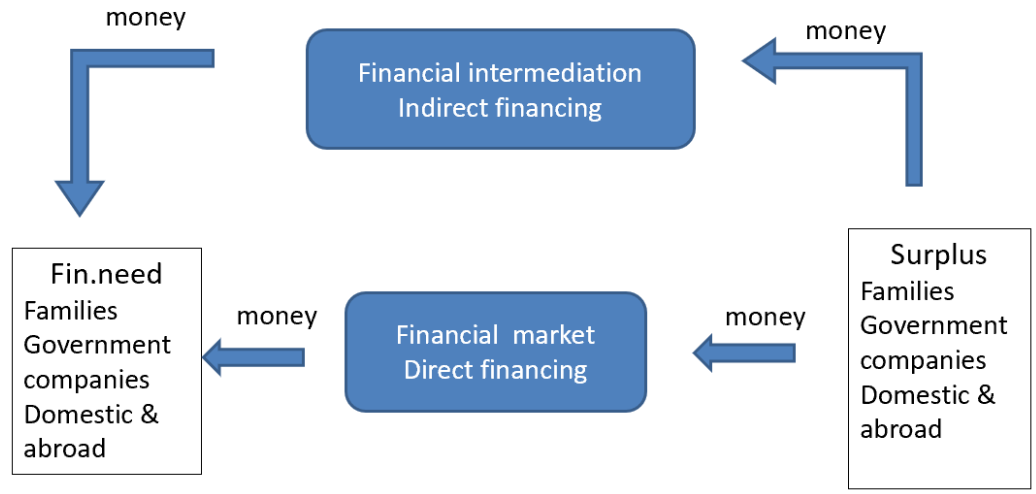
Reason 2 of existence financial intermediairs: reducing market imperfections: What asymmetry problems do financial intermediairs solve ?
Market imperfections stem from information asymmetry
Banks gain a major cost advantage by solving asymmetry problems, 2 before a contract is singed and 1 after
1) Pre-contract - Adverse selection: A bank has to ensure repayment since its lending out money from deposits. If a bank charges a high interest rate, low risk borrowers will look for cheaper alternatives, and the bank is left with only high risk borrowers → to solve this problem they perform a credit analysis to separate low risk from high risk borrowers and charge different interest rates
2) Pre contract - Duplicated screening - centralised search costs: information can be reused (e.g lending money to the same company twice).
Decentralised search costs: every lender does their own credit analysis, the total costs grow exponentially with the size of the economy: TC = 2cn²
Centralised search costs: one central bank does the analysis once and reuses it, total costs grow linearly: TC = 2cn
3) Post contract - Moral hazard: After receiving a loan, a low-risk borrower might behave against the lender's interest (e.g., taking out extra loans at another bank, increasing their debt and default risk). → solution: Banks use their experience to write covenants into loan contracts (=clauses restricting borrower behavior), such as an interest coverage ratio that caps a borrower's interest payments relative to their EBITDA
Reason 3 of existence financial intermediairs (most important): Asset transformation
Primary reason why banks exist: they create added value by
creating tailor made loans and transferring the risk onto their own balance sheets
Even if a creditor defaults, a bank still has to pay back its depositors. In capital markets, the investor eats the loss
Specifically, banks transform 4 qualitative features of assets
maturity: turning immediately redeemable deposits into 10 year loans
credit risk: absorbing borrowers default risk so deposits remain safe
size: pooling many small deposits into 1 big loan
liquidity: turning illiquid loans into liquid deposits
Draw the bank cost function, explain the graph
Technology can shift the position of a bank on this graph and the entire curves
Intercept of bank is higher bus the funds they raise are more costly then ppl using their own money
The banks slope is flatter because they have more experience

Name all the products that are on a banks liability side
Overnight deposits / sight deposits
Savings acounts
Term accounts
Cash & capitalisation bonds
Bonds / securities
Commercial paper / certificates of deposit
What are mortgages ?
Long-term retail loans (typically 20+ years) granted specifically to buy real estate, using the house as collateral.
They can have fixed or floating (capped) rates
Are usually amortising (repaid monthly) rather than bullet loans
Typically involve outstanding balance insurance, a tax advantage, and a legal option to review the rate against a 3-month penalty
What are corporate straight loans ?
Short-term loans for companies (typically 1 year) for a fixed term at a predetermined rate (EURIBOR = Euro Interbank Offered Rate + credit premium).
What are corporate investment loans ?
Long-term loans (3 to 15 years) to industrial and commercial companies to fund investments, priced at a market rate + credit spread.
What are roll-over credits ?
Long-term corporate loans structured as a sequence of consecutive straight loans (e.g., 5 years split into five 1-year loans).They offer more flexibility than investment loans, with the rate fixed at each renewal (reservation fee + market rate + credit premium).
What are consumer credits ?
Retail loans used to finance durable consumption goods (cars, TVs, fridges); not very popular in Belgium.
What are overdrafts ?
Short-term borrowing tied to a current or sight account that lets a client go negative up to a limit to cover temporary cash shortages. They must be cleared regularly and are expensive (charging a reservation fee, a base rate, and a credit premium).
What is leasing ?
A lessor buys a good (car, building) and lets a lessee use it for predetermined compensation (usually run via separate bank branches).
In operational leasing, the lessor keeps legal and partial economic ownership and handles maintenance
In financial leasing, the lessor is only the legal owner while full economic ownership transfers to the lessee.
What is factoring ?
The bank collects invoices on behalf of a company (via a separate branch), giving the company immediate cash and removing its non-payment risk.
What are sight / overnight deposits ?
Immediately redeemable accounts with no maturity, used for making payments. They are registered by name, non-transferable, and come as:
Corporate current accounts (often linked to an overdraft)
or retail sight deposits.
What are savings accounts ?
There are regulated and non-regulated savings accounts
Regulated : Non-maturing savings accounts governed by regulatory rules (cannot be used for direct payments, must pay a basic rate + fidelity premium, max 6 types per bank). They offer overnight liquidity, a €100,000 deposit guarantee, and no withholding tax on interest below €980 per person.
Non-regulated: Non-maturing savings accounts without regulatory tax privileges; they pay virtually 0% interest nowadays and face a 30% withholding tax
Withholding tax = roerende voorheffing
What are term accounts ?
Registered accounts with a fixed maturity (e.g., 1 week, 1 month) or a notice period, earning a fixed interest rate based on the tenor.
What are cash and capitalisation bonds ?
Interest-bearing securities with a fixed term and predetermined coupon (tradable in theory, not in practice).
Cash bonds pay interest yearly
Capitalisation bonds reinvest yearly interest and pay it compounded at maturity.
What are commercial paper and certificates of deposit ?
Short-term capital market deposit products issued by corporations (CP) or banks (CD); tradable in theory, though rarely traded in practice.
What is an off balance sheet ?
A balance sheet containing exposures where the bank may or may not have a future right (off-balance asset) or obligation (off-balance liability).
Because they do not trigger immediate cash flows, they stay hidden until payments or receipts actually occur, at which point they move on-balance.
Analyzing a bank without its off-balance sheet gives an incomplete view of its risks.