Transcription and RNA Processing
 Call Kai
 Learn
 Practice Test
 Spaced Repetition
 Match
 Flashcards
 Knowt Play
1/50

There's no tags or description
Looks like no tags are added yet.
51 Terms
Central Dogma
DNA is transcribed into RNA and RNA is translated into protein.
Transcription
A portion of a DNA nucleotide sequence (a gene) is copied into an RNA nucleotide sequence
Differences between DNA and RNA
The nucleotides in RNA are ribonucleotides -> they contain the sugar ribose instead of deoxyribose
RNA has uracil instead of thymine as a nitrogenous base
RNA is single-stranded while DNA is double-stranded
RNA can fold into 3D shapes -> allows it to have specific structural and catalytic functions
DNA strands are hydrogen-bonded
RNA strands are shorter than DNA strands
Where do transcription and translation take place in the cell
Transcription is in the nucleus, and translation is in the cytoplasmic ribosomes
mRNAs
messenger RNAs -> code for proteins
rRNASs
ribosomal RNAs
for the basic structure of the ribosome and catalyze protein synthesis
tRNAs
transfer RNAs
central to protein synthesis as adapters between mRNA and amino acids
Telomerase RNA
serves as the template for the telomerase enzyme that extends the ends of chromosomes
snRNAs
small nuclear RNAs
function in variety of nuclear processes i.e. splicing of pre-mRNA
snoRNAs
small nucleolar RNAs, help to process and chemically modify rRNAs
lncRNAs
long non coding RNAs
not all of them have a function; some serve as scaffolds and regulate diverse cell processes, including X-chromosome inactivation
miRNAs
MircroRNAs, regulate gene expression by blocking translation fo specific mRNAs and causing their degradation
siRNAs
small interfering RNAs
turn of gene expression by blocking transition of specific mRNAs and causing their degradation
can also regulate RNA stability

non-coding RNAs
final product is RNA and not protein
RNA Polymerase II transcribes all protein -coding genes, as well as snoRNA genes, miRNA genes, siRNA genes, lncRNA genes, and most snRNA genes.
Which RNA polymerase transcribes all protein-coding genes?

RNA polymerase reads the DNA template strand in the 3’->5' direction, while synthesizing RNA in the 5’ -> 3 ’ direction
RNA is complementary and antiparallel to the DNA template strand.
What is the direction of transcription (RNA synthesis)
Base pairing for RNA synthesis (transcription)
DNA → RNA base pairing:
A → U
T → A
C → G
G → C
5′–AUG CCU GAA–3′
Write the RNA transcript made from this DNA template:
3′–TAC GGA CTT–5′
Promoter
upstream 5’ end; where transcription starts
RNA polymerase binds to this DNA nucleotide sequence to start transcription
recruits the transcription machinery and specify where transcription begins
Enhancers
noncoding regulatory regions that contain clusters of DNA-binding sites for transcription factors
When they are bound, they increase the likelihood of transcription initiation from a nearby promoter
UTR (untranslated region)
non-coding regions at the 5’ and 3’ ends of the coding sequence that regulate transcription, processing, stability, and translation
5’ UTR (leader sequence)
segment of mRNA from the transcription start site up to the start codon (AUG)
3’ UTR (trailer sequence)
the segment after the stop codon, often containing regulatory elements for mRNA stability, localization, and degradation
Exon
intervening coding regions
To mature RNAs, introns must be removed, and exons must be added together (RNA splicing)
intron
intervening non-coding regions
Promoter: DNA sequence where transcription begins; includes the TATA box in many genes.
RNA polymerase II: Enzyme that synthesizes mRNA from the DNA template.
Transcription factors: Proteins that help RNA polymerase bind to the promoter and initiate transcription.
TATA-binding protein (TBP): Recognizes and binds the TATA box.
DNA template strand: Strand read by RNA polymerase (3′ → 5′).
Terminator: DNA sequence that signals the end of transcription (termination mechanisms vary in eukaryotes
What are the key components involved in transcription, including proteins and DNA sequences?
Transcription factors
Proteins that help RNA polymerase bind to the promoter and initiate transcription.
General - present in all cell types
Regulatory - present in specific cell types
Bind DNA and and interact with mediator
Enhanceosome - multiple transcription factors working together
Enhances binding to DNA and stabilizes transcriptional complex --
Activators - Transcription factors bound to enhancer sequences that promote formation of transcriptional complex
Repressors - transcription factors bound to silencer sequences that inhibit the formation of transcriptional complex
TATA box
Sequence in the promoter region of many eukaryotic genes that binds a general transcription factor (TFIID) and hence specifies the position at which transcription is initiated
for high regulated genes → actively controlled between no transcription and high levels of transcription, depending on the time/stage/environmental influence and cell types.
General transcription factors
present in all cells (TFIIA, TFIIB, etc). They help to position RNA Pol II at the promoter
Regulatory transcription factors
cell-type specific
help make the decision (and efficacy) in transcription
RNA is processed while it is still being synthesized by RNA polymerase
5’ capping, early splicing, and 3’ end formation all happen while the pre-mRNA is still being synthesized by RNA polymerase II, not only transcription
Why is RNA processing considered a co-transcriptional process instead of a post-transcriptional process
TFIIH phosphorylates CTD (C-terminal domain) polypeptide tail of RNA Pol II, causing the polymerase to be released from the general factors and begin the elongation phase of transcription
What modifications on RNA poly II alllow RNA processing to be co-transcriptional
processing enzymes for splicing and 3’ end processing
additional phosphates are added to the rna polymerase tal, which attracts splicing and 3’ end processing enzymes
What other processing si recruited by RNA Pol III altered CTD
What are the three types of RNA processing
5’ Capping
3’ Polyadenylation (Poly A Tail Addition)
RNA Splicing
5’ Capping
Protects the transcript from degradation
Helps the ribosome attach to the transcript in translation
3’ Polyadenylation (Poly A Tail Addition)
Enzyme PAP (poly A Polymerase) adds 200 A’s, one at a time. ATP required, 5’-3’ covalent bonds link nucleotides (RNA synthesis): does not require a template.|
Makes transcript more stable (protects from degradation)Assists in the export of mRNA (from the nucleus into the cytosol)

RNA Splicing
Eukaryotic genes are broken up into small pieces of coding sequences (exons) interspersed with longer non-coding sequences (introns)
On average, 11 introns in each gene.
Each splicing event occurs between one 5’ splicing site and one 3’splicing site.
Proceeds through two sequential phosphoryl-transfer reactions.
Lariat -> excised intron
Splicing machinery recognizes the 5’ splice site (splicing donor), 3’ splice site (splicing acceptor), and branch point in the intron sequence that forms the base of the lariat.
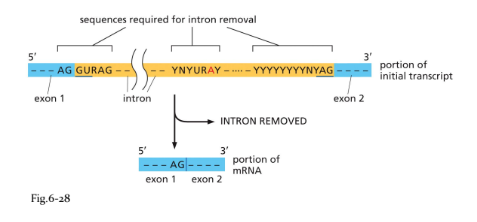
Mechanism for RNA Splicing

5′ cap and 3′ poly(A) tail shield mRNA from exonucleases, block end‑to‑end degradation, and recruit stabilizing proteins, greatly extending mRNA half‑life
How does 5’capping and 3’ polyadenylation protects mRNA from degradation?
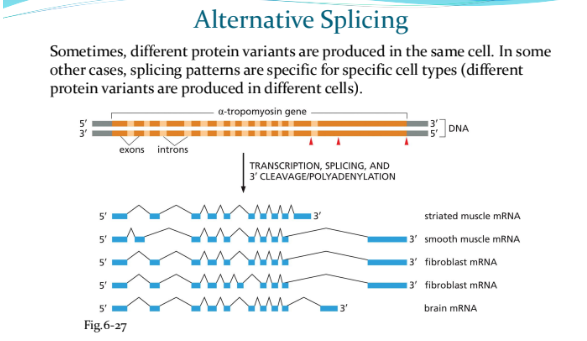
Transcript of a given gene can be spliced in more than one way (alternative splicing) so the same gene can produce different but related proteins
What is the benefit of having introns and then splice them off?

snRNAs (small nuclear RNAs): recognize binding sites
snRNAs + protein=snRNP (ribonucleoprotein)
snRNP is the core of the spliceosome.
snRNAs base pair with pre-mRNA.
What are the major components of the spliceosome? Describe the general steps of splicing (includes the formation of a lariat).
Abnormal RNA splicing, potentially resulting in intron retention or exon skipping
What is the result of a mutation disrupting a conserved splice donor site at exon-intron boundary?
Are MAPKs a family of tyrosine kinases?
no, they are serine/thereonine kinases
Ras activates Raf (MAPKKK), which phosphorylates MEK (MAPKK), which phosphorylates ERK (MAPK). Each kinase activates the next.
Ras → MAPKKK (Raf) → MAPKK (MEK1/2) → MAPK (ERK1/2)
What is the order of the core MAPK cascade after Ras?
It phosphorylates ERK on both a threonine and a tyrosine
MEK phosphorylates ERK on a threonine and a tyrosine in its activation loop, which activates ERK.
What makes MEK a dual-specificity kinase?
Akt is recruited to PI(3,4,5)P3 and activated, then active Akt detaches from PI(3,4,5)P3
FRET rises when Akt is at the membrane bound to PIP3, close to the donor. Once Akt is phosphorylated and activated, it dissociates from the membrane, so FRET drops.
In the FRET experiment (CFP on PI(3,4,5)P3, YFP on Akt), FRET rises within minutes of adding growth factor, then drops. Why?
The two tagged molecules have moved very close together
FRET only occurs when the donor and acceptor are very close, so higher FRET means closer proximity, here Akt binding PI(3,4,5)P3 at the membrane.
What does a rise in FRET between CFP and YFP tell you?
Initiation of transcription of RNA polymerase II
Only for transcription of genes with TATA box promoter. TFIID subunit binds to TATA box, leading to bending of DNA, additional general factors and RNA Pol II recruited to the initiation complex, including TFIIH which unwind DNA, transcription starts.
Transcription initiation:
Transcriptional activators that bind to DNA enhancer sequences Mediation complex - bridges transcriptional activator, general transcription factors, and RNA Pol II 3. Chromatin modifying enzymes
Mediators
Large protein complexes that bridge the activator that is bound to the enhancer, with RNA pol II that is bound to the promoter
Facilitates assembly of the RNA Pol II preinitiation complex
Histone acetylase activity - maintain a promoter region in hyperacetylated state
Cis regulatory elements
DNA loops to bring all of the elements together - Regulating same DNA sequence that they are bound to