Exercise Prescription in Rehab for Mobility Impairments
 Call Kai
 Learn
Learn Practice Test
 Spaced Repetition
 Match
Match Flashcards
 Knowt Play
1/30

There's no tags or description
Looks like no tags are added yet.
Name | Mastery | Learn | Test | Matching | Spaced | Call with Kai | Chat |
|---|
No analytics yet
Send a link to your students to track their progress
31 Terms
Causes for mobility impairments
Psychological-behavioural: cognitive changes
Neural: motor control, nociception
Tissue: changes in structure + fxn, vascular reorganization
Connective tissue physiological adaptations when immobile
Collagen fibres….
Cross-link: fibres get sticky and won’t move as well w/o regular movement
Happens to both dense regular and irregular
Adhesions: cross link btwn 2 diff types of tissues. sticky
Disorganized orientation: Proliferation of Type 3. No instructions to lay fibres
Usually line up according to line of stress
TAKES A LONG TIME
Mechanotransduction
Body converts mechanical loading → cellular response
Promotes structural changes in MSK tissues
Activates tissue remodelling = tissue shortens in cast
Mm physiological adaptations when immobile
Primer: length tension curve → optimal length for contraction
Tone: passive state of mm contraction/resistance to passive tension @ rest
Occur quickly
Less # of sarcomeres in series/row to move mm in optimal position
I.e. increase # sarcomeres to lengthen tricep tissue in cast
Connective tissue mobility components
Move joint thru ROM
Limited by connective tissue
Due to structural changes (i.e. collagen) requires time
C/o stiffness
Mm Flexibility components
Move mm thru full ROM
Limited by mm
Neural control impacts → occurs quickly
C/o: tightness
Connective tissue response to tension depends on…
Rate
Time: force over time
Want to break to regain movement!
Bc its viscoelastic
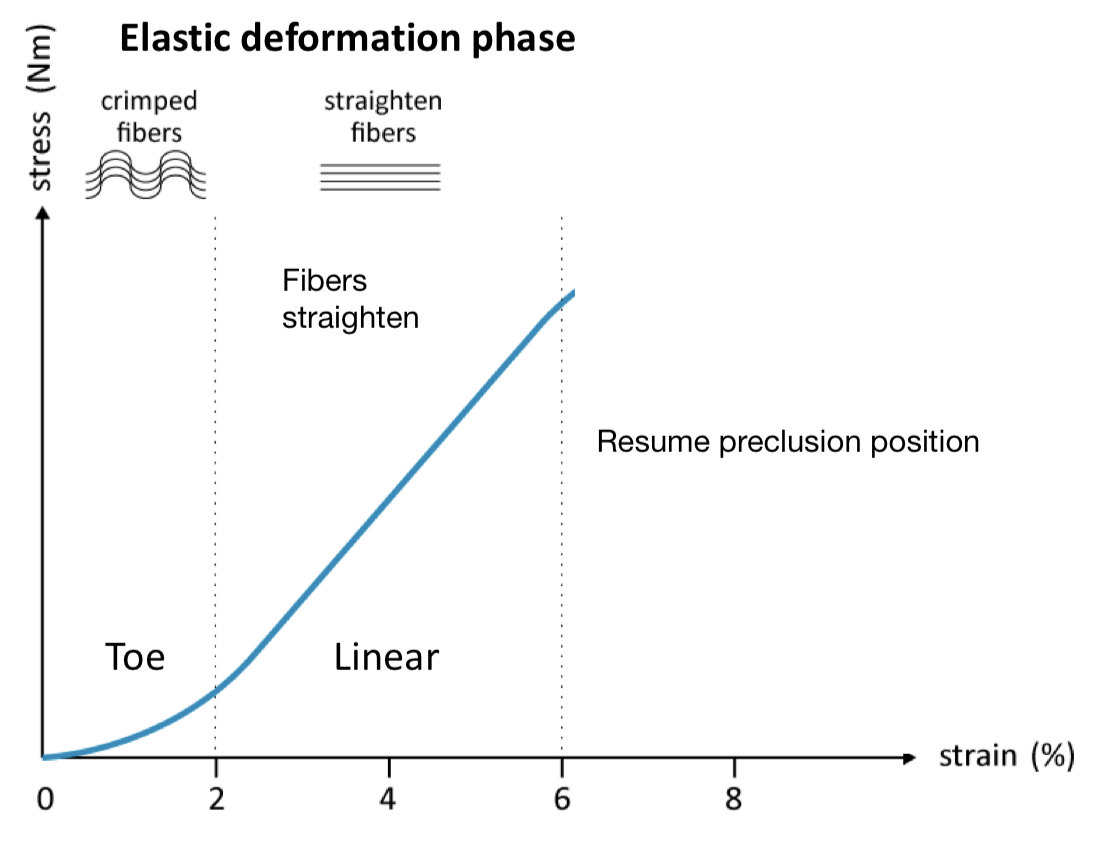
Stress relaxation
Temporarily changes mobility
Elastic deformation phase
Stress relaxation: Some give when apply force to straighten fibres
Tissue relaxes in response to stress
Creep: Increase tissue length over time
Will eventually resume the previous position
TEMPORARILY CHANGE MOBILITY
Microscopic changes/failures. Breaks collagen cross-link adhesions. Discomfort.
Plastic deformation phase
Microscopic failure
Macroscopic failure
Permanent change in mobility!

Ways to improve connective tissue mobility
Low-load prolonged stretch
Total end range time (TERT)
Low-load prolonged stretch
F: > 3x/day [high intensity, low time]
I: into stiffness NOT pain
T: position of tension
V: 5 → 20 mins/session
P: ↑ volume (TERT > 60 mins/day)
↑ intensity w/ gravity/external load
Good for post-op
Connective tissue mobility
F: > 3x/day
I: into stiffness, not pain
T: slow PROM/AAROM/AROM into position of tension
V: 5 →10 reps. hold 10 → 30s , 1→3 sets
P: ↑ vol (TERT). Progress to AROM. [↑ AROM]
Mm response to tension/stretch
Mm spindle activation: intrafusal. Sends 1a afferent sig to SC. Causes contraction thru alpha mn. Inhibitory sig to antagonist. Temporary contraction to mm in response to stretch
Stimulates myotatic/stretch reflex
Mm contraction
How to think of Myotatic/stretch reflex as….
NEUROLOGICAL RESET of mm tone via contraction to restore optimal position of myofilament overlap
Sensory theory
No lasting changes in mm length after static stretching
Temporary ↑ mm flexibility due to ↑ pain/tension tolerance
Change in pain perception, environment around injury has changed.
Tendon response to tension (mm contraction) - GTO
Activates GTO → GTO reflex
MM relaxation
In musculotendonous junction
Stimulated by MM CONTRACTION (not stretch bc spindle does that).
GTO relaxes mm
Consider GOT as…..
Neurological rest of mm tone via mm RELAXATION to restore optimal position of myofilament overlap.
Neuromuscular relaxation theory
Autogenic inhibition: hold-relax to get more mobility.
PNF
Contract relax
After contracting, it relaxes. Immediate response to tone.
Structure unchanged
Types of MM stretching
Dynamic, static, pre-contraction (Proprioceptive Neuromuscular Facilitation)
Benefits of Dynamic stretching
↑ ROM, performance (immediately be4 activity)
Dynamic stretching prescription
F: 3x/wk regularly
I: into tightness not pain
T: slow, controlled concentric of the antagonist to put the agonist in tension
V: 1-3 sets or 5-10 reps
Static stretching effects
↑ ROM
↓ performance be4 activity [strength, power]
Bad for long-duration activity
Short static stretch
DOESN’T affect neuromusclar activation & musculotendinous stiffness
Longer does
Reduce injury risk in high intensity activities
Static stretching prescription
F: 2-3x/wk
I: into tightness not pain
T: slowly + passively assume position of tension in target mm
V: 10-30s (30-60s for older) 1-3 reps
What type of stretch is best?
Pre contraction stretching
Pre-contraction stretching prescription
Contract-relax (hold-relax)
F: 2-3x/wk
I: Gentle isometric contraction ~20% MVC of target mm
Doesn’t take lots of effort to activate GTO
T: Slowly + passively assume position of tension in target mm until feel tightness
V: 3 ≥10s, repeat immediately x 1-3 reps (quickly)
Unilateral stretching improves…
Mobility in contra-lateral (non-stretched limb)
Centrally mediated neuromuscular mechanism
Stretch good leg to get benefits in immobilized leg
FOAM ROLLING
Improves mobility
Comparable to static stretching
Best followed by static stretching
Due to neuromuscular + sensory mechanisms (not structural)
Neurophysiological changes
Temporarily changes tone to relax muscles
NO STRUCTURAL CHANGES!
Eccentirc training improves mobility
Comparable to static stretching
Sarcomerogenesis: increased fascicle length
Strength based
Less temporary, more permanent
Actual structural changes in length
Which type of stretch to use for mm?
Depends on client’s stage of healing, irritability & goal
Best practise to improve connective tissue mobility
Low load prolonged stretching w/ progressive total end range time