Leukocyte responses
 Call Kai
 Learn
 Practice Test
 Spaced Repetition
 Match
 Flashcards
 Knowt Play
1/33

There's no tags or description
Looks like no tags are added yet.
34 Terms
What stimulated production and release of leukocytes
inflammatory cytokines
What are the 5 major types of leukocyte in the circulation?
neutrophils
monocytes
lymphocytes
eosinophils
basophils
Which leukocytes are polymorphonuclear granulocytes?
neutrophils, eosinophils, basophils
Which leukocytes are mononuclear agranulocytes?
lymphocytes and monocytes
What is meant by a left shift?
Hallmark of acute / active inflammation
increase in immature or ‘band’ neutrophils
U or S shaped
What apttern do you see with regenerative left shift
More segmented than immature neutrophils
What patttern do you see with degenerative left shift
more immature than segmented neutrophils
Poorprognosis
What is a Pelger-Heut anomaly
Hyposegmented granulocytes due to hereditary disorder
What are considered toxic changes to neutrophils?
Due to the accelerated production of neutrophils
Dole bodies (blue dots)
foamy cytoplasm
diffuse cytoplasmic basophilla
asynchonus nuclear maturation
giant neutrophils
toxic granules
maturation defects occuring during accelerated neutropoiesis
List different aeitiologies of neutrophilia

Explain the causes and effects of inflammatory neutrophilia
Causes :
infection, immune-mediated, disease, neoplasia, necrosis
Effects :
toxic changes
left shift
(CNS, skin, and UT may not cause neutrophilia)
Explain the causes and effects of stress neutrophilia
Causes :
Excess of endogenous / exogenous glucocorticoids
Effects :
shift of neutrophils from maturing pool to circulating pool
increased release from BM
lymphopenia, monocytosis, eosinopenia
Explain the causes and effects of physiologic neutrophilia
Causes :
excess of catecholamines (fear, excitement, exercise)
Effects :
transient neutrophilia
common in cats
lymphocytosis
shifts from maturing pool to circulting pool
Neutropenia can be caused by :
increased use
decreased production
other health conditions.
Give some example of increased use
Overwhelming acute information
Left shift
toxic changes
Neutropenia can be caused by :
increased use
decreased production
other health conditions.
Give some example of decreased production
Bone marrow disorder
persisitent neutropenia, wihtout left shift
Infections
parvovirus, FeLV, Ehrlichia canis
Drug toxicity
oestrogen, chemotherapy, isiosyncratic reaction
Myelofibrosis, mylephthisis
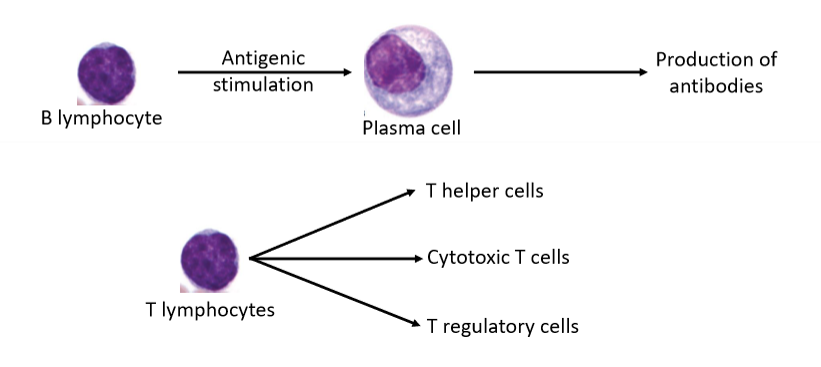
Where are lymphocytes producted and matures
Bm and primary lymphoid tissues
T cells mature in thymus
B cells mature in bm and lymphoid tissues
Decribe the stages of lymphocyte development and stimulation.
List different aetiologies of lymphocytosis

Describe how lymphocytosis appears in a case of chronic inflammation
mild-moderate
reactive lymphocytes seen
often alongside :
neutrophilia, monocytosis, eosinophilia
Describe how lymphocytosis appears in a case of physiologic lymphocytosis
Same as physiologic neutrophilia!
excess catecholamine, transient change!
Describe how lymphocytosis appears in a case of lymphoproliferative disease
eg neoplasia! such as, chronic lymphocytic, leukaemic phase of lymphoma
mild-extreme increase in lymphocytes
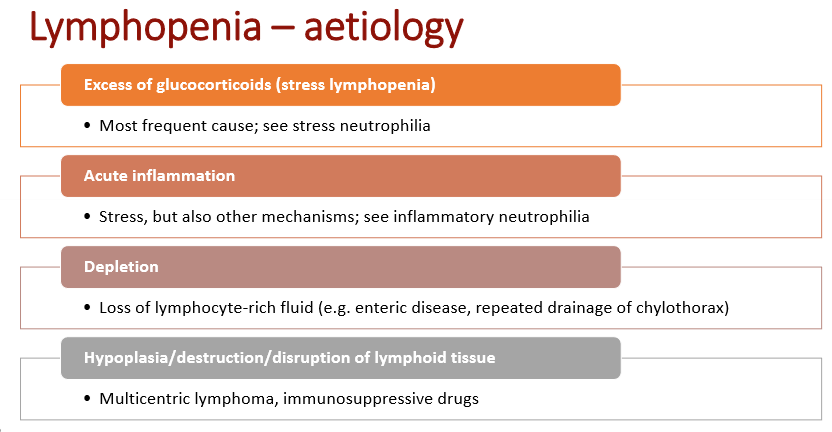
List different aetiologies of lymphopenia
Describe the morphological appearance of monocytes
similar size ot neutrophils with a varibly shaped nucleus
lightly basophillic / amphophillic cytoplasm, coul dhave vaccuoles
low number usually

Describe the life cycle of a monocyte
Produced in bone marrow, live for 1-3 days in blood.
MIgrate into tissues, transformed into macrophages or dendritic cells.
List different aetiologies of monocytosis.

Describe the life cycle of an eosinophil
produced in bone marrow → blood (dont last long here) → tissues (can live for weeks/months)
List different aetiologies for eosinophilia

Describe the life cycle of a basophil
bm → blood (lasts a few days)→tissues (few days)
Describe the morphological appearance of mast cells
LARGE
round nucleus
purple cytoplasmic granules
not seen in health animal
Describe the life cycle of a mast cell
bm → blood (undifferenciated) → tissues (long-lived)
List possible causes of basophilia
hypersensitivity
parasitism
neoplasia
List possible causes of mastocytosis
(even 1 mast cell in blood smear!)
lots = mast cell tumour
few =
dogs - actute inflammatory disease
cats - mast cell tumour.
What can
monocytopenia
eosinopenia
basopenia
indicate?
not a problem - animal an be healthy
stress leukogram - but could be healthy
very rare in any case
What are the indicaators of haematopoietic neoplasia?
marke leukocytosis, but reduced numbers of other leukocytes.
acute = poorly differenciated, overtly abnormalc ells
chronic = well-differenciated cells