Importance of Water and Its Properties-Negative water potential draws water into the root PT2
 Call Kai
 Learn
 Practice Test
 Spaced Repetition
 Match
 Flashcards
 Knowt Play
1/57

There's no tags or description
Looks like no tags are added yet.
58 Terms
Negative water potential draws water into the root

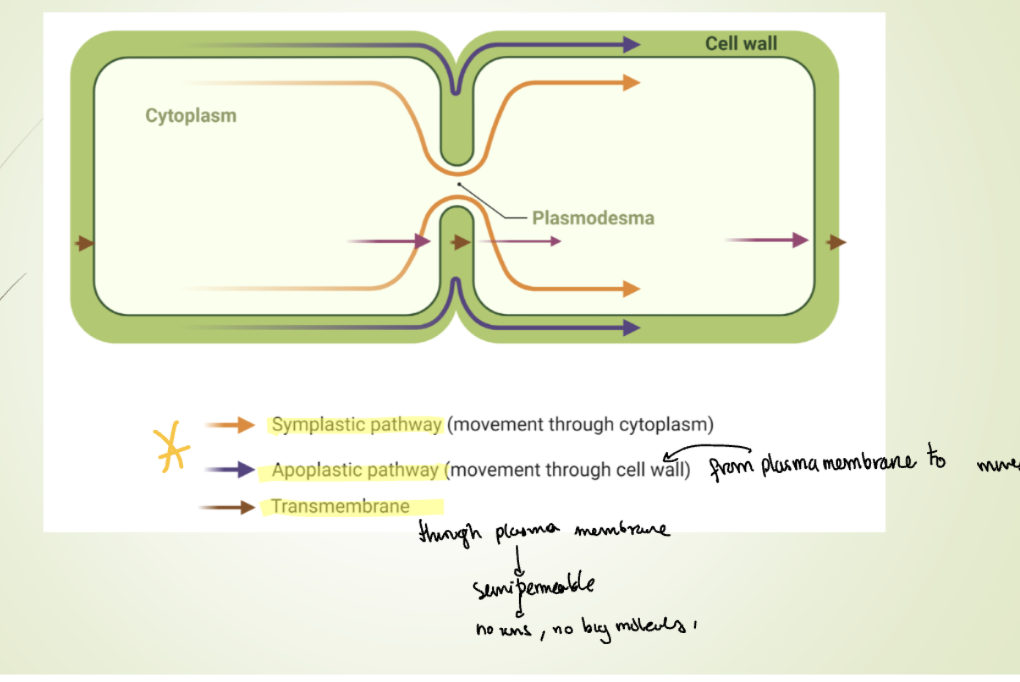
Symplastic pathway
movement through cytoplasm
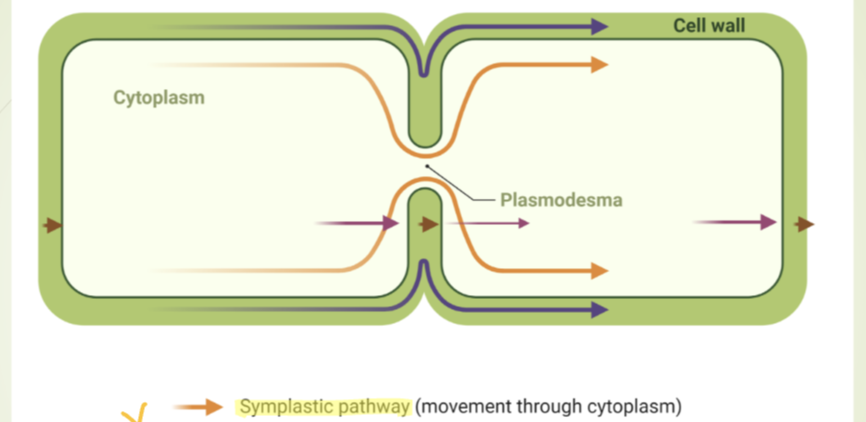
Apoplastic pathway
movement through the cell wall→there is no membrane=free movement

Transmembrane
water repeatedly crosses cell membranes as it moves from cell to cell.
no ions, no big molecules
Absorption of water and ions by roots
Facilitated by root hairs (increase the area)
Absorption through the epidermis of younger roots

In which direction does water move through root tissues?
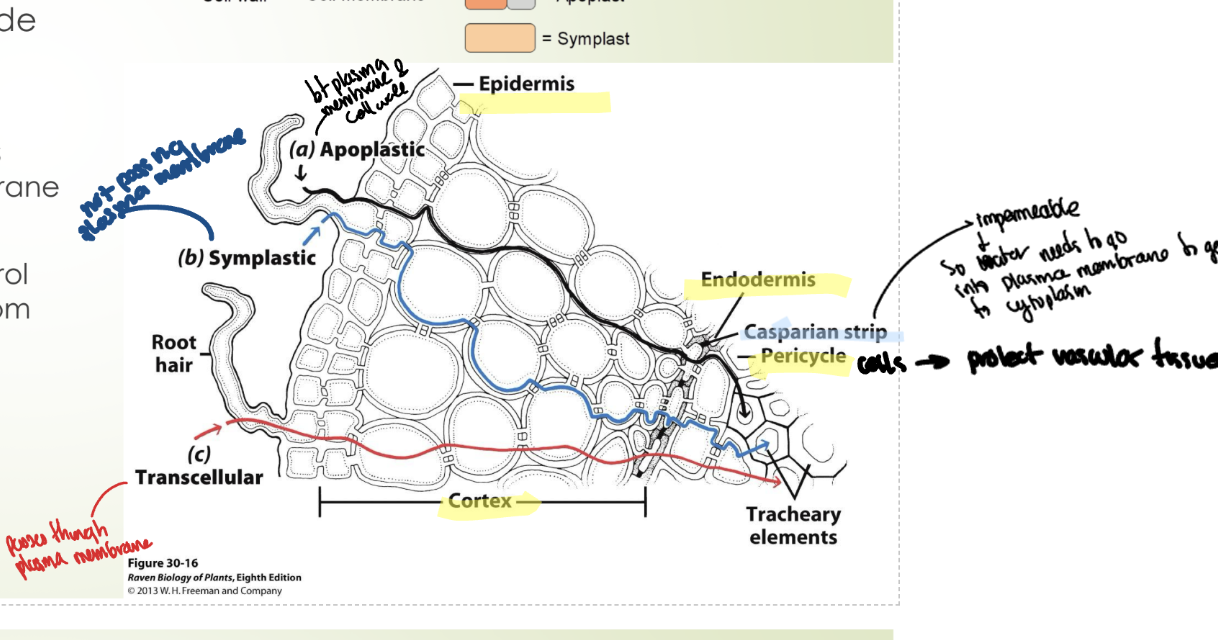
From the epidermis toward the endodermis.
The movements related to this help filtrate ions and toxic heavy metals from the soil.

What is the Casparian strip?
A ring-like, suberin-rich (water impermeable) thickening in endodermal cell walls.
What property does suberin give the Casparian strip?
It is impermeable to water, blocking apoplastic flow.

How does the Casparian strip control water and mineral uptake?
It forces them to cross a selectively permeable plasma membrane before entering.
It maintains water in, like a door/filter.
Located on the endodermis and avoid ions to leak back from the xylem and the water potential becomes more negative.

Uptake of mineral nutrients
How can Brassica napus accumulate K⁺ at 10,000× the external concentration?
Active transport (uses ATP) uses energy to accumulate K⁺ against its concentration gradient.
Which transport mechanisms help root cells absorb mineral ions?
Membrane transport proteins, including carriers and channels; active transport enables uphill accumulation.
How does mineral accumulation affect water uptake by roots?
More dissolved solutes lower root-cell water potential, so water tends to enter by osmosis.
the spontaneous movement of solvent molecules (usually water) through a selectively permeable membrane.
The water moves from an area of low solute concentration (high water potential) to an area of high solute concentration (low water potential) until the concentrations are equal.
How do mycorrhizal fungi improve mineral nutrient uptake?
Their fungal hyphae extend beyond roots, increasing the soil area explored for nutrients.
For which nutrients are mycorrhizal fungi especially important?
Immobile nutrients, especially phosphorusZn, Mn, Cu, which move only short distances through soil.
Root Pressure
What happens if transpiration is very slow or absent (night)?
The gradient of water potential depends mainly on accumulation of ions in the xylem.
Root Pressure
What makes water potential more negative?
Casparian strip on the endodermis avoids ions to leak back from the xylem = water potential more negative
Root Pressure
Is it positive or negative pressure?
Positive pressure, and it forces both water and dissolved ions up the xylem
Root Pressure — Guttattion
Natural release of liquid water droplets containing dissolved minerals, sugars, and enzymes from the tips or edges of plant leaves. Only at night due to no transpiration.
A consequence of root pressure
Exchange between transpiration and assimilate streams can be understood as:
communication between xylem and phloem

Exchange between transpiration and assimilate streams
Circulation of water, inorganic ions (xylem)
What does the transpiration stream transport?
Water and inorganic minerals through the xylem.
Exchange between transpiration and assimilate streams
Circulation of water, inorganic ions (xylem)
In which direction does the transpiration stream move?
Mainly upward, from roots to leaves.
Exchange between transpiration and assimilate streams
Circulation of water, inorganic ions (xylem)
What happens when water and minerals reach the stem?
They move laterally into surrounding tissues.
Exchange between transpiration and assimilate streams
Circulation of water, inorganic ions (xylem)
Where are water and minerals (ions) delivered?
To growing plant parts and mature leaves.

Exchange between transpiration and assimilate streams
Circulation of water, inorganic ions (xylem)
What does the assimilate stream transport?
Sucrose and other substances through the phloem.
Exchange between transpiration and assimilate streams
Circulation of water, inorganic ions (xylem)
What happens in the leaves?
Water and minerals (ions) can enter the phloem and move with sucrose in the assimilate stream.

Exchange between transpiration and assimilate streams
Circulation of water, inorganic ions (xylem)
What are assimilates?
Products of photosynthesis, mainly sucrose.
Exchange between transpiration and assimilate streams
Circulation of water, inorganic ions (xylem)
What does the phloem transport?
Sugars and other dissolved substances throughout the plant.
Exchange between transpiration and assimilate streams
Circulation of water, inorganic ions (xylem)
Why do growing plant parts need the phloem?
To receive sugars, nutrients and water for growth.
Exchange between transpiration and assimilate streams
Circulation of water, inorganic ions (xylem)
What happens to water and solutes reaching the roots through phloem?
They can enter the xylem and be recirculated.
Exchange between transpiration and assimilate streams
Circulation of water, inorganic ions (xylem)
What does recirculation mean?
Substances move from phloem to xylem and travel again in the transpiration stream.
Assimilate transport movement through the phloem
What are assimilates?
Products of photosynthesis (mainly sucrose) + other transported substances (ions, amino acids, hormones, etc)

Assimilate transport movement through the phloem
What is translocation?
Movement of assimilates through the phloem from one part of the plant to another.
Assimilate transport movement through the phloem
What is a source-sink pathway?
Assimilates move from a source (where they are produced or released) to a sink (where they are used or stored).
Source: produces or releases sugars: mature leaves
Sink: uses or stores sugars: growing roots, fruits, young leaves on top.

Pressure Flow Hypothesis
How fast do assimilates move through the phloem?
50-100 cm/hr
Pressure Flow Hypothesis
Is diffusion enough for long-distance transport?
No, diffusion is too slow.
Pressure Flow Hypothesis
What does the hypothesis explain?
Long distance transport of assimilates from source to sink.
Pressure Flow Hypothesis
What drives assimilate movement?
A pressure difference between source and sink.
Source = high pressure
Sink = low pressure
Pressure difference = movement

Pressure Flow Hypothesis
Where is sucrose produced?
Mesophyll cells (leaves)
Pressure Flow Hypothesis
How does sucrose enter companion cells?
Active transport (uses energy→ ATP).
Pressure Flow Hypothesis
How does sucrose enter sieve tubes PHLOEM?
Passively through plasmodesmata by passive transport (No ATP).
Pressure Flow Hypothesis
What happens when sucrose accumulates in sieve tubes (PHLOEM)??
Water potential decreases (where water moves via by osmosis), due to more sucrose.
Pressure Flow Hypothesis
How does water enter sieve tubes (PHLOEM)?
By osmosis (high to low) from the xylem.
Pressure Flow Hypothesis
What increases hydrostatic pressure?
Increased water volume in sieve tubes.
Pressure Flow Hypothesis
What moves phloem sap toward the sink?
hydrostatic pressure = pressure difference
Pressure Flow Hypothesis
What happens to sucrose at the sink?
Used in respiration or stored as starch.
Pressure Flow Hypothesis
What happens when sucrose is unloaded?
Solute concentration (PHLOEM) in the sieve tube decreases.
Pressure Flow Hypothesis
What happens to water potential when sucrose is use at the sink in respiration or stored as starch?
Water potential increases
Pressure Flow Hypothesis
What happens to hydrostatic pressure when sucrose is use at the sink in respiration or stored as starch?
Hydrostatic potential decreases.
Pressure Flow Hypothesis
Where does water move after leaving the phloem?
Into the xylem
Pressure Flow Hypothesis
After water is moved towards the xylem after leaving the phloem, what happens to this water?
It travels upward in the transpiration stream.
What is phloem loading?
Moving sucrose into the phloem.
What is phloem loading?
What does H+-ATPase do?
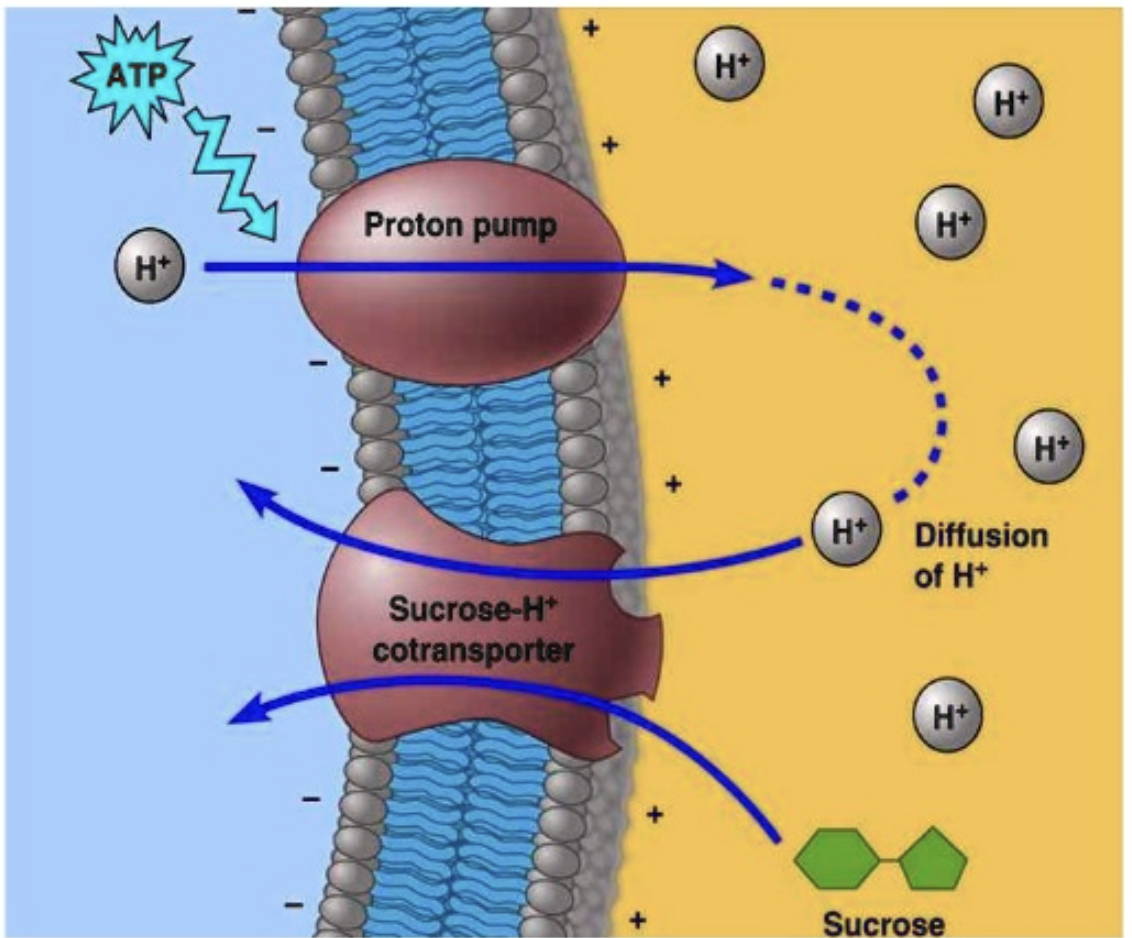
Uses ATP to pump H+ out of the cell.
What is phloem loading?
What is sucrose-proton symport?
H+ and sucrose enter the companion cell together.
What is phloem loading?
What does symport mean?
Two substances move in the same direction.
What is phloem loading?
What provides energy for H+-ATPase?
ATP provides energy for the H+.
2 ways in which phloem loading happens
apoplastic and symplastic via plasmodesmata (polymer trap)
2 ways in which phloem loading happens: apoplastic
Sucrose moves through the apoplast (the cell walls and spaces outside the cell membranes).
A protein called an H⁺/sucrose symporter brings sucrose into companion cells together with hydrogen ions (H⁺).
The H⁺ gradient is created using energy from ATP.

2 ways in which phloem loading happens: symplastic
Sucrose moves directly from cell to cell through plasmodesmata (tiny channels connecting plant cells).
This movement happens through the cytoplasm, so sucrose does not need to cross the cell membrane each time.
In some plants, this uses a special mechanism called the polymer trap.
