Thinking and Intelligence Vocabulary
 Call Kai
 Learn
 Practice Test
 Spaced Repetition
 Match
 Flashcards
 Knowt Play
1/52

There's no tags or description
Looks like no tags are added yet.
53 Terms
Cognitive psychology
The study of mental processes such as memory, thinking, reasoning, and decision-making.
Concept
A mental grouping of things into a distinct category.
Prototype
An ideal representative of a concept.
Schema
A network of interconnected concepts.
Schemas and concepts
Mental structures that reduce effort and support higher-level thinking.
Heuristic
A problem-solving rule of thumb or mental shortcut.
Heuristic accuracy
Heuristics are fast and efficient, but not always accurate or reliable.
Availability heuristic
A shortcut influenced by repeated experiences or attention-grabbing events that come to mind.
Representativeness heuristic
Categorizing something by how closely it resembles a typical example.
Confirmation bias
Attending to existing beliefs while selectively ignoring unfamiliar or contradictory information.
Belief persistence
Maintaining a belief despite encountering contrary evidence.
Intelligence quotient (IQ)
A score derived from a test of intelligence.
Stanford-Binet Intelligence Scale
An intelligence test adapted and revised from Alfred Binet's original test.
Binet's original test
A test designed to identify French schoolchildren needing special education.
Mental age
An estimate of cognitive level measured relative to true age in Binet's test.
True age
A person's actual age, compared with mental age in Binet's test.
IQ of 100
The score assigned when mental age equals true age.
IQ as a predictor
With caveats, IQ predicts academic achievement, job success, health, and longevity.
IQ stability
IQ scores are correlated within individuals across their lifetimes.
Heritable influence on IQ
A genetic contribution to IQ suggested by twin studies.

Environmental influence on IQ
A contribution of environmental conditions to IQ suggested by twin studies.
Socioeconomic status (SES)
An indicator of a family's social and economic position, such as wealth.
Emotional intelligence
The capacity to manage one's emotions and understand others' emotions.
Emotional intelligence and social success
Emotional intelligence predicts success in navigating social situations, including conflict and leadership.
Animal concept formation
The ability of some species to form categories, including same versus different.
Cognitive map
A mental representation of an environment, observed in some animal species.
Animal numerical awareness
The ability of some species to recognize numbers and count.
Animal insight
A capacity shown through self-recognition or novel problem-solving in some species.
Animal tool use
The use of objects as tools, sometimes elaborately, by some animal species.

Mental imagery
Mental representations of sensory experiences such as scenes, voices, or songs.
Mental imagery and brain activity
Imagined stimuli activate brain areas also activated by real stimuli.
System 1 thinking
Fast, unconscious thinking based on associations and assumptions.
System 2 thinking
Slow, conscious thinking.
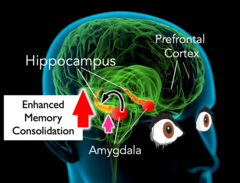
Amygdala
A brain region activated by emotionally arousing content that can enhance attention and memory.
Memory consolidation
The strengthening of memories after they are formed.
Hippocampal-dependent declarative memory
Explicit memory whose consolidation can be enhanced by emotional arousal.
General intelligence (g)
Spearman's general factor associated with cognitive abilities and abstract problem-solving.
IQ standard deviation
A measure of score spread fixed at 15 points in IQ scoring systems.

Wechsler Adult Intelligence Scale
The adult version of the Stanford-Binet test, according to the lecture.
Triarchic theory of intelligence
Sternberg's theory that intelligence has three independent components.
Analytical intelligence
Academic problem-solving and computational ability.
Practical intelligence
Problem-solving ability based on real-life experience and common sense.
Creative intelligence
The ability to solve problems imaginatively and innovatively.
Convergent evolution
Independent evolution of similar features or functions in species not taxonomically related.
Computational theory of mind
The view that the brain processes information through inputs, processing, and outputs.

Dual-system theory of thinking
The view that thinking involves fast, automatic and slow, deliberate systems.
Correlation
An association between things, where one may predict the occurrence of another.
Eugenics
The discredited practice of attempting to control human reproduction to influence inherited traits.
Colorado Adoption Project
A study comparing children's IQ scores with those of biological and adoptive parents.

Grit
Resolve and perseverance in the pursuit of goals.

Grit Scale
A measure of a person's perseverance and resolve toward goals.
Cognitive flexibility
The ability to adapt thinking when circumstances or goals change.
Self-recognition
The ability to recognize oneself as distinct from others.