ASVAB Math
 Call Kai
 Learn
Learn Practice Test
 Spaced Repetition
 Match
Match Flashcards
 Knowt Play
1/59

There's no tags or description
Looks like no tags are added yet.
Name | Mastery | Learn | Test | Matching | Spaced | Call with Kai | Chat |
|---|
No analytics yet
Send a link to your students to track their progress
60 Terms
What are whole numbers?
all positive integers including zero.
Examples - 0,1,2,3

What are integers?
all positive and negative numbers including zero.
Examples - 0, 1,2,3,
-1,-2,-3
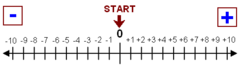
What is a rational number?
any number that can be written as a fraction with integer numerator and denominator.
Example - 2/5, 0, 1, 4/3

What are irrational numbers?
any number that is not a rational number and that cannot be written as a fraction or as a non repeating decimal.
Examples - Pi, 3.145,

What are real numbers?
set of all rational and irrational numbers.
Examples- -√7, -1/3, 0, 1, 3/4

What are Arithmetic operations?
include finding the sum (adding), finding the difference (subtracting), finding the product (multiplying), and finding the quotient (dividing).

What are fractions?
are composed of a numerator (top number) and a denominator (bottom number)

What are proper fractions?
numerator smaller than the denominator. Examples- 1/2 and 7/8

What are improper fractions?
numerator equal to or greater than the denominator. Examples- 6/3 and 2/2

What are mixed fractions?
combination of whole and fractional numbers. Examples- 1 1/4 and 3 3/5

What is equivalent Factions?
when two fractions identify the same quantity and simplify equally. Examples - 1/2 and 2/4

How to simplify a fraction?
by determining what number will divide evenly into both the numerator and the denominator. Example, with the fraction 4/8 four divides evenly into both 4 and 8 giving 4/8 ÷ 4/4 = 1/2.

How do you convert an improper fraction to a mixed fraction?
divide the numerator by the denominator to get a quotient of one and then write the remainder over the original denominator. Example, 15/7 = 2 remainder 1 which is 2 1/7.

When adding and subtracting fractions the denominator must be the same for both numbers. If you have different denominators what do you do?
you need to find the least common denominator by finding a number that both denominators will divide into evenly.

How do you multiplying and dividing fractions?
simply multiply the two numerators together to get the numerator of the answer and multiply the two denominators to get the denominator of the answer.

Formula for simple interest is what?
Interest = principal x (interest x rate)

Formula for compound interest is what?
calculate simple interest for each year making sure to use the new principal + accumulated interest for each year's new interest calculation.

What are Composite numbers?
can be expressed as the product of two or more whole number factors excluding the number itself and one.
Example-

What are prime numbers?
an be expressed as the product of only two factors, the number itself and one.
Example-

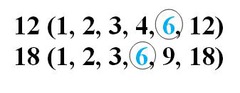
What is the greatest common factor?
of two numbers, it is the largest number that can divide equally into both numbers.
Example, the factors of 18 are {1, 2, 3, 6, 9, 18} and the factors of 15 are {1, 3, 5} so the greatest common factor of 18 and 15 is 3.
What is multiples of numbers?
the set of numbers formed by multiplying a number by other numbers.
Example, the first five multiples of 3 are {3, 6, 9, 12, 15}.

What is the least common multiple?
of two numbers is the smallest number that both numbers factor into evenly.
Example- The first five multiples of of 4 are {4, 8, 12, 16, 20} making the least common multiple of 3 and 4 equal to 12.

What is a fractional?
Denoted by a number followed by an exclamation point. Also is the product of all whole numbers from 1 through that number.
Example- 4! is 4 x 3 x 2 x 1 = 24.
How do exponents work?
A number in superscript next to a base (for example, 23). They represent the number of times (3) that the base (2) will be multiplied by itself. Another way of expressing a number with an exponent of two is squared and with an exponent of three, cubed so 23 is two cubed and 42 is four squared.

What is the inverse of an exponent?
The root which is indicated by a radical sign √. A root consists of a radicand which is the number for which you're finding the root and an index indicating which root you're finding.
Example- in 3√8 the number 8 is the radicand and the number 3 is the root.

P.E.M.D.A.S. stands for what?
Operations inside parentheses and brackets
Exponents and roots
Multiplication
Division
Addition
Subtraction

In algebra constants are called what?
Numbers
In algebra variables are called what?
letters that represent unknown numbers

In algebra coefficients are known to do what?
be a constantly multiplied by a variable

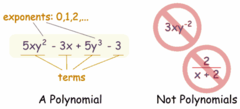
What is a polynomial?
a term in algebra that uses one or more variable.
What is the Distributive property?
when you have an equation that contains both multiplication and addition you can distribute the multipliers.
Example, (2+4)(3+5) = 2(3+5) + 4(3+5).

What is the Commutative property?
you can add or multiply numbers in any order.
Example, 2 x 4 x 7 = 7 x 2 x 4.

What is the Associative property?
when adding or multiplying you can group numbers in any order.
Example, (3+5) + 7 = 3 + (5+7)

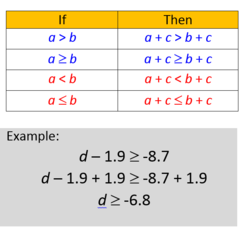
What is the Property of inequality?
if two numbers are equal you can add or multiply those numbers by the same value to get the same result.
Example, if 4 = 2y then 4(7) = 2y(7).
What is the Additive identity?
a number or variable added to zero equals that number or variable.
Example, 7y + 0 = 7y.

What is the Multiplicative identity?
a number or variable multiplied by one equals that number or variable.
Example, 7y x 1 = 7y.
What is the Additive inverse?
a number or variable added to its inverse equals zero. E
Example, 7y + (-7y) = 0.

What is the Multiplicative inverse?
a number or variable multiplied by its reciprocal equals one.
Example, (7y)(1/7y) = 1.

When solving equations with inequalities when do you switch the signs around?
Make sure to reverse the direction of the inequality when you multiply or divide by both sides of the inequality.

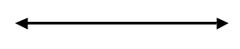
In Geometry what is a line?
is a connection of points that go in a straight path in only two directions.
In Geometry what is a ray?
is a line that has one defined endpoint but other end goes infinitely in a straight path

In Geometry what is are Parallel lines?
are equidistant lines that never cross

In Geometry what is are perpendicular lines?
are lines that intersect at a right angle (90°).

In Geometry what some common angles and their degrees?
Line- 180
Circle- 360
Right-90
Acute-
What are complementary angles?
Two angles that the sum equals 90 degrees.

What are supplementary angles?
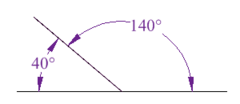
Two angles that the sum equals 180 degrees.
What is the sum of the interior angles of a triangle?
The sum of the interior angles of a triangle always equal 180°

What is a equilateral triangle?
Triangles are equilateral when all three sides have the same length

What is a isosceles triangle?
when two sides have equal length.

How can you find the perimeter of a triangle?
The perimeter of a triangle can be found by adding the lengths of each side and the area can be calculated as 1/2(base)(height).

In Geometry what are quadrilaterals?
are four-sided geometric shapes whose four angles sum 360°

What are some of the most common types of quadrilaterals and what types of angles do they have?
Square- all 4 right angles, to find the area = (side)2
Rectangle- all 4 right angles,
to find the area=
Length x width
Parallelogram- opposite angels are equal,
to find the area=
base x height
Trapezoid- sum of angles is 360,
to find area=
1/2 base1+base2 x height

In geometry circles have?
a radius which measures the length from the center of the circle to any point on its curve

The circles diameter is important why?
is the length, through the center, from one point on the curve to another and equals radius x 2.

The circles circumference is important why?
is the length around the curve and is equal to 2 x pi x radius (2πr) or pi times diameter (πd)

How do you find the area of a circle?
is pi times radius squared (πr2).

What does volume measure?
Volume measures the three dimensional area of an object.

To find volume of a rectangle do?
Volume for a rectangle is found by multiplying length x width x height

How to find volume of a cube?
for a cube with equal side lengths, can be simplified to side3

Volume of a cylinder can be found by?
Volume for a cylinder can be found by multiplying the two dimensional area (πr2) by the height to get πr2h.
