Exam 3: MS
 Call Kai
 Learn
 Practice Test
 Spaced Repetition
 Match
 Flashcards
 Knowt Play
1/63

There's no tags or description
Looks like no tags are added yet.
64 Terms
displays m/z ratio by
desorbing gaseous species from condensed phases, which get fragmented and ionized
these fragments are accelerated by an E-field, which separates the fragments based on their m/z ratio
the area of each peak is proportional to the abundance of each isotope
nominal mass
the whole number masses, based on the most abundant isotope of an element that we use to calculate m/z in MS
1 Da=1 amu
so C=12 Da, H=1 Da, etc
main 3 parts of a MS instrument
ionization source
mass separator/selector
detector
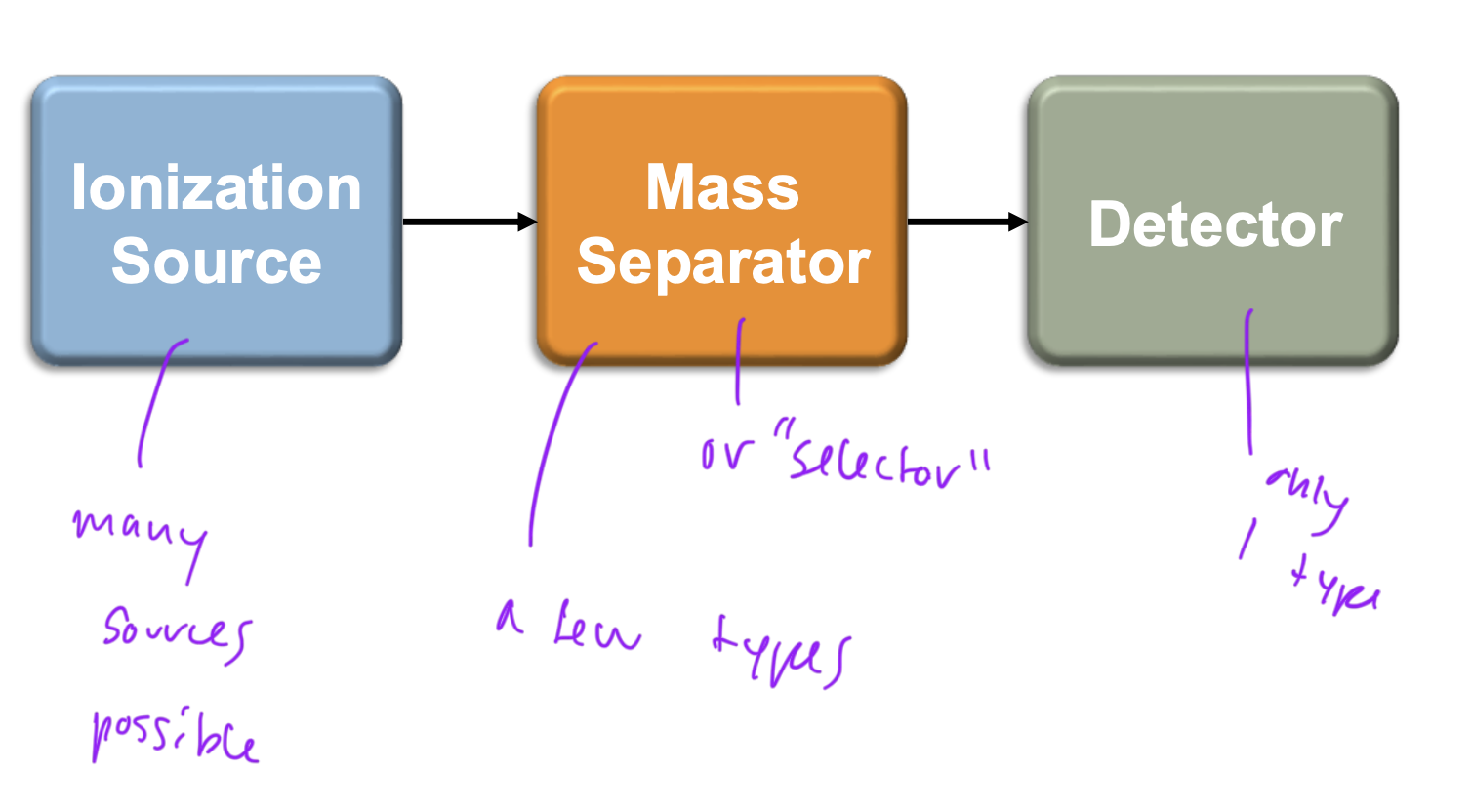
MS ionization sources
EI
CI
ESI
APCI
ICP
MALDI
EI (e- ionization/ e- impact ionization)
MS ionization source
uses an e- beam at +70eV to ionize the gaseous molecule, forming fragments
uses hard ionization since it imparts a lot of enegry onto the molecule
dissociative (the parent molecule) and non-dissociative (ionized parent molecule, which is unstable) results are formed

EI instrumentation
usually starts with GC to form gaseous molecules
when the molecules ionize, they for radicals

not every collision event in EI is
equally likely to occur
at 1eV, most molecules will ionize, so at 70 eV, almost anything will ionize and form a cation, as e- are ejected off
so the molecule (M) gets hit with 70 eV e- beam and forms M+. (the molecular ion) and an e-, which is ejected from the molecule
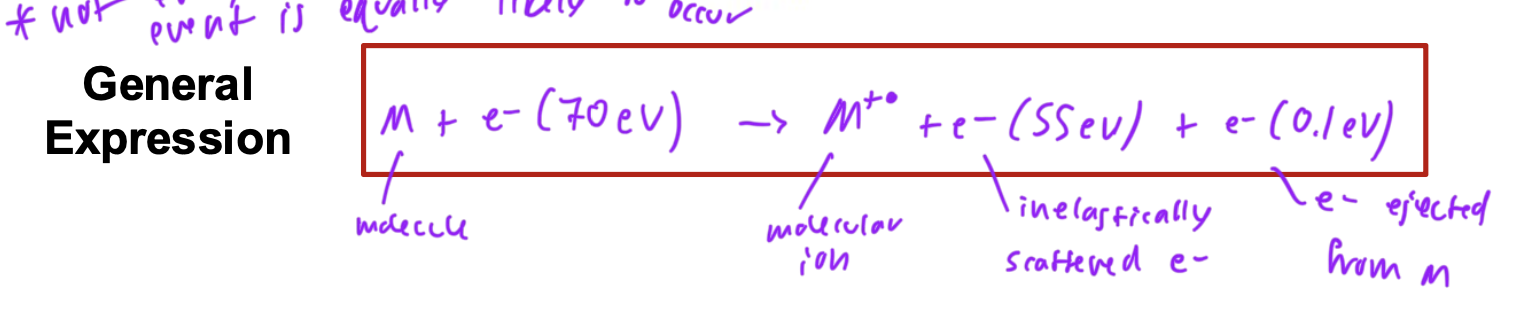
resonance capture
when you use a lower energy e- beam (less than 20 eV) to obtain anionic fragments
resonance capture uses the lowest energy and forms M-.
dissociative capture uss a lower, but intermediate energy to break apart a bond in a molecule (XY) to form X + Y-.

CI (chemical ionization) instrumentation
the products are protonated, so have higher mass than the original molecules
uses some reactive gas like methane or ammonia
soft ionization, imparts low energy onto molecule

in CI to form positive ions, you are trying to
generate a proton to transfer onto your molecule
CH5+ is a common proton donor used
one molecule that has become ionized reacts with the next

CI to form negative ions
ions in sln can produce neg ions
methane and ammonia promote formation of M-
also sometime uses O2-, F-, SF6
either way, produces fragments that are anionic

EI characteristics in its MS spectra
forms many small fragments
no clear molecular ion formed
lots of isotopic patterns
uses hard ionization

CI characteristics in its MS spectra
high abundance of molecular ion peak (MH+)
not as much fragmentation
uses soft ionization

hard vs soft ionization
hard: imparts high energy onto the molecule and leads to a high degree of fragmentation
soft: imparts lower energy onto the moelcule, so forms fewer fragments
EI and CI are often used
in a complimentary fashion
What are the only 2 MS ionization sources we have talked about? more exist but ignore that
EI and CI
How MS selector separates masses using a B field
an ion with both mass and charge (duh) is accelerated through a potential difference given by the acceleration plates
the ion acquires a KE equal to the electric potential difference given by the plates
so an ion with some velocity perpendicular to that of the B field experiences a force (centripetal force), which is proportional to the mass:charge of a given ion

mass separator magnetic sector instrumentation
ionization source
magnet

electric sector instrumentation (MS mass separator)
like magnetic sector, works to direct ions
has lower LOD, good for nuclear materials
helps isolate isotopes

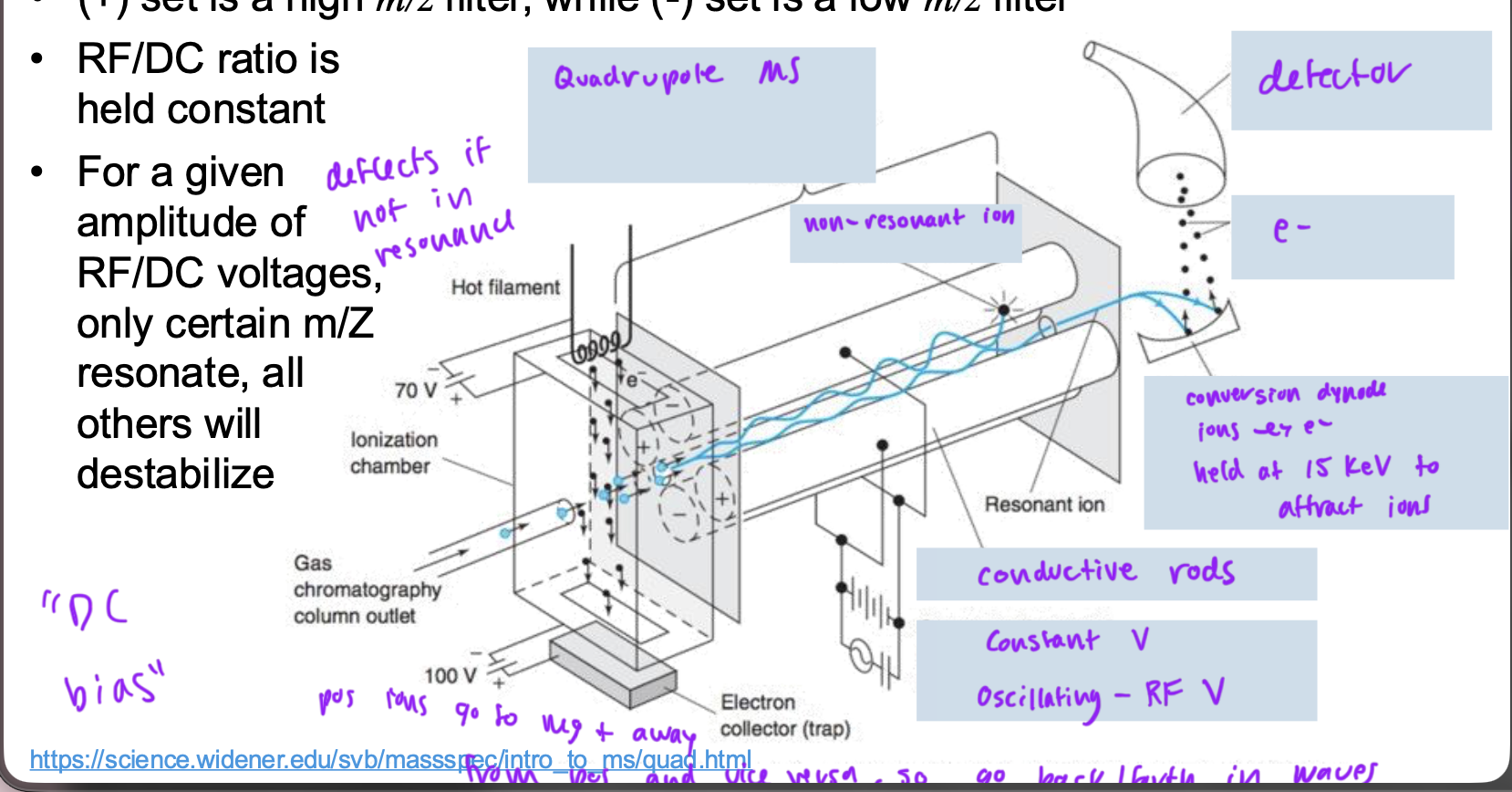
Why is there both a magnetic and a electric sector in a MS mass separator?
using both together helps improve resolution
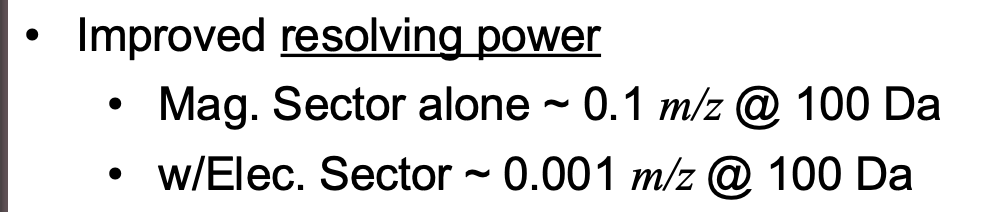
Quadrupole (mass separator)
common detector/separator for small molecules
called quadrupole bc has 4 rods in it (one set is pos charged and other 2 are neg)
pos ions go away from the pos and towards the neg and vice versa, so that ions travel in waves through the Quadrupole
constant DC and RF voltages oscillate between the rods
+ set filters for high m/z
- set filters for lower m/z
so for a given amplitude of DC and RF voltages, only certain m/z will resonate, and all other m/z will be deflected
so only ions of the m/z you want are detected
because a Quadrupole is operated at constant resolution, the spacing between data points is constant as a function of
m/z
whereas magentci sectors operate at constant revolving power, so that spacing between data points increases with m/z
mass accuracy of Quadrupole
0.1-0.2 Da
Quadrupoles can be used in 2 diff modes:
scan-sweep DC/RF voltages to collect m/z spectra
selected-ion monitoring to set to a specific m/z or DC/RF range to monitor what is eluted from the initial GC so that only your analyte goes through, used for trace molecules
What mass separators have we talked abt?
Quadrupole
electric sector
magnetic sector
Only MS detector we are talking abt:
continuous-dynode electron multiplier
continuous-dynode electron multiplier (detector)
multiple e- are created evcerytime an ion collides with a side of the detector, so amplifies the detected signal

resolution
the separation between 2 distinguishable features
resolving power
to what m/z we can reliably separate peaks that are 1 Da apart
either quantified as m/∆m OR m/m1/2
must specify which form you are using since they yield diff answers
m/∆m: x-value where peak is/distance between two peaks
m/m1/2 : x-value where peak is/FWHM
m1/2 is FWHM

is resolving power of a spectrometer is say 14320 Da, then
it has good res at m/z values below 1420 Da, but not as you approach 1420 Da and higher
regarding isotope abundance factors, something with x+2 of 97.3n will have a much higher isotopic abundance than something with say, 3.35n

isotopologues
molecules with the same structure but diff isotopes (say a C12 is subbed for a C13)
can verify a likely structure by looking at the relative abundance of isotopologues
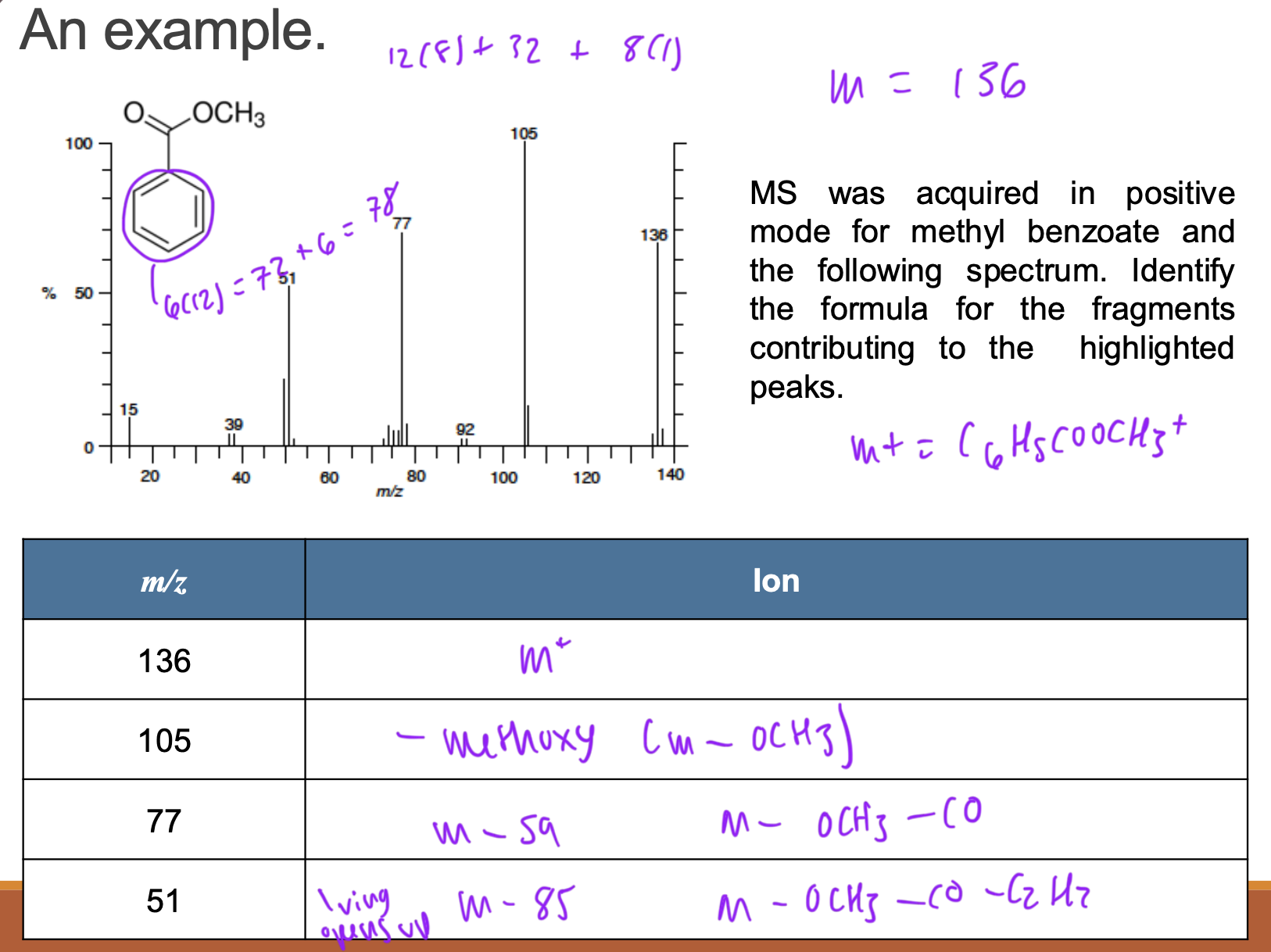
in benzene, C6H6, M+ is given at 78 Da and we know for M+1, C is 1.08n and H is 0.012n
so 6×1.08 + 6×0.012 gives a value of 6.55%
so the 6.55% represents the expected relative intensity (or abundance) of the M+1 isotope peak at m/z = 79 relative to the molecular ion base peak (M⁺) at m/z = 78
halogens have m/z +____
+2 isotopologues
due to the high abundance of x+2 isotopes
M-79 is M- a bromide
rings and double bonds formula (tells us the degree of unsaturation, aka double bond equivalency)
R + DB= c-h/2 + n/2 + 1
c is G14 atoms (things that make 4 bonds)
h is hydrogen and halogens (things that make 1 bond)
n is G15 atoms (things that make 3 bonds, so have a lp)
allows us to propose a plausible structure

What is the highest peak on a MS spectra?
M+.
the peak from the heaviest fragment should be a mass loss from this M+. peak
common loses
-15 (methyl group)
-17 (OH or NH3)
-18 (water)
common fragments

2 peaks can be similar bc they undergo similar fragmentation pathways

ToF (time of flight) mass selector/separator
uses the principle that all ion fragments have the same KE, so ions of diff masses will have different velocities and travel diff distances
lighter ions travel faster and reach the detector first uses a Quadrupole to focus the ions
is a cheap, but very large device
good for biomolecules/macromolecules
collects spectra fast
very high resolving power
has 2ppm=0.001m/z accuracy

ToF instrumentation
larger ions travel farther path so that all have equal KE
reflectron reflects ions at some offset distance depending on energy of the particle, so particles travel a set distance based on their m/z

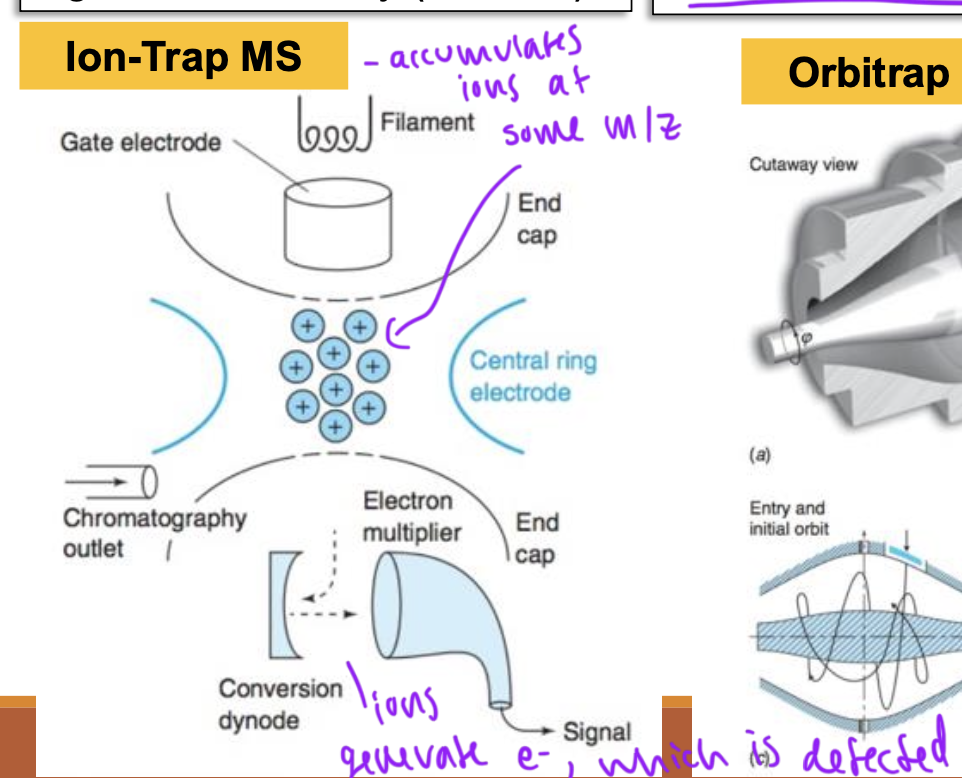
ion-trap MS
accumulates ions at same m/z, the ions then generate e-, which are detected
good with LC-MS
has high sensitivity, especially for low m/z
orbitrap MS
highest mass accuracy and resolving power
for high-precision and accuracy of macromolecules and biomolecules

FTICR MS (Fourier-transform ion cyclotron resonance)
has highest resolution
things make it thru if they are a certain m/z

all MS methods are
destructive
why is it hard to interface liquids with MS
must be aerosolized
have a bunch of solvents with them
large pressure difference
interfacing with GC to do MS
good bc eluent is such a small volume
interfacing with LC
solids can deposit and clog/foul/damage ionization sources
must be mindful that what you are using is compatible with the ionization source
mobile phase must be volatile
common ways to interface LC-MS
ESI electrospray ionization
APCI atmospheric pressure chemical ionization
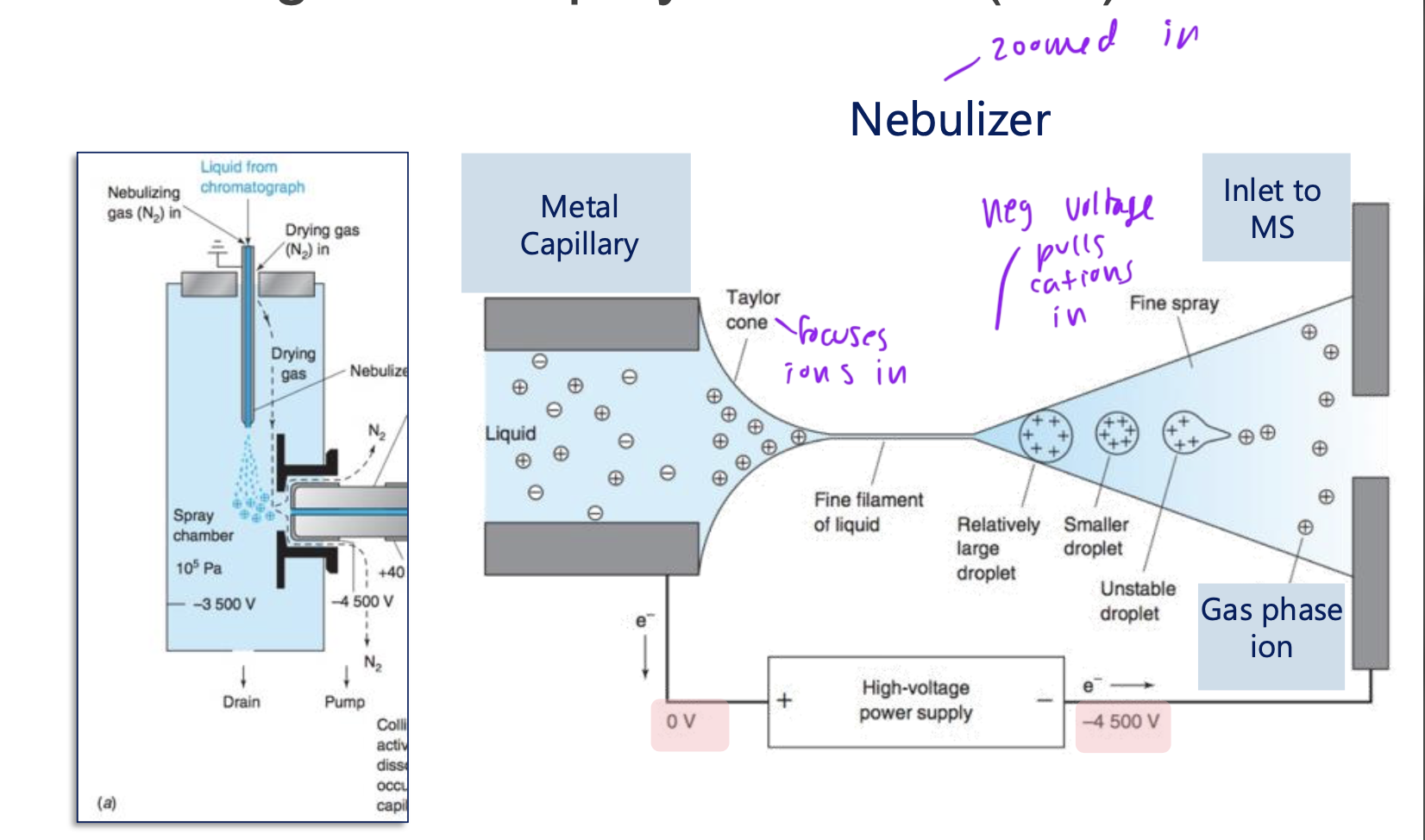
ESI electrospray ionization
good for large molecules, up to 100,000 Da
little fragmentation occurs, ions are formed in sln
target analytes are charged in eluent
nebulizes liquid sln, focuses droplets, which become ionized

zoom in of ESI nebulizer
the neg voltage pulls cations in and the Taylor cone focuses ions in
APCI
useful for smaller molecules that are also in sln
mainly used for polar, thermally stable compounds
takes liquid eluent from LC, heats it to gas, forms cations
soft ionization
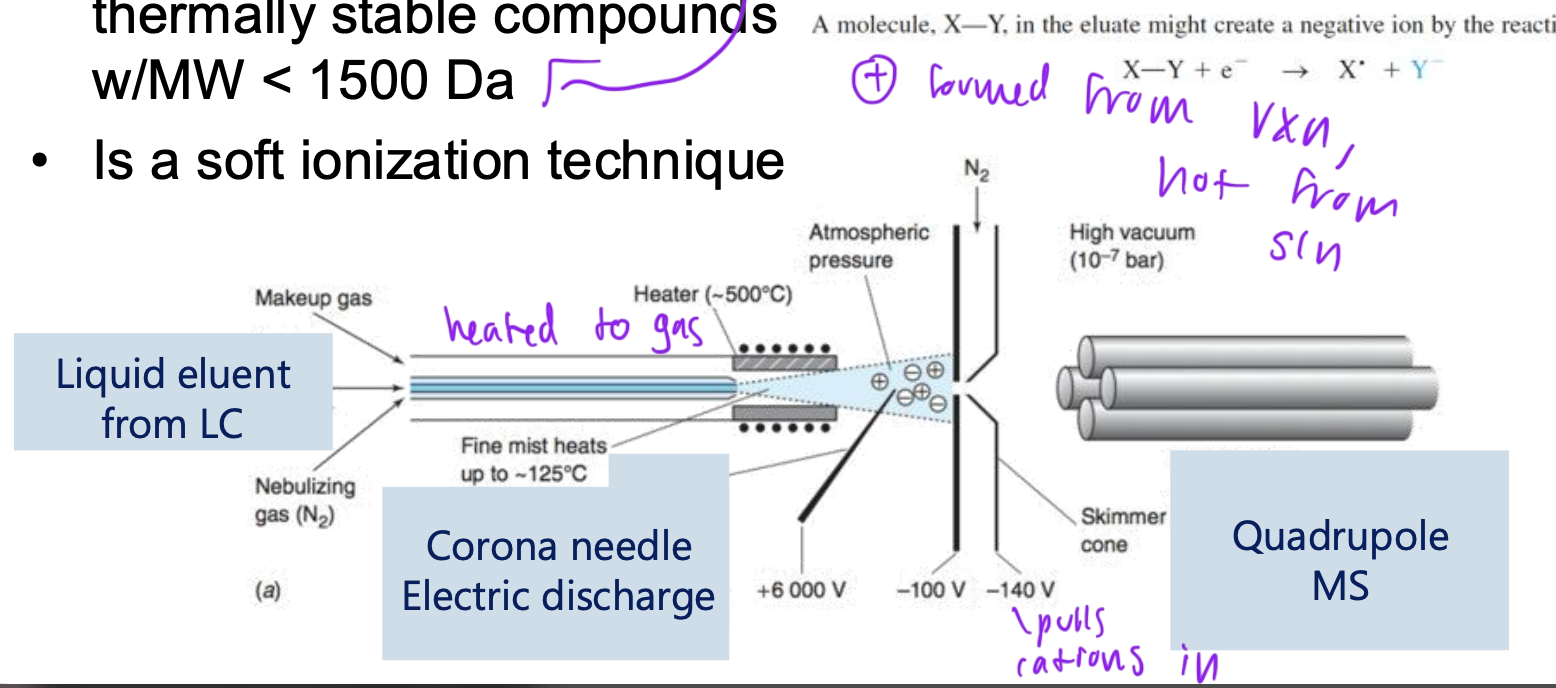
diagram of our ESI-MS, which can also do APCI-MS
has Quadrupole analyzer, ToF selector, LC pump inlet

MALDI matrix-assisted laser ionization
useful for things that are hard to ionize (proteins, bio samples, solids)
matrix is usually organic crystal like 2,5-dihydroxybenzoic acid
can map a surface to do imaging
the molecule absorbs UV-photon and ionizes to create a singly charged species, which is easier to analyze

how does MALDI work
laser pulses sample
another laser pulse (337 nm) hits the sample
matrix absorbs UV radiation, becomes ionized
some charge transfers to the molecule of interest
supersonic expansion of matrix with molecule of interest occurs

when to use ESI-MS vs MALDI
both are soft ionization techniques
ESI-MS: larger molecules that have higher valency charges of liquid samples
MALDI: rapid imaging, solid samples, singly charged molecules
we can tell there are multiple protonation combinations in a MS spectra by the
gaussian nature of the curve, which represents the probabalistic distribution of charge states
compounds all being + shows that mobile phase from the LC was likely acidic, so protonated to form all these species

when n = the # acidic protons

MS has lower res at higher m/z, so number SFs decr

comparing ESI and MALDI
ESI gives way more peaks due to complex charge states (lots of multiply charged M)
MALDI has way fewer peaks bc mostly just singly charged molecules

how could you determine lower-order structures at the molecular subunnit level?
by doing MS-MS

ESI and MALDI both
dont make fragments, so are soft-ionization methods
other ionization methods that exist
open-air sampling-low temp plasma
DESI (open-air sampling desorption electrospray ionization)
DART (direct analysis in real time) analyzes drugs, cookies
DART (direct analysis in real time)
closest thing to non-destructive MS
uses He or N2 to form reactive water droplets
used to analyze drugs
