biol 300 genetics mobile genetic elements quiz
 Call Kai
 Learn
Learn Practice Test
 Spaced Repetition
 Match
Match Flashcards
 Knowt Play
1/68

Earn XP
Description and Tags
UNLV
Name | Mastery | Learn | Test | Matching | Spaced | Call with Kai | Chat |
|---|
No analytics yet
Send a link to your students to track their progress
69 Terms
are transposons found in prokaryotes or in eukaryotes?
both
what are several possible mutations caused by transposons?
insertions
deletions (nearby information may be cut out)
gene / promoter disruptions (when transposon is inserted)
can transposons infect other hosts other than a host in which they are found?
no, they cannot go outside of their cell (not a virus)
can transposons make copies of themselves?
yes
can transposons move from one location to another within the same genome?
yes
what are some strategies that an organism uses to deal with transposons?
methylation (silence transposons)
RNAi (RNA interference)
are sequences for new transposition insertion random?
no, the sequences are specific "target sequences" or can have hotspots
are transposable elements common in many organisms?
yes
why are composite transposons called "composite"?
because they can carry more than one gene (such as antibiotic resistant genes) and are flanked by IS (insertion sequences)
in mosst cases, what proteins are responsible for choosing the target sequence for transposons?
transposase
where is the gene for transposase located?
in the transposon between the inverted repeats (in the insertion sequence)

what does it mean to be "autonomous"?
the ability to function on its own
e.g. transposase contains genes needed for transcription and transposition and does not need outside help
can transposons exist in genomic dna and plasmids?
yes
can one organism have more than one type of transposons?
yes
how are the ends of IS elements different from the target sequences?
IS elements: end with inverted terminal repeats
target sequences: are direct repeats
what is the result of the target sequence after transposition?
Gets replicated (copy + paste) or moves (cut + paste)
Turns into direct repeats
why is resolvase needed in replicative transposition?
a conintegrate is formed and needs to be resolved
a cointegrate allows the transposon to be replicated without leaving its original location
when a transposon is removed from one location and transposed to another, are the "cuts" precice?
no, they are rarely precise and will take nearby information and/or gene
what is the difference between replicative and nonreplicative transposition?
Replicative: (copy + paste mechanism) where the element is duplicated and remains in orginal location and the new copy is transposed to a new site
Nonreplicative: (cut + paste mechanism) where the element moves as a physical entitiy from one site to another without being duplicated
what is the difference between a retrovirus and other dna or rna viruses?
Retrovirus converts their ssRNA genome into dsDNA once inside of a host cell to integrate it into the host genome.
why is the dna stage necessary in the retrovirus life cycle?
Converts ssRNA into dsDNA for integrase to insert the DNA into the host genome
what is the difference between (+) and (-) strand of viral RNA?
(+) strand: message strand [coding]
(-) strand: template strand [noncoding]
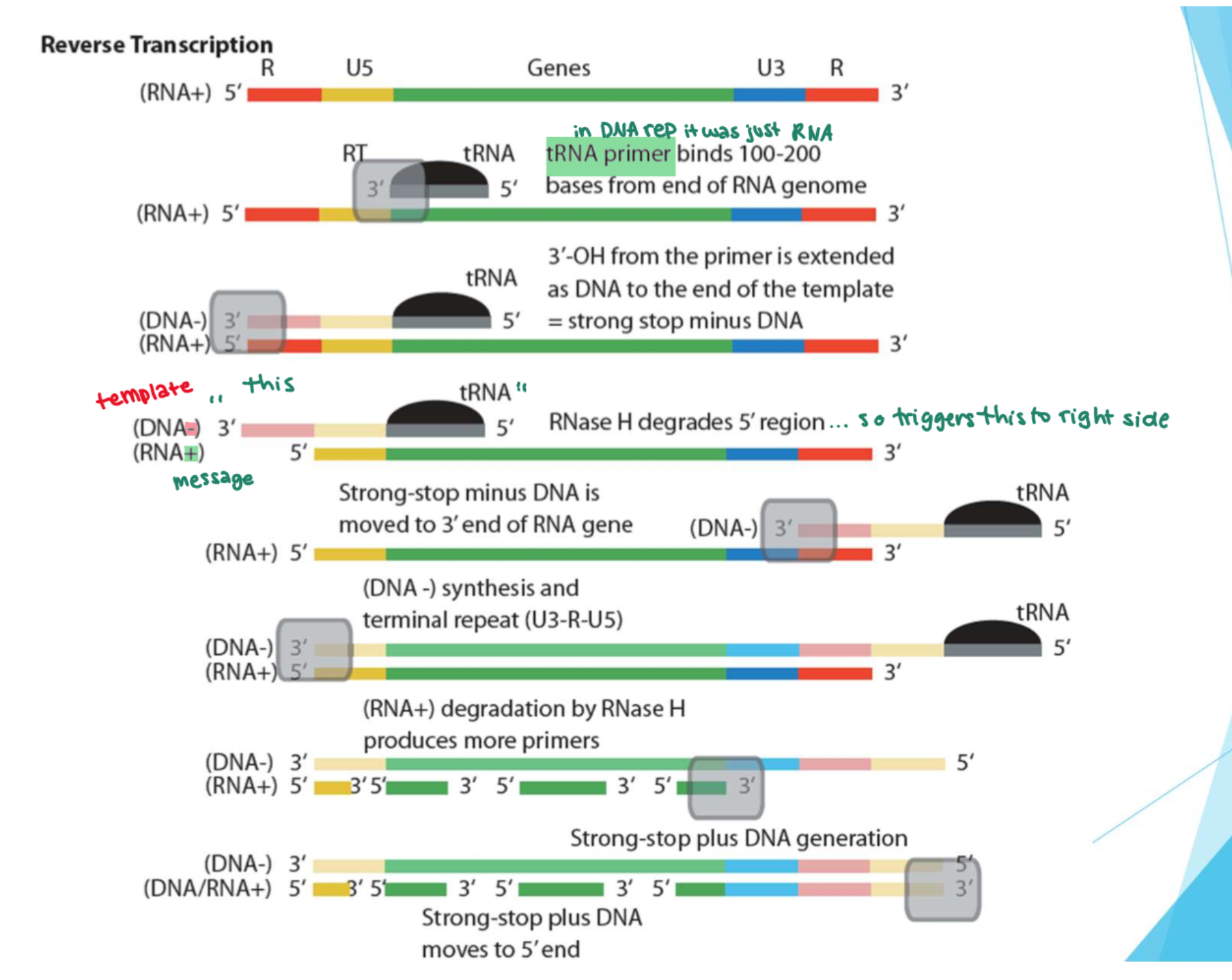
what serves as a primer for RTase during retroviral infection?
tRNA(100-200 bp long) initially
and then primers produced by (RNA+) degredation by RNase H
what enzyme is required for the integration of a dsDNA retroviral genome into the host genome?
integrase
why can genes in a viral genome quickly become mutated?
bc there is no proofreading mechanism in reverse transcriptase
when a retrovirus integrates into DNA, does it generate extra direct repeats just a transposons do?
yes
what are the activities of RTase?
RNA dependent DNA polymerase activity
ssRNA used as template to build/synthesize 1st strand of DNA
Ribonuclease H activity
degrades RNA
DNA dependent DNA polymerase activity
1st strand of DNA as template to build/synthesize 2nd strand of DNA
what are retrotransposons?
genetic elements that can amplify themselves using an RNA intermediate but are not infectious
what is the difference between a retrotransposons and retrovirus?
unlike retroviruses, retrotransposons are not infectious and cannot move from cell to cell (because they don’t have the env gene which is what would make them infectious)
where is RTase encoded in LTR retrotransposons?
In the TyB in the LTR of the transposons themselves
what is VLP?
“virus like particle” that looks like a virus but is missing key genes needed for infectivity (env proteins)
if supplemented with extra enzymes, can a retrotransposons become a functional retrovirus?
yes, if it has the env gene
what are transposons?
movable dna elements found in prokaryotes and eukaryotes
can transposons be silenced?
yes, through methylation or RNAi
what is the base structure of a transposon in bacteria?
contains insertion sequence (IS) composed of the transposase gene and inverted repeats on either side

what is transposase?
enzyme that recognizes inverted repeats and excise sequence and transports to new location

what are the two types of transposons?
insertion sequences (IS) and composite transposons (Tn elements)
whar are insertion sequence?
simplest transposons, autonomous (contains genes needed for transposition). they have inverted terminal repeats
genes: transposase
what are composte transposons and what are they composed of?
insertion sequences (identical or closely related to) and can carry other genes such as antibiotic resistance genes
genes: transposase + can carry additional genes


Two transposition types
faith of transposition
analogy
is transposase needed?
is resolvase needed?
is the initial break ss or ds?
is a cointegrate formed?
1. Replicative transposition
Faith: element is duplicated. One element stays put in the original location. Copied element becomes transposed to a new site
Analogy: Copy + Paste
Transposase needed? Yes
Resolvase needed? Yes
Initial break: Single-stranded
Cointegrate formed? Yes
2. Non-replicative transposition
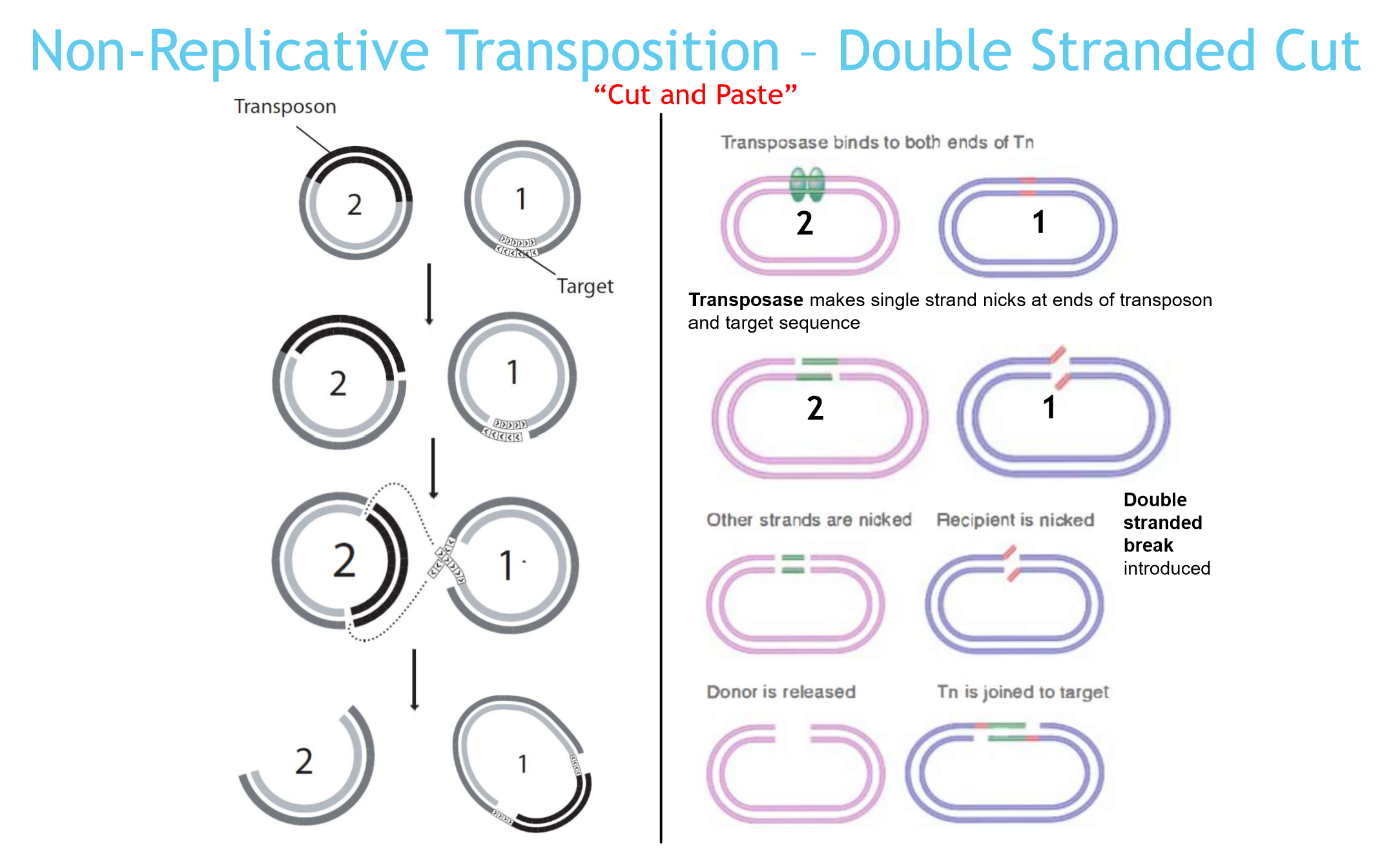
Faith: Element moves as a physical entity from one site to another without being duplicated
Analogy: Cut + Paste
Transposase needed? Yes
Resolvase needed? No
Initial break: Single or double-stranded
Cointegrate formed? No

what is resolvase?
assist in copy and paste mechanism allows for duplication of transposon without leaving original location
resolves cointegrate
Copy + Paste Mechanism (Replicative transposition)


Cut + Paste Mechanism (non-replicative transposition)
SINGLE STRANDED CUT


DOUBLE STRANDED CUT

what are retroviruses?
infectious virus whose genome is RNA (single or double stranded)
what is the function of retroviruses?
converts RNA to DNA inside the host cell so that it can incorporate its genome into the host genomes (permanently)
what unique enzmyes do retroviruses have?
reverse transcriptase (converts ssRNA → DNA)
integrase (inserts DNA into host genome)
what are gene cassettes?
genes that have the same function and located near one another
what are the three major gene cassettes?
gag, pol, and env gene cassettes
function of gag gene cassette
packaging
i.e. matrix, capsid, nucleocapsid
function of pol gene cassette
enzymes needed to process the retroviral genome into a state where it can be integrated
i.e. reverse transcriptase, integrase, and proteases
function of env gene cassette
signaling proteins
i.e. surface and transmembrane proteins
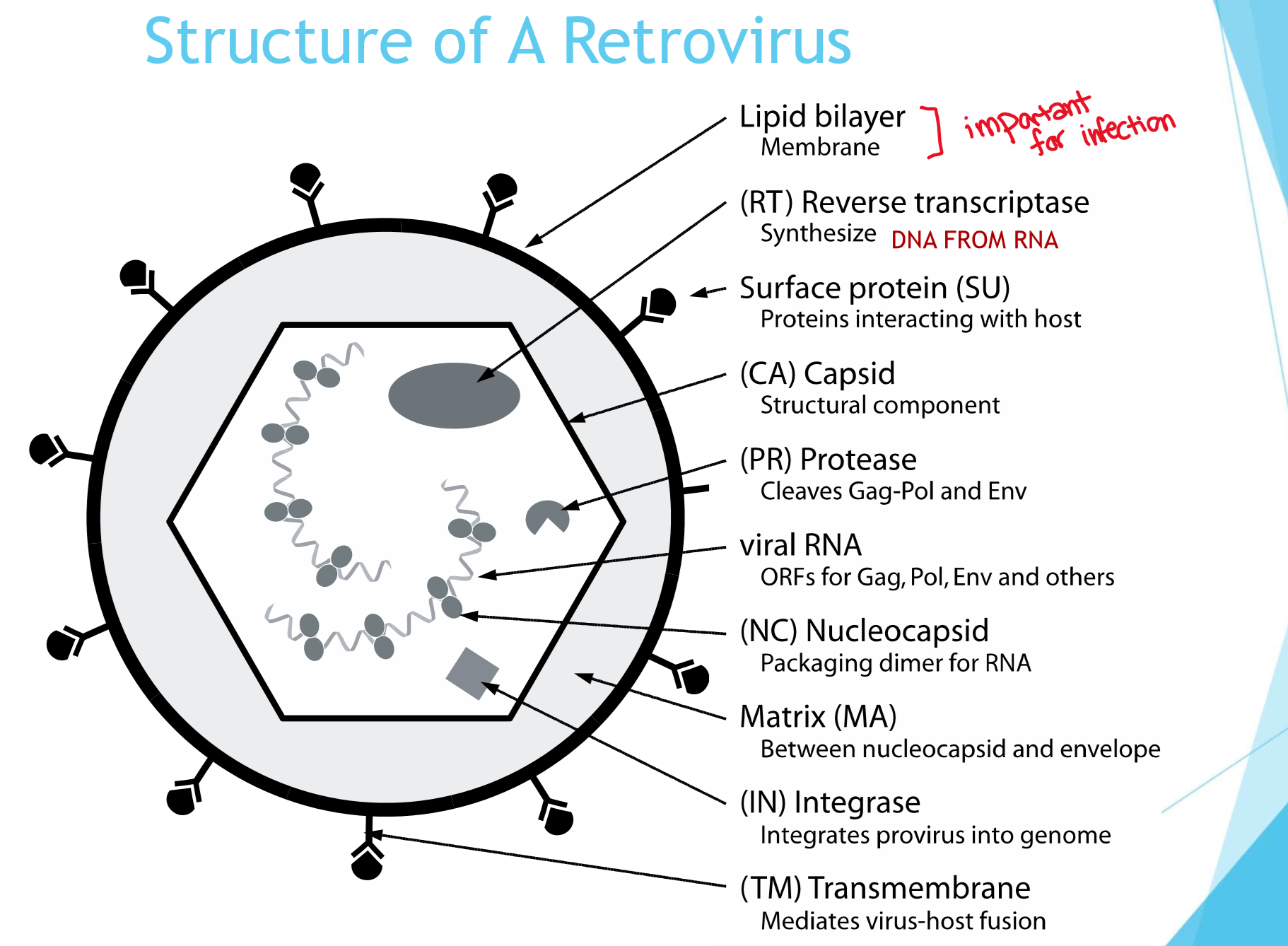
lipid bilayer
membrane (helps with fusion in our cells, important for infection)
(RT) reverse transcriptase
synthesizes dna from rna
surface proteins (SU)
proteins interacting with host
(CA) capsid
structural componenet
(PR) protease
cleaves Gag-Pol and Env
viral RNA
ORFs for gag, pol, env, and others
(NC) nucleocapsid
packaging dimer for rna
(MA) matrix
between nucleocapside and envelope
(IN) integrase
integrates provirus into genome
(TM) transmembrane
mediates virus host fusion
Structure of a retrovirus diagram
steps of retrovirual integration
1. virus attaches to membrane
2. rtase synthesizes first strand of dna
3. rtase degrades rna
4. rtase synthesizes second strand of dna
5. viral dna is integrated into host dna
6. viral dna is transcribed
7. viral rna is exported
8. viral rna is translated
9. viral rna and proteins are packed into new virus

Reverse transcription diagram


are retrotransposons able to escape from the cell?
no
how are retrotransposons related to retroviruses?
ability to transform RNA to DNA to integrate into host genome however is not infectious and does not move from organism to organism or cell to cell
why are LTR (long terminal repeats) retrotransposons noninfectious?
they lack gene cassette for membrane signaling proteins and viral envelope (env)
they lost env which is vital for infection

difference between
LTR (long terminal repeats) retreotransposons
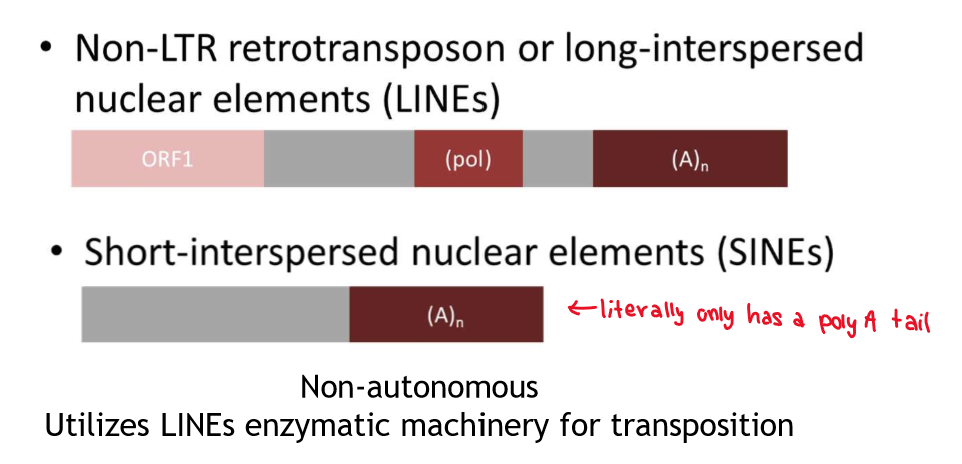
non-LTR / long-interspersed nuclear elements (LINEs)
different method of recombination than LTR as it does not encode for integrase or protease

difference between:
Non-LTR retreotransposon or long-interspertsed nuclear elements (LINEs)
short-interspersed nuclear elements (SINEs)
SINEs are non-autonomous and utilizes LINEs enzymatic machinery for transposition