Organic Chemistry
 Call Kai
 Learn
 Practice Test
 Spaced Repetition
 Match
 Flashcards
 Knowt Play
1/101

There's no tags or description
Looks like no tags are added yet.
102 Terms
Alkene
Hydrocarbon contain a C=C double bond
Alkyne
Hydrocarbon containing a C≡C triple bond
Electrophile
Electron-deficient species that accepts electrons.
Nucleophile
Electron-rich species that donates electrons.
Carbocation
Carbon with a positive charge.
Regiochemistry
Determines which atom or group attaches to which carbon.
Stereochemistry
Describes the 3D arrangement of atoms.
Markovnikov addition
Hydrogen adds to the carbon that already has more hydrogens; the other group adds to the more substituted carbon.
Anti-Markovnikov addition
The opposite regiochemical orientation.
Syn addition
Two groups add to the same face of a double bond.
Anti addition
Two groups add to opposite faces of a double bond.
Rearrangement
Atoms or groups shift to produce a more stable carbocation.
For a hydrohalogenation alkene reaction what is the reagent and product?
Reactant: HX
Product: Markovnikov addition
For an acid-catalyzed hydration alkene reaction what is the reagent and product?
Reactant: H₂O, H₂SO₄
Product: Markovnikov alcohol
For an oxymercuration-demercuration alkene reaction what is the reagent and product?
Reactant: 1. Hg(OAc)₂, H₂O 2. NaBH₄
Product: Markovnikov alcohol; avoids rearrangements
For a hydroboration-oxidation alkene reaction what is the reagent and product?
Reactant: 1. BH₃·THF 2. H₂O₂, OH⁻
Product: Anti-Markovnikov alcohol; syn addition
For a halogenation alkene reaction what is the reagent and product?
Reactant: Br₂ or Cl₂
Product: Vicinal dihalide; anti addition
For a halohydrin formation alkene reaction what is the reagent and product?
Reactant: Br₂/H₂O
Product: Halogen and OH added; OH goes to more substituted carbon
For a solvomercuration alkene reaction what is the reagent and product?
Reactant: Hg(OAc)₂ in alcohol, then NaBH₄
Product: Ether formation
For a dihydroxylation alkene reaction what is the reagent and product?
Reactant: OsO₄, workup
Product: Two OH groups; syn addition
For an ozonolysis alkene reaction what is the reagent and product?
Reactant: 1. O₃ 2. (CH₃)₂S
Product: Cleaves double bond into carbonyl compounds
For a cyclopropanation alkene reaction what is the reagent and product?
Reactant: CH₂I₂, Zn(Cu)
Product: Adds a CH₂ group to form cyclopropane
For a hydrogenation alkene reaction what is the reagent and product?
Reactant: H₂, Pd/C
Product: Converts alkene to alkane
Alcohol-producing reaction: Acid-catalyzed hydration
Markovnikov (rule)
Carbocation intermediate
Rearrangements possible
Stereochemistry not controlled
Alcohol-producing reaction: Oxymercuration-demercuration
Markovnikov
No significant carbocation rearrangements
Not stereospecific
Alcohol-producing reaction: Hydroboration-oxidation
Anti-Markovnikov
Syn addition
Avoids carbocation rearrangements
Bromination reaction
Br₂ adds across a double bond through a cyclic bromonium ion. The addition is anti
Halohydrin reaction
Br₂/H₂O produces a bromine and an OH group on adjacent carbons
Dihydroxylation reaction
Adds two OH groups to an alkene. OsO₄ produces syn addition
Ozonolysis reaction
Breaks the C=C bond and produces carbonyl compounds.
Alkyne halogenation reaction
One or two equivalents of halogen determine how many additions occur.
Alkyne hydrohalogenation reaction
Generally follows Markovnikov's rule; two equivalents can produce a geminal dihalide.
HBr with peroxides reaction
Produces anti-Markovnikov addition
Markovnikov vs. anti-Markovnikov
Markovnikov
More substituted carbon
H goes to the carbon with more H atoms.
Other group goes to the more substituted carbon.
Examples: HBr, acid hydration, oxymercuration.
Anti-Markovnikov
Less substituted carbon
H goes to the more substituted carbon.
Other group goes to the less substituted carbon.
Example: hydroboration-oxidation and HBr/ROOR.
Syn vs. anti addition
Syn addition | Anti addition |
|---|---|
Same face | Opposite faces |
Hydroboration | Bromination |
OsO₄ dihydroxylation | Br₂ addition |
Produces cis relationship in a ring | Produces trans relationship in a ring |
Alkyne reactions
Reagents | Result |
|---|---|
H₂, Pd/C | Complete hydrogenation to alkane |
H₂, Lindlar catalyst | Partial hydrogenation to cis alkene |
Na, liquid NH₃ | Partial hydrogenation to trans alkene |
1 equivalent HX | One addition |
2 equivalents HX | Two additions; commonly geminal dihalide |
1 equivalent Br₂ | Dihaloalkene |
2 equivalents Br₂ | Tetrahalide |
O₃ or KMnO₄ | Oxidative cleavage |
Proton NMR (¹H NMR)
¹H NMR provides three important pieces of information:
Chemical shift: Where the signal appears.
Integration: The relative number of hydrogens represented.
Multiplicity: How many lines appear in a signal
Chemical shift
Chemical shift is measured in parts per million (ppm).
Upfield = right side of spectrum = lower ppm = more shielded.
Downfield = left side of spectrum = higher ppm = more deshielded.
Common approximate ¹H chemical shift ranges:
Hydrogen environment | Approximate ppm |
|---|---|
Alkyl (R–CH₃, R–CH₂–) | 0.8–2.0 |
Near a pi bond / allylic | 1.5–2.5 |
Attached to C near O, N, or halogen | 3.0–4.5 |
Alkene (vinylic) | 4.5–6.5 |
Aromatic | 6.0–8.5 |
Aldehyde | 9–10 |
Carboxylic acid OH | 10–12 |
Important: Electronegative atoms pull electron density away, deshielding nearby hydrogens and moving their signals downfield.
Integration tells you the ratio of different types of hydrogens.
Integration | Meaning |
|---|---|
3H | Usually a CH₃ group |
2H | Usually a CH₂ group |
1H | Usually a CH group or one individual hydrogen |
6H | Could be two equivalent CH₃ groups |
9H | Could be three equivalent CH₃ groups |
Remember: Integration gives a ratio, not automatically the exact number of hydrogens.
Multiplicity: The N+1 rule
The N+1 rule tells you how many lines a signal splits into.
N = number of neighboring equivalent hydrogens.
Add 1 to get the number of lines.
Neighboring H (N) | Splitting | Number of lines |
|---|---|---|
0 | Singlet | 1 |
1 | Doublet | 2 |
2 | Triplet | 3 |
3 | Quartet | 4 |
4 | Quintet | 5 |
5 | Sextet | 6 |
6 | Septet | 7 |
Easy way to remember:
Singlet = 0 neighbors
Doublet = 1 neighbor
Triplet = 2 neighbors
Quartet = 3 neighbors
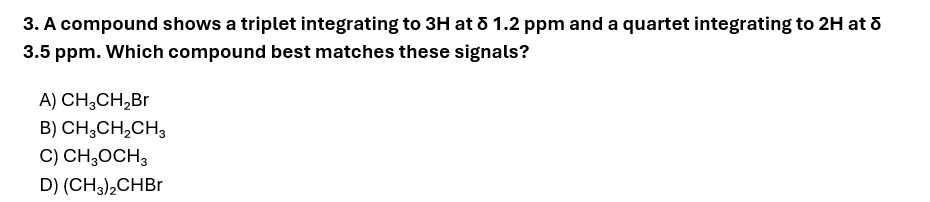
Example: CH₃–CH₂–Br
CH₃ has 2 neighboring hydrogens → triplet.
CH₂ has 3 neighboring hydrogens → quartet.
Mass spectrometry
Mass spectrometry identifies ions according to their mass-to-charge ratio.
m/z
Mass-to-charge ratio
Molecular ion (M⁺•)
Ion formed when a molecule loses an electron
Base peak
Tallest peak; assigned 100% relative abundance
Fragmentation
Breaking apart of a molecular ion into smaller ions
Relative abundance
How much of a particular ion is detected
M+1 peak
Peak one mass unit above the molecular ion, often due to ¹³C
M+2 peak
Peak two mass units above the molecular ion, often important for halogens
Important mass spectrometry patterns
Element | Isotope pattern |
|---|---|
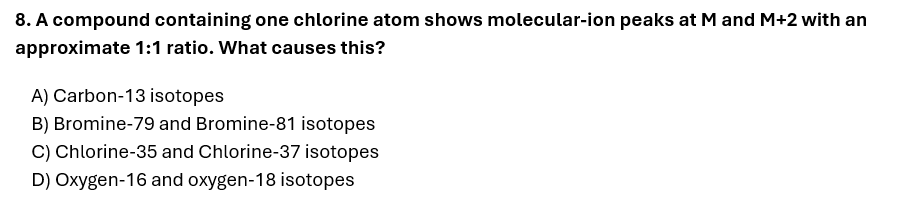
Chlorine | M : M+2 = approximately 3:1 |
Bromine | M : M+2 = approximately 1:1 |
Important fragments to memorize:
Fragment | m/z |
|---|---|
Methyl cation (CH₃⁺) | 15 |
Ethyl cation (C₂H₅⁺) | 29 |
Phenyl cation (C₆H₅⁺) | 77 |
Tropylium ion (C₇H₇⁺) | 91 |
Water loss | 18 mass units below M |
Common fragmentation patterns:
Alkylbenzenes frequently form the tropylium ion.
Alcohols can lose water.
Carbonyl compounds can form resonance-stabilized acylium ions.
Allylic cleavage can produce resonance-stabilized allyl cations.
What is the major organic product of CH₃–CH=CH₂ + HBr → ?
B. 2-Bromopropane
Which reagent combination converts 1-butene into 1-butanol as the major product?
C. BH₃·THF; then H₂O₂, OH⁻
Predict the major product: CH₃–C(CH₃)=CH₂ + H₂O / H₂SO₄ → ?
B. 2-Methylpropan-2-ol
Which reagent combination converts 2-methylpropene to 2-methylpropan-2-ol while avoiding carbocation rearrangements?
C. Hg(OAc)₂, H₂O; then NaBH₄
What is the major product of CH₃–CH=CH–CH₃ + Br₂ → ?
B. 2,3-Dibromobutane
The addition of Br₂ to an alkene generally proceeds through which intermediate?
C. A cyclic bromonium ion
What is the major product of CH₃–CH=CH₂ + Br₂ / H₂O → ?
B. CH₃–CH(OH)–CH₂Br
Which statement correctly describes hydroboration–oxidation of an alkene?
B. Anti-Markovnikov addition with syn stereochemistry
Which reagent converts cyclohexene into cis-1,2-cyclohexanediol?
C. OsO₄, followed by appropriate workup
What is the major product of CH₃–CH=CH–CH₃ + O₃; then (CH₃)₂S → ?
A. Two molecules of ethanal
Which reagent is commonly used to convert an alkene into a cyclopropane without introducing a halogen substituent?
A. CH₂I₂, Zn(Cu)
What is the major product when 1-butene reacts with HBr in the presence of peroxides (ROOR)?
B. 1-Bromobutane
Which reagent combination converts 2-butyne predominantly into trans-2-butene?
C. Na, liquid NH₃
What is the major product of CH₃–C≡CH + 2 HBr → ?
B. 2,2-Dibromopropane
Which statement about addition of Br₂ to trans-2-butene is correct?
B. Meso-2,3-dibromobutane by anti addition
What is the major product of CH₃–CH=CH₂ + 1. Hg(OAc)₂, CH₃OH; 2. NaBH₄ → ?
A. CH₃–CH(OCH₃)–CH₃
Which reaction converts 2-methyl-2-butene into 2-methylbutan-2-ol as the major product?
B. H₂O, dilute H₂SO₄
What is the major product of (CH₃)₂C=CH₂ + 1. O₃; 2. (CH₃)₂S → ?
A. Acetone and formaldehyde
Which reaction is most likely to involve carbocation rearrangement?
C. Acid-catalyzed hydration
Which reagents can convert 1-butene into butane?
A. H₂, Pd/C
How many distinct proton NMR signals are expected for CH₃–CHBr–CH₃?
B. 2
What is the expected splitting pattern for the CH₃ protons in CH₃–CH₂–Br?
C. Triplet
A compound shows a triplet (3H) near 1.2 ppm and a quartet (2H) near 3.5 ppm. Which structure best fits?
A. CH₃–CH₂–Br
Which proton generally appears most downfield in a ¹H NMR spectrum?
C. CH₃–CHO (aldehydic H)
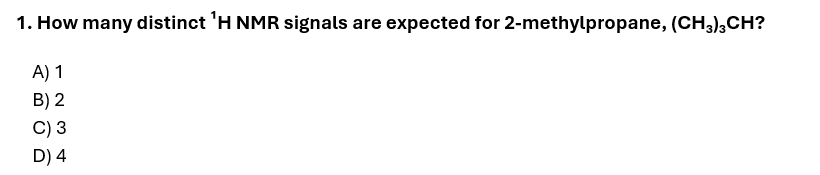
How many distinct ¹H NMR signals are expected for (CH₃)₃CH?
B. 2
Which compound is expected to show a singlet integrating to 9H?
B. (CH₃)₃C–Br
How many distinct carbon signals are expected in a broadband proton-decoupled ¹³C NMR spectrum of CH₃–CO–CH₂–CH₃?
C. 4
In a mass spectrum of a compound containing one bromine atom, what approximate intensity ratio is expected for M and M+2?
A. 1:1
Which fragment ion is commonly observed at m/z = 91 in mass spectra of alkylbenzenes such as toluene?
B. Tropylium ion
A compound C₃H₈O shows δ 1.1 ppm (doublet, 6H), δ 3.9 ppm (septet, 1H), and a broad OH signal. Which structure fits?
B. CH₃–CH(OH)–CH₃
Carbon NMR (¹³C NMR)
Carbon NMR identifies different carbon environments.
Important differences from proton NMR:
Each chemically distinct carbon generally gives one signal.
Broadband proton-decoupled ¹³C spectra do not show ordinary C-H splitting.
Integrals are not normally used.
DEPT helps identify the number of hydrogens attached to carbons.
Common approximate carbon chemical shift ranges:
Carbon environment | Approximate ppm |
|---|---|
Alkyl | 0–50 |
Attached to O, N, or halogen | 40–90 |
Alkyne | 65–90 |
Alkene / aromatic | 100–160 |
Ester, acid, amide carbonyl | 160–185 |
Aldehyde / ketone carbonyl | 190–220 |

B

A

B

A

A

A

B

C

B

B
A

C
A

C

C

B

B
B