Genetics & Cancer Anatomy
 Call Kai
 Learn
 Practice Test
 Spaced Repetition
 Match
 Flashcards
 Knowt Play
1/12

There's no tags or description
Looks like no tags are added yet.
13 Terms

Embryo
Telencephalon (1a), Diencephalon (1b), Mesencephalon (1c)
Nasal primordium (2) Optic primordium (3)
Atrial primordium (6a), Ventricle primodium (6b)
Liver primodium (7) Arm bud (8) Leg bud (9) Somites (vertebral primordium,10)
Chromosome
Sister chromatids
Centromere
Kinetochore
DNA (cutaway)
Meiosis
Homologous chromosomes
Ovum
Spermatid
Spermatozoa
Spermiogenesis
Spermatogonium
Zygote (diploid)
Oogonium
Primary spermatocyte/oocyte
Polar body
Secondary spermatocyte/oocyte
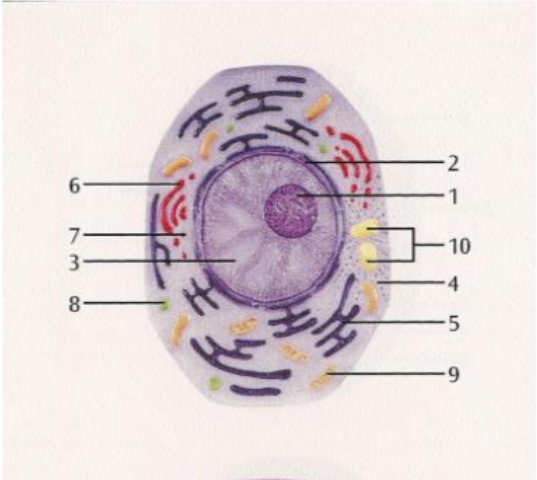
Model 1: Interphase (G1 phase)
1. Nucleolus
2. Nuclear membrane
3. DNA
4. Microtubules
5. Endoplasmic reticulum
6. Golgi apparatus
7. Vesicle
8. Lysosome
9. Mitochondrion
10. Centrioles

Model 2: Prophase I (beginning); Meiosis I
1. Nucleolus
2. Nuclear membrane
3. Chromosome
4. Centrioles (paired)
5. Central spindle apparatus

Model 3: Prophase I (middle)
1. Maternal homologue (sister chromatid)
2. Paternal homologue (sister chromatid)
3. Homologous Chomosomes in synapsis (tetrad)

Model 4: Prophase I (late)
1. Homologous chromosomes
2. Chiasmata (genetic exchange, crossover)

Model 5: Prophase I (end)
1. Nuclear membrane (note chromosomes have detached)
2. Centromere
3. Chiasmata

Model 6: Metaphase I
1. Centrioles
2. Nuclear membrane (dissolving)
3. Kinetochores at centromeres
4. Microtubules
5. Homologous chromosomes; random assortment
6. Chiasmata (still intact)
7. Endoplasmic reticulum (dissolving)
8. Golgi apparatus (dissolving)

Model 7: Anaphase I (haploid phase)
1. Homologous Chromosomes separating
2. Kinetochore
3. Kinetochore microtubule
4. Centrioles
5. Polar microtubule
6. Cleavage furrow
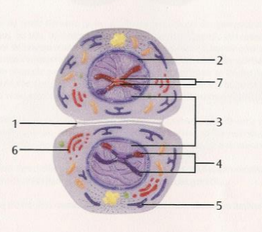
Model 8: Telophase I
1. Actin microfilaments creating constriction
2. Thin nuclear membrane
3. Daughter nuclei
4. Chromosome consisting of 2 sister chromatids
5. Endoplasmic reticulum
6. Golgi apparatus
7. Centromeres
End of Meiosis I
Interkinesis (no S phase)
Meiosis II: just like mitosis; Prophase II, Metaphase II
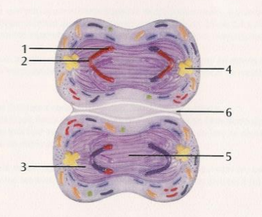
Model 9: Anaphase II
1. Sister chromatids separating
2. Kinetochore
3. Kinetochore microtubule
4. Centriole
5. Polar microtubule
6. Cleavage furrow

Model 10: Telophase II and Cytokinesis II
1. Four haploid cells; genetically unique because of crossing over (Prophase I) and random assortment (Metaphase I)
End of Meiosis II