Tryptophan Operon
 Call Kai
 Learn
 Practice Test
 Spaced Repetition
 Match
 Flashcards
 Knowt Play
1/18

There's no tags or description
Looks like no tags are added yet.
19 Terms

What are the two types of termination in bacteria
WHAT
WHAT
What are the two types of termination in bacteria
Factor-independent termination
Rho-dependent or factor-dependent termination
Factor-independent termination is caused by a WHAT stretch of DNA followed by WHAT
Factor-independent termination is caused by a GC-rich stretch of DNA followed by 7-8 A’s

Factor-independent termination
The GC-rich section forms a WHAT
The transcribed section of Us causes RNA Pol to WHAT and WHAT
RNA Pol encounters the WHAT and WHAT
Factor-independent termination
The GC-rich section forms a STEM-LOOP
The transcribed section of Us causes RNA Pol to PAUSE and BACKTRACK
RNA Pol encounters the STEM-LOOP and RELEASES

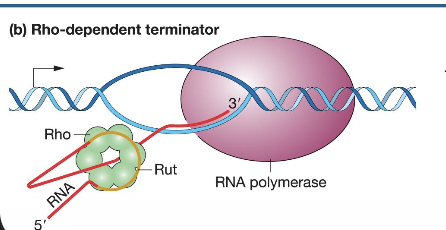
Rho-dependent termination
Relies on proteins called WHAT
Rho factors recognize WHAT termination sites
Triggers WHAT release of RNA Pol
Rho-dependent termination
Relies on proteins called Rho FACTORS
Rho factors recognize C-rich termination sites
Triggers Rho-mediated release of RNA Pol
The tryptophan operon
Regulation should switch ON operon when tryptophan is WHAT and fine-tune expression depending in how much WHAT is needed
The tryptophan operon
Regulation should switch ON operon when tryptophan is INSUFFICIENT and fine-tune expression depending in how much TRYPTOPHAN is needed

The tryptophan operon undergoes both WHAT and WHAT
The tryptophan operon undergoes both NEGATIVE REGULATION and ATTENUATION
The tryptophan operon
Negative regulation switches the operon on when WHAT is WHAT
Attenuation fine-tunes expression depending on WHAT
The tryptophan operon
Negative regulation switches the operon on when TRYPTOPHAN is INSUFFICIENT
Attenuation fine-tunes expression depending on AVAILABLE TRYPTOPHAN
Negative regulation of the tryptophan operon
A regulatory gene WHAT encodes a WHAT
When the tryptophan is WHAT, the repressor is unable to bind to th operator, and the operon is switched WHAT
Negative regulation of the tryptophan operon
A regulatory gene trpR encodes a REPRESSOR
When the tryptophan is INSUFFICIENT, the repressor is unable to bind to the operator, and the operon is switched ON

Negative regulation of the tryptophan operon
When tryptophan is abundant, it acts as the WHAT of the repressor
The binding of tryptophan to the repressor enables it to bind to the operator, blocking RNA Pol and thus preventing WHAT - the operon is switched WHAT
Negative regulation of the tryptophan operon
When tryptophan is abundant, it acts as the ALLOSTERIC EFFECTOR of the repressor
The binding of tryptophan to the repressor enables it to bind to the operator, blocking RNA Pol and thus preventing EXPRESSION - the operon is switched OFF

Attenuation is another method of WHAT of expression
Attenuation is another method of NEGATIVE REGULATION of expression
Expression of the trp operon is ‘attenuated’ (decreased) when tryptophan is WHAT
Expression of the trp operon is ‘attenuated’ (decreased) when tryptophan is ABUNDANT
Attenuation acts after WHAT initiation and relies on WHAT attachment to nascent transcripts - a process mapped to the WHAT of the operon
Attenuation acts after TRANSCRIPTION initiation and relies on RIBOSOME attachment to nascent transcripts - a process mapped to the LEADER SEQUENCE of the operon


This section (trpL) encodes a short (14bp) WHAT
This section (trpL) encodes a short (14bp) LEADER PEPTIDE

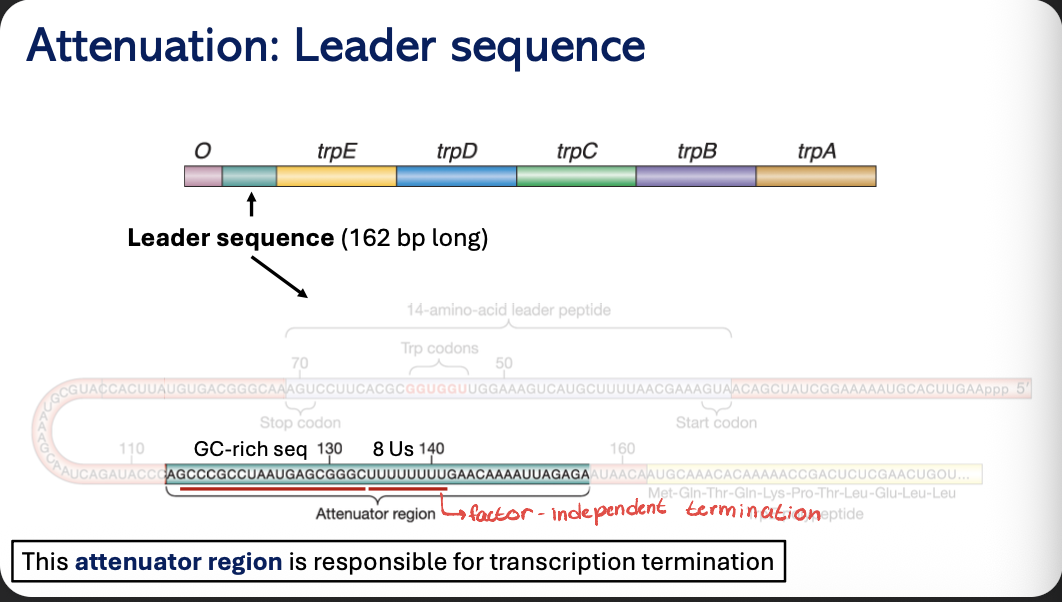
The attenuator region is responsible for WHAT
The attenuator region is responsible for TRANSCRIPTION TERMINATION

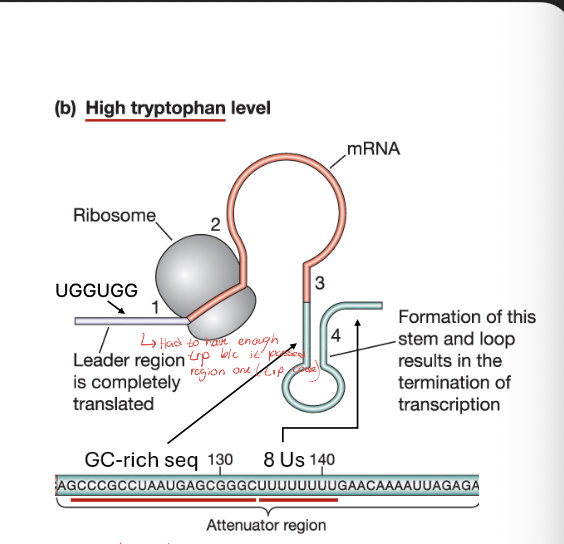
The mRNA leader sequence forms two possible WHAT structures (4 important stem regions)
At any given time, the sequence will form one of two conformations: WHAT pairing or WHAT pairing (happier here)
The mRNA leader sequence forms two possible STEM-LOOP structures (4 important stem regions)
At any given time, the sequence will form one of two conformations: 3-4 pairing or 2-3 pairing (happier here)
When there is abundant tryptophan
The leader peptide is completely WHAT (2 Ws are available)
Ribosomes able pass from region WHAT to region WHAT
This causes region WHAT and WHAT to pair, allowing the WHAT in region 4
RNA-Polymerase at region 4 undergoes WHAT termination
WHAT expression of operon
This only occurs when the operon is WHAT
When there is abundant tryptophan
The leader peptide is completely TRANSLATED (2 Ws are available)
Ribosomes able pass from region 1 to region 2
This causes region 3 and 4 to pair, allowing the STEM-LOOP in region 4
RNA-Polymerase at region 4 undergoes FACTOR-DEPENDENT termination
LOW expression of operon
This only occurs when the operon is ON
When there is low tryptophan
Ribosomes WHAT at the leader peptide - not enough Ws to translate
Regions WHAT and WHAT pair, which leaves region 4 WHAT
Stem-loop at region 4 is not WHAT
No WHAT termination
WHAT expression of operon
When there is low tryptophan
Ribosomes STALL at the leader peptide - not enough Ws to translate
Regions 2 and 3 pair, which leaves region 4 UNPAIRED
Stem-loop at region 4 is not FORMED
No TRANSCRIPTION termination
HIGH expression of operon

