Patient Classification
 Call Kai
 Learn
 Practice Test
 Spaced Repetition
 Match
 Flashcards
 Knowt Play
1/85

There's no tags or description
Looks like no tags are added yet.
86 Terms
Patient Classification
The conversion of patient difficulty into a classification system
What is the two-tier classification system?
DHI (calculus classification -A,B,C, or D)
and
Periodontal Classification (based on attachment loss and bone loss - S/G = staging and grading)
DHI stands for
Dental Hygiene Index
Dental Hygiene Index (DHI) represents
Calculus Classification
P stands for
Periodontal
Periodontal (P)
Periodontal Classification
S stands for
Staging
Staging options (S)
- Healthy
- Gingivitis
- Stage (I - IV)
G
Grading
Grading option (G)
A, B, C
DHI options
A, B, C, D
Calculus Assessment/DHI procedure (2)
-Explore the dentition with ODU 11/12 explorer
-Determine the amount, location, severity, and extent of calculus by exploring the M, D, F, & L surfaces (4 surfaces).
ODU 11/12 use
calculus detection
What is the appearance of SUPRAGINGIVAL dehydrated calculus?
white and chalky
You can see it best by blasting air on it
Where are calculus deposits located in supragingival calculus?
in the gingival margin
Instruments for the Detection of Subgingival Calculus (3)
Mirror
Explorer
Dental Light
What skill is required for the detection of subgingival calculus?
Tactile Sensitivity
Calculus Classification (Supragingival - C1)
Light = 1
Moderate = 2
Heavy = 3
Very Dense = 4
ABCD
A = light (0-3 DHI pts)
B = moderate (4-5)
C = Heavy (6-8)
D = Very Dense (9+)
The number assigned for calculus classification is known as
Deposit Points
Light Supragingival Calculus location
mandibular anteriors due to proximity to wharton's/bartholins duct
(if you have plaque on your teeth the saliva from the duct puts Ca++ and P into the plaque and soon the organic portion calcifies)
What is the requirement for moderate supragingival calculus deposit points?
both anterior AND posterior supragingival calculus
(mandibular anteriors and buccal of maxillary molars)
Moderate Supragingival Calculus (Location)
mandibular anteriors due to wharton's/bartholin's duct and buccal of maxillary molars due to proximity of Stenson's duct.
(requires both anterior and posterior teeth)
What is the requirement for moderate subgingival calculus deposit points?
requires interproximal posterior calculus on at least two posterior teeth in every quadrant
(instructor/student negotiation required for score of 4 or 6 on subgingival calculus)
Light Subgingival Calculus (Location) (2)
- At gingival Margin + slightly subgingivally
- Slight Interproximal roughness located in the concavities
(**Difficult to find, requires a great deal of tactile sensitivity)

The light subgingival calculus is...
difficult to find and requires a great deal of tactile sensitivity
The light subgingival calculus is described as feeling like...
sandpaper (ie. grainy)
c1 refers to
supragingival
c2 refers to
subgingival
Plaque is primarily found in...
1. Gingival Margin
2. Interproximal Spaces
Grade A
Severity Points = 0 to 3
Type of Appointment = Prophy
Number of Appointments = 1
Requirements of Moderate Subgingival Calculus
interproximal posterior calculus on at least two teeth in every quadrant
(Minimum of 8 deposits)
Moderate Subgingival Calculus (Location)
The mesial of first molars and distal of last tooth in the arch
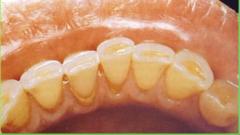
Grade B
Ant and post calculus
minimum of 8 deposits
Severity Points = 4 to 5
Type of Appointment = Prophy
Number of Appointments = 1
Requirements of Heavy Supragingival Calculus
sheet or layer of supragingival calculus covering multiple surfaces
The appearance of (dehydrated) heavy supragingival calculus is described as...
dull and smooth
It becomes yellow when you dry it
Heavy Supragingival Calculus (Location)
mandibular anteriors due to wharton's duct and buccal of maxillary molars due to stenson's duct
(same location as moderate)
Requirements for Heavy Subgingival Calculus
interproximal calculus on at least 12 surfaces in a half mouth (minimum of 24 deposits)
Heavy Subgingival Calculus (Location)
The buccal and/or lingual surfaces with definite spicules (speed bumps) in interproximal spaces
(doesn't require as much tactile sensitivity)
Heavy subgingival calculus and tactile sensitivity relationship
does NOT require as much tactile sensitivity as there are definite spicules and no guessing involved

Grade C
Severity Points = 6 to 8
Type of Appointment = Periodontal Debridement (w/ anesthesia)
Number of Appointments = 2 - Half mouth w/ anesthesia (quad 1+4 or quad 2+3)
Number of Reappointments = 1 (for reevaluation)
What is the difference between D4342 and D4341?
D4342 = 1-3 teeth have 4mm+ pockets per quad
D4341 = 4 or more teeth have 4mm+ pockets per quad
D4341
4 or more teeth have 4+ mm pocket depths per quadrant.
D4342
1 - 3 teeth have 4+ mm pocket depths per quadrant.
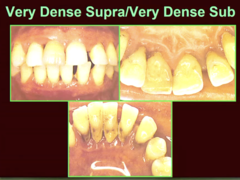
Requirements for Very Dense Supragingival Calculus
ledges that weld the teeth together forming a bridge that prevents flossing.
Very Dense Supragingival Calculus (Location)
mandibular anteriors due to wharton's duct and buccal of maxillary molars due to stenson's duct.
(same as modeate and heavy)
Requirements for Very Dense Subgingival Calculus
Generalized interproximal ledges/rings of calculus on at least 12 surfaces per quadrant (48 deposits minimum)
Wall to wall calculus
Very Dense Subgingival Calculus (Location)
heavy, long-standing definite rings/deposits that encircle the tooth and are very difficult to remove
ADA Code for Grade "D"
4341 & 4342
4342 & 4341 (Grade "D")
Severity Points = 9+
Type of Appointment = Periodontal Debridement
Number of Appointments = 4 - Quadrant (w/ anaesthesia)
Number of Reappointments = 1 (1 month)
Conversion of Deposit Points to DHI
The total score for supragingival and subgingival calculus to determine the overall DHI
A (Light)
0 - 3
B (Moderate)
4 - 5
C (Heavy)
6 - 8
D (Very Dense)
9+
Periodontal Classification (3)
Healthy/Gingivitis (Type I)
Stage I-IV
Grading A-C
What is periodontal classification based on?
attachment loss and bone loss
(probe depth and recession, review radiographs to determine bone loss)
Type I
Gingivitis
Type I (Gingivitis)
A. NO bone loss
B. NO attachment loss
C. Changes in Color
D. Changes in consistency
E. Changes in texture
F. Changes in contour
G. The presence of bleeding and/or exudate.
How do you view bone loss?
Review radiographs
What are the two primary risk factors for the development of periodontal disease? (2)
Smoking
Diabetes
What is the critical amount of bone loss?
> 15% and 33% <
P
Periodontal Classification
(based on attachment loss and bone loss)
How do you determine periodontal classification? (3)
Review the patient's medical history.
Review the patient's attachment loss.
Review the patient's radiographs.
Why do you review the patient's medical history?
To determine if the patient is a smoker or has diabetes
How do you determine the patient's attachment loss?
Probe Depth + Recession
Why do you review the patient's radiographs?
To determine the amount of bone loss.
CAL
Clinical Attachment Loss (AKA Total Attachment Loss)
RBL
Radiographic Bone Loss
What is the purpose of the RBL?
To determine the percentage of bone loss.
Stage I-IV
Identify the SEVERITY of disease at presentation and COMPLEXITY of disease management.
Stage I
-Initial Periodontitis
-less than 15% bone loss
Stage II
Moderate Periodontitis
15 - 33% bone loss
Stage III
Severe Periodontitis w/ potential for additional tooth loss (greater than 6mm).
greater than 33% bone loss
Stage IV
Severe Periodontitis w/ potential for loss of dentition
greater than 33% RBL
Grading (G) - what you are looking for
Identify the rate of disease progression, relation of plaque to destruction, and risk factors (modifiers).
Based on smoker (# of cigs) and A1c classification
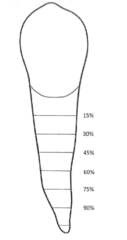
radiographic bone loss diagram
2 mm from CEJ is normal
What is easier to deal with: horizontal bone loss of vertical bone loss?
horizontal
(vertical bone loss means greater pocker depths; first you get horizontal bone loss and then it can progress into vertical)
Staging - Stage I list
SEVERITY:
CAL: 1-2mm
RBL: less than 15%
Tooth loss: None
COMPLEXITY:
Probe depth: greater than or = 4
bone level: horizontal
NO furcation involvement
Staging - Stage II
SEVERITY:
CAL: 3-4mm
RBL: 15-33%
Tooth loss: None
COMPLEXITY:
Probe depth: greater than or = 5
bone level: horizontal
NO furcation involvement
Staging - Stage III
SEVERITY:
CAL: greater than or equal to 5mm
RBL: greater than 33% of root
Tooth loss: less than or = to 4 teeth
COMPLEXITY:
Probe depth: greater than or = 6
bone level: vertical
furcation involvement can be II or III
ridge defects
Staging - Stage IV
SEVERTIY:
CAL: greater than or = 5mm
RBL: greater than 33% of root
Tooth loss: greater than or = 5 teeth
COMPLEXITY:
masticacy disfuncation, 20 or less teeth remain, bite colapse