Topic 7 - Approaches to Finding Phenotypes
 Call Kai
 Learn
 Practice Test
 Spaced Repetition
 Match
 Flashcards
 Knowt Play
1/27

There's no tags or description
Looks like no tags are added yet.
28 Terms
Site-Directed Mutagenesis
Method of making a specific change to a DNA sequence, done through either:
-Assigning a function to a gene without a known function (ie, gene recovered in a homology based cloning approach)
-Investigation of structure/function relationships for genes with a known function
-Engineering of proteins with altered properties
-Generating additional mutant alleles for a characterized gene
Requirements of Site-Directed Mutagenesis
Requires: Detailed knowledge of gene sequence
-Various methods, ex; QuikChange
Site-Directed Mutagenesis Example
Already have a clone containing a GOI, want to mutate a G/C bp to a T/A bp to link gene to phenotype
-DNA is methylated since it came from a living organism
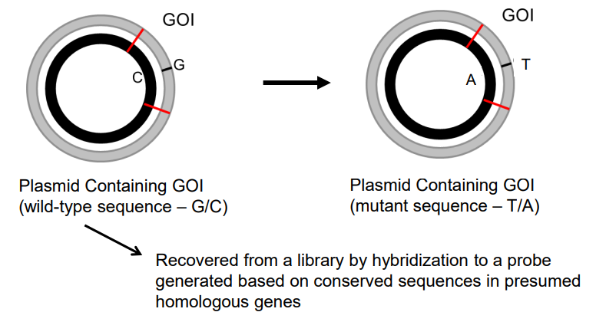
Site-Directed Mutagenesis - Primer Design
Design pair of “mutagenic primers” whose sequence is complementary to the target of interest except where you would like to introduce your mutation
-Requires TWO mutagenic primers, one complementary (except for the mutation) to each of the two parental strands
The mutation you wish to generate should be in the middle of the mutagenic primer
Site-Directed Mutagenesis - Denaturation
Denature the template containing the goi to mutate
Site-Directed Mutagenesis - Annealing of Primers
Anneal the mutagenic primers

Site-Directed Mutagenesis - Extension
Using pfuUltra Polymerase
-High fidelity, processive (fast), and does not displace 5’ ends
Site-Directed Mutagenesis - Products after Extension
After 16 cycles of extension, there will be 3 types of DNA product:
1. Parental Homoduplexes (consist of WT sequence), fully-methylated
2. Heteroduplexes (one parental, one mutant strand), hemi-methylated
3. Mutant Homoduplexes (both strands are mutants). Non-methylated
Site-Directed Mutagenesis - Digestion
Digest the extension products with DpnI
-DpnI digests Methylated and Hemi-Methylated DNA only
Site-Directed Mutagenesis - Transformation
Transform plasmid into E.coli
-Plasmid recovered via miniprep from E.coli, presence of mutation can be confirmed by sequencing
-Transform mutant plasmid into organism of choice and assay for a mutant phenotype

RNAi
RNA Interference, method used to knock-down expression of a GOI
-Useful in identifying the phenotype of a gene
RNAi is an endogenous cellular process, part of the antiviral response
Discovery of RNAi
Discovered by Andy Fir and Craig Mello when attempting to express the sense strand of RNA in C. elegans
-Samples were contaminated with antisense RNA and thus dsRNA formed → introduction of dsRNA initiates the RNAi pathway results in no observed expression
-RNAi pathway is universal among eukaryotes
Components of the RNAi System
Dicer - Nuclease Activity
RISC Complex - RNA helicase activity
Process of RNAi
RNAi pathway initiated by either dsDNA or shRNA (short hairpin RNA)
-Processed into double-stranded siRNA (short-interfering RNA) by DIcer activity
-siRNA is a template for RISC Complex —> unwinds the ds siRNA, releasing the ss siRNA with a sequence complementary to a target mRNA
-Forms a dsRNA with target mRNA, which is then degraded by cell machinery
Production of Vector for RNAi
Clone sequences of GOI into a MCS flanked by opposing promoters
-Transcription proceeds from both promoters, generating a “sense” and “antisense” RNA, complementarity results in dsRNA
Opposing Promoters and Stutter Fragments
Cloning site flanked by opposing U6 and H1 promoters
-Stutter Fragments - Sequence between the two promoters

Digestion of Stutter Fragment
Digest vector using Bbsi, releases the “stutter fragment” between the two promoters
-Generates sticky ends for ligation and cloning of GOI sequence
Ligation of GOI Sequence
Bbsi restriction fragment containing goi sequences can be ligated into BbsI site of cleaved vector
-Cloned goi insert is expressed from the double promoters, generating desired dsRNA

Introduction of dsRNA into Organisms
Varies based on the type of host:
-For C. elegans: Soaking, Feeding, Microinjection, Transgene
-We can use other transformation methods to introduce the vector into mammalian cells
Northern Blot
Allows us to measure gene expression at the RNA level
-Hybridization signals can be optically scanned
Ex; DDR1 signal can be represented as a proportion relative to the control (Actin)
Matsuyama et Al
Matsuyama et al. 2006 role of Discoidin domain receptor 1 (DDR1) in inflammation
Mouse cells transfected with:
1. Nothing – untreated cells
2. Empty vector (double promoter + stuffer fragment present)
3. Vector with DDR 1 siRNA seq 1
4. Vector with DDR 1 siRNA seq 2
5. Vector with unrelated sequence
Using Multiple siRNA Sequences
Some siRNAs are more effective than others
-Different sequence used from DDR to generate dsRNA (thus two sequences used)
Results of Matsuyama et al
DDR1 siRNAs 1 and 2 appear similarly effective at knocking down DDR1 expression at the RNA level

Controls in siRNA Experiments
1. Untreated cells - Baseline to compare our experimental condition to
2. Empty Vector - Ensures the vector backbone does not influence the target gene
3. Vector w/ Unrelated or Scrambled Sequence - Ensure simple stimulation of RNAi pathway does not influence target gene)
4. Mock Transfection - Ensures transfection reagents do not influence expression
RT-PCR (Reverse Transcription-PCR)
Extract total RNA and amplify specific RNA sequence via gene-specific primer (not polyT primer)
Reverse transcribe to generate first-strand cDNA of our RNA of interest
Taq DNA polymerase extends, use second-gene specific primer for second strand
Amount of cDNA should be proportional to amount of mRNA
RT-PCR products subject to electrophoresis
Wen et Al Experiment
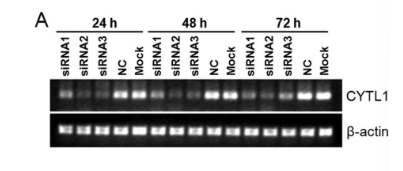
-Investigating role of Cytokine-like 1 (CYTL1) gene in cellular growth
Generated 3 different siRNA constructs
-CYTL1 expression determined by RT-PCR at 24, 48 and 72 hours after transfection with siRNA constructs
-Appears that siRNA2 and 3 are more effective at knocking down expression at the RNA level than siRNA1
Protein Difference in Wen et Al
Reduced expression by siRNA2/3 is not shown in their Western Blot
-Shows that you cannot state that a knockdown in RNA expression = protein level reduction

Off-Target Effects - Jackson et Al
Investigated off-target effects of a PIK3CB siRNA in HeLa cells
-Knockdown investigated by Western Blot (shown here) and RT-PCR not shown
Pik3CB gene sequence has a lot of similarity with FADD and YY1’s genes
First lane = untransfected HeLA cells
-Lanes 2-8 = increasing concentration of transfected siRNA, represented by the wedge
-FADD and YY1 protein expression is knocked down by the PIK3CB siRNA
