Lecture 6: Nitrigen Fixation:
 Call Kai
 Learn
 Practice Test
 Spaced Repetition
 Match
 Flashcards
 Knowt Play
1/44

There's no tags or description
Looks like no tags are added yet.
45 Terms
Nitrogen in the Atmosphere:
Nitrogen is abundant in the atmosphere as inorganic molecular oxygen (N2), makes up 78% of our atmosphere
The form of N2 cannot be incorporated in organic molecules
What is Nitrogen Fixation:
Conversion of N2 into bioavailable forms of nitrogens, including NH4+ (ammonium), NO2- (nitrite), NO3- (nitrate), N2O (nitrous oxide), NO (nitric oxide)
nitrogen fixation is just one of the various processes involved in the global nitrogen cycle
What is the Nitrogen cycle?
the continuous movement and transformation of nitrogen in various chemical forms through the air, water, soil, and living organisms
What are the Steps of the Nitrogen Cycle:
N2 fixation, Ammonification, Assimilation, Nitrification and Dentrification
The Steps of Nitrogen Cycle:
N2 Fixation: conversion of N2 into bioavailable products such as NH4+ or NOx by lightning, humans or bacteria
Ammonification: production of NH4+ through breakdown of organic nitrogen compounds from decaying plant and animal matter by bacteria and fungi
Assimilation: Absorption of NO3- or NH4+ from the soil by plants
Nitrification: conversion of NH4+ to NO3- primarily by soil-living bacteria and other nitrifying bacteria
Denitrification: reduction of NO3- to N2 by denitrifying bacteria
How can Nitrogen FIxation Occur?
Natural Process:
biological (= diazotrophy); by bacteria, producing NH4+
physical; by lightning, producing NOx; this has a relatively small contribution to the worldwide nitrogen cycle
Artificial Process:
by humans, by burning fossil fuels or by industrial (fertilizer) production
Biological Nitrogen Fixation (diazotrophs)
only organism capable of natural nitrogen fixation
are symbiotic organisms that form nodules on the roots of leguminous plants
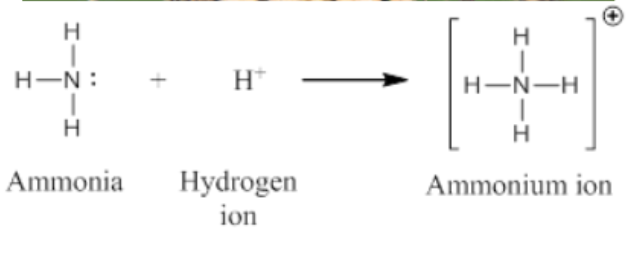
The CA form of NH3, ammonium ion (NH4+), is the form of nitrogen that is used in the first stages of the synthesis of organic compound
Nitrogen-Fixation Reaction and it’s Enzyme:
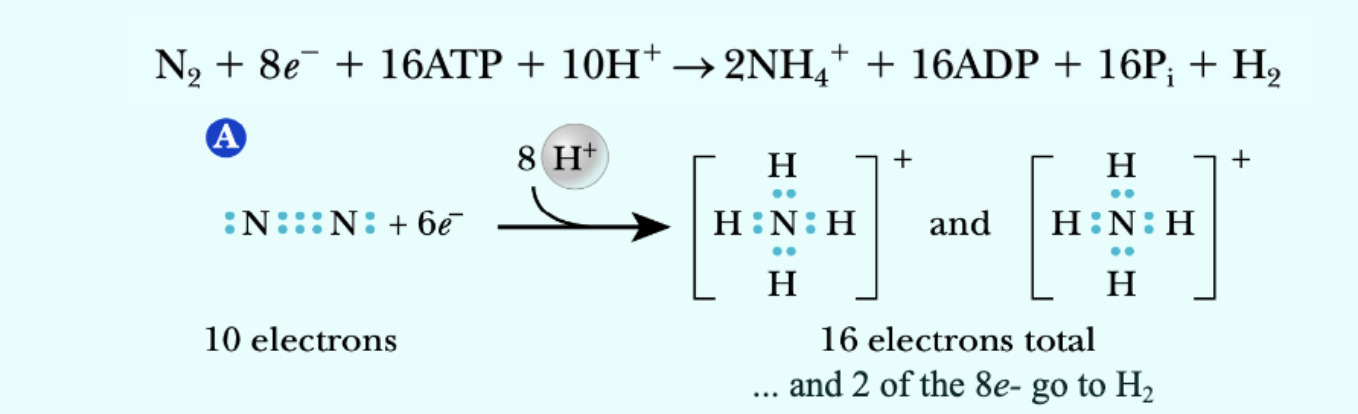
reduction reaction catalysed by nitrogenase enzyme complex
N2 + 8e- + 16ATP + 10H+ → 2NH4+ + 16 ADP + 16Pi + H2
What is the central role of Glutamate and Glutamine?
play a central role in amino acid synthesis
Glutamate is produced from alpha-ketoglutarate
Glutamine is formed from glutamate:

Reaction of Glutamate from Alpha-Ketoglutarate ad it’s Enzyme:
Catalysed by glutamate dehydrogenase and the reaction is a reductive amination
NADPH + H+ consumed, and H2O is made, NH4+ must be put in and N becomes organic
This reversible reaction establishes the stereochemistry of the α-
carbon atom, by only producing L-Glu

Reductive Amination Reaction
electrons are gained from oxidating NADPH and an electron group is being transferred
The production of Glutamine from Glutamate
Catalysed by glutamine synthetase and the reaction is an amidation
ATP is used in this reaction and H2O is made

Amidation
formation of an amide bond (-NHCO-)
Where are almost all amino acids dervided from
glycolysis, CAC and Pentose Phosephate pathway
What do intermediates of these pathways give rise to?
The 6 Amino Acid Families (HAS GAP)
Histidine, Aromatic, Serine, Glutamate, Aspartate and Pyruvate
The Biosynthesis of Amino Acids involves a common set of reactions: including
Transamination and transfer of one-carbon units (formyl and methyl groups)
Essential Amino Acid Deficiencies:
A deficiency of even one amino acid results in a negative nitrogen balance; In this state, more protein is degraded than is synthesized, and more nitrogen is excreted than is ingested (HiIsLeLyMe, PheThrTrVa)
Amino Acids Biosynthesis
Amino acids are made from a carbon skeleton coming from a metabolic pathway binding with an amino group (nitrogen group mostly obtained from glutamate and glutamine)
How does glutamate help make other amino acids?
Through the process of transamination, in which glutamate transfers it’s amine group to an alpha ketoacid, creating a-ketoglutarate and alpha-amino acid
catalysed by pyridoxal phosphate-dependent aminotransferases

What is Pyridoxal Phosphate
a coenzyme derived from vitamin B6
It functions as a temporary amino group acceptor/donor in transaminations
Schiff Base
a covalent bond that attaches Pyridoxal Phosphaste to the lysine residue of an enzyme during transaminations
How does PLP transfer amino groups? (Phase 1)
Phase 1: PLP accepts an amino group in order for it to be donated to another group later
An amino acid enters the aminotransferase's active site
Its amino group forms a temporary bond with PLP, replacing the bond between PLP and the enzyme's lysine.
The amino acid loses its amino group and becomes an α-keto acid.
PLP gains the amino group and becomes PMP (pyridoxamine phosphate).
The α-keto acid leaves the enzyme.
How does PLP transfer amino groups? (Phase 2)
Phase 2: PMP donates the amino group
A different α-keto acid enters the active site.
PMP transfers its amino group to this α-keto acid.
The α-keto acid becomes a new amino acid.
PMP returns to its original PLP form.
Therefore, PLP is regenerated and can be used again.
Why is it called a Bimolecular Ping Pong Reaction?
it can revert when the α-keto acid leaves the active site of the enzyme and another one enters
which 3 α-keto acid can be converted into amino acids in one step through the addition of an amino group
α-ketoglutarate (glutamate), pyruvate (alanine) and oxaloacetate (aspartate)
malate-aspartate shuttle uses aspartate to turn into oxaloacetate, and this reaction allows glutamate and alpha-ketoglutarate to occur
How is the excess nitrogen waste excreted of?
Ammonia: NH4+ in fish, they are ammonotelic
Uric Acid: in birds, they are uricotelic
Urea: in terrestrial animal, they are ureotelic
Process that generate nitrogen waste (catabolism and extrahepatic tissues)
Catabolism: amino group of an AA is transferred to a-ketoglutarate to produce Glutamate, leaving behind the carbon skeletons (alpha-keto acid)
Extrahepatic Tissues: Glutamate is converted into glutamine and then transported through the blood to the liver
As free NH4+ is toxic, Gln acts as a nontoxic transporter of amino groups to the liver

What happens in the liver?
Once glutamine reaches the liver, it releases nitrogen as NH₄⁺, which is used in the urea cycle to produce urea.
this reaction causes glutamine is converted back into glutamate removing NH4+

What is Urea Production
occurs almost exclusively in the liver and it passes into the bloodstream to the kidneys and is excreted into the urine

Glucose-Alanine Cycle:
Another transporter of NH4+ is alanine, muscles and other tissues that are degraded into amino acids for fuel
the alanine formed from pyruvate in the muscles passes into the liver and then is changed back into glutamate (which also releases NH4+ to be used for urea cycle) and pyruvate
NH4+ is released and used in urea cycle
Urea Product formation: (Urea Cycle)
One of the nitrogen atoms of urea is transferred from aspartate
The other nitrogen atom is derived directly from free NH4+
`(obtained from Glu)
The carbon atom comes from HCO3- (derived by the hydration of CO2)

Overall Reaction Urea Cycle:
CO2 + NH4+ + 3 ATP + Asparate + 2H2O → urea + 2ADP + Pi + AMP + PPi + fumarate
Urea Cycle link to CAC
Fumarate is produced during the urea cycle.
Fumarate can be converted into oxaloacetate through malate associated with the citric acid cycle.
oxaloacetate undergoes transamination to form aspartate
Aspartate can then provide nitrogen to the urea cycle again.
These two Cycles link:
reductive potential (NAD+/NADH), carbon skeleton metabolism though CAC and nitrogen metabolism through urea cycle
Catabolic Fate of Amino Acids
amino acids are either degraded to alpha-keto acids that are either
oxidised to CO2 and H2O in the CAC
used in gluconeogenisis
Purine Synthesis:
All nucleotides are synthesised using preformed ribose-5-phosphate and a purine ring
all nitrogen atoms of the purine ring are derived from amino acids
the purine ring is being assembled while being bonded to the ribose phosphate, producing inosine-5-monophosphate (IMP)

AMP and GMP formation from IMP
Once Inosine-5’-monophosphate has been produced, it can be converted into two different purine nucleotides
adenylate (AMP) can be made through aspartate contributing an amino group and fumarate is released
guanylate (GMP) can be made through glutamine providing amino group for the highlighted NH₂ group in GMP, and is therefore produced released glutamate
Deoxyribonlucleotide Synthesis:
Deoxyribonucleotides (both purines and pyrimidines) are synthesized from their corresponding ribonucleotides by the reduction of their 2'-OH (diphosphate form)
exception: dTTP is synthesised via the dUMP to dTMP route

Pyrimidine Synthesis
The pyrimidine ring is assembled before it is attached to ribose-5-phosphate (from PPP)
Pyramidine rings are assembled from bicarbonate and ammonia and asparate
Reaction takes place in the cytosol
Carbamoyl Phosphate
ammonia and bicarbonate together, in the pyrimidine ring
ammonia + bicarbonate + 2ATP → Carbamoyl Phsophate + 2ADP + Pi
UTP Formation
the purine ring is added to PRPP, by removing two phosphates
UTP to CTP formation
By adding an amino group to the position of the C=O

How to go from dUMP to dTMP:
N5,N10-Methylene-THF serves as a coenzyme that provides the methyl group for the conversion of dUMP to dTMP
using the enzyme thymidylate synthase

dTMP synthesis inhibition:
both anticancer drugs and certain antibiotics interfere with folate metabolism, inhibiting DNA synthesis in dividing cells
Role of folate in nucleotide biosynthesis:
Folate (vitamin B9) is converted into tetrahydrofolate (THF).
THF derivatives carry and transfer one-carbon units.
N¹⁰-formyl-THF donates two carbon units during purine ring synthesis.
N⁵,N¹⁰-methylene-THF donates a one-carbon unit during dTMP synthesis.
Therefore, folate is important for nucleotide biosynthesis and DNA synthesis.