dispersion B
 Call Kai
 Learn
Learn Practice Test
 Spaced Repetition
 Match
Match Flashcards
 Knowt Play
1/54

There's no tags or description
Looks like no tags are added yet.
Name | Mastery | Learn | Test | Matching | Spaced | Call with Kai | Chat |
|---|
No analytics yet
Send a link to your students to track their progress
55 Terms
What is an emulsion?
An emulsion is a mixture of two immiscible liquids in which one liquid is dispersed as small droplets throughout the other.
Remember: Immiscible means two liquids do not mix or dissolve in each other. For example, oil and water.
What is an emulsifying agent?
emulsions often contain an emulsifying agent.
An emulsifying agent is an excipient that helps stabilize the emulsion by preventing oil and water droplets from easily separating.
It works by helping reduce the interfacial tension between the two liquids.
multiple emersions possible
complicated emulsions:
o/w/o: Oil-in-water-in-oil
w/o/w: Water-in-oil-in-water
Routes of administration for emulsions
Route | Explanation |
|---|---|
Oral | Taken by mouth; usually o/w |
Topical | Applied to skin; can be o/w or w/o |
Parenteral | Administered by injection |
Ophthalmic | Used in the eye |
most emulsions are topical. medication is usually found in the internal (dispersed) phase.
what are 3 problems in a emulsion
Creaming
Cracking
Phase inversion
what is creaming
when internal phase droplets merge and
separate from the continuous phase
After creaming has occurred can re-disperse with
shaking
what is Cracking
Cracking occurs when dispersed droplets coalesce (join together), causing the emulsion to separate into distinct liquid phases.
what is Phase inversion
Phase inversion occurs when an emulsion switches from oil-in-water (o/w) to water-in-oil (w/o), or vice versa.
Emulsions can be stabilized through use of? (4)
1) Natural emulsifiers
2) Synthetic surfactants
3) Hydrocolloids
4) Solid particles
What is acacia?
Acacia is a natural emulsifying agent obtained from the Acacia senegal tree.
It is also known as Gum Arabic.
In pharmacy, acacia helps stabilize emulsions, particularly oil-in-water (o/w) emulsions.
What is a surfactant?
A surfactant is a molecule containing both a hydrophilic and a lipophilic portion.
Hydrophilic: Attracted to water.
Lipophilic: Attracted to oil or fats.
. How do surfactants work?
Concentrate at the oil–water interface: Their water-loving portions face water, while their oil-loving portions interact with oil.
Reduce interfacial tension: This decreases the resistance to forming an interface between oil and water.
Help form smaller droplets: Lower interfacial tension makes it easier to break large oil globules into smaller droplets.
Surfactants can also help prevent these droplets from merging again.
Three types of synthetic surfactants
Type | Charge | Examples from lecture |
|---|---|---|
Anionic | Negative (−) | Sodium docusate, sodium oleate |
Nonionic | No net ionic charge | Spans and Tweens |
Cationic | Positive (+) | Quaternary ammonium halides |
Acacia vs. synthetic surfactants
Acacia | Synthetic surfactants |
|---|---|
Natural emulsifier | Manufactured emulsifying agents |
Derived from Acacia senegal | Examples include Spans and Tweens |
Can form a protective layer around droplets | Concentrate at oil–water interface |
Helps prevent droplets from combining | Reduce interfacial tension and stabilize droplets |
what are Hydrocolloids
Hydrocolloids are substances that interact with water and help stabilize emulsions by forming protective layers around dispersed droplets.
how do they work
May provide a charge which causes droplets to repel each other
May swell to increase viscosity of system
Hydrocolloids may be natural (gelatin), semi-
synthetic (methylcellulose) or synthetic (Carbopol)
How do solid particles stabilize emulsions?
Tend to form layer around droplet and swell Increases viscosity and reduces attraction between droplets
Examples of solid particle emulsifiers
Bentonite
Aluminum hydroxide
Magnesium trisilicate
What is an auxiliary agent?
An auxiliary agent is an ingredient added to help stabilize an emulsion by increasing its viscosity (thickness).
Auxiliary agents cannot form an emulsion by themselves. They must work alongside a primary emulsifying agent.
ex of auxilary agent
Examples: fatty acids (stearic acid), fatty alcohols
(cetyl alcohol) and fatty esters (glyceryl
monostearate)
How do auxiliary agents work?
Remember that emulsions contain droplets of one liquid dispersed in another liquid.
When viscosity is low, droplets can move around more easily.
When viscosity increases, droplets move more slowly.
Slower movement reduces how frequently droplets collide, helping prevent separation.
Higher viscosity → Slower droplet movement → Improved emulsion stability.
Advantages of Emulsions
Liquid dosage form, good alternative to tablets and capsules
Undesirable taste in the internal phase can be
maskedAqueous phase can be flavored
Sustained and controlled drug delivery
Improved drug stability
Disadvantages of emulsions
Physical instability, phases tend to separate. Need to shake before use to ensure redispersion
Accuracy need to measure the dose
Storage condition may affect stability
Microbial contamination can lead to cracking (need for preservation)
Bulky dosage form, difficult to transport
what is Hydrophilic-Lipophilic Balance (HLB),
helps pharmacists choose the correct emulsifying agent when preparing emulsions.
what does and low and high HLB mean
Low HLB = Oil-loving → indicate emulsifier is oil-soluble so oil phase will pre-dominate and form a w/o emulsion
High HLB = Water-loving → Oil-in-water (o/w) emulsion
hlb value range

How are emulsions prepared?
Energy must be put into the system to break one liquid into small droplets and disperse them throughout the other.
three techniques help
name the techniques
Technique | Simple explanation |
|---|---|
Homogenization | Uses mechanical force to break large droplets into smaller, more uniform droplets |
High-speed shear | Uses rapid mixing and strong shear forces to break up droplets |
Trituration | Uses grinding and mixing with a mortar and pestle to help form an emulsion |
Four methods of extemporaneous preparation used to compound emulsions.
Continental method
English method
Bottle method
Beaker method
what is continental/dry gum method
Also called the dry gum method.
The emulsifying agent (such as acacia) is initially mixed with oil.
Water is then incorporated to form the primary emulsion.
Dry Gum Method = Gum + Oil first → Add water all at once → Triturate vigorously.

what ratio is used for dry gum method and list the prepartion proess
from oil (4 parts), water (2 parts), hydrocolloid or gum emulsifier (1 part)

what is English method
Also called the wet gum method.
The emulsifying agent is initially mixed with water.
Oil is gradually incorporated to form the primary emulsion.
what ratio is ingrediants for wet gum method and how is it perfomed
:2:1 = Oil : Water : Gum

what is Bottle method
Also called the Forbes method.
Ingredients are mixed by shaking them in a bottle.
Works best if oil has low viscosity
what proportion does bottle method use and what order does it go in
Same proportions of oil, water and gum (4:2:1)

what is Beaker method
Unlike the Continental, English, and Bottle methods, the Beaker Method commonly uses synthetic surfactants instead of gum emulsifiers such as acacia. approximately 5% synthetic surfactant is typically needed.
How is the Beaker Method performed?
always add the internal phase to the external phase in the Beaker Method,

What is a colloidal dispersion?
A colloidal dispersion is a mixture containing extremely small particles dispersed throughout another substance.
colloidal particles range from: 1 nm to 1 μm
char of colloidal dispersion

how do you Classifiy colloids
Lyophilic colloids: Have an affinity for the dispersion medium.
Lyophobic colloids: Have little affinity for the dispersion medium.
why do colloids carry a surface charge
May carry a surface charge depending on pH of system and chemical functional groups of colloid
Charge keeps particles separated
Why are hydrophobic colloids less stable?
Hydrophobic colloids have little affinity for water.
Because they interact poorly with the surrounding aqueous phase:
They are less easily stabilized by hydration.
Particles have a greater tendency to associate with one another.
This association may cause aggregation and phase separation.
This makes hydrophobic colloids generally less stable than hydrophilic colloids in water.
How can hydrophobic colloids be stabilized?
Add surfactants - Surfactants can adsorb onto the particle surface and improve its interaction with the surrounding liquid.
Add protective colloids - Protective colloids, such as gelatin, can coat the hydrophobic particles.
How can hydrophobic colloids remain dispersed
some hydrophobic colloids can:
Carry an electrical charge on their surfaces.
Adsorb ions from the surrounding solution.
Some hydrophobic colloids may also carry a charge or adsorb ions from the solution Mutual repulsive forces and Brownian movement then keep colloid dispersed
What role does Brownian movement play?
Brownian movement is the random movement of very small particles caused by collisions with surrounding liquid molecules.
Because colloidal particles are extremely small, Brownian movement helps keep them dispersed and counteracts settling.
Together, surface charge and Brownian movement help maintain colloidal stability.
What happens when electrolytes are added?
Electrolytes produce ions in solution.
Addition of electrolyte may neutralize charge
and cause settling
What are gels?
A gel is a thick, jelly-like preparation formed by a network of molecules that traps liquid and prevents it from flowing freely.
Hydrophilic: Attracted to water.
Colloidal system: Contains very small dispersed particles or large molecules.
Cross-linking: Molecules connect together to form a 3D network.
High viscosity: The gel is thick and does not flow easily.
Gelling agent (0.5–2%): Ingredient that helps create the thick gel structure.
Main idea: The 3D network restricts movement of the liquid, making the gel thick.
Single-phase vs. two-phase gels
Single-phase gels
Single-phase gels contain large organic macromolecules uniformly distributed throughout the liquid, with no apparent boundaries between dispersed and continuous phases.
two-phase gels
Two-phase gels contain discrete solid particles dispersed within the gel matrix.

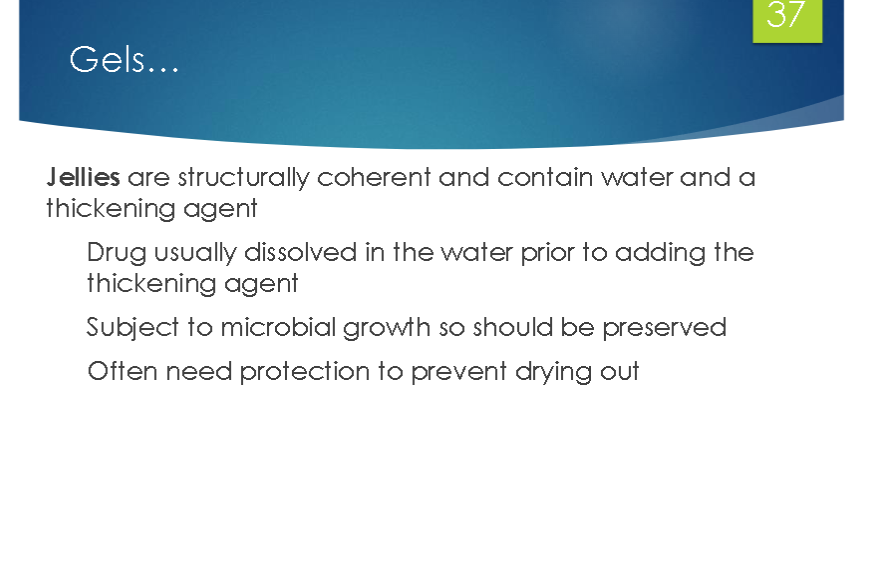
What are jellies?
What is the main problem when preparing gels?
wetting of the gelling agent as a major problem.
When dry gelling powder is added to water, its outer surface may hydrate rapidly.
This can create lumps with a hydrated outer layer and dry powder trapped inside.
Result: The lumps become difficult to disperse and hydrate completely.
How do we prevent lumps?
add powder gradually
Pre-disperse in a nonsolvent
Levigation
how can adding powder gradually help
Add the gelling agent in small portions.
Mix vigorously during addition.
This helps distribute the powder before lumps form.
how can Pre-disperse in a nonsolvent help
First disperse the powder in a compatible liquid in which it is insoluble.
Then add the dispersion to the appropriate solvent with mixing.
This helps prevent the powder from clumping immediately.
what do Many gelling agents include
Alginic acid
Bentonite or Vee Gum (magnesium aluminum silicate)
Carbomer (Carbopol) – alcohol compatible
Poloxamer (15-50% concentration)
what are some food items that are emulsions
milk is an oil in\ water emulsion
margarine is a water in oil emulsion
ice cream is an oil and air in water emulsion
Other food emulsions include mayonnaise, salad dressings
Use of emulsion disperse systems
Useful for topical, oral, ophthalmic and parenteral
(injectable) dose forms. To be shaken before use
