Medical Microbiology exam 1
 Call Kai
 Learn
Learn Practice Test
 Spaced Repetition
 Match
Match Flashcards
 Knowt Play
1/77

Earn XP
Description and Tags
Eukaryotic, bacteria, and Archaea
Name | Mastery | Learn | Test | Matching | Spaced | Call with Kai | Chat |
|---|
No analytics yet
Send a link to your students to track their progress
78 Terms
What types of organisms that study by microbiologist?
Bacteria, Archaea, Eukarya
What is on the tree of life and where protozoa fall on it?
it’s where on organism origin from and protozoa fall in the Eukarya
Where microorganisms/infectious agents fall on the tree of fall?
In bacteria and Eukarya
What type of microbes that can cause disease?
Fungi (yeasts & molds)
Parasite (Protozoa, Helminths)
Bacteria
Viruses
What are structures do eukaryotes cells have?
Cell membrane
Golgi Apparatus
Nucleus
Ribosomes
What are structures do Prokaryotes cell have?
Lack a Membrane-bound nucleus
70s ribosomes
Cell wall
Nucleoid
Plasmids
What are some differences between prokaryotes and eukaryotes?
Prokaryotes lack cell-bound organelles but eukaryotes do have cell-bound organelles
Prokaryotes can only be unicellular but eukaryotes can be both
What are some similarities between prokaryotes and eukaryotes?
Both can cause disease
have a cell membrane, ribosomes, cytoplasm, and DNA
What is the size of a protozoan parasite?
Skittle ( intracellular)
Red vine (extracellular)
What is the size of a Fungus
M&M
What is the size of a bacteria?
M&M ( large)
Tic-Tac ( small)
What is the size of a virus?
Sprinkles (large virus)
Grain of sugar (Small virus)
What kind of cells are protozoa?
Eurkaryotes
What do ALL protozoa have?
Nucleus
Mitochronia
Ribsomes
Cell membrane
What is a pellicle and what its composition?
Its inside of the plasma membrane that add rigidity
its a band of proteins
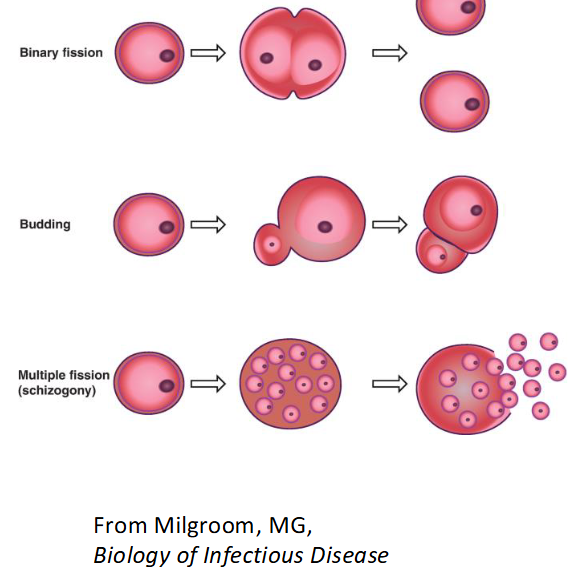
How do some protozoan reproduced?
Sexual ( Gametocyte = sexually reproducing form )
Asexual
1. Binary Fission: grows larger divides in two
2. Budding: smaller daughter cell pinches off of larger mother cell
3. Schizogony/Multiple fission: nucleus divides mutiple times and
Why do some Protozoa form cysts?
protect against unfavorable environmental changes
site of nuclear reorganization or cell division
allows transfer between hosts
What is the formation of cyst in protozoa?
Encystment ( forms cyst)
excystment (occurs when conditions are favorable growth)
What are the three types of motility of protozoa?
flagella
Cilia
pseudopods
What are characteristics of ALL fungi?
Eukaryotes
Cell walls (different from plant cell walls, can contain chitin, glucan, mannan)
Cell membrane (contain ergosterol0
What are characteristics of some fungi?
Multicellular
Unicellular ( Yeast)
Spore formation
Hyphae
How does yeast reproduce?
Asexually through budding but can sometimes reproduce sexually
What is dimorphism in terms of fungi?
Temperature can affect the form of a fungus ( Two forms)
In cooler temperatures can appear as mutilcellular while hot temperatures can appear as yeast
How do overall fungi reproduce?
sexually through spores ( producing genetic identical offspring to be dispersed in new locations) or have two nuclei fusing into one
asexual through budding
How do fungi get there nutrients?
through soil
through break down of carbs ( chemoheteroph)
dead things ( saprophyte)
What are the composition of the fungi cell wall?
chitin
What are hyphae made of?
filaments
multiple hyphae called mycelium
chitin
How are protozoan cysts, Fungal spores, bacterial endospores similar?
All are formed when they need to be in different environments
Cysts and endospores are formed when it needs to be survive (environments are not favorable)
Spores are used for reproduction/growth
What is Cyclospora?
Protozoan parasite
only human host
causes explosive diarrhea that lasts for 10-12 weeks (untreated)
testing requires stool samples
What is Yersinia pestis?
gram-negative bacillus-shaped bacterium
in domesticated, urban, and wild animals
when transmitted by flea cause bubonic plague ( swollen hard, red painful lymph nodes)
transmitted by direct contact with infected animals
if in airways pneumonic plague
What is Giardia?
Flagellated protozoan parasite
habits health GI host
present soil, water, or food contaminated with feces
cause severe GI distress
What is Coccidioides immitis or valley Fever?
soil-dwelling fungus
transmitted by air borne spores
experiences headaches, fever cough, SOB, fatigue, muscle aches, rash
resolves on its own but ppl with HIV, pregrant, diabetic, black or filipino should recevie treatment
What is Plasmodium sp.
intracellular protozoan parasite (non-motile)
spread by female mosquitos
rupture RBCs which cause fever, infects liver cells & infects RBC
causes malaria
How are archaea similar to bacteria?
Prokaryotes
Have cell walls but archaea don’t have peptidoglycan
highly resistant to their environment
Where do Archaea live?
They live in extreme environments
Thermophiles ( hot)
Halophiles (salty)
Methanogens (produce methane gas)
how does Archaea climate change affect?
Since some live in GI system the can produce methane which producing greenhouse gases
what are the shapes of Bacteria
Coccus
Coccobacillus
Vibrio (bent rod)
Bacillus
Spirillum ( zig-zag)
Spirochete ( crowscrew)
Strepto = multiple/Chain
Staphyl = cluster

What is the function of the bacterial cell wall?
maintains shape and rigidity
protects form cell osmotic lysis ( taking in too much water)
can contribute to pathogenicity
What is the composition of a bacterial cell wall?
Peptidoglycan (PGN)
LIpoteichoic acids
Lipopolysaccharides (LPS)
What is PGN made out of?
NAG( N-acetylglucosamine)
NAM ( N-acetylmuramic acid)
tetrapeptide side chains
What are three types of cell walls?
Gram-positive ( purple, thick layer of PGN 60-90%)
Gran-negative ( pink, thin layer of PGN 10-20%)
Acid Fast
No cell wall
What is the outer membrane called of a gram-negative cell wall?
lipopolysaccharides (LPS) (made out of carbohydrate: head and lipid: tails)
relatively impermeable
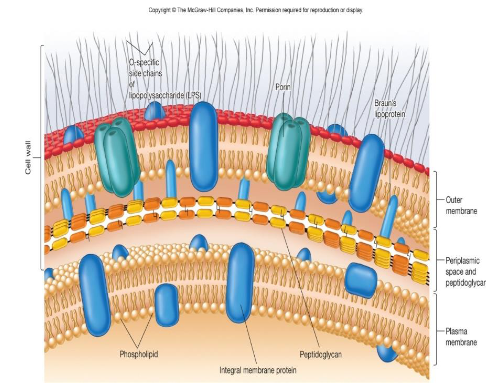
What bonds the PGN to cell membrane in gram-positive?
lipoteichoic acids

What are the difference between cell walls and cell membranes?
Composition
Membrane made out of phoslipid bilayer
Wall made out of PGN
Function
Membrane: controls what goes in and out
Cell wall: protects cell
Location
Membrane on the outside
Wall is outside of membrane
How does the cell wall protect the cell from lysis?
when water flows in it limits the cells flexibility
What are acid-fast bacteria cell wall made out of?
considered gram-positive but poorly stained
made out of 60% of lipid (mycolic acid) which makes it waxy
ex: mycobacterium
What is the example of bacteria without cell walls?
Mycoplasma
have sterols in cell membrane for stability
What are L-forms?
bacteria that normally have a cell wall can lose their ability to form it
can be cause but chronic/recurrent infections that are difficult to treat
ex: mycobacterium
Why is it hard to treat bacteria without cell walls?
certain antibiotics target the making of PGN or cell wall
What is the difference between the Mycobacterium and Mycoplasma?
Bacterium: acid-fast cell wall but can lose its ability to form it
Plasma: no cell wall ever
What is so special about the horseshoe crab?
The injection of the blue blood the horseshoe crab (Limulus test) which helps endotoxin which is produced they presents of Lipopolysaccharides (LPS).
What is endotoxin shock?
septic shock
Blood vessel vasodilate causing blood pressure to drop, poor circulation, poor oxygen delivery, shutting organs down, death
What is a Glycocalyx
slime layer (thin more secrete stops from drying out) or capsule (more tight provides protection from) of bacteria
What is composition of Fimbriae and pili?
proteins
help attach to surfaces
What types of flagella placement?
amphitrichous (both send ends)
Peritrichous (all over)
monotrichous ( one end)
lophotrichous ( lump one end)
Why causes run & tumble in bacteria?
Chemotaxis
Phototaxis
Thermotaxis
Aerotaxis
Osomtaxis
What is Axial Filaments in Spirochete?
found in cell wall in periplasmic space
help do the crowscrew motion
What is bacteria chromosomes vs. plasmids?
Chromosomes circular single DNA
Plasmids circular, replicate independently carries non essential information
What is difference bacterial ribosomes and Eurkarytoe ribosomes?
Bacteria: 70s
Eukaryote: 80s
What the two bacteria that endospores that are medically important?
Clostridium
Bacillus
Tetaus is examlpe
What five things that bacteria cause disease?
Get in host
stay in host
grow in host
avoid immune response
Damage/disrupt toxin & enzymes
What are the structures help bacteria cause disease?
cell wall
What are secrete mocules bacteria to cause disease?
enzymes
Toxin
What is a A -B toxin?
B binds to target cell
A component agitates or disrupts the function of target cell
What are factors of virulence?
toxin & enzymes
What is the genome location & what is its composition?
Nucleic Acid
found in core of virus
May be DNA or RNA

What is the capsid and its composition?
made out of capsomeres which made out of proteins
surrounds the genome
What is a envelope?
lipid bilayer from the host cell in which the virus produced
What do spikes and what’s its composition?
They help attachment to host cells and made out of protein
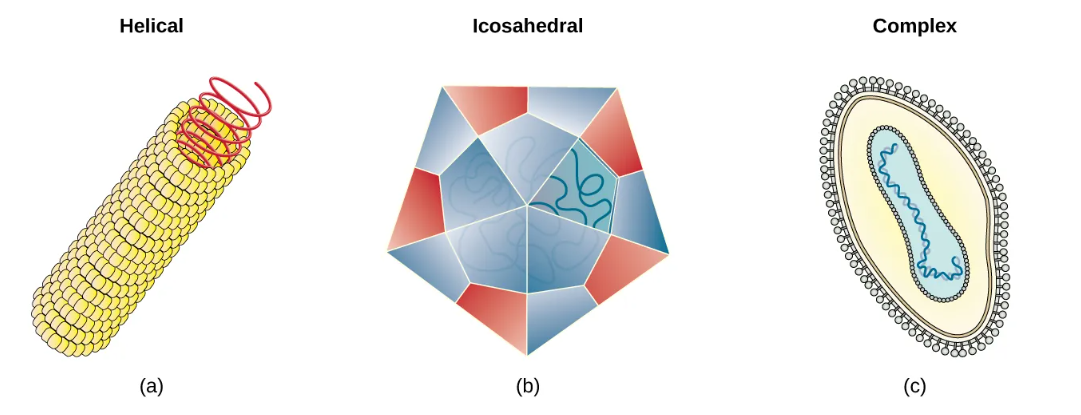
What are the shapes of viruses?
helical, polyhedral, complex
Why viruses are not considered to be alive?
to be alive they have to growth, self-replication, responsiveness
They CANT replicate independently, carry out metabolism or make ATP
What are the five steps in viral replication that are common to ALL viruses?
Attachment
Entry/penetration & uncoating
Synthesis
Assembly
Release
What is attachment in viral replication?
virus attach to host cell using capsid proteins ( naked virus) or spikes (enveloped)
What is entry/penetration of viral replication?
naked virus insert genome into host cell
enveloped viruses fusing their envelope into host cell’s membrane
What is synthesis in viral replication?
They need ribosomes to make and nucleic acids make DNA & RNA
What is assembly in viral replication?
DNA might get packaged into the viral capsids and then be delivered to a new host cell (transduction)
What is release in viral replication?
release viruses from host cell by budding
this can kill a host cell