Clemson Psych 3240 Exam 1
 Call Kai
 Learn
 Practice Test
 Spaced Repetition
 Match
 Flashcards
 Knowt Play
1/69

There's no tags or description
Looks like no tags are added yet.
70 Terms
Mind-Brain Problem
What is the nature of the mind and brain? What is the relationship between them?
Dualism
The mind and the brain belong to different worlds. Mind controls the brain by "interacting" with it. Body is material, mind is nonmaterial.
Monism
Mind and Brain belong to the same world- the physical world (materialism),
Rene Descartes
Dualism, mind is metaphysical, shifted emphasis from mind to body. Mind interacts with brain at pineal gland. First to describe a model for nervous system
Descartes Hydraulic Model
Nerves are hollow tubes where fluid "animal spirits" flow. Pineal gland pumps fluid through brain and nerves. Mind tilts pineal gland to direct fluid to specific nerves to inflate the muscles there.
Galvani
Experimented on frogs, discovered nerves are like wires conducting electricity. Contradicts Descartes model
Helmholtz
Experimented how fast a nerve impulse travels (90ft/s) which is much slower than electricity. Discovered Descartes model is too simple
Motor Neurons
Receives information from other neurons, carries info to muscle or gland cells. "Output"
Sensory Neuron
Receives a type of sensory info, carries info to other neurons. "Input"
Interneuron
Connect 1 neuron to another in a particular part of the CNS
Oligodendrocyte
Glial Cells that build myelin around axons in brain and spinal cord
Schwann cells
Glial cells that build myelin around axons in periphery
Hyperpolarization
Increase in polarization
Ex: -70 to -80, farther from 0
Depolarization
Decrease in polarization
Ex: -70 to -60, closer to 0
Human Genome Project
Goal to map the location of all the genes on human chromosome and determine the order of bases in each gene
Heritability
Percentage of the variation in a characteristic that can be attributed to genetics
Vulnerability
Genes contribute a predisposition for the disorder
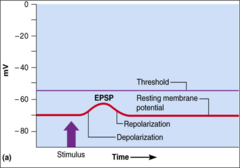
Excitatory postsynaptic potential (EPSP)
Receptors open sodium channels, hypopolarization of dendrites and cell body
Inhibitory postsynaptic potential (IPSP)
Receptors open potassium channels or chloride channels so K+ moves in or Cl- moves out, hyper polarization of dendrites and cell body

Spatial Summation
Combines potentials occurring simultaneously at different locations on the dendrites and body
Temporal Summation
Combines potentials arriving a short time apart
Reuptake
Transmitter taken back into terminals by transport proteins to be put in vesicles
Neural Networks
Groups of neurons that function together to carry out a process
Absolute refractory period
Na+ channels can't reopen so can't produce another action potential, limits how many AP a neuron can produce over time
Relative refractory period
Only stimuli stronger than usual can produce an AP
Rate law
Intensity of a stimulus is encoded by the rate of the AP
All or none law
AP strength is independent of the intensity of the stimulus
Important properties of AP
1. Only in axon, not dendrites or soma bc of channels
2. All or none law
3. Nondecremental-doesnt decay as it travels axon
Important properties of Graded Potential
1. Can happen in axon, dendrites, soma
2. Strength depends on intensity of stimulus
3. Decremental-decays as it travels
Nerve
Bundles of axons in peripheral (PNS)
Ganglion
Group of cell bodies in peripheral (PNS)
Tract
Bundle of axons in Central (CNS)
Nucleus
Group of cell bodies in Central (CNS)
Axosomatic
Between terminal button of one neuron and soma of another neuron

Axodendtritic
Between terminal button of one neuron and dendrite of another neuron

Axoaxonic
Between terminal button of one neuron and terminal button of another

Effects of Axoaxonic synapse
- effects the activity of the other n heron by changing the permeability of the membrane to calcium.
-presynaptic excitation
-postsynaptic inhibition
-Overall: 1 way of synaptic modulation
Presynaptic excitation
Increase in the release of neurotransmitter by presynaptic neuron. Calcium gates get opened so increase in exocytosis.
Postsynaptic inhibition
Decrease in the release of neurotransmitter by presynaptic neuron. So even if an AP occurs calcium channels closed.
Autoreceptors
Special proteins in presynaptic membrane. Can sense the amount of neurotransmitter in cleft.
Receptors in the postsynaptic cleft
Change the sensitivity or in number to compensate for unusual increases or decreases of neurotransmitter in cleft. Causes drug tolerance
Agonist
Chemical that mimics or increases the effect of a neurotransmitter by usually looking like it molecularly. Ex: morphine mimics endorphins
Antagonist
Chemical that blocks effect of neurotransmitter. Ex: curare poison blocks acetylcholine receptors in muscles which causes paralysis
Acetylcholine
Principle in muscles, in brain, involved in learning
Serotonin
(Monamines) Involved in mood, sleep, and arousal, and in aggression depression, OCD and alcoholism
Dopamine
(Monamines) Contributes to movement control and promotes reinforcement of abused drugs, food, sex/ Involved in schizophrenia and Parkinson's disease
Norepinephrine
(Monamines) Hormone released during stress. Increase arousal and attentiveness to environment. Involved in depression
Epinephrine
(Monamines) Stress hormone related to norepinephrine. Plays a minor role as NT in the brain
Glutamate
(Amino Acids) Principal excitatory NT in the brain and spinal cord. Vitally involved in learning and implicated in schizophrenia
Gamma aminobutyric acid (GABA)
(Amino Acids) Predominant inhibitory NT. Receptors respond to alcohol and transmitters called benzodiazepines. Deficiency in GABA or receptors is one cause of epilepsy
Glycine
(Amino Acids) Inhibitory NT in the spinal cord and lower brain. The poison strychnine causes convulsions and death by affecting glycine activity.
Endorphines
(Peptides) Neuromodulators that reduce pain and enhance reinforcement
Substance P
(Peptides) Transmitter in neurons sensitive to pain
Neuropeptide Y
(Peptides) Initiates eating and produces metabolic shifts
Nitric Oxide
(Gas) One of two know gases transmitters, along with carbon monoxide. Can serve as a retrograde transmitter which influences the presynaptic neuron release of NT. Viagra enhances male erections by increasing nitric oxides ability to relax blood vessels.
Forebrain
-Cerebral Hemispheres
-Corpus Callosum
-Thalamus
-Hypothalamus
Midbrain
Very tiny part in the middle
Hindbrain
-Pons
-Medulla
-Cerebellum
Neuraxis
An imaginary line drawn through the center of the CNS from the bottom of the spinal cord to the front of the forebrain.
Anterior
front, Is the face for a human head
Posterior
back, Feet in humans, also back of head
Ventral
belly side, also neck in humans
Dorsal
toward the back, also crown in humans
Horizontal Plane

Sagittal Plane

Coronal Plane

Ridge
Gyrus
Groove
Sulcus
Grey matter
Cortex mainly made up of unmyelinated cell bodies
White matter
Center of gyres have myelinated axon pathways