AP Chemistry Unit 1
 Call Kai
 Learn
Learn Practice Test
 Spaced Repetition
 Match
Match Flashcards
 Knowt Play
1/80

There's no tags or description
Looks like no tags are added yet.
Name | Mastery | Learn | Test | Matching | Spaced | Call with Kai | Chat |
|---|
No analytics yet
Send a link to your students to track their progress
81 Terms
What isotope is used as the standard in establishing the atomic mass scale?
Carbon - 12 which is defined to have a mass of 12 amu
What is the difference between atomic mass, mass number, and atomic number
atomic mass is the actual mass of the atom measured in amu, or in g/mol. It is the mass of a single atom or as shown on the periodic table, a weighted average mass of naturally occurring isotopes.
Mass number is the number of protons + number of neutrons for a particular isotope
Atomic number is the number of protons
What is the difference between accuracy and precision for data
Accuracy gives the right answer, precision gives the same answer (over multiple trials)
What were the 4 postulates of Dalton's atomic theory (billiard ball model)
1. Each element is composed of extremely small particles called atoms
2. All atoms of a given element are identical, but the atoms of one element are different from the atoms of all other elements
Atoms of one element cannot be changed into atoms of a different element by chemical reactions, atoms are neither created nor destroyed in chemical reactions
Compounds are formed when atoms of more than one element combine, a given compound always has the same relative number and kind of atoms.
What were the laws that led from Dalton’s atomic theory
Law of constant composition (explained by postulate 4): in a given compound, the relative number of atoms are constant
Law of conservation of mass (explained by postulate 3): the total mass is the same before and after a chemical reaction
Law of multiple proportions (deduced by Dalton and verified): If two elements A and B combine to form more than one compound, the masses of B that can combine with a given mass of A are in the ratio of small whole numbers
What are the prefixes for simple organic compounds
They are based on the # of carbons
1-meth
2-eth
3-prop
4-but
5-pent
6-hex
7-hept
8-oct
9-non
10-dec
What is the general formula for alkanes
CₙH₂ₙ₊₂
Alkanes only have single carbon-carbon bonds
What is the general formula for alkenes
CₙH₂ₙ
Alkenes have a double carbon-carbon bond
What is the general formula for alkynes
CₙH₂ₙ₋₂
Alkynes have a triple carbon-carbon bond
What is the general formula for alcohols and carboxylic acids
Alcohols - CₙH₂ₙ₊₁OH
Carboxylic acids - CₙH₂ₙ₊₁COOH
What is an isomer
Compounds that have the same number of each type of atoms but are connected differently. This gives them different properties.
What is the purpose of combustion analysis? How do you determine empirical formula using it.
To determine empirical formulas of hydrocarbons and compounds containing carbon, hydrogen, and one other element.
All of the carbon in the CO₂ collected came from the sample, and all of the hydrogen in the H₂O came from the sample, so use these values for the empirical formula calculation.
What are examples of physical separation techniques?
Decanting, filtration, sifting, flotation, sedimentation, scooping, magnetic separation, centrifugation, freezing, fractional distillation, extraction, paper chromatography.
What experiment did JJ Thompson conduct and what did it teach him about atoms?
He used a phosphorescent coating to “see” invisible cathode rays (beams of electrons). He noticed that these rays were deflected by a magnet.
He concluded that there were tiny negatively charged subatomic particles (electrons), and he eventually proposed the plum pudding model (negative electrons in a positive sphere)
What experiment did Rutherford conduct and what did it teach him about atoms?
He conducted the gold foil experiment, where he shot a beam of alpha particles (positively charged particles) at an extremely thin sheet of gold foil. Most particles went straight through but some were deflected by the positive nucleus of the gold atoms. Through this he discovered the nucleus of the atom.
What were the problems that rutherford encountered after discovering the nucleus?
Shouldn’t the protons in the nucleus repel themselves and rip the nucleus apart?
Shoudn’t the electrons crash into the nucleus if they are negatively charged and the nucleus is positively charged?
What are the properties of light (electomagnetic radiation)
It is a form of energy
It does not contain matter
Does not require a medium to travel through
Not all light is visible
What does the wave model of light explain?
Explains the reflection of light (light bounces off surfaces)
Explains interference patterns (constructive/destructive interference)
Explains diffraction (light bends around obstacles)
Explains refraction (light bends when changing medi)
What is wavelength, amplitude, frequency, and velocity (for light waves)
wavelength - distance from crest to crest. (symbol λ, measured in m)
Amplitude - ½ the vertical distance from crest to trough. (symbol A, measured in m)
frequency - # of cycles per second (symbol f or v [nu], measured in s⁻¹ or Hz)
Veolcity - speed the wave travels through the medium, speed is dependent on the medium (symbol v, measured in m/s)
What is the universal wave equation and the relationship between wavelength and frequency?
c=λf (where c is the speed of light)
Relationship:
f=c/λ, therefore f∝1/λ (because c is a constant)
What is the em spectrum in order of increasing frequency
radiowave, microwave (μ), infrared (ir), ROYGBIV (visible light), UV, xray, gamma rays
What is the wavelength range for visible light?
400 nm - 750 nm
What are things that cannot be explained by the wave nature of light
Blackbody radiation (things glow when they get hot enough)
Photoelectric effect (light can knock electrons off of metals. A minimum frequency of light is needed regardless of how bright the light is)
Atomic spectra (specific wavelengths are emitted by excited atoms)
What other properties does light exhibit beyond wave properties?
It exhibits properties of particles
Light particles do not have mass
This is known as the wave-particle duality of light
What did Planck discover about energy? What is planck’s constant?
Energy is quantized, meaning that a system (light) can only possess certain discrete energy values rather than a continuous range of values.
Planck’s constant (h=6.626×10^-24 Js) is the size of the “steps” for energy.

How can we calculate the energy of a photon?
E (photon) = hf
h=planck’s constant
f = frequency
Higher frequency photons have more energy, this is why high frequency light such as UV light can break chemical bonds and mutate DNA
How does a light get “brighter” according to the wave model and the particle model?
Wave model - brighter light will have greater amplitude
Particle model - brighter light will be shooting out more photons (however the energy per photon stays the same)
When you use light to knock off electrons from an atom, how do you determine the kinetic energy of the electrons you knock off?
KE (electron) = E (photon) - E (needed to remove electron)
The energy of the photons are transferred to the electrons.
What are the 3 postulates of Bohr’s model?
Only orbits of certain radii corresponding to certain specific energies are permitted for the electron in a hydrogen atom
An electron in a permitted orbit is in an allowed energy state. An electron in an allowed energy state does not radiate energy and therefore does not spiral into the nucleus
Energy is emitted or absorbed by the electron only as the electron changes from one allowed energy state to another. This energy is emitted or absorbed as a photon that has energy E = hf
How do you read atomic spectra?
Only colours of light with a frequency corresponding to an energy equal to the difference in energy levels can be absorbed or emitted.
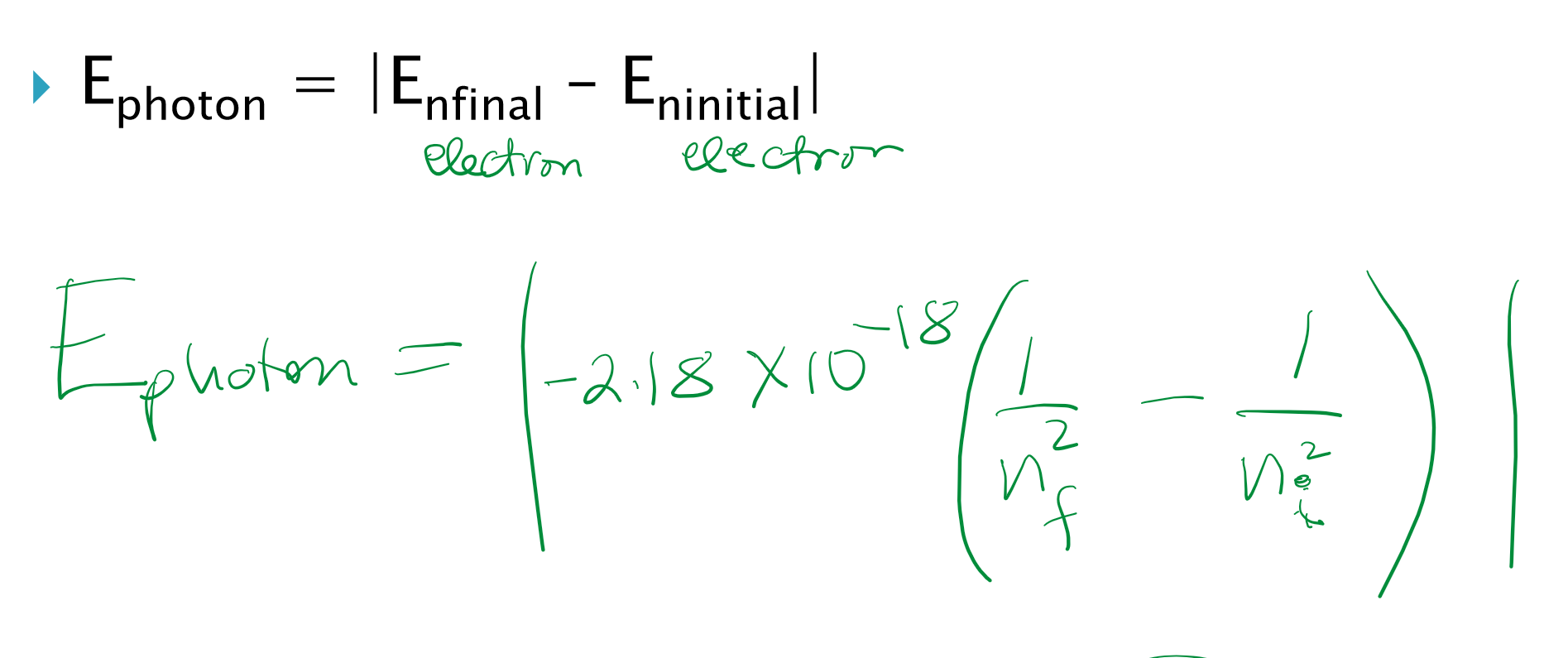
Eₚₕₒₜₒₙ = |ΔEₑₗₑcₜᵣₒₙ|

According to Bohr’s model for hydrogen, how do you calculate the energy of an electron in the nᵗʰ energy level.

What happens when an atom absorbs a photon? What happens when an atom emits a photon?
Absorbs photon - electron moves from lower to higher energy state
Emits photon - electron moves from a higher to lower energy state
How do you calculate the energy of a photon emitted/absorbed by hydrogen
Where “n” is the energy level
What were the successes and failures with Bohr’s model
Successes - idea of discrete energy states of electrons, idea of energy absorbed or released to change states
Failures - calculations only work if there is only one electron in the species: H, He⁺, Li²⁺ and for many electron species there seem to be subshells.
What property do electrons have that is similar to light?
Electrons also exhibit wave-particle duality (as demonstrated by the double slit experiment)
What is Heisenberg’s uncertainty principle
You cannot know both the position and momentum (speed and direction) of a quantum particle.

Why did Bohr fail?
Because you can’t know an electron’s energy and position (distance from nucleus).
What did Schrodinger do?
He created the physics needed to describe electron’s wave-particle behaviour in an atom (quantum mechanics)
We can draw a probability cloud or produce a radial probability graph of where the electron might be
We talk about orbitals instead of fixed orbits

What are quantum numbers, what is Pauli’s exclusion principle?
Quantum numbers are a set of 4 numbers which describe a particular electron in an atom.
3 quantum numbers describe the orbital in which the electron is found.
Each orbital can hold 2 electrons, so the 4th quantum number distinguishes between the two electrons.
Pauli’s exclusion principle: no two electrons in the same atom can have the same set of quantum numbers
Which quantum numbers describe the orbital where the electron is found, which quantum number distinguishes between the two electrons?
n, l, mₗ describe orbital
mₛ distinguishes
What is the principal quantum number (n)? What are its allowable values? What happens when n increases?
It corresponds to the energy level of the electron.
Allowable values are positive integers (n=1,2,3,4,5 …)
When n increases, the size of the orbital increases

What is the angular momentum (azimuthal) quantum number (l)? What are its allowable values?
It refers to the sublevel within the energy level
Allowable values are integers from 0 to n-1, therefore:
when n=1, l=0. when n=2, l=0,1. when n = 3, l=0,1,2 and so on.
l relates to the shape of an orbital (as seen in the image)

What is the magnetic quantum number (mₗ)? What are its allowable values? What are orbitals with the same n and l value but different m1 values called?
It describes the orientation of the orbital in the sublevel.
Allowable values are between -l ←→ l (-l to l), therefore:
if l=0, mₗ=0 (so the s sublevel has one orbital)
if l=1, mₗ=-1,0,1 (so the p sublevel has three orbitals)
if l=2, mₗ=-2, -1, 0, 1, 2, (so the d sublevel has five orbitals)
if l=3, mₗ=-3,-2,-1,0,1,2,3 (so the f sublevel has seven orbitals)
Orbitals with the same n and l value but different m1 values are said to be degenerate (meaning they have the same energy)

What is the spin quantum number (mₛ)? What are its allowable values? How do we represent spin in an orbital diagram?
It describes the direction in which the electron spins.
Allowable values: +1/2, -1/2
Represent spin in an orbital diagram by drawing electrons as half arrows

With species that only have a single electron, what can we say about orbitals with the same n (what does the energy of an electron in the species depend on)?
If there is only 1 electron, then all orbitals with the same n are degenerate (same energy). This means that the energy of an electron only depends on n (as Bohr suggested), therefore in order of increasing energy we can say:
1s < 2s=2p < 3s=3p=3d

With species that have multiple electrons, what does the energy of an electron in the species depend on?
For many electron species, energy of an electron depends on n and l.
For the same l: as n increases, energy increases.
For the same n: as l increase, energy increases.
What is the Aufbau principle? What is the filling order for electrons?
Aufbau principle: orbitals are filled in order of increasing energy (lowest energy gets filled first)
The order is 1s<2s<2p<3s<3p<4s<3d<4p<5s and so on

How do you use the periodic table to determine electron configuration for atoms?
note that space (1, 8A) should be filled in grey (it is still part of 1s)

What is Hund’s rule?
For degenerate (same energy) orbitals, the lowest energy is attained when the number of electrons with the same spin is maximized.
How do electron configurations rank in order of decreasing stability (most stable to least stable).
full shells are most stable (noble gases)
full sublevels are the next most stable. Example Zn: [Ar] 4s²3d¹⁰ is quite stable because the 4s and 3d sublevels are full
half-filled sublevels are the the next most stable. Example in the picture. Nitrogen’s electron configuration is more stable than oxygen’s
![<ol><li><p>full shells are most stable (noble gases)</p></li><li><p>full sublevels are the next most stable. Example Zn: [Ar] 4s²3d¹⁰ is quite stable because the 4s and 3d sublevels are full</p></li><li><p>half-filled sublevels are the the next most stable. Example in the picture. Nitrogen’s electron configuration is more stable than oxygen’s</p></li></ol><p></p>](https://assets.knowt.com/user-attachments/3ea999f6-38a6-44c7-8734-c008959a1c57.png)
What are the anomalous electron configurations we have to memorize? Why does this happen?
One of the s electrons is promoted to the d sublevel.
These actual configurations are more stable (lower energy overall) than the expected configuration

Where are valence electrons found? What do non-valence electrons do?
They are found on the highest n
Full sublevels on lower n don’t do much other than shielding
For transition elements, unfilled d orbitals may play a role in reactions/ions
How do you add electrons in anions according to electron configuration?
For anions, electrons get added according to filling order.
How do you remove electrons in cations according to electron configuration?
When atoms lose electrons, they come from the highest n level

What does isoelectornic mean?
It means that the two species have the same electron configuration.
What is photoelectron spectroscopy (PES), what does it do?
The fastest electrons come from the valence shell, and the slowest electrons come from the 1s orbital. The ejected electrons are forced around a bend (using a magnetic field), and the fastest electrons make a wider turn (because of inertia). The height of the output signal indicates the number of electrons with the given energy.

What are microwaves, infrared, visible light, uv, x-ray, and gamma rays used for with spectroscopy.
Microwaves are used to rotate molecules
Infrared light is used to vibrate bonds
Visible and low frequency UV light is used for electronic transition (electrons jumping levels)
High frequency UV, x-rays, and gamma rays are used to break bonds or remove electrons
Who created the periodic table?
Mendeleev. He made predictions of properties of undiscovered elements based on the table he created.\\\
periodic table is organized based on properties
Atomic number is number of protons
What is coulomb’s law?

What does the force of attraction between an electron and the nucleus depend on?
Depends on effective nuclear charge (Zeff)
Depends on distance between nucleus and electron (based on n)
What is effective nuclear charge (Zeff)?
Charge of the nucleus as experienced by a specific electron
Why is Zeff smaller than Z?
Because electron shielding cancels out some of the effect of the charge of nucleus. This is because the electrons repel each other.
What is Zeff equal to in a 1s electron?
For a 1s electron, Zeff ≈ Z
It is slightly less than Z because there is a nonzero chance that an electron in a higher energy level might be closer to the nucleus than the 1s electron.
How will we calculate Zeff for this unit?
Zeff = Z - S
S being the number of core electrons
What is the trend for Zeff and the force of attraction on valence shell across a period.
The distance is the same because n is the same
Zeff increases, because the number of protons increases while the number of core electrons stays the same
Coulombic attraction increases
What is the trend for Zeff and the force of attraction on valence shell down a group.
Distance increases because n increases
Number of protons goes up by the same amount as the number of core electrons. This means Zeff is the same.
Coulombic attraction decreases
How do you find the nonbonding atomic radius?
it is ½ of the distance of closes nuclear approach (the point where two atoms “hit” each other)
How do you find the bonding atomic radius?
½ of the bond length
Why are bonding radii shorter than nonbonding radii
Bonding radii are shorter than nonbinding radii due to orbital overlap
What is the trend in atomic radius across a period?
Across a period size decreases.
Because Zeff goes up and n stays the same. This means stronger coulombic attraction so valence electrons are pulled in tighter
What is the trend in atomic radius down a group?
Size increases because n increases and Zeff stays the same so there is the same charge pulling on a greater distance which means weaker coulombic attraction.
What is first ionization energy?
The energy required to remove the ourtermost electron from an atom in a gaseous state
Why does ionization energy increase after each electron is removed?
After you remove an electron, there is less repulsion between the electrons, this means that the electrons are pulled in tighter.
Why are there big jumps in successive ionization energies?
Big jumps happen after a valence level is emptied and the next electron comes from a lower “n”
After the valence level is emptied, the electrons are closer and zeff increases because there are fewer core electrons. This makes it much harder to remove the next electron.
What are the periodic trends for ionization energy across a period and down a group
across period - same energy level, higher Zeff so harder to remove electron because more attraction
down group - higher energy level, same Zeff so easier to remove electron because less attraction
What is electron affinity?
The energy change when an electron is added to a gaseous atom
What does a positive electron affinity and negative electron affinity mean?
Positive EA: requires energy to force the electron onto the atom (adding the electron makes it less stable)
Negative EA: releases energy when the electron is added (adding the electron makes it more stable)
What is metallic character?
The lower the ionization energy, the more metallic character an atom has
How do you make an acidic oxide and a basic oxide
nonmetal oxide + water → acid
metal oxide + water → base
What is the trend in reactivity for metals?
Metals lose electrons when they react.
Metals which have weaker coulombic attraction to their valence electrons are more reactive (easier to lose those electrons)
What is the trend in reactivity for nonmetals?
Nonmetals gain electrons or share valence electrons when they react
Nonmetals which have stronger coulombic attraction are better at grabbing electrons so they are more reactive