AQA A-Level Biology 3.1.3: Lipids, Triglycerides and Phospholipids
 Call Kai
 Learn
Learn Practice Test
 Spaced Repetition
 Match
Match Flashcards
 Knowt Play
1/78

There's no tags or description
Looks like no tags are added yet.
Name | Mastery | Learn | Test | Matching | Spaced | Call with Kai | Chat |
|---|
No analytics yet
Send a link to your students to track their progress
79 Terms
What are lipids?
Lipids are fats, oils, waxes, and fat-like molecules (such as steroids) that provide energy, insulation, waterproofing, and form membranes and hormones.

What is the structure of triglycerides?
Triglycerides consist of one glycerol molecule and three fatty acid chains.

What is the difference between saturated and unsaturated fatty acids?
Saturated fatty acids have no double bonds between carbon atoms, while unsaturated fatty acids have one (mono) or many (poly) double bonds.

What type of bond is formed between glycerol and fatty acids in triglycerides?
Ester bonds formed by condensation reactions.

What is a phospholipid?
A phospholipid is a triglyceride in which one of the three fatty acid molecules is replaced by a phosphate group.

How do phospholipids arrange themselves in a cell membrane?
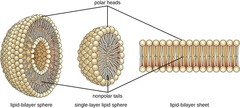
Phospholipids form a bilayer with hydrophilic heads pointing outward and hydrophobic tails pointing inward.

What is the role of cholesterol in cell membranes?
Cholesterol regulates the fluidity of the membrane and is hydrophobic, allowing it to sit within the bilayer.

What are the main functions of triglycerides?
Triglycerides serve as an energy source, energy store, insulation, buoyancy, and protection for organs.

What are the two types of fatty acids based on the number of double bonds?
Mono-unsaturated (one double bond) and poly-unsaturated (multiple double bonds).

What are the components of a triglyceride?
A triglyceride consists of one glycerol molecule and three fatty acids.
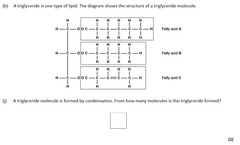
What is the significance of the hydrophobic nature of fatty acid chains?
The hydrophobic nature makes lipids insoluble in water, allowing them to form structures like droplets or bilayers.

What elements do lipids contain?
Lipids contain carbon (C), hydrogen (H), and oxygen (O).

What is the process called that forms lipids?
Condensation reactions.

How many water molecules are produced when forming a triglyceride?
Three water molecules are produced.

What is the difference between a triglyceride and a phospholipid?
Triglycerides have three fatty acids, while phospholipids have two fatty acids and one phosphate group.
What is the role of lipids in waterproofing?
Lipids help to create a waterproof barrier, preventing water loss in organisms.
What is the function of lipids in insulation?
Lipids act as insulators, particularly around nerve cells, to maintain temperature and protect against heat loss.
What is the significance of the hydrophilic and hydrophobic parts of phospholipids?
The hydrophilic heads attract water, while the hydrophobic tails repel water, allowing for membrane formation.
What is a key characteristic of unsaturated fatty acids?
Unsaturated fatty acids contain double bonds between carbon atoms, resulting in fewer hydrogen atoms.
What is the main difference in structure between saturated and unsaturated fatty acids?
Saturated fatty acids have straight chains, while unsaturated fatty acids have kinks due to double bonds.
What is the primary role of lipids in energy storage?
Lipids store energy efficiently without affecting the water potential of cells due to their insolubility.
What is the role of lipids in buoyancy for aquatic mammals?
Lipids are less dense than water, helping aquatic mammals to stay afloat.
What is the function of lipids as shock absorbers?
Lipids around organs provide protection by acting as shock absorbers.
What is the structure of a fatty acid molecule?
A fatty acid consists of an acid (COOH) group attached to a hydrocarbon chain.

What is the significance of the ester bond in triglycerides?
Ester bonds link fatty acids to glycerol, forming triglycerides and storing energy.
What is the role of triglycerides in respiration?
Triglycerides are broken down in respiration to release energy and generate ATP.
What is a saturated fatty acid?
A fatty acid in which there are no double bonds between the carbon atoms.

What is a triglyceride?
An individual lipid molecule made up of a glycerol molecule and three fatty acids, containing ester bonds.
How do lipids differ from proteins and carbohydrates?
Lipids are not polymers, but they are still organic molecules containing hydrogen and carbon.
What are the two types of lipids mentioned?
Triglycerides and phospholipids.
What components make up a triglyceride?
A glycerol molecule and three fatty acid chains.
What components make up a phospholipid?
A glycerol molecule, a phosphate group, and two fatty acid chains.
What type of bond forms between the glycerol and fatty acids in triglycerides?
Ester bonds formed by condensation reactions.
What property of fatty acid chains makes lipids insoluble in water?
The fatty acid chains are hydrophobic (repel water).
What is the structure of unsaturated fatty acids?
Unsaturated fatty acids have double bonds between carbon atoms, resulting in fewer hydrogen atoms.
What is the significance of the double bond in unsaturated fatty acids?
The double bond causes the chain to bend or kink.
How do phospholipids arrange themselves in water?
They form a bilayer with hydrophilic heads facing outwards and hydrophobic tails facing inwards.
What role do lipids play in organisms?
They provide energy, help to insulate organisms, act as waterproofing, and form membranes and hormones.
What is the term for the reaction that forms lipids?
Condensation reaction.
What is the difference in structure between saturated and unsaturated lipids?
Saturated lipids have no double bonds, while unsaturated lipids have one or more double bonds.
What happens to the fatty acid chains when triglycerides are broken down?
A lot of energy is released.
What is the hydrophilic part of a phospholipid?
The phosphate group.

What is the hydrophobic part of a phospholipid?
The fatty acid chains.
How many water molecules are needed to break down a triglyceride?
Three water molecules.
What is the function of the phospholipid bilayer in cells?
It creates a barrier that allows separation of solutions and different conditions on either side of the membrane.
What is the role of omega-3 fatty acids?
They are a type of unsaturated fatty acid beneficial for health.
What is the significance of the ester bond in lipids?
It links fatty acids to glycerol, forming triglycerides and phospholipids.
What does the term 'monounsaturated' refer to?
Fatty acids that contain one double bond between carbon atoms.
What does the term 'polyunsaturated' refer to?
Fatty acids that contain multiple double bonds between carbon atoms.
Describe the structure of olestra.
Olestra is an artificial lipid made by attaching fatty acids to a sucrose molecule.
What is bond X in the context of lipid structures?
Bond X refers to the ester bond formed between fatty acids and glycerol or sucrose.
What is the primary function of triglycerides?
To serve as an energy store in organisms.
What are lipids made up of?
Lipids are made up of carbon, hydrogen, and oxygen.
Are lipids soluble in water?
No, lipids are insoluble in water (hydrophobic) but can dissolve in organic solvents like ethanol.
What are the two main types of lipids?
Triglycerides and phospholipids.
What is the structure of a triglyceride?
A triglyceride consists of one glycerol molecule joined to three long-chain fatty acids.
What type of bond forms between glycerol and fatty acids in triglycerides?
Ester bonds.
What is the difference between saturated and unsaturated lipids?
Saturated lipids have only single carbon-carbon bonds, while unsaturated lipids have one or more carbon-carbon double bonds.
What state are unsaturated fats at room temperature?
Unsaturated fats are liquid at room temperature.
What state are saturated fats at room temperature?
Saturated fats are solid at room temperature.
Why do lipids release more energy than carbohydrates or proteins?
Lipids contain many more carbon and hydrogen atoms relative to oxygen, and when carbon-hydrogen bonds are broken during respiration, energy is released.
What is the structure of a phospholipid?
A phospholipid consists of a phosphate group and two fatty acids bonded to one glycerol.
What part of a phospholipid is hydrophilic?
The phosphate group is hydrophilic.
What part of a phospholipid is hydrophobic?
The fatty acid tails are hydrophobic.
What is the phospholipid bilayer?
The phospholipid bilayer is the main component of cell membranes formed by phospholipid molecules.
What is the emulsion test?
The emulsion test is a biochemical test used to identify lipids.
What is the role of ester bonds in lipids?
Ester bonds form between the hydroxyl group of glycerol and the carboxyl group of fatty acids.
What happens to ester bonds during digestion?
Ester bonds can be broken by lipase enzymes through hydrolysis.
What is the significance of the number of double bonds in fatty acids?
The greater the number of double bonds, the weaker the intermolecular forces.
Define hydrophobic.
Hydrophobic refers to substances that do not interact well with water.
Define hydrophilic.
Hydrophilic refers to substances that can interact well with water.
What is the function of triglycerides?
Triglycerides serve as energy storage molecules.
What is a key characteristic of phospholipids in water?
Phospholipids form layers in water due to their hydrophilic and hydrophobic properties.
What is the role of fatty acids in triglycerides?
Fatty acids provide energy and are components of triglycerides.
How do the properties of lipids affect their biological roles?
The hydrophobic and hydrophilic properties of lipids allow them to form membranes and store energy efficiently.
What is the importance of the glycerol molecule in lipids?
Glycerol serves as the backbone to which fatty acids are attached in triglycerides and phospholipids.
What is the significance of the polar nature of the phosphate group in phospholipids?
The polar nature allows phospholipids to interact with water, forming cell membranes.
What is the main component of cell membranes?
The phospholipid bilayer is the main component of cell membranes.
What type of reaction forms ester bonds in triglycerides?
Ester bonds are formed during a condensation reaction.