Giant covalent and Metallic
 Call Kai
 Learn
 Practice Test
 Spaced Repetition
 Match
 Flashcards
 Knowt Play
1/24

There's no tags or description
Looks like no tags are added yet.
25 Terms
Types of Giant Ionic Structures
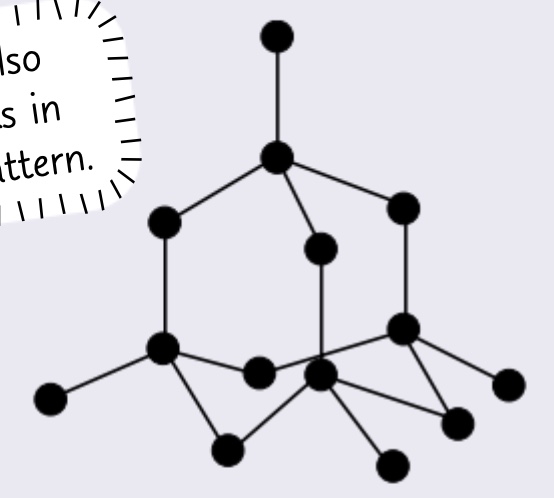
-Diamond
-Silicon dioxide
-Graphite
-Graphene
Draw diamond
Draw silicon dioxide

Properties of giant covalent structures
-High melting point
-Hard
-Good thermal conductors
-Insoluble
Which giant covalent structures can conduct electricity
Graphite/graphene
Which giant covalent structures can’t conduct electricity
-Diamond
-Silicon dioxide
Explain why giant covalent compounds have high melting points
Strong covalent bonds
Explain why giant covalent compounds are hard
Strong covalent bonds
Explain why giant covalent compounds are good thermal conductors
Lattice is stiff, so vibrations travel through them easily
Explain why giant covalent compounds insoluble
No ions and more attracted to neighbours than solvents
Explain why graphite/graphene can conduct electricity whilst most giant ionic compounds can’t
Each carbon forms three bonds, leaving delocalised electrons to carry charge
Draw graphene

Graphite
Layers of graphene held together by weak forces
Metallic bonding
The electrostatic attraction of positive metal ions to delocalised negative electrons
Describe a metallic structure
Lattice of positive ions in a sea of delocalised electrons
Draw the bonding in magnesium

Properties of metals
-High melting point
-Malleable and ductile
-Good thermal conductors
-Good electrical conductors
-Insoluble
Explain why metallic compounds have a high melting point
Strong metallic bonding
Explain whether sodium or magnesium has a higher melting point
Magnesium, as it forms Mg2+ ions, unlike Na+ ions, so there are more delocalised electrons, increasing the strength of the metallic bond
Explain whether sodium or potassium has a higher melting point
Sodium, as Na+ has a smaller ionic radius than K+, so the metallic bonds are stronger
Explain why metallic compounds are malleable/ductile
There are no bonds holding ions together, so the layers of metal ions can slide over each other without disturbing the attraction between positive ions and electrons
Explain why metallic compounds are good thermal conductors
Delocalised electrons can pass kinetic energy to each other
Explain why metallic compounds are good electrical conductors
Delocalised electrons are free to move and carry charge
Explain how impurities in metallic compounds affect electrical conductivity
Drastically reduce conductivity, as they remove delocalised electrons to form anions
Explain why metallic compounds are insoluble
Strong metallic bonds