made by ai: Dental Cements & Fixed Prosthodontics
 Call Kai
 Learn
Learn Practice Test
 Spaced Repetition
 Match
Match Flashcards
 Knowt Play
1/21

There's no tags or description
Looks like no tags are added yet.
Name | Mastery | Learn | Test | Matching | Spaced | Call with Kai | Chat |
|---|
No analytics yet
Send a link to your students to track their progress
22 Terms
Dental Cement
A binding material used to unite objects or fill spaces between teeth and restorations.
Luting
The application of dental cement to attach a fixed prosthesis to underlying tooth structure.
Primary function of luting cement
To fill voids, mechanically lock restorations, and prevent dislodgement during mastication.
Non-adhesive luting
Retention achieved by cement filling micro-irregularities along a single path of withdrawal.
Micromechanical bonding
Retention via cement resin penetrating small, deep surface micro-pits.
Provisional luting agent
A soft cement intended for short-term retention and easy restoration removal.
Effect of eugenol on resin
Inhibits the polymerization of resin-based materials.
Conventional vs. Contemporary cements
Conventional includes Zinc Phosphate, Polycarboxylate, GI; Contemporary includes RMGI and Resin cements.
Zinc Polycarboxylate composition
Powder of zinc oxide with metal oxides; liquid of aqueous polyacrylic acid copolymer.
Zinc Polycarboxylate adhesive mechanism
Bonds to clean enamel and dentin via calcium complexation.
Zinc Oxide-Eugenol (ZOE) main use
Provisional cementation of crowns/FPDs and cavity lining due to soothing pulpal effects.
Glass-Ionomer Cement (GIC) composition
Powder of calcium aluminum fluorosilicate glass; liquid of polycarboxylic and tartaric acid aqueous solution.
Glass-Ionomer main advantages
Fluoride release, easy mixing, high strength, and potential chemical adhesion.
Resin-Modified Glass-Ionomer (RMGI)
A hybrid cement combining resin polymerization with conventional glass-ionomer acid-base reaction.
RMGI contraindication
All-ceramic restorations susceptible to etching and endodontic posts (due to hygroscopic expansion).
Dual-cure resin cement
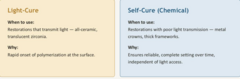
Cement that sets via light irradiation, self-chemical reaction, or both.
Etching time for Lithium Disilicate (e-Max)
20 seconds with 5% hydrofluoric acid.
Etching time for Feldspathic porcelain
60 seconds with 5% hydrofluoric acid.
Primer-free monomer mechanism in Panavia SA
MDP monomer bonds to metal/zirconia; LCSi monomer bonds to silica-based ceramics.
Intraoral working time of Panavia SA Universal
40 seconds at body temperature (37°C).
Purpose of radiopacity in dental cement
Allows radiographic detection of residual excess cement to prevent peri-implantitis or inflammation.
Steps for screw-retained implant crown closure
Tighten screw with torque wrench, cover hole with Teflon tape, and seal with composite.