FINA UNIT 9 REVIEW - Stocks and Stock Valuation
 Call Kai
 Learn
 Practice Test
 Spaced Repetition
 Match
 Flashcards
 Knowt Play
1/65

There's no tags or description
Looks like no tags are added yet.
66 Terms
Multiple Approaches to Stock
Valuation
1. Intrinsic or fundamental valuation: This method carefully
examines various types of cash flows generated by the company
and discounts them to arrive at a value.
2. Relative valuation: This method dispenses with examination of a
company’s financials and instead values the subject company
against peer companies by using a common financial ratio (e.g.,
price earnings, price to book, enterprise value multiples).
* A third approach, technical analysis, is not a valuation method per
se but is often used to provide insights into buy-sell-hold decisions
about stock.
Define and calculate a P/E (price-
to-earnings) ratio

Define and calculate a P/B (price-to-
book) ratio

Define and detail alternative valuation
multipliers, including P/S ratio, P/CF
ratio, and dividend yield.

Enterprise Value (EV) Multipliers

Enterprise Value (EV) Multipliers 2
– EV/Revenue (EV/R). Also called EV/Sales, EV/R is a valuation metric
used to understand a company’s total valuation compared to its annual
sales levels. EV/R can help provide an analyst with an idea of exactly
how much investors pay for every dollar of a company’s sales revenue.
EV/R is considered a relatively crude metric but can be useful when
analyzing companies that have different methods of revenue recognition.
– EV/EBIT. A firm’s earnings before interest and taxes (EBIT) is an
indicator of its profitability before the effects of interest or taxes. EBIT is
also referred to as operating earnings, operating profit, and profit before
interest and tax.
– EV/EBITDA. EV/EBITDA is a ratio that compares a company’s
enterprise value (EV) to its earnings before interest, taxes, depreciation,
and amortization (EBITDA). EBITDA is often used by analysts as a
substitute for cash flow and can be applied to capital analysis using tools
such as net present value and internal rate of return. It is relatively easy
to calculate, EV/EBITDA ratio is a commonly used metric to compare the
relative values of different businesses.
Identify and use DDMs (dividend
discount models)
The dividend discount model (DDM) is a stock
valuation method based on the concept that a
share’s worth is the present value of all the future
dividends it pays.
• The DDM has many forms depending on assumptions made about
the company and future dividends it pays.
– The Gordon Growth Model
– Zero Growth Model
– Constant Growth Model
– Variable or Non-constant Growth Model
– Two-Stage Model
Dividend Discount Models (DDMs)
• Companies normally pay dividends in relation to the
company’s growth and profitability.
• No growth in profits/dividends may be assumed.
Alternately, profits/dividends may grow consistently or at
different rates over different time periods. All of these
scenarios can be modeled using spreadsheet software.
Gordon Growth Model

Zero Growth Model

Constant Growth DDM

Final Thoughts on DDMs

Discounted Cash Flow (DCF) Model
• When investors buy stock, they do so in order to receive cash inflows at
different points in time in the future. These inflows come in the form of cash
dividends (provided the stock does indeed pay dividends, because not all do) and
also in the form of the final cash inflow that will occur when the investor decides to
sell the stock.
• The investor hopes that the final sale price of the stock will be higher than the
purchase price, resulting in a capital gain. The hope for capital gains is even
stronger in the case of stocks that do not pay dividends.
• When securities have been held for at least one year, the seller is eligible for
long-term capital gains tax rates, which are lower than short-term rates for most
investors. This makes non-dividend-paying stocks even more attractive, provided
that they do indeed appreciate in value over the investor’s holding period.
• Meanwhile, short-term gains, or gains made on securities held for less than
one year, are taxed at ordinary income tax rates, which are usually higher and
offer no particular advantage to an investor in terms of reducing their taxes.
Discounted Cash Flow (DCF) Model
• The DCF model is an absolute valuation model, meaning that it does
not involve comparisons with other firms within any specific industry but
instead uses objective data to evaluate a company on a stand-alone
basis.
• The DCF model focuses on a company’s cash flows, determining the
present value of the entire organization and then working this down to
the share-value level based on total shares outstanding of the subject
organization.
• This highly regarded methodology is the evaluation tool of choice for
experienced financial analysts when evaluating companies and their
common stock.
• Many analysts prefer DCF methods of valuation because these are
based on a company’s cash flows, which are far less easily manipulated
through accounting treatments than revenues or bottom-line earnings.
Applying the DCF Model

How the DCF model differs from DDMs

Define preferred stock.
Preferred stock is a form of equity sold by some
firms that offers preferential claims in ownership.
• Preferred stock features a dividend that a company is obligated to
pay before any dividend payments to common stockholders.
• In bankruptcy and liquidation, preferred stockholders have priority
claim to assets before common stockholders.
• Preferred stockholders are usually entitled to a set (or constant)
dividend every period.
Calculate the intrinsic value of
preferred stock.

Common Stock vs. Preferred Stock

Efficient Markets
Operational and Informational
Efficiency
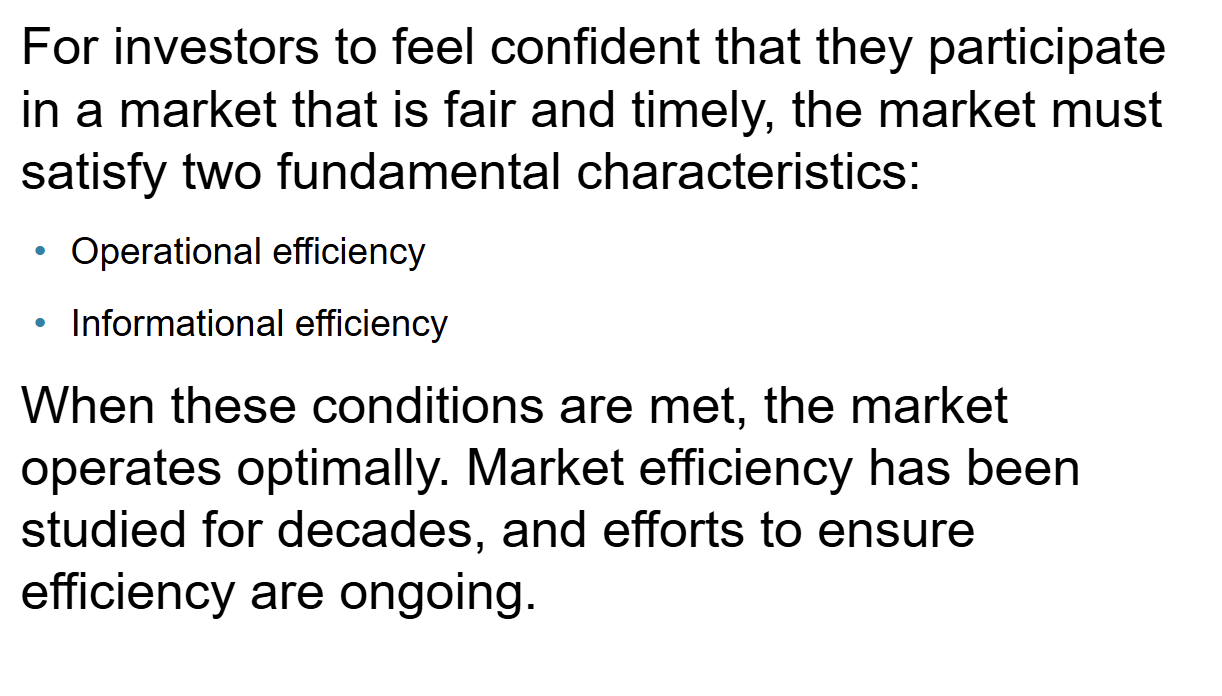
• Operational efficiency involves the “mechanics” of the
market that allow buyers and sellers to execute their
orders as quickly and accurately as possible. Such
systems continue to evolve as the technology employed
evolves.
• Informational efficiency describes how much and how
well relevant information about companies, markets, and
economics is processed by investors.
Efficient Market Assumptions
The well-known efficient markets hypothesis describes
how well the market processes relevant information. It
rests on two assumptions:
1. Since the 1930s, with the Securities Act of 1933 and the Securities
Exchange Act of 1934, securities issuers must provide to the public all
relevant and correct information regarding a securities issuance.
2. Investors use this information to make knowledgeable buy-sell-hold
decisions.
Depending on one’s view, the market may be considered
efficient, but to varying degrees it is categorized having as
strong, semi-strong, or weak efficiency.
Summary
• This section introduced common stock and some of the models and
calculation methods used by investors and financial analysts to determine the
prices or values of common shares. The most evaluative ratios that can be
computed from a company’s financial statements include the price-to-earnings
(P/E), price-to book (P/B), price-to-sales (P/S), and price-to cash-flow (P/CF)
ratios.
• The dividend discount model, or DDM, is a method used to value a stock
based on the concept that its worth is the present value of all of its future
dividends. The most common DDM is the Gordon growth model, which values
stock entirely on expected future dividends. Other techniques include the zero
growth DDM, which depends on fixed dividends; the constant growth DDM, which
assumes that dividends will grow at a constant rate; and the variable growth or
nonconstant growth DDM, which is based on the assumption that stock value will
progress through different stages of growth. There is also the two-stage DDM,
which is based on the assumption of two stages of dividend growth: an initial
period of higher growth and a subsequent period of lower, more stable growth.
31
Summary (2 of 2)
• Investors buy stock to receive cash inflows at different points in the future. These
inflows may come in the form of dividends or a final cash inflow. If the investor
chooses to wait for a final cash flow, the hope is that capital gains will be even
stronger. The DCF model is usually used to evaluate firms that are relatively young
and do not pay dividends to their shareholders. The DCF model focuses on a
company’s cash flows, determining the present value of an entire organization using
objective data and then working this down to the share-value level based on total
shares outstanding of the subject organization.
• Preferred stock is a unique form of equity sold by some firms that offers preferential
claims in ownership. Preferred stock carries a stated par value, but unlike bonds,
there is no maturity date, and consequently, there is no final payment of the par value.
The term preferred comes from preferred shareholders receiving all past (if
cumulative) and present dividends before common shareholders receive any cash
dividends.
• Efficient markets are markets in which costs are minimal and prices are current and
fair to all traders. There are two forms of efficiency: operational efficiency and
informational efficiency. Operational efficiency concerns the speed and accuracy of
processing a buy or sell order at the best available price. Informational efficiency
concerns how quickly a source reflects comprehensive information in the available
trading prices. Financial economists have devised three forms of efficient markets
from an information perspective: weak form, semi-strong form, and strong form.
Key Terms
Amortization
the process of spreading business costs in accounting; similar
to depreciation, but differs in that it generally refers to intangible assets such as
patents or copyrights
capital employed
also known as funds employed; the total amount of capital
used for the acquisition of profits by a firm or on a project
common stock
a security that represents partial ownership of a corporation
comparable company analysis (comps)
a method for valuating a company
using the metrics of other businesses of similar size in the same industry
Depreciation
the process of spreading business costs in accounting; similar to
amortization, but differs in that it generally refers to fixed, tangible assets such as
buildings, machinery, furniture, fixtures, and equipment
discounted cash flow (DCF)
a method for estimating the value of an
investment based on the present value of its expected future cash flows
Dividend
a sum of money paid regularly (typically quarterly) by a company to
its shareholders out of its profits or reserves
dividend discount model (DDM)
a quantitative method for predicting the
price of a company’s stock based on the theory that its present-day price is worth
the sum of all of its future dividend payments when discounted back to their
present value
dividend yield
a financial ratio (dividend/price) that shows how much a
company pays out in dividends each year relative to its stock price, expressed as
a percentage
earnings per share (EPS)
the ratio of a company’s profits to the outstanding
shares of its common stock; serves as an indicator of a company’s profitability
EBIT
short for earnings before interest and taxes; an indicator of a firm’s
profitability before the effects of interest or taxes; also referred to as operating
earnings, operating profit, and profit before interest and tax
efficient markets
markets in which costs are minimal and prices are current,
fair, and reflective of all available relevant information
enterprise value (EV)
a company’s total value; often used as a more
comprehensive alternative to equity market capitalization
enterprise value (EV) multiples
also known as company value multiples;
ratios used to determine the overall value of a company and, by extension, the
value of its common stock
equity multiples
metrics that calculate the expected or achieved total return
on an initial investment
Gordon growth model
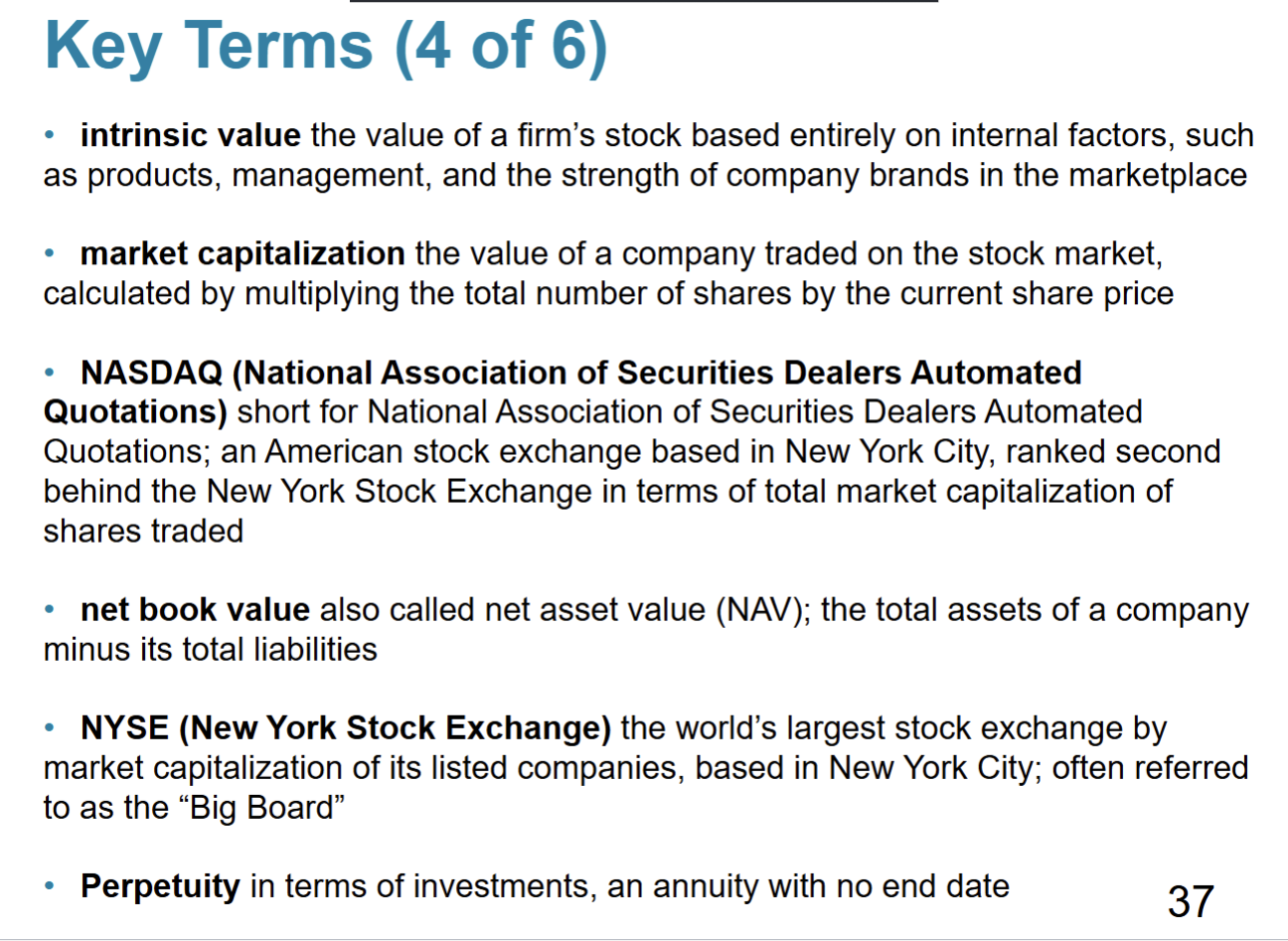
a methodology used to determine the intrinsic value of
a stock based on a future series of dividends that grow at a constant rate
growth rate
the rate at which the dollar amount of dividends paid on a specific
stock holding increases
intangible assets
assets that are not physical in nature, such as goodwill,
brand recognition, and intellectual property (i.e., patents, trademarks, and
copyrights)


Review Questions
1. Briefly discuss one of the primary benefits of using comparative P/E ratios.
Primary benefits of using comparative P/E ratios: Comparative P/E ratios provide a straightforward, relative valuation method. They allow investors to quickly benchmark a company against industry peers to determine if its stock is overvalued or undervalued based on current earnings rather than relying on complex cash flow projections.
2. Name an important characteristic of companies for which the price-to-book (P/B) ratio does
not work well.
Characteristic of companies where P/B ratio does not work well: The price-to-book ratio is ineffective for technology, service-oriented, or asset-light companies that have few tangible assets but derive significant value from intangible assets (like intellectual property, software, or human capital) not reflected on the balance sheet.
3. Briefly describe the main type of scenario in which the two-stage DDM approach might be
used to value a firm and its stock.
Scenario for the two-stage DDM approach: This approach is best used to value companies expected to experience an initial phase of rapid, high dividend growth (e.g., due to a new product line or market expansion), followed by a transition into a steady, sustainable, and lower long-term growth rate.
4. Briefly describe a major shortcoming of the zero growth DDM model.
Major shortcoming of the zero growth DDM model: The model unrealistically assumes that a company's dividend payments will remain exactly the same fixed dollar amount in perpetuity, ignoring inflation, earnings growth, and changing economic conditions.
5. Briefly describe the required inputs for the discounted cash flow (DCF) model.
Required inputs for the DCF model: A discounted cash flow model requires projected future cash flows for a specific forecast period, an estimated terminal value at the end of that period, and a discount rate (the required rate of return) to calculate the present value of those flows.
6. Briefly describe preferred stock and some of its ownership advantages compared to
common stock.
Preferred stock and ownership advantages: Preferred stock is an equity security with priority over common stock. Its main advantages are receiving a predetermined, constant dividend before any common dividends are paid and having a higher priority claim on the company's assets during liquidation.
7. Briefly explain what is meant by the terms cumulative and noncumulative as they relate to
preferred stocks.
Cumulative vs. noncumulative preferred stocks: "Cumulative" means any unpaid past dividends (dividends in arrears) accumulate as a liability and must be paid to preferred shareholders before any dividends can be issued to common shareholders. "Noncumulative" means missed dividends do not accrue; if the company skips a payment, the shareholder loses the right to collect it later.
8. What were Super DOT and SOES, and what were they designed to do?
Super DOT and SOES: These were early electronic order routing and execution systems used by major stock exchanges (NYSE and NASDAQ) to increase operational efficiency. They allowed brokers to instantly route and execute trades (especially small orders) electronically rather than relying on manual, human floor trading.
9. What are operational efficiency and informational efficiency, and how do they differ in terms
of trading markets?
Operational vs. informational efficiency: Operational efficiency refers to the "mechanics" of the market—how quickly, accurately, and cheaply buyers and sellers can execute orders. Informational efficiency refers to how rapidly and accurately relevant public information is processed and reflected in current security prices.
10. What is meant by informational efficiency, and how does it affect the price of a stock?
Informational efficiency and stock prices: Informational efficiency implies that a stock's current market price already incorporates all available relevant information. Therefore, an investor cannot consistently achieve higher-than-average returns by trading on public information, as the price has already adjusted to reflect that data.
Problems
1. Today, Sysco Enterprises paid dividends on its common stock of $1.25 per
share. If dividends per share are expected to increase to $3.50 per share six years
from now, what is the percentage dividend growth rate?

2. Let’s say you want to purchase shares of Fontaine Ltd. and then hold this stock
for six years. The company has a stated dividend policy of $2.00 annually per share
for the next six years, at the end of which time you will sell the stock. You expect to
be able to sell the stock for $35.00 at that time. If you want to earn an 8% return on
this investment, what price should you pay today for this stock?

3. Damian Painting Systems has established a dividend policy of $3.00 per share
per year. If the company plans to be in business forever, what is the value of this
stock if an investor wants a 10% return?

4. Wilk Productions wants its shareholders to earn a 12% return on their
investment in the company. At what value would Wilk stock be priced if the
company paid $2.75 per share in constant annual dividends forever?

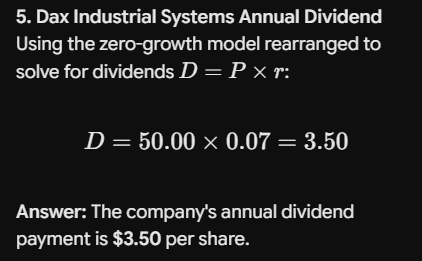
5. Dax Industrial Systems has stock currently priced at $50.00 per share. If
investors are earning a 7% return on Dax Industrial, what is the company’s annual
dividend payment per share?
6. If a stock is selling at $400 with a current dividend of $40 and a potential
investor’s required rate of return is 15%, what would be the anticipated dividend
growth rate?

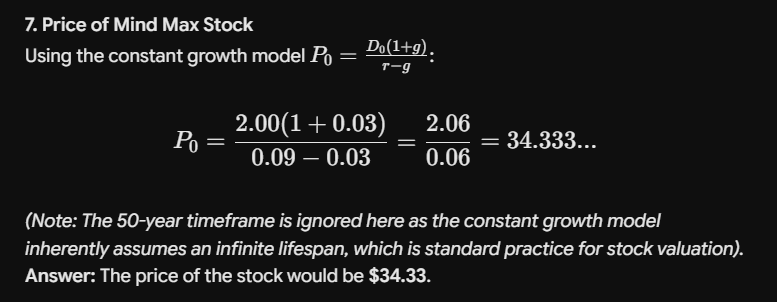
7. Mind Max Inc. has a dividend policy that increases annual dividends by 3%
each year. If last year’s dividend was $2.00, the company intends to stay in
business for 50 years, and an investor wants a 9% return, what would be the
price of Mind Max stock?
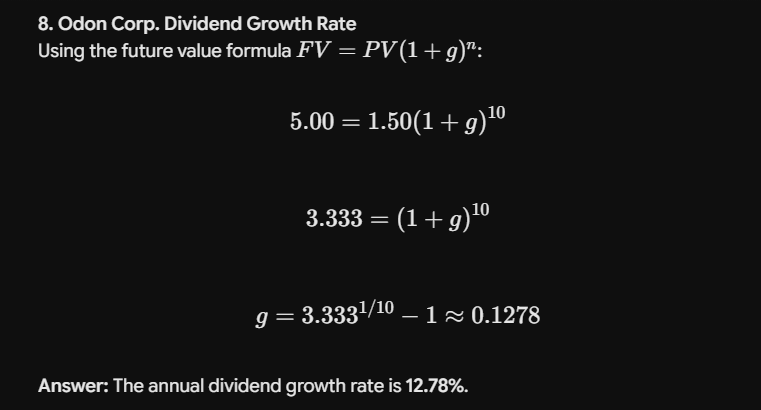
8. Odon Corp. paid dividends today in the amount of $1.50 per share. If Odon will
pay dividends of $5.00 10 years from today, what is the annual dividend growth
rate over this 10-year period?
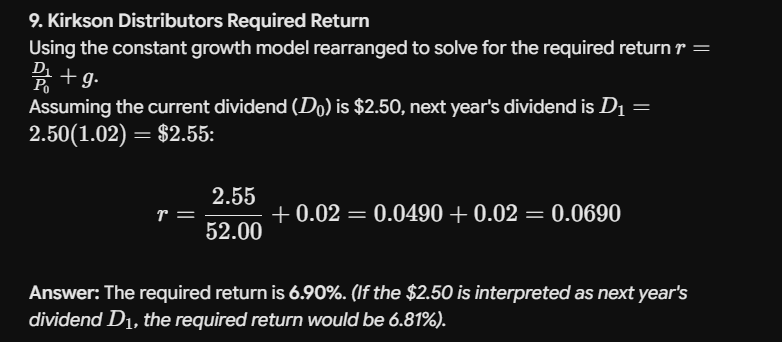
9. The Kirkson Distributors common stock is currently selling at $52.00 per share,
pays dividends annually at $2.50 per share, and has an annual dividend growth
rate of 2%. What is the required return?
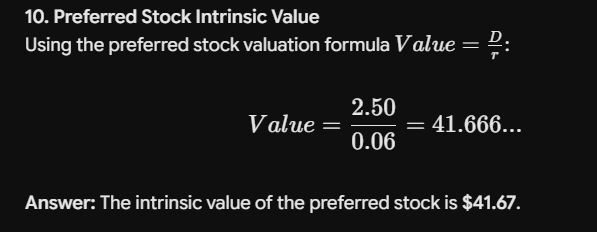
10. If a preferred share of stock pays dividends of $2.50 per year and the
required rate of return for the stock is 6%, what is its intrinsic value?