Year 10 Physics Astrophysics
 Call Kai
 Learn
Learn Practice Test
 Spaced Repetition
 Match
Match Flashcards
 Knowt Play
1/47

There's no tags or description
Looks like no tags are added yet.
Name | Mastery | Learn | Test | Matching | Spaced | Call with Kai | Chat |
|---|
No analytics yet
Send a link to your students to track their progress
48 Terms
How has our understanding of the universe changed?
Early thoughts: Earth was the centre of the universe
Galileo: Discovered the Earth orbited the Sun and therefore the Sun is the centre of the Universe
Newton: Discovered the Sun was a star and Earth was one of 6 planets orbiting it
What is a star/sun?
A large luminous sphere of gas/plasma held together by gravity
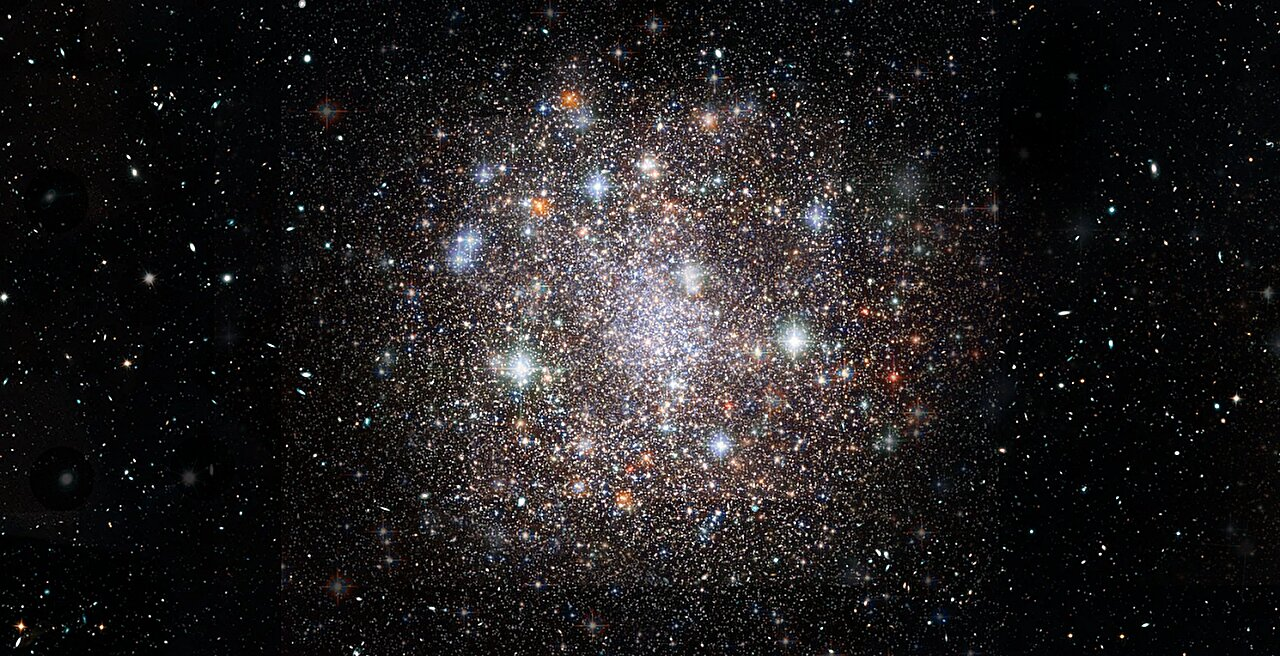
What is a planet? What effect does it have on other objects?
A large body of matter that orbits a sun
Its gravity is large enough to clear the surrounding area of other objects

What is a galaxy? What are the types of galaxies?
Galaxy: A group of solar systems that are held together by a gravitational force
Types: Spiral, elliptical, peculiar, irregular, barred spiral
The Milky Way is a barred spiral

What is a solar system? What are the planets (in order) of our solar system?
Solar system: A series of planets and moons orbiting the same star/sun
Memory cue: My Very Educated Mother Just Served Us Nachos
My = Mercury
Very = Venus
Educated = Earth
Mother = Mars
Just = Jupiter
Served = Saturn
Us = Uranus
Nachos = Neptune

Why do the stars appear to move through the night?
The Earth's rotation makes the stars appear to rotate around a celestial pole each night
The stars only appear to move as the Earth rotates on its axis
In the Southern Hemisphere, the stars appear to rotate around the south celestial pole

How do astronomers detect new planets?
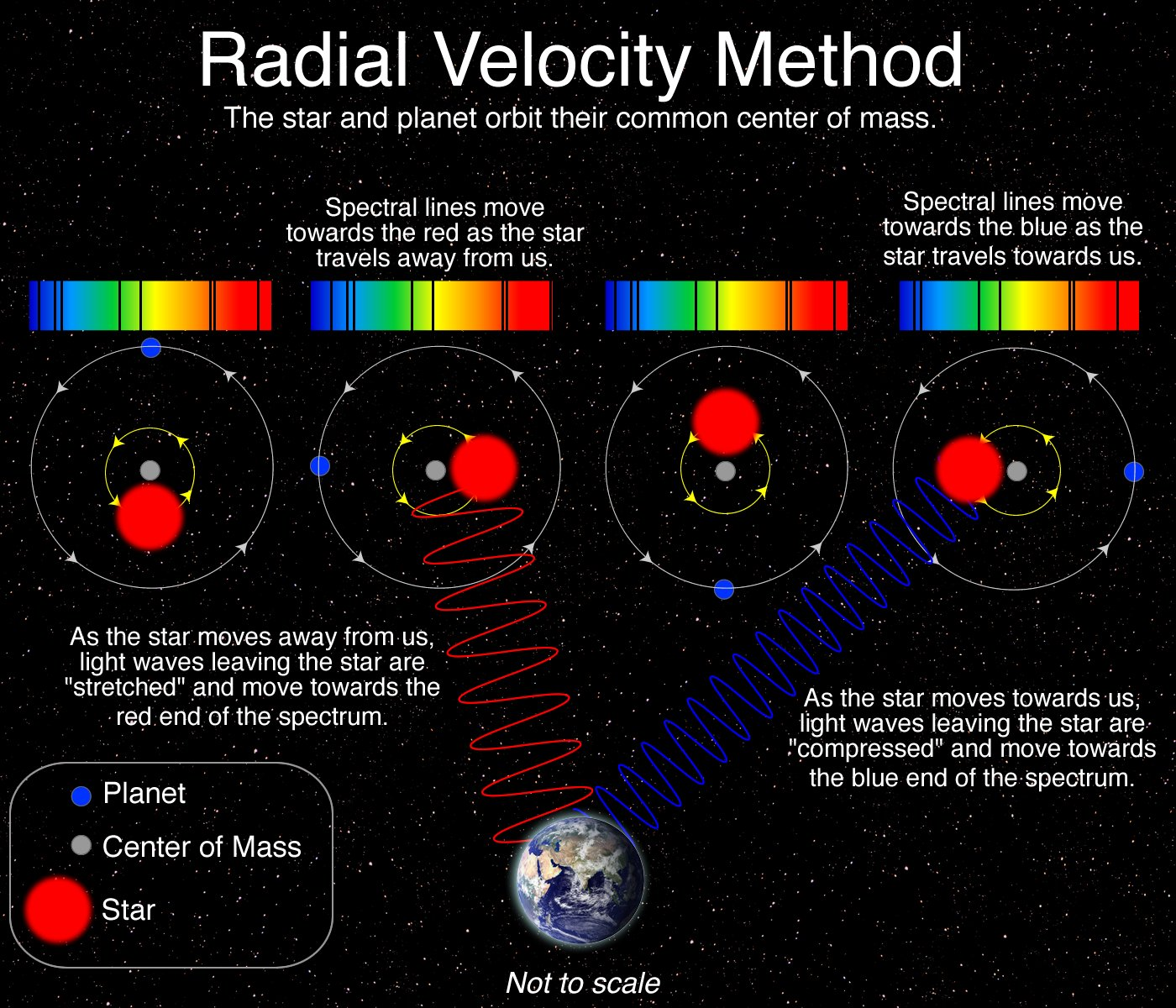
By observing the slight wobble of a star caused by the gravitational pull of an orbiting planet
A planet's gravity pulls on its star which causes it to wobble
Astronomers detect this wobble to infer the presence of an orbiting planet
This detection method is called the radial velocity (Doppler) method
What is an Astronomical Unit?
The distance from the Earth to the Sun (AU)
Used to measure distances within our solar system
EG Distance between planets, distance from the Sun to other planets
1 AU: 1 AU in KM = 149,598,000 kilometers
What is a Parsec?
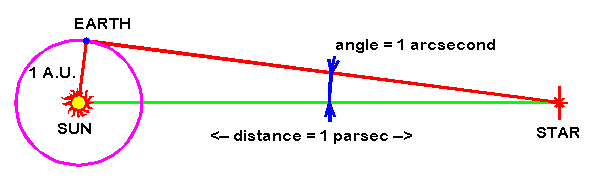
The distance to an object whose parallax angle is 1 arcsecond (pc)
1 arcsecond = 1/3600th of a degree
Generally measured from the sun to the object

How does the distance of an Astronomical Unit, Parsec, Light Year and Megaparsec compare?
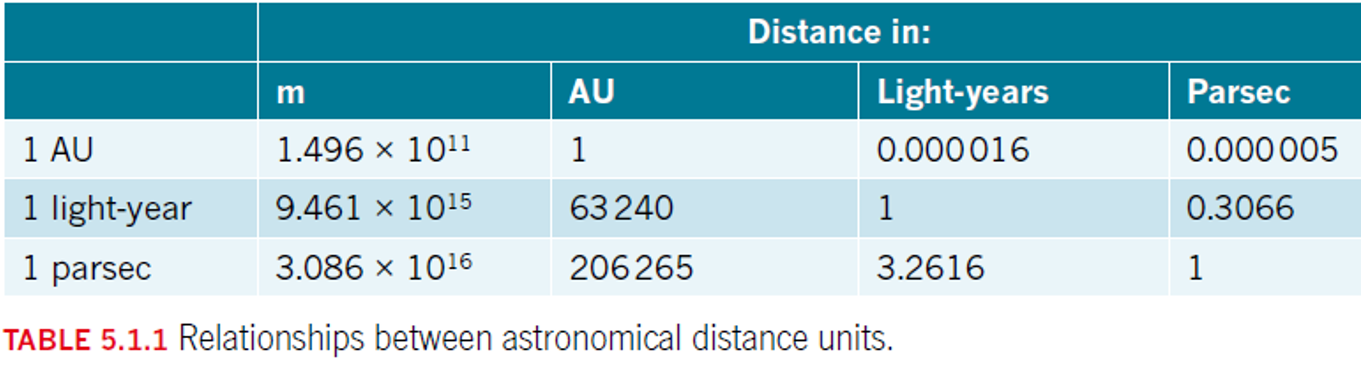
Unit | Distance | Used for |
|---|---|---|
Astronomical Unit (AU) | 149.6 million km | Distances within the Solar System |
Light Year (ly) | 9.46 trillion km | Distances to nearby stars |
Parsec (pc) | 3.26 light years or 31 trillion km | Distances to stars and star clusters |
Megaparsec (Mpc) | 1 million parsecs (≈ 3.26 million light years) | Distances to galaxies and galaxy clusters |
Smallest: AU → Light Year → Parsec → Megaparsec
What is parallax? How is parallax used to measure the distance to stars?
Parallax: The apparent change in the position of an object when viewed by an observer from a different position
Used to measure the distance to nearby stars
Nearby stars show a larger apparent shift than distant stars
The larger the parallax angle, the closer the star
What is the largely discredited theory for the origin of the universe?
The steady state theory
States that the universe has no beginning and no end, where new matter is constantly created yet the universe’s appearance remains the same
Discredited as there was little evidence to support it
What is the widely accepted theory of the creation of the universe?
The Big Bang Theory
States that the universe began about 13.8 billion years ago from an extremely hot, dense state and has been expanding and cooling ever since.
Describe the process of how the Big Bang Theory created the universe. How were the first stars formed from this?
E = mc² shows that energy can be converted into matter (and matter into energy)
In the early universe, energy formed matter and antimatter.
Matter and antimatter annihilated, producing energy in the form of photons (energy particles)
Slightly more matter than antimatter remained, which seperated from the photon as it cooled and expanded
This allowed protons and electrons combined to form hydrogen atoms
Gravity pulled hydrogen atoms together into clouds of hydrogen gas.
Increasing mass → gravity → pressure → temperature.
When the core became hot and dense enough, nuclear fusion began → the first stars formed
How does Einstien’s famous equation help support the Big Bang Theory?
E = mc² shows that energy can be converted into matter and matter can be converted into energy
In the early universe, vast amounts of energy formed matter and antimatter
Matter and antimatter annihilated, converting back into energy
Slightly more matter than antimatter remained, allowing the universe to form
Explains how matter could have formed after the Big Bang, supporting the Big Bang Theory
What is a singularity?
A point where a huge amount of energy was condensed into an extremely small, hot, and dense state with no mass
What are the 4 piecesd of evidence that support the Big Bang Theory?
Cosmic background radiation
Red-shifted light from galaxies
Presence of primordial elements
The formation of galaxies over time
How does cosmic background radiation provide evidence to support the Big Bang theory? (1 of 4)
The energy from the initial expansion of the universe still exists
It has cooled and now exists as electromagnetic microwaves throughout the universe
How it supports: It is evidence of leftover energy from the universe's beginning
How does red-shifted light from galaxies provide evidence to support the Big Bang theory? (2 of 4)
Light from other galaxies is red shifted, showing that that galaxies are moving away from us
The further away a galaxy is, the faster it is moving away
How it supports: Shows the universe is expanding

How does evidence of primordial elements provide evidence to support the Big Bang theory? (3 of 4)
The first atoms to form were the simplest elements (hydrogen)
Heavier elements formed when stars collapsed
The current ratio of light to heavy elements supports the universe being about 13.7 billion years old
How it supports: The observed element ratios match its predictions
How does the process of galaxy formation provide evidence to support the Big Bang theory? (4 of 4)
Galaxies formed and evolved over time as the universe expanded.
The formation of heavier elements in stars is similar to the formation of the first elements during the Big Bang.
This shows that galaxies continued to evolve over time, as predicted by the Big Bang Theory
What does the luminosity of a star depend on?
It’s actual brightness and its distance from Earth
What does the colour of a star depend on? What can be determined from the colour of a star?
The colour of star depends on it’s surface temperature
From colour, it’s temperature and element composition can be found
Most stars are either red or orange
What is the dispersion of white light?
The process of white light dispersing into its different colours when it passes through a triangular glass prism
White light contains all the colours of the visible spectrum
Each colour is refracted (bent) by a different amount as it passes through the prism
Causes the colours to spread out and form a spectrum
What colours does white light disperse into? How does their wavelength and frequency differ?
6 Colours: Red, Orange, Yellow, Green, Blue, Violet
Frequency increases and wavelength shortens moving from Red - Violet
What is emission spectrum?
The unique pattern of narrow, discrete bands of coloured light produced when the light emitted by a heated element is separated

What is emission spectra? How is it viewed and what can be determined from it?
When an element is heated, its atoms emit light which can e separated into narrow, discrete bands of colour
The bands of colour are characteristic of that particular element
An emission spectrum can be viewed using a spectroscope
Since every element has a unique emission spectrum, it can be used to identify the elements present
What is absorption spectrum?
The unique pattern of dark lines produced when white light passes through a cold gas element, and the gas absorbs specific wavelengths

What is absorption spectra? What can be determined from it?
A cool element absorbs the same colours of light that it emits when heated
When white light passes through a cloud of cool gas, the gas absorbs specific wavelengths, leaving dark lines in the spectrum.
Each element has a unique absorption spectrum.
An absorption spectrum can be used to identify the elements present in a gas or the outer atmosphere of a star.
How do absorption and emission spectra differ?
Emission spectrum: The unique pattern of narrow, discrete bands of coloured light produced when the light emitted by a heated element is separated
Absorption spectrum: The unique pattern of dark lines produced when white light passes through a cold gas element, and the gas absorbs specific wavelengths
What do the dark bands of a star’s absorption spectrum tell you compared to the emission spectrum of the same star?
The dark bands in a star's absorption spectrum occur at the same wavelengths as the bright lines in its emission spectrum.
This confirms the star's elemental composition, as each element has a unique pattern of spectral lines.
What implication do red and blue shift have for the motion of stars relative to Earth?
Red shift and blue shift show whether a star or galaxy is moving away from or towards Earth.
Red shift: Light is shifted towards the red end of the spectrum, indicating the star or galaxy is moving away from Earth.
Blue shift: Light is shifted towards the blue end of the spectrum, indicating the star or galaxy is moving towards Earth.
The greater the shift, the faster the object is moving.
Red and blue shift are caused by the Doppler effect.
How does the speed of light affect what we see?
Light travels at a fixed speed that takes time to travel across space
Therefore we view distant stars/galaxies as they were in the past, not as they are now
The further away an object, the further back in time we are seeing it due to the increased time taken for light to travel
What is the doppler effect? How does it explain the observations of red and blue shift?
Doppler effect: The apparent change in the wavelength and frequency of a wave caused by the relative motion between the source and the observer
As a star or galaxy moves away from Earth its light waves are stretched, increasing their wavelength and causing a red shift.
As a star or galaxy moves towards Earth its light waves are compressed, decreasing their wavelength and causing a blue shift
The greater the red or blue shift, the faster the object is moving relative to Earth.
Astronomers use the Doppler effect to determine the direction and speed of stars and galaxies.
What are 3 important conclusions related to the movement of galaxies that Edwin Hubble made from observations of the universe?
Edwin Hubble's observations provided evidence that the universe is expanding
His 3 important conclusions on the movement of galaxies:
Distant galaxies are receding from Earth.
Space itself is expanding
The universe is expanding faster than the speed of light at great distances, meaning light from these galaxies will never reach Earth
What does the Hertzsprung-Russell Diagram describe?
The Hertzsprung–Russell (H–R) Diagram plots a star's absolute brightness (luminosity) against its surface temperature, which is determined from its colour
Groups stars into the following categories:
Main sequence
Giants
Supergiants
White dwarfs

What does the Hertzsprung-Russell Diagram show?
Blue stars have hotter surface temperatures than red stars.
Most stars are main sequence stars, where they spend most of their lives.
Low-mass main sequence stars have cooler surface temperatures.
Stars can be grouped into categories: main sequence, giants, supergiants, and white dwarfs

What colour stars have hotter surface temperatures? What mass stars have hotter surface temperatures in the main sequence?
High-mass stars have hotter surface temperatures than low-mass stars
High-mass stars have stronger gravity, causing higher core temperatures
This increases the rate of nuclear fusion, producing more energy
Therefore, high-mass stars are hotter, brighter, and blue, while low-mass stars are cooler, dimmer, and red

What is the lifecycle of a star?
All stars: Nebula → Protostar → Main Sequence
Low-mass stars: Main Sequence → Red Giant → Planetary Nebula → White Dwarf
High-mass stars: Main Sequence → Supergiant → Neutron Star or Black Hole
The mass of a star determines the path it follows after the main sequence stage
What is a nebula? How does it form a protostar?
Nebula: A giant cloud of gas (mostly hydrogen) and dust
Gravity causes denser regions of the nebula to collapse and clump together
Density and temperature increase as matter is pulled inward
As the clump contracts further, it heats up and forms a protostar

What is a protostar? How does it form a main sequence star?
Protostar: The earliest stage star created from the collapse of gas and dust within a nebula
Gravity continues pulling matter inward, causing the protostar to become more dense and hotter.
Pressure and temperature in the core continue to increase.
When the core becomes hot and dense enough, hydrogen nuclear fusion begins.
The protostar becomes a main sequence star

What stage do stars spend most of their lives in? What outcomes follow this stage of a stars life?
Main sequence star: A stable star where hydrogen nuclei fuse into helium in the core, releasing energy
Hydrogen fusion produces energy that creates outward pressure
This balances the inward force of gravity, keeping the star stable
The star remains in this stage for most of its lifetime
When hydrogen in the core is depleted, the star evolves depending on its mass (low = red giant, high = supergiant)

What is a red giant? How do low mass stars become this?
Red giant: A low-mass star that expands after most hydrogen in its core has been used
Hydrogen fusion in the core slows and eventually stops.
Gravity causes the core to contract, increasing its temperature.
The outer layers expand and cool, causing the star to become larger and redder.

What are supergiants? How do high mass stars become this?
Supergiants are extremely large, luminous stars formed from high-mass main sequence stars.
High-mass stars use up their hydrogen fuel in the core.
The core contracts, causing temperature and pressure to increase.
The outer layers expand significantly, forming a supergiant.
The core begins fusing heavier elements.

What are black holes? How do they form following supergiants?
A black hole is an object with immense gravity where light can’t escape.
A very high-mass star becomes a red supergiant.
The core runs out of fuel and can no longer support itself against gravity.
The core collapses after a supernova explosion.
If the remaining core is extremely massive, it collapses into a black hole.

What are neutron stars? How do they form following supergiants?
A neutron star is an extremely dense star remnant made mostly of neutrons.
A high-mass star becomes a red supergiant and eventually undergoes a supernova.
The remaining core collapses under extreme gravity.
The pressure forces protons and electrons to combine, forming neutrons.
This creates a neutron star.

What is a planetary nebula? How do they form following red giants?
A planetary nebula is a glowing cloud of gas released from a low to medium-mass star.
A red giant becomes unstable near the end of its life.
It ejects its outer layers of gas into space.
Radiation from the remaining hot core causes the gas to glow, forming a planetary nebula.
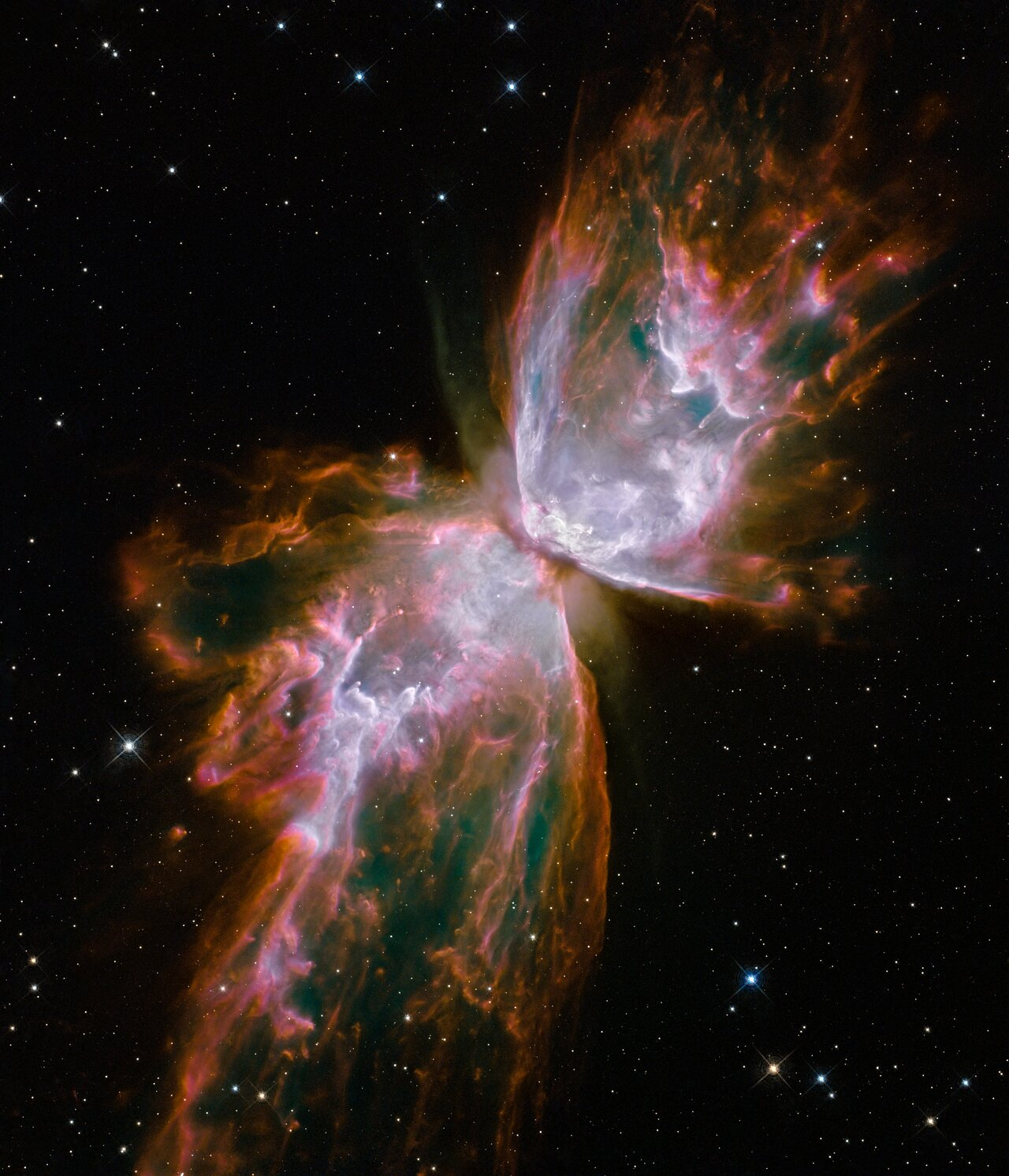
What stage follows a star becoming a planetary nebula?
A white dwarf follows the planetary nebula stage.
The remaining hot, dense core is left behind after the outer layers are expelled.
Nuclear fusion has stopped.
The white dwarf slowly cools over time.
