Hearing Physics
 Call Kai
 Learn
 Practice Test
 Spaced Repetition
 Match
 Flashcards
 Knowt Play
1/46

There's no tags or description
Looks like no tags are added yet.
47 Terms
what type of waves are sound waves?
longitudinal waves
what are the 3 characteristics of waves?
Transport energy
Created by vibrating objects
Propagated through a medium.
what is the simplest sound wave?
sinusoidal wave
what is the audible range
20-20,000 Hz
what is sound intensity? and its formula (inverse sqaure law for intensity)? units?
def: sound power carried by a wave, per unit area
formula:
I = power / area OR I = power / 4∏r²
unit: watts / meter²
what is power, formula, unit?
def: rate that energy is transferred by a wave
formula: P = energy / time
unit: watts OR joules / second
what is the surface area of a sphere?
4πr2
explain the relationship between intensity and distance
Intensity is inversely proportional to the square of distance from the source: I ∝ 1/r2
Note: The inverse-square relationship does NOT apply indoors because sound energy can reach a listener by reflection from the walls and ceiling.
what is the lowest intensity sound?
1 x 10-12 W/m2
what is the decibel scale?
Humans hear sounds over a vast range of intensities.
To accommodate this wide range: intensity is measured on a logarithmic scale - the decibel scale (dB)
Measures ratio: comparing the sound we are interested in, to a reference value.
The dB is a logarithmic way of describing a ratio
what is dB IL (intensity level)
Ratio of the amount of energy flowing through a unit of surface area to a reference.
what is dB SPL (sound pressure level)?
Ratio of: amount of pressure exerted on a unit of surface area to a reference.
Sound level meters, also called sound pressure level meters (SPL) are calibrated in dB SPL.
They measure how loud sounds are to determine the level of hazard.
what is decibel ratings and the common types?

Weighting curves to mimic the way a human ear hears sound
common types: dB(A), dB(C), dB HL, dB SL
what is dB(A)? what is the reference quantity / smallest change in pressure detectable by the ear?
Weighting curve represents sound at a low volume
Why is this used?
Sound is a change in pressure relative to atmospheric pressure = reference quantity is the smallest pressure change detectable by the ear (hearing threshold), 20 μPa in air - corresponding to 0 dB SPL.
However, the human ear does not perceive all frequencies in the same way.
Healthy ear = more sensitive to 2 to 5 kHz.
why dB(A) is used → the most common weighting in noise measurement
It effectively cuts off frequencies that the average person cannot hear.
reference quantity remains the same; 20 μPa and the units are still dB SPL, but each value has a different gain depending on the frequency in order to better represent human auditory perception.
what is dB(C)
C weighting is used for very high noise levels
what is dB HL?
Decibels Hearing Level
dB relative to the quietest sounds that a young healthy individual ought to be able to hear - termed 0 dB HL.
Audiometers use this
what is dB SL?
Decibels Sensation Levels
Uses a person's own threshold as a reference
0 dB SL = the number of decibels above the threshold for that same stimulus.
For example: a person has a threshold of 20 dB HL at 1000 Hz, and a 1000 Hz tone is presented at 50 dB SL for that individual, the tone will equal 70 dB HL.
dB HL= Threshold(dB HL) + dB SL(Sensation Level) = 20 dB HL + 50 dB SL = 70 dB HL
what is the formula for dB IL? what are some factors to remember?
dB = 10log10(I/I0)
I = intensity of sound
I0 = lowest intensity that can be heard
If the dB level increases by 10, the intensity rises by a factor of 10.
every tenfold increase in intensity adds 10 dB, so 1000 times (10³) gives 3 × 10 = 30 dB.
If the intensity of a sound x 2 → add 3 to the dB IL
If the intensity is ½ → subtract 3 from dB IL
This does NOT mean the sound is heard as being twice as loud.
You CANNOT do this when calculating dB as that is a ratio
If a dB IL is negative, it just means the 2nd sound is lower than the reference sound
what is sound pressure level (SPL)? what does 0 dB SPL mean?
Acoustic measures are usually made in units of pressure, NOT power.
Instruments used to measure sound levels measure pressure rather than intensity.
Jackhammer = 130dB SPL // Loud Factory = 90 dB SPL // normal conversation = 60dB SPL
The ear detects fluctuations in air pressure that impinge upon the eardrum.
0 dB SPL = ratio between the pressure generated and pressure of reference are the same (doesn’t mean no sound)
what is sound pressure? its units? lowest sound pressure possible to hear?
Sound Pressure: force of sound on a surface area perpendicular to the direction of the sound
Force is measured in Newtons (N)
Units for the Sound Pressure are N/m2 or Pascal (Pa).
The lowest sound pressure possible to hear is ~ 2 x 10⁻⁵ Pa (20 μPa).
what is the relationship between intensity of sound wave to pressure?
Intensity of sound wave = pressure2
I / I0 = P2 / P02
how do you calculate SPL in dB SPL?
dB SPL = 20 log10(P / P0)
P = actual sound pressure level of a given sound
P0 = pressure of the reference value of 20 μPa, which corresponds to the lowest hearing threshold of the young, healthy ear.
dB IL vs dB SPL?
dB SPL is x2 dB IL:
Double the pressure of dB SPL: dB + 6
Halve the pressure of dB SPL: dB - 6
identify key aspects of the equal loudness curve / fletcher-munson curves? at where does phons = dB SPL , threshold of normal ear @ 0dB HL, at what frequencies does the human ear amplify sound?


what are phons?
Phon: loudness level we perceive (what the contoured lines of the graphs are)
If 2 sounds are perceived as the same loudness = they have the same number of phons
A 30Hz sound at about 70dB is perceived = as loud as 1000Hz sound at 20 dB. ~ same number of phons
If 2 sounds with same intensity BUT diff frequencies = perceived as DIFFERENT loudness ~ diff number of phons
what is the sound shadow? cause? effect?
Cause: absorption or obstruction of a sound wave by an object in its path
Effect: perception of reduction in loudness depending on:
observer's position
with respect to the sound source
obstructing object
= is greatest when the 3 are aligned.
This barrier → it can cause sound shadows
When waves strike a barrier they curl around it = diffraction = causes sound shadow
amount of curling depends on: length of barrier, wavelength of wave
what will long wavelength and short wavelength sounds result in frequencies and sound shadows? what neural concept will dominate?

define acoustic impedance?
Acoustic impedance (Z) measures the resistance to the propagation of sound waves (i.e., the flow of energy) through a medium.
Each medium has a unique acoustic impedance.
Impedance is related to the mass of the particles in the medium.
↑ mass of object = ↑ its resistance to movement or vibration.
e.g moving hand in air vs water
Sound propagation from one medium (e.g., air) to another (e.g., fluid)
Collisions are usually between different sized molecules = Energy is NOT passed equally from one to the next, much of it is reflected.
= “acoustic impedance” makes this harder
what are 2 processes the middle ear does to match impedance? explain both. what is the intensity each increases?
30dB decrease in intensity due to acoustic impedance from middle ear to inner ear
Middle ear acts as an amplifier by matching impedance
Area Ratio Effect | Eardrum’s area (17 x) > stapes footplate’s area (1 x).
|
Lever Action Effect | The ossicles form a lever that achieves an amplification of force. The seesaw effect
= This increases pressure by: 20 log10(1.3/1) = 20 x (0.114) = 2.3 dB |
what is coulombs law?
opposites attract, like charges repel
what is Ohm’s Law?
V= IR
that the voltage across a conductor is directly proportional to the current flowing through it, provided all physical conditions and temperatures remain constant.
V = potential difference or voltage (volts) - the “driving force”
I = current (amperes (amp)) - the amount of electricity is “flowing”
R= resistance (ohms (Ω)) - anything that reduces/interrupts flow
what is an electronic circuits requirements? where is it used?
Requires |
|
Where it is used |
|
what happens in a series (electronic circuit)? what is the relation to ohm’s law?
Current flows sequentially through resistors (e.g., lightbulbs).
Single closed loop = if one path fails, all the lightbulbs will fail
Relation to Ohm’s Law: ↑ resistance (more lightbulbs) we add in series = ↓ the current = the dimmer all the light globes become
what happens in a parallel circuit?
Current flows through separate paths → Lightbulbs can operate independently.
If one path fails, the other paths still working
Multiple closed loops to complete the circuit.
CON: uses voltage more quickly - i.e., drains the battery
compare DC and AC. what AC voltages are used in America / Australia?
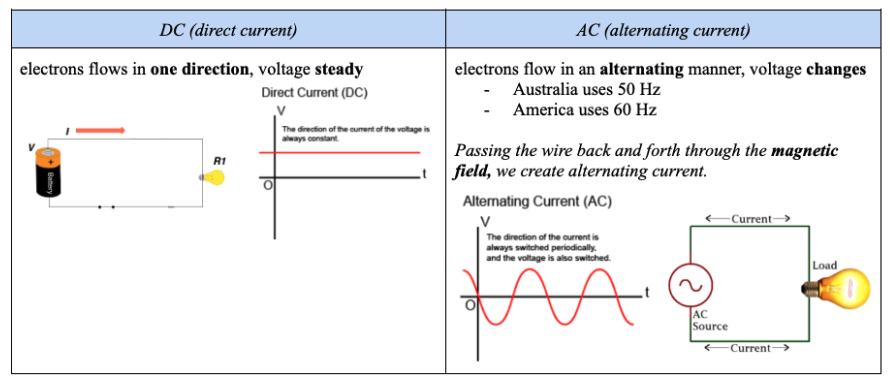
definitions of capacitors?
A capacitor stores energy (similar to a battery) BUT only stores electrons
Charging and discharging energy
Maintaining the voltage at the same level
Filtering - removing noise
A capacitor is an electronic device made up of 2 metal plates and an insulator (called dielectric - material can be gases, oils, ceramics, and resin).
Electric charge builds up between the 2 plates, before being “discharged” through the rest of the circuit.

what are capacitors controlled by in terms of frequency?
A capacitor can be thought of as a variable resistor whose value is controlled by the applied frequency.
As the AC frequency ↑ = ↓ of the opposition to current or its capacitive reactances = easier the flow of electricity through the capacitors.
why do we store energy in capacitors?
Power to most equipment comes via 240V Alternating Current.
50 times/s there is 0 current flowing.
= So, if AC current is being used, without capacitors they would also stop 50 times/s
what is capacitance and factors that influence it?
ability of an object to store an electrical charge.
The capacitance of a capacitor is affected by:
the area of the plates
the distance between the plates
ability of the dielectric to support electrostatic forces

what are inductors? what is faraday’s law of induction? how do they produce electrical flow? what are 2 key factors inductors do?
the production of current in a conductor as it moves through a magnetic field.
Consists of: an insulated copper wire wrapped around a core.
A magnet produces lines of magnetic force. Iron filings align themselves along the invisible lines of flux.
Due to Faraday's Law of Induction:
if you take a wire and move it back and forth in a magnetic field, you cut across the lines of flux.
The magnetic field pushes on electrons in the metal.
Copper has 27 electrons, the last two in the orbit are easily pushed on to the next atom.
= This movement of electrons is electrical flow.
Inductors (opposite to a capacitor)
oppose fast changing (or high frequency) currents
allow slowly changing (or low frequency) currents to pass with little opposition.
what are resistors?
Resistors have a specific, never-changing electrical resistance.
limits the flow of electrons through a circuit.
Used to:
reduce current flow
adjust signal levels
to divide voltages
bias active elements
terminate transmission lines
A resistor equally opposes DC currents and AC currents of all frequencies
what is electrical impedance?
Impedance (Z) is the total opposition that an electronic component, circuit, or system offers to AC and/or DC current
Includes resistance and reactance
what is resonance and electrical resonance?
Resonance: when an object or system is subjected to an external force or vibration that matches its natural frequency.
Electrical Resonance: occurs in an electric circuit at a particular resonant frequency when the impedance or admittance of circuit elements cancel each other → impedance is at a minimum and the current is at a maximum.
E.g turning on a radio: When we turn the knob to tune in a station, we are changing the natural frequency of the receiver's electrical circuit to match the transmission frequency of the radio station
what are band pass filters? and the 2 types? what do they let go through?
a filter that only allows a band of frequencies to pass
E.g vocal tract acts as a filter allowing small bands of frequencies to pass and strongly attenuating all other frequencies. These peaks or resonances were the formant frequencies.
A formant: is a concentration of acoustic energy around a particular frequency in the speech wave.
Low pass filter: allows easy passage to low frequency signals and difficult passage to high frequency signals.
Allows for higher cutoff frequencies = cuts off the higher frequencies
High Pass filter: allows easy passage to higher than cutoff frequency signals and difficult passage to lower frequencies signals.
what are amplifiers? what type of feedback loop do they use?
(def.) electronic devices which amplify signals (voltages, currents or power).
used in wireless communications and broadcasting, and in audio equipment of all kinds (like hearing aid)
can also be present as components of an electrical circuit.
Positive Feedback Loop | Negative Feedback Loop |
a small portion of the output is added to the input. | In negative feedback, a small portion of the output is subtracted from the input. Negative feedback stabilises the gain of the amplifier.
|
what is the formula for gain?
Gain = Voltage ouput / Voltage input
what is distortion of amplifiers? when does it happen?
Pure signal always has a single frequency component where voltage varies positive and negative by an equal amount.
If this variation is less than full 360o cycle = the signal is distorted.
The unwanted alterations generated during amplification = distortion.