CH 5 electrostatics and dynamics (physics)
 Call Kai
 Learn
 Practice Test
 Spaced Repetition
 Match
 Flashcards
 Knowt Play
1/73

There's no tags or description
Looks like no tags are added yet.
74 Terms
x-ray imaging converts _______ into ________ energy
electricity, into electromagnetic energy.
in an x-ray tube the x-ray ______ are the electromagnetic energy
photons
electric charge comes in discrete units that are _____ or _______
positive or negative
this electrical charge is associated with electrons that orbit the nucleus. electrons are free to travel of one atom to another. electron is equal to one unit of ____ charge.
negative charge
this is associated with protons. these protons are subatomic particles that are fixed inside the nucleus of an atom and not free to move. one proton has one unit of ______ charge
positive charge
if something is said to have a positive charge it is actually just less ______. it does not gain protons it just has less electrons.
negative
this is the study of stationary or resting electric charges and the forces between them. ex static electricity. charges don’t flow in a current they build up then discharge.
electrostatics
just like protons these are fixed inside the nucleus but unlike protons they do not have a charge
neutrons
a ______ atom has the same number of electrons and protons
neutral atom
an object is said to be _____ if it has too few or too many electrons
electrified
all discussions dealing with electric charge deal with ______ electric charges since electrons are free to travel
negative
this is an atom or molecule that’s total number of electrons are not equal to the number of protons, so it has a net positive or negative charge. (taking away an electron, like during ionization makes atom positive)
ion
this is the moving or shifting or electrons. we need this to make x-rays
electricity
what are the five laws of electrostatics
-like charges repel, unlike charges attract
-concentration of charges on curved surfaces of a conductor is greatest where curvature is greatest.
-electric charges reside on the external surface of conductors (it is uniform due to attraction/repulsion)
-electrostatic force between two charges is proportional to the product of their quantities but inverse to the square distance between them.
-only negative charges can move in solid conductors.

what law of electrostatics does this diagram show?
the first. like charges repel and unlike charges attract.
this is a tiny imaginary charge used to probe the electric field, it is almost always positive.
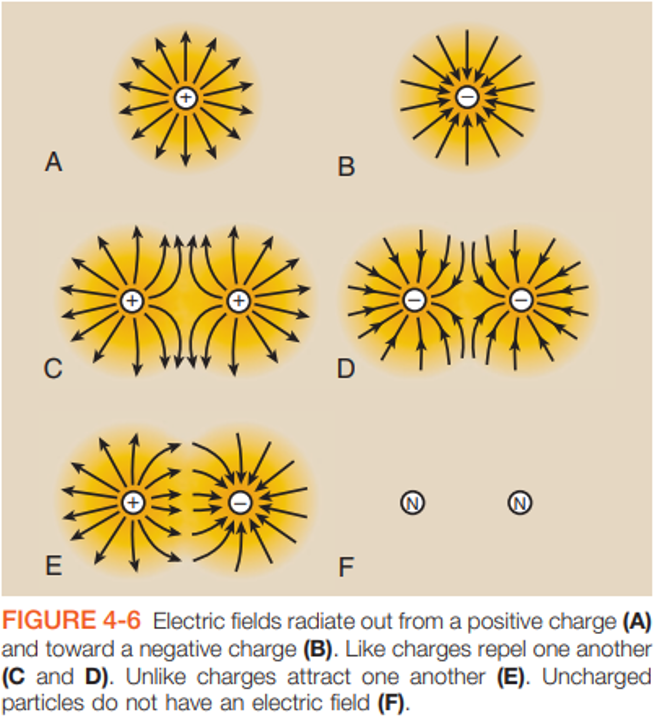
it is why in this diagram the electric fields radiate out from the positive but in to the negative.
test charge

electric charges on a conductor concentrate at the sharpest curve since the negative charges repel each other. this can cause undesirable discharge in x-ray tube or ______ radiation as well
extrafocal
an object that can accept electric charges from an electrified object. earth is an example. good for when you have excess negative charge since all the electrons are trying to repel each other.
electric ground

what electrostatic law does this demonstrate
electric charges reside on the external surface of a conductor. (if it is a non conductor book says charges are uniform throughout)
the force of attraction between unlike charges or repulsion between like charges is due to electric field. it is called ______ _____
electrostatic force
electrostatic force between two charges is proportional to the product of their quantities. ex if charge is greater than the repelling or attracting force will also be greater
Coulomb’s Law
electrostatic force is inversely proportional to the square of the distance between charges
inverse square law
only negative charges can move freely in solid conductors this is because protons are _____ bound
tightly bound within the nucleus
this is adding or removing electrons from a body of matter (not just an atom) meaning it ends up with an excess or deficiency of electrons. process of giving an object charge.
electrification
this is a material in which electrons move freely. like silver, gold, copper, or aluminum. allows electrification to occur.
conductor
tungsten is a _____ conductor which is why it is good as filament
poor
this is any material that does not allow electron flow. it resists the flow of electric current or heat. examples are rubber, glass, ceramic, plastic. it can block or reduce conduction
insulator
this is a material that does not conduct electricity at all. most material conducts some current if voltage is high enough. so this is moreso a synonym for the perfect insulator. examples are wood and wool (electrons are tightly bound to atom)
non-conductor
this is three ways that electrification (process of giving an object charge) can be created
friction (simplest most fundamental)
contact
induction
The removal of electrons from one object by rubbing with another of a different kind. ex you walk on a carpet the electrons from it rub off onto your socks. now you are move negatively charged. these excess electrons want to discharge
friction
in this when an object is charged and it touches an uncharged object the uncharged object will be left with that charge. for example a negative charged object touches a neutral object, an electron goes to neutral object making it negative. or positively charged object touches neutral object it will get an electron from the neutral which is now left positive.
contact
charged objects confer or exchange some kind of charge on any ______ object it comes in contact with
uncharged.
if net positive object comes into contact with a neutral object the neutral object will become ______
positive
if net negative object comes into contact with neutral object it will make neutral object ______
negative
An uncharged metallic object experiences a shift of electrons when brought into the electric field of a charged object.
induction
If a neutral metallic body is brought into the field of a negatively charged object (not in contact with) The excessive negative charge will cause the negative electrons in the neutral body to repel and move away from the negatively charged body (shift). the once neutral body will stay positive if there is a ground. once it is removed the neutral object will be _______
positive
in induction the charged body exchanges the ______ charge to the metallic (neutral) body
opposite
grounding prevents…
shock, fire, electrical damage
electric charges have ____ ____ or the ability to do work when they fly apart.
potential energy
this is the unit of electric potential. the higher this is the greater the potential to do work in US it is 110 ____ x ray requires 220 __ or higher (kind of like how much push is available to move electrons)
voltage (V)
this is the study of electric charges in motion. without this we would not have current for x-rays
electrodynamics
electrons moving in the same direction is called ______ _______
electric current
this is usually used in MRI. it is a substance that exhibits no resistance to electron flow below a critical temperature (Tc) (niobium, titanium). at room temp all material resist flow of electrons as temp decreases so does resistance.
superconductor
material that can act as a conductor in some conditions or as an insulator under other conditions. (CT and DR use this) silicon, germanium
semiconductor
the _____ ______ acts as an insulator in the x-ray tube
glass envelope
three ways to increase resistance in an electric circuit
smaller diameter conducting wire (wire gauge)
insert different material (circuit elements) like rubber
increase length of wire
when resistance is controlled and a conductor is made into a closed path this is the result
electric circuit
increasing resistance leads to a ______ electric current
reduced
this is proportional to the number of electrons flowing in the electric circuit. it is measured in amperes. 1 ampere equals 1C flowing through the conductor each second. affected by resistance and voltage.
Current
there is always something to slow electrons down (current) this is the opposition to the flow of electrons. measured in ohm’s
resistance
electric potential measured in volts. electrons that have a high potential energy have a high capacity to do work. if this is higher in a tube it means we get higher energy and faster electrons.
Voltage
what is the formula for voltage across a circuit
V=IR
the manner in which electric currents behave in an electric circuit is described by _____ ____. the voltage across circuit is equal to the current times the resistance.
ohm’s law
resistance and current (amperes) have an ______ relationship
inverse
voltage and amperes have a _____ relationship
direct
name the two basic types of electrical circuits
series and parallel
this circuit is designed to send electrons through various resistance devices by linking them one after the other. ex old christmas lights one goes out so do the rest.
series circuit

this type of circuit is designed by giving each component an individual branch ex new christmas lights have their own path to the power source
parallel circuit

how do you find resistance (ohm’s) in a series circuit?
you add all of them together. R1 + R2 etc.
how do you find total current (A) in a series circuit?
current will be the same so if I1=25 A then I2=25 A etc total current will be 25 A
how do you find total voltage in a series circuit?
you add all the voltage together. so V1+V2+V3 . reason voltages are different is due to voltage drop.
this is the voltage difference between two ends of the resistor when current flows through it.
voltage drop
how do you find the current (A) in a parallel circuit?
you add all the current together. since each current has its own branch
how do you find voltage in a parallel circuit?
voltage is going to be the same. So if voltage is 12V then it is 12 across the battery since each branch is directly connected to the source and does not have to pass through multiple resistors.
how to find resistance in a parallel circuit
the total is the inverse of the sum of the reciprocals of each individual resistance. and it will always be less then the smallest individual resistor. so 1/R1 + 1/R2 + 1/R3= 1/Rt
this description of electronic circuits shows flow going from positive to negative. it was the original assumption of electricity.
conventional current
this shows flow going from negative to positive it is the actual flow
electron flow
when electrons flow in one direction along the conductor. voltage and current stay the same over time.
direct current

most applications of electricity require this. it is when electrons oscillate back and forth. they flow first in one direction and then in the opposite direction. they alternate between positive and negative 60 times per second 60 hertz in a house.
alternating current

this graph can describe direct current. vertical seperation between voltage and time represents magnitude of the voltage.
voltage waveform
voltage waveform for alternating current is a _____ _____
sine curve
this is the amount of energy transferred or converted per unit of time. rate energy is used, transferred or converted. Measured in Watts which is equal to one joule per second.
Power
what is the formula for electrical power
P=IV where I is the current in amperes and V is the voltage. (remember ohm’s law that V=IR if you need to find voltage)
if you increase current or voltage you increase ______
power