13.5 Synapses
 Call Kai
 Learn
 Practice Test
 Spaced Repetition
 Match
 Flashcards
 Knowt Play
1/90

There's no tags or description
Looks like no tags are added yet.
91 Terms
What needs to happen for the impulse to reach the CNS or an effector?
the impulse often needs to be passed between several neurones
Synapse?
The junction between two neurones (or a neurone and effector)
How are impulses transmitted across the synapse?
using chemicals called neurotransmitters

Synapse structure: 1?
myelin sheath
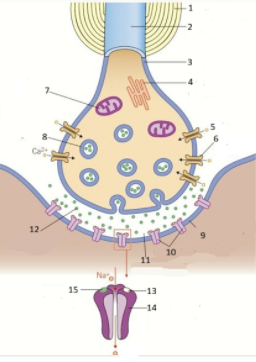
Synapse structure: 2?
axon of presynaptic neurone
Synapse structure: presynaptic neurone?
neurone along which the impulse has arrived

Synapse structure: 3?
membrane of presynaptic neurone
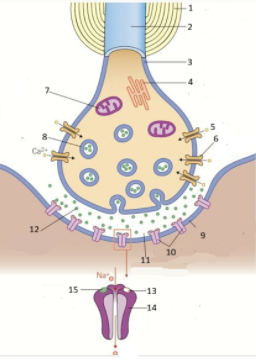
Synapse structure: 4?
smooth endoplasmic reticulum
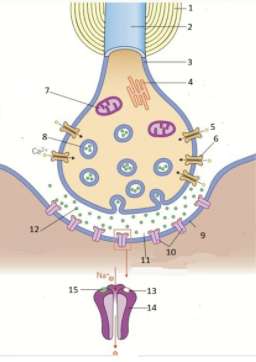
Synapse structure: 5?
Ca2+

Synapse structure: 6?
calcium ion channel
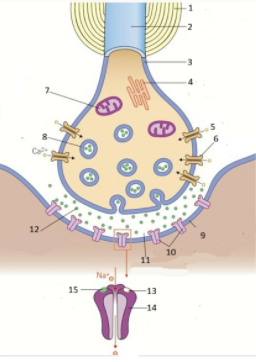
Synapse structure: 7?
mitochondrion
Synapse structure: synaptic knob?
the swollen end of the presynaptic neurone. It contains many mitochondria and large amounts of endoplasmic reticulum to enable it to manufacture neurotransmitters (in most cases)

Synapse structure: 8?
synaptic vesicle (containing acetylcholin)
Synaptic vesicles?
vesicles containing neurotransmitters - The vesicles fuse with the presynaptic membrane and release their contents into the synaptic cleft

Synapse structure: 9?
membrane of postsynaptic neurone
Synapse structure: postsynaptic neurone?
neurone that receives the neurotransmitter
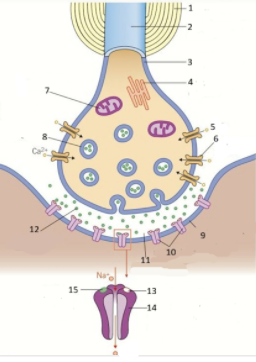
Synapse structure: 10?
sodium ion channels

Synapse structure: 11?
synaptic cleft
Synapse structure: synaptic cleft?
the gap which separates the axon of one neurone from the dendrite of the next neurone
Synapse structure: size of synaptic cleft?
It is approximately 20-30 nm across

Synapse structure: 12?
neurotransmitters (acetylcholine molecule)
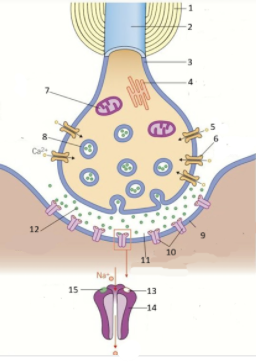
Synapse structure: 13?
empty receptor site
Synapse structure: Neurotransmitter receptors?
receptor molecules which the neurotransmitter binds to in the postsynaptic membrane

Synapse structure: 14?
One of five protein sub-units that make up the sodium ion channel
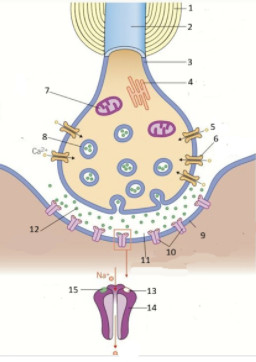
Synapse structure: 15?
acetylcholine molecule in receptor site
Why is this synapse known as a cholinergic synapse?
the neurotransmitter which passes across the synapse is acetylcholine
The two types of neurotransmitter?
Excitatory and inhibitory
Excitatory neurotransmitters: what do they do?
These neurotransmitters excite the post-synaptic neurone
Excitatory neurotransmitters: example?
Acetylcholine
Inhibitory neurotransmitters: what do they result in?
hyperpolarisation in the post-synaptic neurone
Inhibitory neurotransmitters: what does hyperpolarisation in the post-synaptic neurone prevent?
an action potential being triggered
Inhibitory neurotransmitters: example (that can be found in some synapses in the brain)?
Gamma-aminobutyric acid (GABA)
Transmission across the synapse - 1: where does the action potential reach?
the end of the presynaptic neurone
Transmission across the synapse - 2: what does Depolarisation of the presynaptic membrane cause?
calcium ion channels open
Transmission across the synapse - 3: where do calcium ions diffuse?
into the presynaptic knob
Transmission across the synapse - 4: what does this cause synaptic vesicles containing neurotransmitters to do?
to fuse with the presynaptic membrane
Transmission across the synapse - 4.2: how is the Neurotransmitter released into the synaptic cleft?
by exocytosis
Transmission across the synapse - 5: what happens to the neurotransmitter?
diffuses across the synaptic cleft and binds with its specific receptor molecule on the postsynaptic membrane
Transmission across the synapse - 6: what does this cause to open?
sodium ion channels
Transmission across the synapse - 7: what does this trigger in the post-synaptic neurone?
(Sodium ions diffuse into the postsynaptic neurone) which triggers an action potential and the impulse is propagated along the postsynaptic neurone
Transmission across the synapse - 8: what do enzymes break down?
any leftover acetyl choline, and also remove it from the receptor molecules
Once a neurotransmitter has triggered an action potential in the postsynaptic neurone, why is it important that it is removed?
so the stimulus is not maintained, and so another stimulus can arrive at and affect the synapse
Therefore, what do enzymes do to any neurotransmitter left in the synaptic cleft (e.g. Acetycholine)?
breaks it down and removes it
Where are the products taken after being released from the receptors on the postsynaptic membrane?
taken back into the presynaptic knob
Why is Removing the neurotransmitter from the synaptic cleft important (2)?
prevents the response from happening again and allows the neurotransmitter to be recycled
What neurotransmitter do Cholinergic synapses use?
the neurotransmitter acetyl choline
Where are Cholinergic synapses common?
in the CNS of vertebrates and at neuromuscular junctions
Neuromuscular junctions?
where a motor neurone and a muscle cell (an effector) meet.
What does Acetyl Choline trigger (If the neurotransmitter reaches the receptors on a muscle cell)?
it will cause the muscle to contract
What is Acetylcholine released from?
the vesicles in the presynaptic knob
Acetylcholine then diffuses across the synaptic cleft where it binds with specific receptors in the postsynaptic membrane - what does this trigger?
an action potential in the postsynaptic neurone or muscle cell
Once an action potential has been triggered what happens to acetylcholine?
it is hydrolysed
What is acetyl choline hydrolysed into?
choline + ethanoic acid
What hydrolyses acetyl choline?
a specific enzyme - acetylcholinesterase
Where is acetylcholinesterase situated?
on the postsynaptic membrane
How many molecules of acetylcholine can acetylcholinesterase break down per minute?
around 25 000 molecules
Where are the breakdown products taken?
back into the presynaptic knob to be reformed into acetylcholine (and the postsynaptic membrane is ready to receive another impulse)
Cholinergic synapse transmission - 1: where does an action potential arrive?
at the end Of the presynaptic neurone
Cholinergic synapse transmission - 1.2: what does this arrival of an action potential cause to open?
calcium ion channels to and calcium ions (Ca2+) enter the synaptic knob

Cholinergic synapse transmission - 2: what is released into the synaptic cleft (due to the influx of calcium ions into the presynaptic neurone causing synaptic vesicles to fuse with the presynaptic membrane)?
causes the release of the neurotransmitter acetylcholine
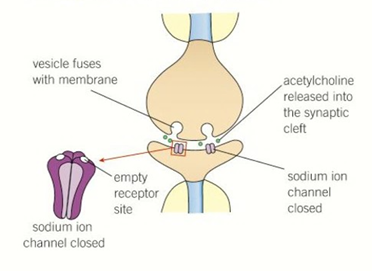
Cholinergic synapse transmission - 3.1: what do Acetylcholine molecules fuse with?
receptor sites on the sodium ion channel in the membrane of the postsynaptic neurone
Cholinergic synapse transmission - 3.2: what does acetylcholine molecules fusing with receptor sites on the sodium ion channel in the membrane of the postsynaptic neurone cause?
the sodium ion channels to allowing sodium ions (Na+) to diffuse in rapidly along a concentration gradient

Cholinergic synapse transmission - 4: what does this influx of sodium ions initiate?
an action potential in the postsynaptic neurone

Cholinergic synapse transmission - 5: what does Acetylcholinesterase hydrolyses acetylcholine into?
choline and ethanoic acid (acetyl)
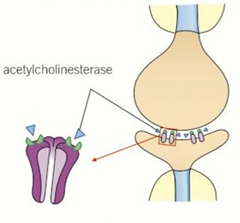
Cholinergic synapse transmission - 5.2: how is the choline and ethanoic recycled?
diffuse back across the synaptic cleft into the presynaptic neurone
Cholinergic synapse transmission - 5.3: what does the breakdown of acetylcholine also prevent?
prevents it from continuously generating a new action potential in the postsynaptic neurone
Cholinergic synapse transmission - 6: how are choline and ethanoic acid recombined into acetycholine?
ATP released by mitochondria is used
Cholinergic synapse transmission - 6.2: where is this acetylcholine stored for future use?
in synaptic vesicles

Cholinergic synapse transmission - 6.3: why do sodium ion channels close?
in the absence Of acetylcholine in the receptor sites
A specialized cholinergic synapse?
A neuromuscular junction - the postsynaptic cell is a skeletal muscle fibre instead of another neurone
Transmission across a neuromuscular junction - 1: where does an action potential arrive?
at the end of a motor neurone, at the neuromuscular junction
Transmission across a neuromuscular junction - 2: what does this action potential cause the release of?
the neurotransmitter acetylcholine
Transmission across a neuromuscular junction - 3: what does the release of the neurotransmitter acetylcholine initiate?
an action potential in the muscle cell membrane (Sarcolemma)
Transmission across a neuromuscular junction - 4: what is this action potential carried quickly into the large muscle cell by?
invaginations in the cell membrane called T-tubules
Transmission across a neuromuscular junction - 5: what does the action potential cause to release its store of calcium ions into the myofibrils?
the sarcoplasmic reticulum
Transmission across a neuromuscular junction - 6: what does Ca2+ cause to be displaced?
causes tropomoysin to be displaced
Transmission across a neuromuscular junction - 7: what does tropomoysin being displaced uncover?
myosin binding sites on actin
Transmission across a neuromuscular junction - 8: what can now attach and take place?
Myosin cross bridges can now attach and the cross bridge cycle can take place
Transmission across a neuromuscular junction: what is the reverse of these steps?
relaxation
Role of synapses: what do they ensure about impulses?
that they are unidirectional
Role of synapses: why is it good they ensure impulses are unidirectional?
the neurotransmitter receptors are only present on the postsynaptic membrane, so impulses can only travel from the presynaptic neurone to the postsynaptic neurone
Role of synapses: what can they allow?
an impulse from one neurone to be transmitted to a number of neurones at multiple synapses
Role of synapses: what does allowing an impulse from one neurone to be transmitted to a number of neurones at multiple synapses result in?
a single stimulus creating a number of simultaneous responses
Role of synapses: what may a number of neurones feed into?
the same synapse with a single postsynaptic neurone
Role of synapses: what does a number of neurones feeding in to the same synapse with a single postsynaptic neurone result in?
stimuli from different receptors interacting to produce a single result
Summation?
if the amount of neurotransmitter builds up sufficiently to reach the threshold then this will trigger an action potential
Two types of summation?
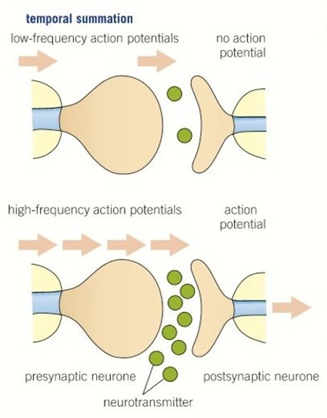
Spatial summation and Temporal summation
Spatial summation: when does it occur?
when a number of presynaptic neurones Connect to one postsynaptic neurone
Spatial summation: how does it occur?
each presynaptic neurone releases neurotransmitters which builds up to a high enough level in the synapse to trigger an action potential in the single postsynaptic neurone

Temporal summation: when does it occur?
when a single presynaptic neurone releases neurotransmitter as a result of an action potential several times over a short period
Temporal summation: how does it happen?
the neurotransmitters build up in the synapse until the quantity is sufficient to trigger an action potential