INTB TEST 2
 Call Kai
 Learn
Learn Practice Test
 Spaced Repetition
 Match
Match Flashcards
 Knowt Play
1/107

There's no tags or description
Looks like no tags are added yet.
Name | Mastery | Learn | Test | Matching | Spaced | Call with Kai | Chat |
|---|
No analytics yet
Send a link to your students to track their progress
108 Terms
ethical dilemma
Situation in which there is no ethically acceptable solution.
ethics
Accepted principles of right or wrong that govern the conduct of a person, the members of a profession, or the actions of an organization.
business ethics
Accepted principles of right and wrong governing the conduct of businesspeople.
ethical strategy
Course of action that does not violate a company’s business ethics.
Leon Sullivan
An African-American minister and General Motors board member
Sullivan’s principles
firms were expected to refuse participation in apartheid (segregation) within their own workplaces and to use their influence to push for the system’s end.
Quote - I think everyone is like me but they are not
“Don’t look in the mirror and see the world”
Mustafa story
PB & J - African man who had a job at Ed’s factory "nuts and berries"
Beer story
Ed chugged bottle of beer in China - ethnocentric behavior
cross-cultural literacy
Understanding how the culture of a country affects the way business is practiced.
How does Edward Taylor define culture
“that complex whole which includes, knowledge, belief, art, morals, law, custom, and other capabilities acquired as a member of society.”
culture
System of values and norms that are shared among a group of people and that when taken together constitute a design for living.
values
Abstract ideas about what a society believes to be good, right, and desirable.
norms
Social rules and guidelines that prescribe appropriate behavior in particular situations.
society
Group of people who share a common set of values and norms.
William Graham - 2 norms categories
folkways and mores
folkways
Routine conventions of everyday life. conventional routines, manners, behaviors, dress. If people violate them- its not a big deal, they are just kind of weird
Mores
Norms seen as central to the functioning of a society and to its social life.
greater moral signfigance - theft, adultry, for ex. Saudi Arabia → alc = jail , tomorrow = next week
Determinants of culture
Social Structure
Language
Political Philosophy
Religion
Economic Philosophy
Education
social structure
The basic social organization of a society.
Highly stratified societies -
Castes are strong - India - People’s opportunities are tied with their background
Low stratified societies-
Castes are not strong - United States - Background doesn’t impact opportunities
group
An association of two or more individuals who have a shared sense of identity and who interact with each other in structured ways on the basis of a common set of expectations about each other’s behavior.
What’s important in Japan?
The group - group oriented culture
social strata
Hierarchical social categories often based on family background, occupation, and income.
Social stratification
trait of society, not a reflection of individuals differences
carries from one generation to the next
generally universal but variable
involves not just inequality but also beliefs
social mobility
The extent to which individuals can move out of the social strata into which they are born.
caste system
A system of social stratification in which social position is determined by the family into which a person is born, and change in that position is usually not possible during an individual’s lifetime.
class system
A system of social stratification in which social status is determined by the family into which a person is born and by subsequent socioeconomic achievements; mobility between classes is possible.
strongest caste system in the world
India - IT sector + rural India
class consciousness
Tendency for individuals to perceive themselves in terms of their class background. This perception shapes their relationships with members of other classes.
Religions-
Christianity - 2.2 billion
Islam - 1.6 billion - don’t charge interest
Hinduism - 1.1 billion
Buddhism - 0.5 billion
Guanxi
Chinese- relationships/connections valuing social hierarchy and reciprocal obligations
Guanxiwang
“relatonship network” - legal rules can be bent/broken
Why did the video say that women worked in factories?
Easy to manage
Geert Hofstede
psychologist - worked for IBM - did a study on employee attitudes and values
power distance
less powerful members of society accept and expect that power is distributed unequally.
high power distance societies
hierarchy is seen as natural and legitimate - strong respect for authority ex. China low = US
individualism versus collectivism
focused on the relationship between the individual and others - individual achievement is highly valued - collectivism: ties are tight, born into collectives, good of everyone
uncertainty avoidance
Extent to which cultures socialize members to accept ambiguous situations and to tolerate uncertainty.
motivation towards achievement and success
extent to which individuals are drive to attain high performance, excel in competition, and obtain visible markers of accomplishment
long-term versus short-term orientation
culture programs its citizens to accept delayed gratification of their material, social, and emotional needs. It captures attitudes toward time, persistence, ordering by status, protection of face, respect for tradition, and reciprocation of gifts and favors.
criticisms of Hofestede’s work
not accurate - only had US and European workers
gender bias could have impacted this
all his subjects worked at IBM
Global Leadership and Organizational Behavior Effectiveness (GLOBE)
designed to address the notion that a leader’s effectiveness is contextual
World Values Survey (WVS)
spanning more than 100 countries that explores people’s values and norms and how they change over time
ethnocentrism
Behavior that is based on the belief in the superiority of one’s own ethnic group or culture; often shows disregard or contempt for the culture of other countries.
Tragedy of the Commons
a resource owned in common is compromised by an individual or group. ex. cigarette butts on the high way
Global Tragedy of the Commons
moving your production to a place where there is no law against your pollutant/compromising behavior ex. climate change bc of pumping out chemicals
Foreign Corrupt Practices Act (FCPA)
U.S. law regulating behavior regarding the conduct of international business in the taking of bribes and other unethical actions.
Noblesse Oblige
honorable, benevolent (beneficial) behavior is the responsibility of all successful companies.
FCPA - Facilitating payments, speed money, grease payments
legal payments that are used in the course of business to ensure that a company receives the treatment that they deserve and is common.
Convention on Combating Bribery of Foreign Officials
OECD standard to criminalize bribery in international business
Bribe
Payment made for preferential treatment.
Roots of Ethical Behavior
personal ethics
decision-making processes
organizational culture
Unrealistic performance goals
societal culture
leadership
organizational culture
Values and norms shared among an organization’s employees.
camel ride story
guy from UAE - won a camel race and won a range rover
Ethics
in the mind of the beholder
Straw Men
the ethics theories are easy to criticize because they give weak guidance for real decisions.
Friedman doctrine
a company’s main duty is to earn profits as long as it obeys the law.
cultural relativism
Belief that ethics are culturally determined and that firms should adopt the ethics of the cultures in which they operate.
cultural relativism quote
when in rome, do as the romans do
righteous moralist
One who claims that a multinational’s home-country standards of ethics are the appropriate ones for companies to follow in foreign countries. (you follow your home country’s ethics)
naive immoralist
One who asserts that if a manager of a multinational sees that firms from other nations are not following ethical norms in a host nation, that manager should not either. (if firms from other nations are not following host nation norms you don’t either)
utilitarian approaches to ethics
The moral worth of your actions is based on the consequences
Kantian ethics
people are not machines they deserve dignity and respect
The sheik story
the sheik goes to KY to make horse deals - has a massive 747 plane that doesn’t fit on the runway - the guy just pays the fine
rights theories
Twentieth-century theories that recognize that human beings have fundamental rights and privileges that transcend national boundaries and cultures.
Universal Declaration of Human Rights
United Nations document that lays down the basic principles of human rights that should be adhered to.
just distribution
Distribution of goods and services that is considered fair and equitable. John Rawls: veil of ignorance
sister story -
owes $5000 for car dealership - moral dilemma
Doug Evans
hired african american man to put company in his name - didn’t pay him - guy cashed a check - doug got mad- doug got arrested
golf story
Jack needed to sell thing to Al to get bonus in certain time - jack signed for al - rob got fired
Phoenix International
sued because its for profit
Best decisions from utilitarianism perspective:
those that produce the greatest good for the greatest number of people
moral agent
Any person or institution that is capable of moral action such as government or corruption
7 actions an international business can take to make sure ethical issues are considered:
hiring and promoting people w good ethics
build org. cultre and leadership w good behavior
decision-making process in place that require people to consider ethical dimension
institute ethics officers
develop moral courage
corporate social responsibilities a cornerstone
pursue strategies that are sustainable
code of ethics
A business’s formal statement of ethical priorities.
Is this decision ethical? Must be yes to all
Does my decisions fall within accepted values and standard in my org?
Am I willing to see the decision communicated to all stakeholders?
Would this make my fam. proud?
5 step process to think through ethical problems
1. business people should identify which stakeholders a decision would affect and in what ways
2. involves judging the ethics of the proposed strategic decision
3. requires management to establish moral intent
4. requires the company to engage in ethical behavior
5. requires the business to audit its decisions
Ethics officers
High-ranking individuals responsible for managing their organization's ethics and legal compliance programs
Corporate social responsibility (CSR)
Idea that businesspeople should consider the social consequences of economic actions when making business decisions
Sustainable strategies
Strategies that help a firm make profits without harming the environment and acting in a socially responsible manner
Confucianism
Loyalty, reciprocal obligations, honesty
Precautionary principle
States that when scientific knowledge is insufficient, inconclusive, or uncertain, potentially dangerous actions should be postponed
gains from trade
when countries specialize in the production (and export) of goods and services that they can produce most efficiently, while importing goods and services that they cannot produce so efficiently from other nations.
free trade
The absence of barriers to the free flow of goods and services between countries.
new trade theory
The observed pattern of trade in the world economy may be due in part to the ability of firms in a given market to capture first-mover advantages.
factor endowments
A country’s endowment with resources such as land, labor, and capital.
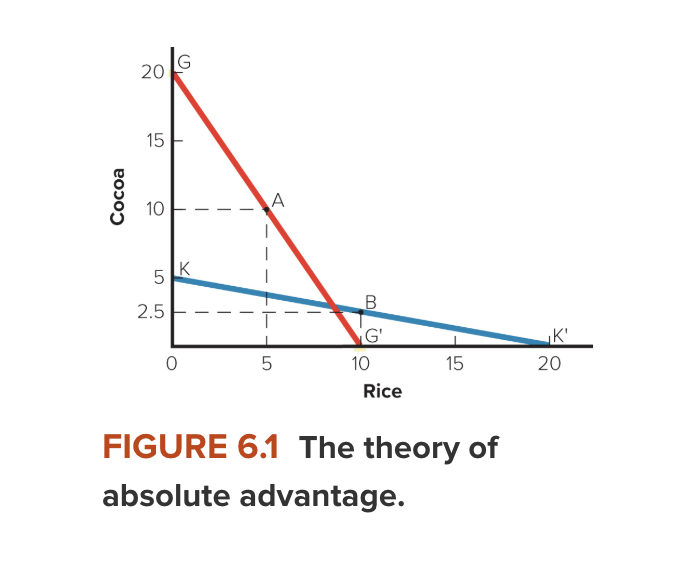
absolute advantage
A country has an absolute advantage in the production of a product when it is more efficient than any other country at producing it.

Comparative advantage
An economy's ability to produce a particular good or service at a lower opportunity (less efficiently) than its trading partners. David Ricardo
The conclusion that free trade is universally beneficial is a rather bold one to draw from such a simple model. Our simple model includes
l. We have assumed a simple world in which only two countries and two goods exist. The real world includes many countries and many goods.
2. We have assumed away transportation costs between countries.
3. We have assumed away differences in the prices of resources in different countries. We have said nothing about exchange rates, simply assuming that cocoa and rice could be swapped on a one-to-one basis.
4. We have assumed that resources can move freely from the production of one good to another within a country. In reality, this is not always the case.
5. We have assumed constant returns to scale; that is, that specialization by Ghana or South Korea has no effect on the amount of resources required to produce I ton of cocoa or rice. In reality, both diminishing and increasing returns to specialization exist. The amount of resources required to produce a good might decrease or increase as a nation specializes in production of that good.
6. We have assumed that each country has a fixed stock of resources and that free trade does not change the efficiency with which a country uses its resources. This static assumption makes no allowances for the dynamic changes in a country's stock of resources and in the efficiency with which the country uses its resources that might result from free trade.
7. We have assumed away the effects of trade on income distribution within a country.

constant returns to specialization
The units of resources required to produce a good are assumed to remain constant no matter where one is on a country’s production possibility frontier.
Heckscher–Ohlin theory
comparative advantage comes from factor endowments (land, labor, captial) Countries export what they have a lot of and import what they're short on.
Mercantilism
An economic philosophy advocating that countries should simultaneously encourage exports and discourage imports.
Zero-sum game
A situation in which an economic gain by one country results in an economic loss by another.
Leontief paradox
the United States—the world's most capital-abundant country—exported labor-intensive goods and imported capital-intensive goods
The Product Life Cycle Theory
As demand rises & US exports more, it becomes smarter to produce offshore and become an importer of the product you create. ex. young guy cutting grass
New Trade Theory (2)
Trade increases variety + lowers price
Only a few firms will survive, first mover advantage is important.
New Trade Theory
economies of scale dictate trade pattern
economies of scale
Cost advantages associated with large-scale production.