microbioLAB #3: Basic Lab and Culture Techniques
 Call Kai
 Learn
Learn Practice Test
 Spaced Repetition
 Match
Match Flashcards
 Knowt Play
1/27

There's no tags or description
Looks like no tags are added yet.
Name | Mastery | Learn | Test | Matching | Spaced | Call with Kai | Chat |
|---|
No analytics yet
Send a link to your students to track their progress
28 Terms
What is sterilization?
Sterilization is the process of
rendering a medium or material free of all forms of life.
What are the Five different techniques?
autoclave
dry-heat sterilization
ultraviolet (uv) radiation
ethylene oxide gas
filtration
autoclave
is a use of pressure chamber to sterilize
equipment supplies oat 121 degree and 15 lb of pressure
for 15 min or longer of pressure, conditions under which
microorganisms will not survive, even endospores
Dry-heat sterilization:
- glassware such as pipettes and petri plates are placed in an
electric oven at 160 -170 degrees for 2 hours.
3. Ultraviolet (UV) radiation:
what can it not sterilize?
- Use of radiation at 260 nm to sterilize air and exposed surfaces.
- UV can’t be used to sterilize glass, water, and other substances
4. Ethylene oxide gas:
- Microbicidal and sporicidal.
- It is used for heat-sensitive material such as plastics
5. filtration:
Bacteriological filter when media is made from components that will not withstand heating at high temperature.
Bacteriological filter removes bacteria and larger microorganisms from the solution using a membrane with 0.22 mm pores.
Microbiological Media
what is media?
what are the physical forms of media?
What is the purpos for each?
Media : nutrient preparations that are used for culturing
microorganisms.
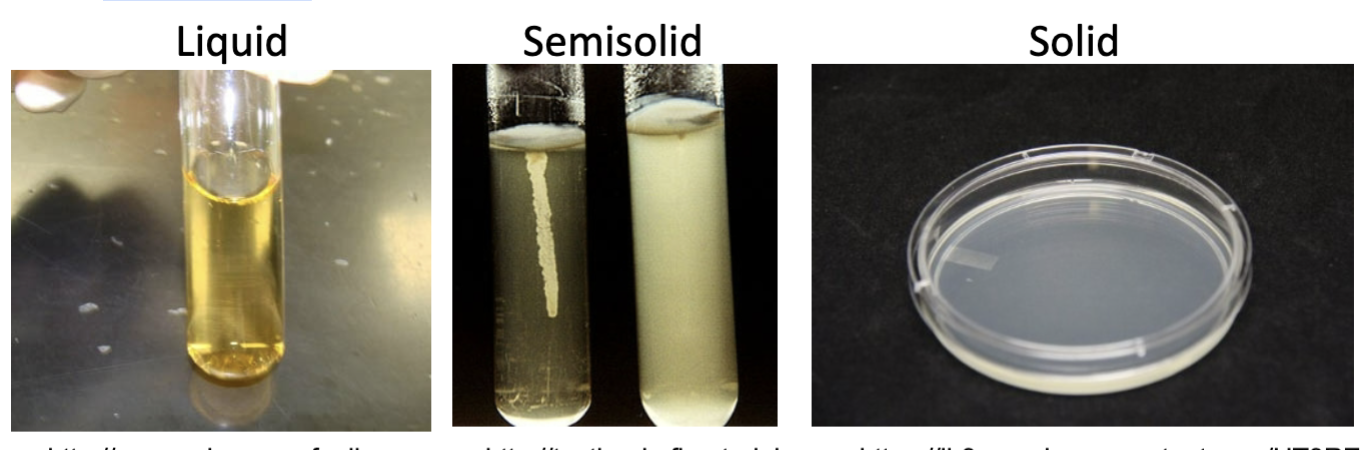
Three physical forms of media:
1- Liquid or broth
to propagate large numbers of microorganisms.
2- Semisolid contains Agar
to determine bacterial motility and promote anaerobic growth.
3- Solid contains Agar
a) for surface growth of microorganisms in order to observe colony appearance
b) for pure culture isolation
c) for storage of cultures
d) observe specific biochemical reactions
Making solid media
In a liquified state, media is poured into
1. Test tube for agar slants and agar deep tube.
2. Petri dish- for agar plate.
3. Liquid media-broth tube, this shows turbid solution of bacterial cell growt
Liquid agar + test tube = slant/deep
Liquid agar + Petri dish = plate
Liquid media WITHOUT agar + tube = broth
And turbid = cloudy, which means bacteria have grown in the broth.
look at image for making solid media
Microbiological Media
what are the two diff media used to culture microorganisms?
Two different media used to culture microorganisms
1- Chemically defined or synthetic - known amounts of pure
chemicals
2- Complex or non synthetic media - complex materials rich in vitamins and nutrients usually beef extract, yeast extract and
peptones
how is sterile media made?
When lab personnel make media they measure out
a quantity of dry powdered nutrient media, add
water and check the pH.
They dispense the media into bottles, cap it and
autoclave. This is a process similar to home canning
techniques in food preservation.
The autoclave exposes the media to high
temperature (121°C) and pressure (15 psi) for 20
minutes.
Once the media is autoclaved (or pressure cooked)
it is considered sterile (all life forms killed)
Bacteria and other microbes have particular requirements for growth. in order to successfully grow bacteria in lab,we must provide an environment suitable for growth. HOW/what do u need?
whats media?
whats TSA?
Growth media (singular = medium) are used for microbial growth.
Media = mixtures of nutrients that the microbes need to live.
Also provides a surface and the necessary moisture and pH to support microbial growth.
Tryptic Soy Agar (TSA) is the media that we often use
Complex nutrient media which supports the growth of a wide variety of microbes
Culture Transfer Instruments and Techniques
pipette
inoculating loop
Pipette: instrument used to transfer aliquots of culture.
Pipettes ranges 20-200 ul and 100-1000 ul
Down to the 1st level then 2nd level to eject.
Inoculating loop: transfers microorganisms from 1 media to
another.
how to use micropipettes

spread plate technique:
- Label with a Sharpie the BOTTOM of the Agar plate.
- Pipette a 100 ml volume of a bacterial mixture
onto the center of an agar plate.
- Spread evenly over the surface with a sterilized spreader until the liquid
is absorbed.
- Invert the plate and incubate at 37 degrees for 24-48 hours
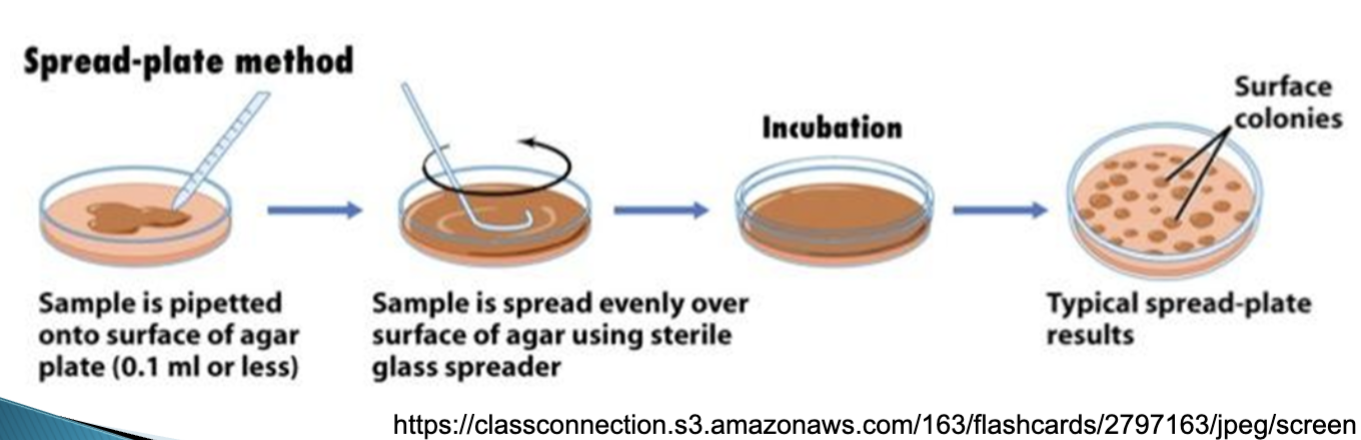
spread plate technique
Bacterial mixture is transferred to the edge of an agar plate
with an inoculating loop and spread in a specific pattern.
This creates a diluted gradient (most colonies in the 1st
section to the least in the last).
pure culture Can be developed from colonies well isolated
contaminatin of a streak plate is caused by what?
leaving the plate open too long or not shielding properly with the lid
whats the purpose of streaking? principle?
purpose—to obtain pure, isolated colonies
principle—by spreading a large amt of bactria over the large surface of a plate, the amt of bacteria is diluted until individual cells are spread on the surface of the plate. Ea individual cell grows into a single colongy. all of the cells in this colony are genetically identical
Ea species of bacteria produces a distinctive colony appearance.
Streaking = spreading bacteria out to separate individual cells.
Individual cell → grows into a colony → colony contains genetically identical bacteria → gives you a pure culture.
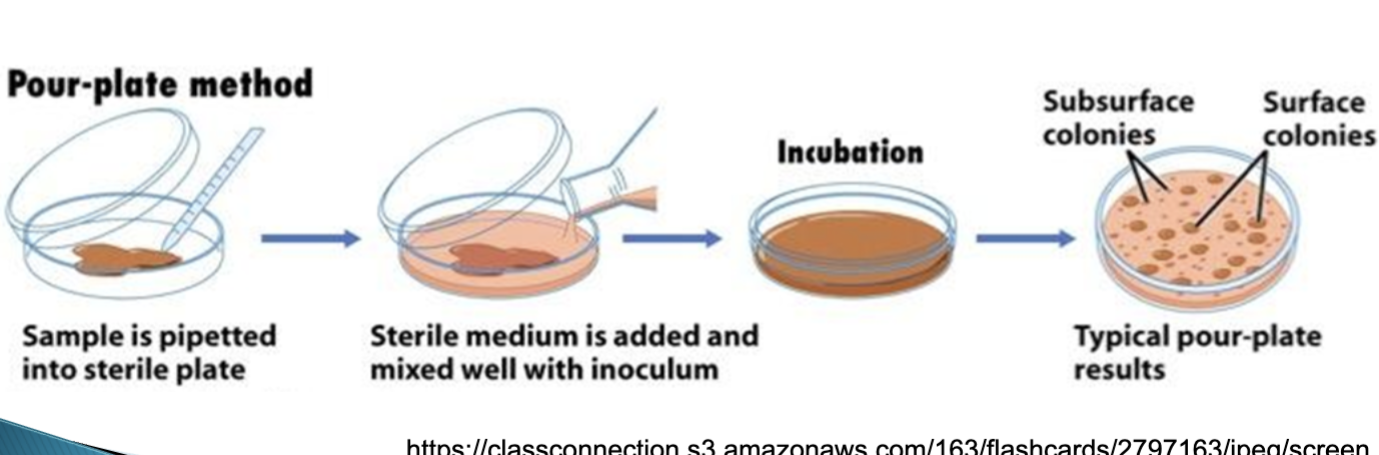
the pour plate technique is used for what?
bacteria and fungi
in pour plate technique the original sample is diluted many times because?
diluted many times to yield isolated colonies
pour-plate method
Culturing: serial dilution
Serial dilution- lowering the concentration of substance in a
stepwise fashion or a series of dilution. The dilution is constant
between each step. Helps to quantify them amount cells in culture

Dilution equation for culturing: serial dilution
Dilution = (vol transferred/final vol) x initial dilution
To convert from uL to mL
To convert from mL to uL
divide by 1000
multiply by 1000
Dilution Calculation Example:
1st dilution is 50 μl of undiluted bacterial culture is added to 4.95 ml of saline solution
2nd dilution 50 μl of 1st dilution (10-2) is added to 4.95 ml of saline solution
FIRST DILUTION
undiluted bacteria = 50 uL bacteria
add 50 uL to 4.95 mL saline
1) first convert 50 uL to mL
50 ÷ 1000 = 0.05 mL
2) find total volume to find final volume
4.95 mL + 0.05 mL = 5.00 mL
3) Use the dilution formula
= (vol transferred)/(final vol) x initial dilution
= (0.05)/(4.95+0.05) x 1←undiluted culture
= 0.01 =10^-2 ←100-fold dilution
SECOND DILUTION
= (0.05)/(4.95+0.05) x 0.01←fr first dilution
= 0.0001 = 10^-4 ←10,000-fold dilution
final plate should have between how many colonies?
25-250
number of colonies = what?
= number of live bacteria that grow = CFU colony forming units
CFU/ml = number of colonies in the plate x dilution factor