physio 1
 Call Kai
 Learn
Learn Practice Test
 Spaced Repetition
 Match
Match Flashcards
 Knowt Play
1/62

There's no tags or description
Looks like no tags are added yet.
Name | Mastery | Learn | Test | Matching | Spaced | Call with Kai | Chat |
|---|
No analytics yet
Send a link to your students to track their progress
63 Terms
A typical feedback loop that regulates our physiology may involve
A) a sensor
B) an integrating center
C) target cells
D) a stimulus
E) All of the above
e) all of the above
neurotransmitters are stored and released from
A) axon terminals.
B) vesicles near the axon terminus.
C) dendritic spines.
D) cell bodies.
E) A and B
E) a and b
Hormones rely on the ______ system in order to be transported to target cells
A) Endocrine
B) Trophic
C) Feedback
D) Circulatory
D) circulatory
Based on Fick’s law the rate of diffusion across a membrane will increase if the
A) The size of the molecule decreases
B) The concentration gradient decreases
C) The size of the molecule increases
D) The molecule is less lipid soluble
A) the size decreases
The loss or slowing of the rapid withdrawal reflex can be associated with
A) Blows to the head causing neural degeneration in the primary motor cortex.
B) Decreased sensory-motor integration by the thalamus
C) Loss of myelination in the ascending tract of the spinal cord
D) myelin degeneration in spinal interneurons
E) None of the above
E) none of the above
Graded potentials may
A) initiate an action potential
B) depolarize the membrane to the threshold voltage
C) hyperpolarize the membrane
D) generate excitatory or inhibitory signals in the cell body of neurons
E) All of the above
E) all of the above
Which of the following is a way for solutes in an aqueous solution to move from an area of low solute concentration to an area of high solute concentration?
A) Simple diffusion
B) osmosis
C) active transport
D) none of the above
C) active transport
The force generated by a single muscle fiber
A) is always the same.
B) can be increased by decreasing the frequency of action potentials.
C) can be increased by increasing the velocity of the contraction.
D) depends on the overlap between actin and myosin filaments
D) depends on the overlap
For spatial summation to occur in the cell body of a neuron, one presynaptic neuron increases frequency of depolarization until a threshold level is reached.
A) True
B) False
B) false
Which of the following would decrease the delay between an action potential reaching the neuromuscular junction and the generation of force in a muscle cell?
A) Decrease the concentration of Ca+2 in the sarcoplasmic reticulum
B) Increase the amplitude of the action potential
C) Decrease the distance between the sarcoplasmic reticulum and troponin
D) Decrease the length of the actin filaments
C) decrease distance between sarcopalsmic reticulum and troponin
The purpose of transverse tubules (t-tubules) is to
A) ensure a supply of Ca2+ ions through the muscle fiber.
B) rapidly conduct action potentials to the interior of the muscle fiber.
C) ensure a supply of glycogen throughout the muscle sarcoplasm.
D) conduct ATP molecules out of the mitochondria throughout the sarcoplasm.
E) All of the above are true.
C) ensure supply of glycogen throughout the muscle sarcoplasm
A newly discovered neurotoxin is found to slow the opening of voltage-gated sodium channels. What effect does this substance have on the function of neurons?
A) The start of the repolarization (falling) phase is delayed.
B) Depolarization will have to depend on voltage-gated potassium channels
C) The rate of membrane depolarization will be slower
D) Action potentials will propagate in the wrong direction
C) the rate of membrane depolarization will be slower
The autonomic nervous systems consists of two _______ branches which induce
opposing effects on _______ .
A) sympathetic; neurotransmitters
B) parasympathetic; receptors
C) antagonistic; target cells
D) somatic; muscle cells
C) somatic, muscle cells
The brain region known to regulate numerous homeostatic functions is the
A) Thalamus
B) Hippocampus
C) Hypothalamus
D) Cerebellum
E) Medulla oblangata
C) hypothalamus
If a muscle fiber is using glucose as a fuel, it could be a
A) Slow oxidative fiber
B) Fast oxidative fiber
C) Fast glycolytic fiber
D) Each of these answers can be true
E) None of these answers are true
D) each can be true
homeostasis
a set point our body wants to return to. Internal and external changes result in loss of homeostasis.
extracellular fluid vs intracellular
extracellular makes up 1/3 of our bodies liquid, and includes plasma and interstitial fluid. high sodium low potassium
intracellular makes up 2/3 of our bodies liquid. high potassium low sodium
if disequilibrium between these two is not preserved, the cell will die. both 300 mOsm/L
red blood cell in hypotonic solution
less ions on outside than inside, cell is lysed (bursts) water is moved into the cell
red blood cells in isotonic
normal cell, equilibrium
red in hypertonic solution
more solutes outside the cell than in, cell will shrivel
Fick’s law of diffusion
rate of diffusion is proportional to surface area, conc gradient, and memb permeability
membrane proteins
communicatins/signaling: structural proteins, enzymes, membrane receptor proteins
transport: channel proteins, carrier proteins
channel proteins (gated vs open membrane transporters)
create a water-filled pore. gated channels open and close in response to signals. open channels are usually open.
carrier proteins, three types
never form an open channel between the two sides of the membrane
uniport (transport only one kind of substrate, glu transport), symport (moves two substrates in the same direction, SGLT), and antiport (move substrates in opposite directions, needs ATP so its an active transport )
signaling pathways- basic cascade
___ binds to___activates____alter____creates____
signal molecule binds to membrane protein receptor, which activates intracellular signaling molecules, which alter target proteins and create a response
types of local communications between cells
gap junctions: direct connection between cells
contact dependent signals: cell on the left reaches for receptor of cell on the right, could be through integrin
autocrine/paracrine signals: autocrine cell is stimulating itself, paracrine one cell to the next through extracellular fluid
long distance communication between cells
endocrine system: signal moves through blood stream touching cells regardless of if they have a receptor, and eventually reaches is target which accepts the signal (slower but longer lasting)
nervous stem: neurotransmitter sends electric signal through neuron directly to the target cell (specific and very fast)
what can hormones alter
existing proteins (rate of rxn, etc), gene expression and protein synthesis (ie. membrane permeability)
polypeptides vs steroids
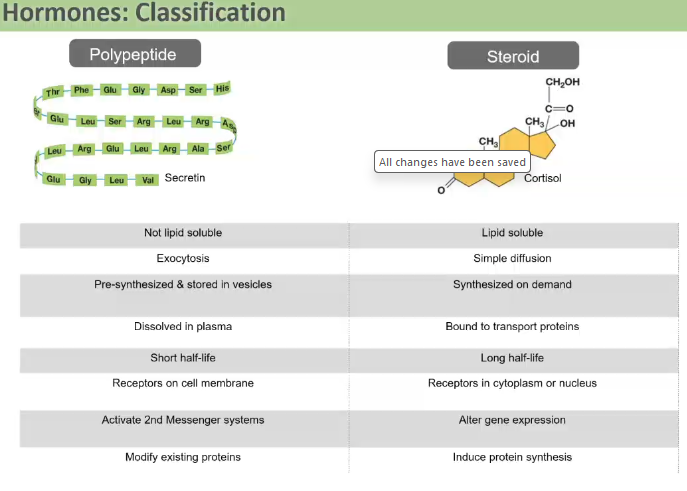
prohormone (for polypeptides)
has an extra tail to prevent the hormone from being read in the cell its created in.
preprohormone has another tail that must be cut off that will tell the ER it is leaving the cell eventually. after pre is removed the prohormone goes through golgi and is put in vesicle to leave the cell. in vesicle, pro is removed
hormone interactions: permissiveness, synergism, antagonism
permissiveness: one hormone enhances cellular responses to another hormone
synergism: the combines effect of multiple hormones exceeds the sum of their individual efforts
antagonism: one hormone decreases the effect of the other
trophic hormone
endocrine regulation of hormone release, often involves the hypothalamus-anterior pituitary axis
endocrine pathologies: hypersecretion and hyposecretion, target cell pathologies
hyper: excess hormone secretion, loss of feedback regulation, excessive production
hypo: deficient hormone secretion, loss in production
target cell: loss/down-regulation of target cell receptor, transduction of signal
Glial cells
nervous system: support cells
astrocyte: surrounding neurons; keep them pristine
oligodendrocytes: central nervous system, mylonated
Schwann cells: peripheral nervous system, myelinated
Stem cells: lead to other cell types
neurons
cell body is like most cells, axon is the long membrane extension through a narrow space, at the end of axon is the postsynaptic neuron to communicate with another cell. axons have myelin sheaths (prevent charge loss)
dendrites extend off body and increase surface area
axon hillock is the integrating center for the neuron, will trigger action potential
Nernst Equation
Eion= (61/z) log (ion out/ ion in)
resting membrane potential -70m/V as potassium leaks out
phases of na/k action potential
once the polarize membrane of -70 reaches the threshold of -50, all of the sodium voltage gated channels open and rapid depolarization happens. to eventually repolarize, potassium channels open. peak at +30
rapid depolarization of membrane potential during the rising phase of an action potential is caused by
opening of a Na+ channels, initiating a positive feedback loop
how to resist current/charge loss (this increases signal strength over longer distance)
large axons (faster) and myelinated. action potentials occur in nodes, then graded potential flows through myelinated space to next node
myelin degeneration
can result in loss of function (multiple sclerosis, myelitis, leukodystrophy)
types of synapses
electrical (found in CNS, smooth muscle, cardiac muscle) (gap junction)
Chemical (most prevalant, ionotropic-fast uses ligand, metabotrophic-slow, g protein receptor ) (needs atp/vesicles))
events at the synapse and exocytosis
axon terminal depolarized by action potential
2- depolarization opens voltage gated Ca2+ channels and Ca2+ enters the cell
calcium entry triggers exocytosis of synaptic vesicle contents
neurotransmitter diffuse across synaptic cleft and binds the receptors
ionotropic receptors
ligand gated ion channels are specialized protein complexes in cell membranes that open a pore to let ions pass through when a chemical messenger binds to them
metabotrophic
membrane-bound receptors that indirectly modulate cellular and ionic activity through G-protein-coupled signaling cascades rather than forming an open ion pore themselves
true or false: ionotrophic synapses are always excitatory
false
disruption of synaptic transmission
neurotoxins target synapse and distrupt transmission (ie bacteria, sea snakes)
also a symptom of many neurological disorders (depression, schizo, alzheimer’s)
white matter vs gray matter
white matter has myelinated axons, and contains very few cell bodies
gray matter is loaded with cell bodies, and contains lots of dendrites/axon terminals
control centers of brain (frontal lobe, parietal lobe, occipital lobe, cerebellum, thalamus, medulla oblongata, pons, temporal lobe, pituitary, hypothalamus)
primary motor cortex, somatic sensory cortex, visual cortex, movement coordination, sensory motor integration, control of involuntary functions, respiratory control, auditory/olfactory/gustory, hormone secretion, equilibrium)
hypothalamus functions
activates sympathetic nervous system (fight or flight)
maintains body temp
controls body osmolarity
controls reproductive functions
controls food intake
influences cardiovascular control centrer in medulla oblongata
regulates release of hormones from the pituitary gland
spinal cord anatomy: dorsal root ganglion and ventral root
outside the central spinal cord, afferent signals in through dorsal and efferent out through ventral root
spinal cord anatomy: visceral sensory nuclei and somatic sensory nuclei
in dorsal horn, info integrated here
spinal cord anatomy: descending tract and ascending tract
descending is coming back from the brain, ascending is entering the brain
antagonistic branches: parasympathetic vs sympathetic
parasympathetic: rest, relax, homeostasis, more controlled and specific responses
sympathetic: causes global response, body aligned to do one thing. ganglia close to spinal cord
types of muscle (skeletal, cardiac, smooth
skeletal: striated, sarcomere, multi-nucleated, fastest twitch speed, somatic motor
Cardiac: striated, sarcomere, uninucleated, intermediate twitch speed, autonomic motor
smooth: internal organs, oblique bundle uninucleated, slowest twitch speed, autonomic
actin chain activation
when calcium binds to troponin it helps move tropomyosin out the way
muscle contraction pathway
neuromuscular junction (must have 2 acetyl-coA bound), excited contraction coupling, sends Ca2+ signal, and makes contraction-relaxation cycle. leads to muscle twitch and sliding filament theory
in response to a depolarization of the t-tubles, the ryanodine receptor channels open causing
calcium to be released from the sarcoplasmic reticulum
during a skeletal muscle contraction-relaxation cycle ATP is needed to
binding to myosin heads to allow for cross-bridge detachment and removing CA2 from the cytoplasm back into the sarcoplasmic reticulum
length-tension muscle relationship
the # of crossbridges will determine the tension (intermediate length is where most crossbridges are, and actin and myosin have the most overlap)
intrinsic property (structure of sarcomere)
force-velocity relationship: shortening= contraction
isotonic contractions (length/time) . takes longer to shorten muscle the more mass you add. more force means more cross-bridges
the nervous system regulates muscle force…
through changes in action potential frequency
changing # of muscle cells activated
motor unit recruitment
motor unit recruitment
small mu (slow twitch) makes up 30% intermediate (intermediate twitch) makes up another 30% and the large mu (fast twitch) makes up for the remaining 40%
more mysosin heads in large motor units
more myoglobin in small motor units as they require oxygen
fiber types
fast twitch, maximum amount of force but occurs very quickely
intermediate twitch, medium force about twice as long
slow twitch, low force movement but longest life