Genetics 3 End of Ch9
 Call Kai
 Learn
 Practice Test
 Spaced Repetition
 Match
 Flashcards
 Knowt Play
1/61

There's no tags or description
Looks like no tags are added yet.
62 Terms
Transfer RNAs define/describe
Transfer RNAs (tRNAs) carry specific amino acids and match with mRNA code with an anticodon. Short single-stranded RNAs
What is an anticodon
A complement to an mRNA codon on mRNA
What bond connects tRNA and a specific amino acid
Covalent
Discuss the three levels of tRNA structure
Primary structure: Nucleotide sequence
Secondary structure: Due to base pairing/hydrogen bonding of short complementary sequences within the tRNA. Cloverleaf shape
Tertiary structure (L shape) is formed by 3-dimensional folding
Does the amino acid attach to the 3’ or 5’ end of tRNA? What function group is on that end?
3’ end with an OH/hydroxyl
What is aminoacyl-tRNA synthetase?
It recognizes a specific amino acid and the structure features of its corresponding tRNA to connect them
What recognizes a specific amino acid and the structure features of its corresponding tRNA to connect them?
Aminoacyl-tRNA synthetase
Discuss the structure of aminoacyl-tRNA synthetase
It has three pockets, the three pockets are for
Glycine only
tRNA only
ATP only
Discuss the process of charging tRNA
An aminoacyl-tRNA synthetase has three pockets for a specific amino acid, ATP, and a specific tRNA
The specific amino acid is phosphorylated by ATP
The phosphorylated amino acid is attached to the tRNA
Discuss the experiment/process that proved tRNAs are specific
tRNA with cystine has a specific anticodon for cystine and mRNA codon for cystine
Treatment with nickel hydride modifies the cystine to alanine on the tRNA, but keeps the anticodon and codon the same
Everywhere that cystine was expected in a polypeptide chain, there is alanine
What is wobble with tRNA?
Some tRNAs can recognize more than one codon. There is flexibility in base pairing between 3’ nucleotides in the codon and 5’ nucleotide in anticodon.
What does wobble in tRNA do?
It enables tRNAs to recognize all possible codons
Describe the specificity of the (3’) first, second, and third (5’) nucleotide in anticodon
1st and 2nd are very specific, 3rd/5’ is the wobble position

A:
5’ CGC 3’
What are the different ways that tRNA bases can be modified
Modified U
xm5 = Adding a carbon based tag
Different in prokaryotes and eukaryotes
s2 = Adding sulfur
o5 = An oxygen atom is directly attached
Modified A
Addition of oxygen
Modified C
Ribosomes are composed of ??? and ???
Ribosomes are composed of proteins and ribosomal RNAs (rRNAs)
What is the role of ribosomes with polypeptide synthesis?
Recognize mRNA features that signal the start of translation
Coordinate movement of tRNAs to match genetic instructions oof mRNAs, stabilizing both molecules to complete translation.
Supply enzymatic activity to link amino acids and move 5’ to 3’
Facilitate termination
What direction do ribosome move in polypeptide synthesis
5’ to 3’
What bond do ribosomes use to link amino acids?
Peptide bonds
Describe the difference between ribosome structure for eukaryotes and prokaryotes
Eukaryotic ribosomes are larger and more complex
The LSU has 3 RNA and more protein
What is the difference between the LSU and SSU in ribosomes?
LSU has more protein and RNA than SSU
The genes of the SSU evolve more slowly and are very important, so modifications can have large effects
Discuss the unit “S”, how it related to ribosomes
S is the measure of particle size, mass, and shape
Measured different parts of the ribosome to see how mych time it took to sediment
Discuss the different parts of a ribosome and functions
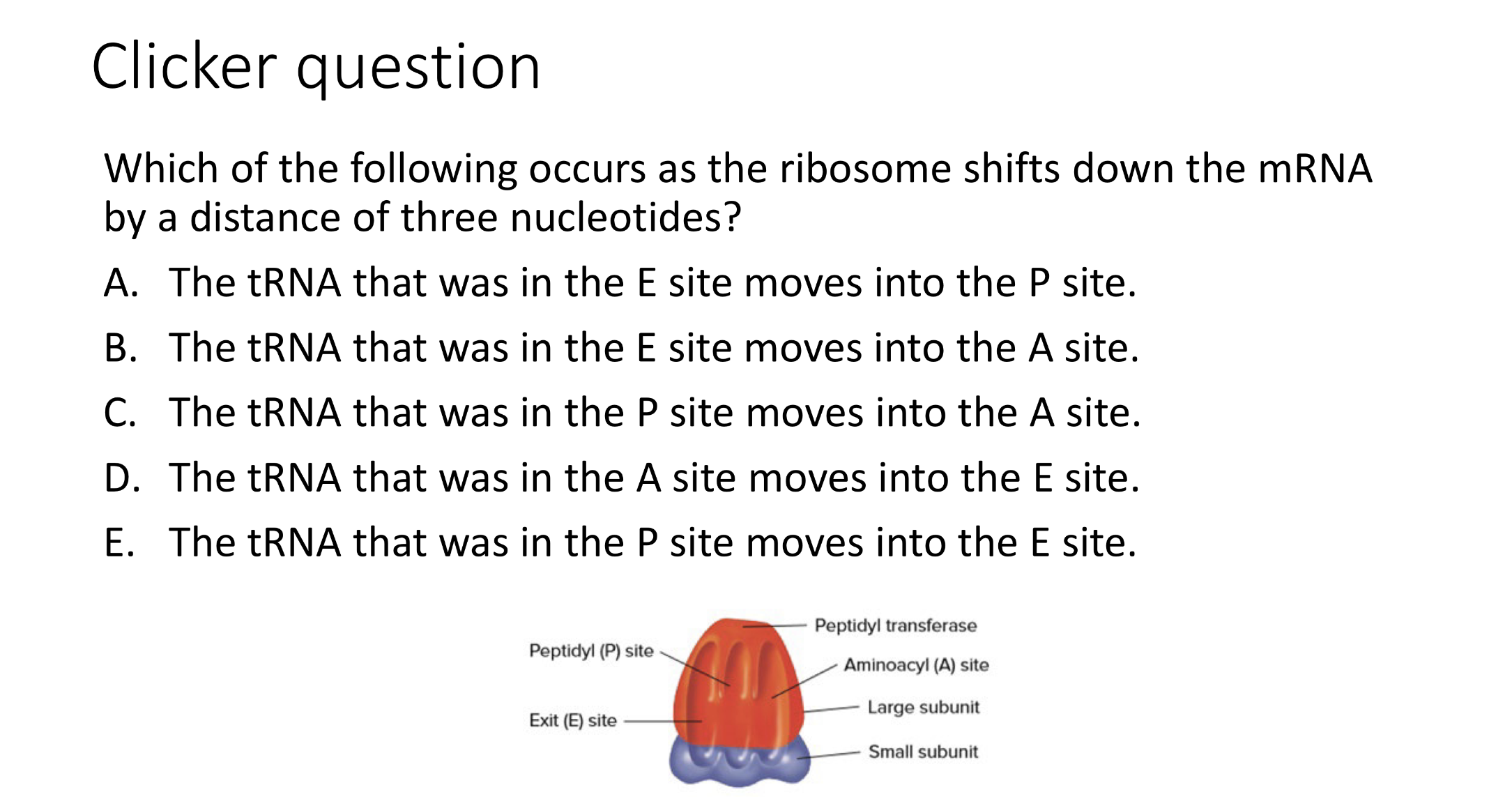
Large subunit:
Has peptidyl transferase activity and catalyzes the formation of peptide bonds
Small subunit:
Binds to mRNA
In Both:
Exit (E) site
Peptidyl (P) site
Aminoacyl (A) site
Briefly describe the steps of the mechanism of translation for both prokaryotes and eukaryotes
Initiation Stage: Initiator codon is AUG at 5’ end of mRNA
Elongation Stage: Amino acids are added to growing polypeptide. 5’ to 3’ direction
Termination Stage: Polypeptide synthesis stops at the 3’ end of the reading frame
Discuss initiation phase of translation in prokaryotes
Ribosomes bind to the Shine-Dalgarno box and an AUG
Small ribosomal subunit binds to the box at the E-site which establishes the reading frame
fMet-tRNA positioned in P site
Large subunit binds
What is the Shine-Dalgarno box
It is a specific six nucleotide sequence that ribosomes bind to during prokaryotic translation. It is in the 5’ UTR. The small ribosomal subunit has a high affinity for it.
Why is it important for the small ribosomal subunit to bind to the shine-dalgarno box at the E site
It positions AUG with the P site and establishes the reading frame
Discuss initiation phase of translation in eukaryotes
Small ribosomal subunit binds to the methylated 5’ cap
The SSU scans for AUG
Initiator tRNA carries Met and attaches to P-stie
Large ribosomal subunit binds
What is the difference in initiation phase of translation in eukaryotes and prokaryotes?
Establishing the reading frame
Eukaryotes: Methylated 5’ cap establishes
Prokaryotes: Shine-Dalgarno box establishes
Initiator tRNA
Eukaryotes: Met
Prokaryotes: fMet
What is the full name of fMet?
formylmethionine
Discuss elongation phase of translation of mRNAs
Ribosome moves towards the 3’ end of the mRNA
Addition of amino acids to C-terminus of polypeptide
Charged tRNA is put into A site by an elongation factor
Peptidyl transferase creates a peptide bond between the two amino acids
Polyribosome define
Complex of several ribosomes translating the same mRNA
What do polyribosomes allow for?
Simultaneous synthesis of many polypeptide copies from a single mRNA
True or False: When the binding site is free, new translation can be initiated.
True. Multiple ribosomes can attach. It forms a polyribosome
Discuss termination phase of translation of mRNAs
Release factors recognize and bind to stop codons
Release factors are a protein with a strong affinity to stop codons
This leads to the release of the ribosomal subunits, mRNA, and polypeptide
True or False: tRNAs typically have an anticodon for the stop codon
False: No normal tRNAs carry anticodons for the stop codon
What binds to stop codons during translation?
Release factors

D
What are the two different kinds of post translational processing?
Enzymatic cleavage and addition of chemical constituents
What are the three kinds of enzymatic cleavage with translation? Discuss them
N-terminal Met Removal
Very common in prokaryotes
There is a cleavage after fMet, as most proteins do not require fMet
Polyprotein processing
Breaking up a large polyprotein into multiple smaller polypeptides
Zymogen activation
The prosegment of a zymogen is cleaved which activates the protein
Stops digestive enzymes from immediately starting to digest
What is a zymogen?
An inactive precursor of an enzyme that requires activation
What are the four kinds of addition of chemical constituents with translation? Discuss them
Phosphorylation
Addition of phosphate to serine
Phosphorylation = Activates protein
Dephosphorylation = Deactivates protein
Glycosylation
Addition of a sugar to threonine
Used to tag/label as the sugar is specific to the organism. Allows the immune system to recognize it as “self” vs. “nonself”
Lipidation
Addition of fatty acid to N-terminal glycine
Allows protein to connect to membranes
Ubiquitination
Addition of ubiquitin peptides to lysine
The number of added ubiquitins is proportional to the age of the protein
E
What are the 6 differences in transcription in eukaryotes vs. prokaryotes
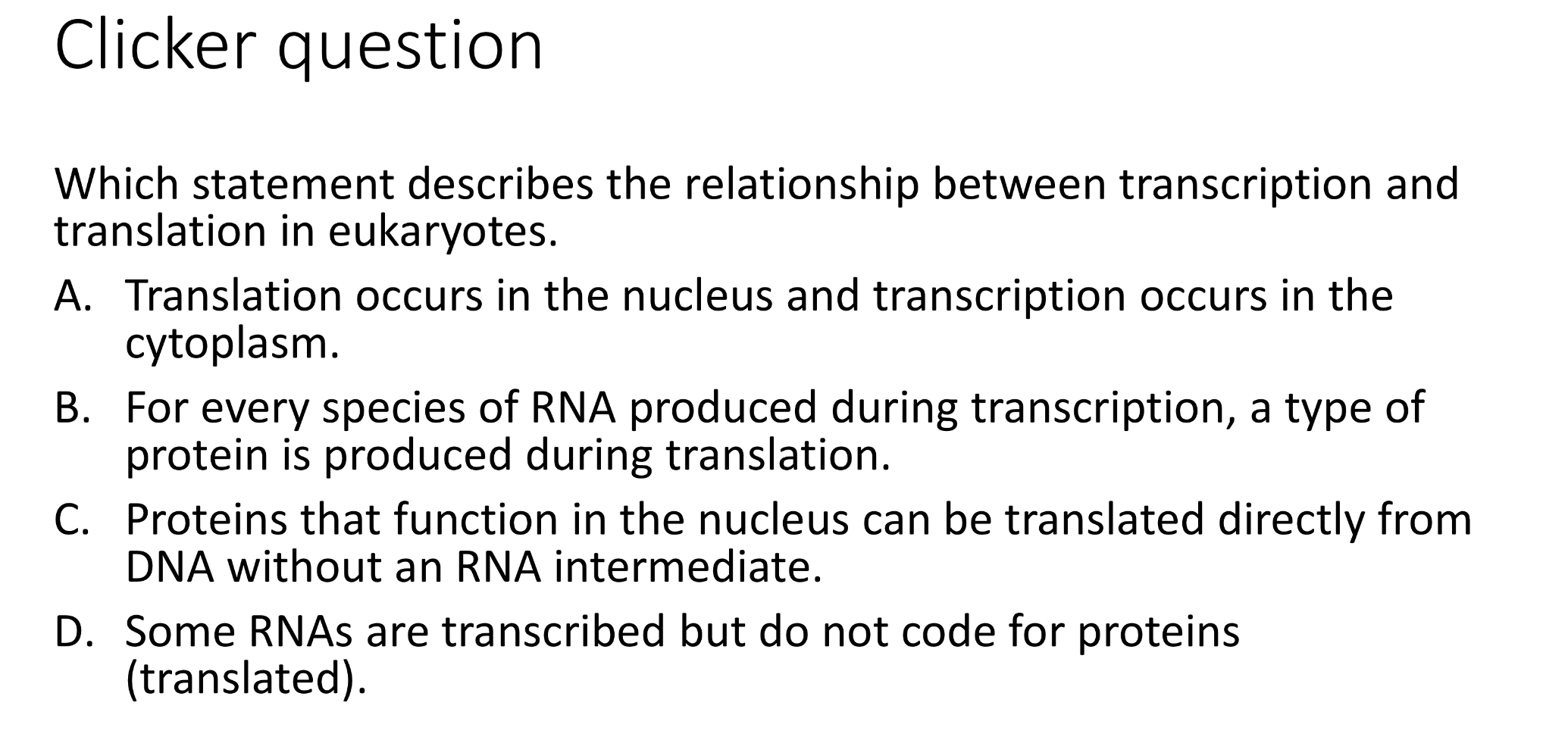
Prokaryotes have no nucleus while Eukaryotes do. Prokaryotes have transcription and translation occurring at the same place and same time
Eukaryotes are divided into introns and exons while prokaryotes are not
Eukaryotes have some parts of gene that are condensed on histones in nucleosomes while Prokaryotes are not wound up in chromatin
In Eukaryotes, they are influenced by enhancers
Prokaryotes have an accessible promoter free of nucleosomes
Eukaryotes have enhancers that clear histones from the promoter
Eukaryotes require splicing, prokaryotes do not
Eukaryotes add the 5’ methylated cap and 3’ poly-A tail, prokaryotes do not
Where is the Shine-Dalgarno sequence found?
In prokaryote mRNA
What are the 3 major differences in translation in prokaryotes and eukaryotes
In prokaryotes, unique initiator tRNA carries formylmethionine, while eukaryotes carry methionine
Prokaryotes are monocistronic or polycistronic. Eukaryotes are always monocistronic
In prokaryotes, mRNAs have multiple ribosome binding sites and can direct synthesis of different polypeptides. In eukaryotes, mRNAs only have one start site and can only synthesize one kind of polypeptide
In prokaryotes, the small ribosomal subunit immediately binds to the mRNA ribosome binding site. In eukaryotes, the small ribosomal subunit binds first to the methylated cap and scans the mRNA to find the ribosome binding site
True or False: Eukaryotes can sometimes be polycistronic
False
Define operon
A functioning unit of DNA containing a cluster of genes under the control of a single promoter
D
What is a conservative mutation?
When the change of amino acid is within the same family/has the same chemical properties
What is nonconservative mutation?
When the change of amino acid is in a different family/has different chemical properties
True or False: Mutations outside the coding sequence have no effect on gene expression
False. Mutations outside the coding seqeunce can disrupt gene expression
Loss-of-function mutant alleles are usually ??? to ???
Loss-of-function mutant alleles are usually recessive to wild-type
Define Null/Amorphic mutations
Completely blocks function of gene product (Ex: Deletion of an entire gene)
Define Hypomorphic mutations
Produces less of wild-type protein, or less effective mutant protein
Diss the mixing of wild-type alleles with a null or hypomorphic mutation

Incomplete dominance define
Phenotype varies continuously with the amount of functional gene product
Some loss-of-function alleles are dominant/recessive to wild-type
Some loss-of-function alleles are dominant to wild-type
Haploinsufficiency define
One wild-type allele does not produce enough gene product to avoid mutant phenotype
What is an example of haploinsufficiency?
GLI3/GLI3+
GLI3+ codes for nonsense mutation in the TF
Gives human polydactyly
Gain-of-function mutations are usually dominant/recessive
Gain-of-function mutations are usually dominant
Hypermorphic mutations define
Generate more gene product or the same amount of a more efficient gene product