MSK Key Concepts
 Call Kai
 Learn
 Practice Test
 Spaced Repetition
 Match
 Flashcards
 Knowt Play
1/50

There's no tags or description
Looks like no tags are added yet.
51 Terms
Convex on concave rule
Move in opposite directions
Example: Surface of convex humeral head moves down the glenohumeral cavity while the bone of the humerus is abducted up)

Concave on convex rule
Glide in the same direction

Isometric muscle contractions
No change in length and no joint motion
Isotonic muscle contractions and specific types
Muscle contractions with a change in length
Eccentric: lengthening (bicep extension)
Concentric: shortening (bicep flexion)
Passive insufficiency
Inability of a muscle to elongate (lengthen) enough to allow a joint to move through its full range of motion
Example: wrist extensors are passively insufficient when the wrist is flexed; cannot flex fingers all the way into a tight fist
Active insufficiency
When muscle fibers are maximally shortened, the muscle cannot contract any further, even if the joint did not exhibit its full range of motion
open packed positioning
The joint surfaces have the least contact, ligaments are relaxed for mobility
closed pack positioning
The bones fit tightly together; ligaments and capsule are taut for max stability
Forces bones to act as a single functional unit
adaptive shortening
What does it mean if you can get PROM but not AROM
Muscular and/or nervous system cannot drive its own movement
Tendon or nerve injury
muscle weakness
If PROM is limited…
the issue is usually structural
contractures, joint capsule stiffness, arthritis or bone changes
Osteokinematics
gross paths of movements of bones and joints that are usually visible
Arthokinematics
smaller, internal movements occuring between surfaces of bones that form joints
Open kinetic chain
free movement of the distal body segment in space, allowing joints to move together or independently of the others
requires less muscle recruitment, prioritizes mobility
Closed kinetic chain
proximal joints are moved in relation to a fixed (nonmoving) distal joint
promote stabilization
Effort (exerted force)
Internal force generated by muscles
Resistance (resistive force)
external forces that must be overcome by effort
Moment/torque
A muscle’s moment is its ability to rotate a joint
Action
The specific motion that a muscle can generate at a specific joint
Agonist
prime mover that generates the most force to produce motion
antagonist
muscle that produces the contrary movement to agonist needs to relax when the agonist is working its magic
fixators/stabilizers
when a muscle contracts, the area of its orgin needs to remain relatively stable
synergist
assist prime movers (ie., brachialis assists biceps in flexion)
force couple
muscles working together, though acting in different directions, to produce the same motion or stabilize a joint
For example, scapular upward rotation, an important component of upper extremity motion, involves forces generated in different directions—as a force couple in synergy—by the upper trapezius, serratus anterior, and lower trapezius
load rate
how quickly force is applied to tissue
the load rate of force applied to body tissue impacts how the tissue responds or, in cases of excessive force, the type of injury that occurs.
Ball and socket joint
most mobile, can rotate in at least three distinct axes
glenohumeral joint

Ellipsoid joint
permits flexion and extension and ABD/ADD around 2 axis
radiocarpal joint
metacarpalphalangeal joints

Hinge joint
just flexion and extension
humeroulnar joint
interphalangeal joints

Saddle joint
Convex and concave articulating surfaces moving around two axes
CMC thumb joint

gliding joint
found between two flat surfaces and allows the least movement, does not move around an axis but translates (glides)
carpal bones
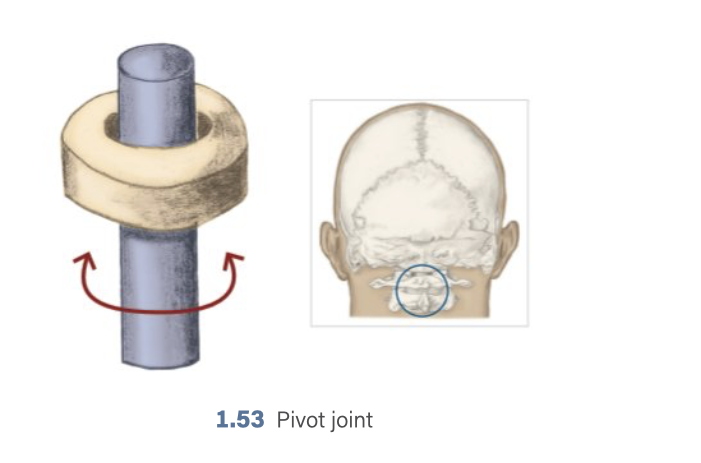
pivot joint
single axis bone rotation
radio ulnar
Stress and strain
Stress: amount of applied force per area (lbs per square inch), independent of amount of material
Also considered load that is in an object
Strain: amount of material displacement (stretch) under specific amount of stress (response to stress)
% change in length
Mechanical stress
How force affects the body during activity or inactivity
Strength vs tensile strength
Strength: ability of a muscle or group of muscles to generate force against resistance
Tensile Strength: max amount of tensile stress (stretch) a material can take before failing
Tension
Forces that pull something apart
Compression
Force applied when something comes together
Shear
Back and forth rubbing motion
Yield point (elastic limit)
When a material begins to deform plastically, the material has reached its yield point and is permanently deformed
Plastic deformation
Goes beyond its yield point, doesn’t return to original shape
Creep
continued deformation (elongation or compression) over time with a constant load (could be a good things if lengthening a contracture)
Loading rates
Fast or slow strain rates can lead to different types of injury
Pressure formula
Pressure = Force/area
If there is a lot of weight in a small area- pressure increases
To decrease it, need to reduce it by distributing body weight over larger area
Intervention: create/promote
Does not assume a disability or impairment, enhances performance in natural contexts
After school art program addresses social skills
Intervention: establish/restore
Establish skills not yet developed, restoring skills that were lost
Intervention: maintain
Preserving current performance
Preventing decline- assumes that there would be decline without intervention
Examples
Providing a home exercise program to sustain newly regained shoulder range of motion
• Setting up daily memory aids for a client with early-stage dementia so they can keep managing their own medications.
• Scheduling periodic wheelchair seating checks to preserve skin integrity and posture.
Intervention: modify
Supports performance in natural settings by compensating and adapting
Shower bench
Intervention: prevent
with or without disability/impairment but AT RISK
Blocking future threats
Anticipate and stop potential problems, hazards, or dysfunction before they start
Examples
Removing throw rugs and installing grab bars to stop falls before one happens.
• Teaching proper ergonomic body mechanics to an office worker to avoid repetitive strain injuries.
S
Subjective: how the client perceives the situations
Personal feelings, perspective, and experience
O
Objective: what did therapist observe the client do
Measurable, factual data related to client’s performance
Do not report what the clinician did
Examples:
Client brushed teeth with setup and universal cuff while seated in w/c at sink.
Client donned elastic waist pants with partial assist for balance when standing from EOB to pull pants up.
A
Assessment: what is my skilled analysis of the data
Interpretations, barriers to participation, problem and strength list
Examples
Decreased RUE AROM, strength, sensation, and coordination, all of which significantly impair ability to be independent with daily activities, such as dressing, bathing, and toileting.
Cognitive deficits in attention, memory, and executive functions limit safety with ADLs and ability to be home alone.
P
Plan: what is the treatment plan for OT
Examples:
Continue 60 min sessions 1x/wk for 6 weeks.
Continue OT daily for 30 min sessions until discharge.