WFC 111 (birds)
 Call Kai
 Learn
Learn Practice Test
 Spaced Repetition
 Match
Match Flashcards
 Knowt Play
1/123

There's no tags or description
Looks like no tags are added yet.
Name | Mastery | Learn | Test | Matching | Spaced | Call with Kai | Chat |
|---|
No analytics yet
Send a link to your students to track their progress
124 Terms

What this bird
Wood duck

What this bird
Tree swallow
Why care about birds
Most visible, widespread, abundant and diverse group
We relate to birds
Terrestrial
Diurnal
Visually, oriented
Highly mobile

What this bird
Cassowary
Economically important
In 2022, 2.8 million people hunted migratory birds
38.7 million (home) and 17 million (travel) observed, photographed birds (~5 million in CA)
96 million “observed, fed, or photographed” birds
More than 1 in 4 Americans! (interact with birds)
$43 billion spent hunting/wildlife watching
Conservation status of wild birds
Globally, 13% species are threatened with extinction • An additional 20% are IUCN Near Threatened
150 species have gone extinct since the year 1500 (1,000- 10,000x background)
Rapid declines in once-common species • Variation by guild and life histories
Causes?
Agriculture (impacts 74% of threatened species)
Deforestation (50% of species)
Invasive species (39% of species)
Overexploitation – hunting and pet trade (33% of species)
What makes a bird a bird (generally)
feathers
beaks
wings
crazy feet
hollow bones
lay eggs
bipedal
some can fly
generally small
lots of variation though
Deep history
In cambrian explosion most modern phyla came into existence
Birds came in Pennsylvanian, here we have the last common ancestor of birds
Synapsids (mammal precursor) evolved

Synapsids (mammal precursor) vs Diapsid skull
Skull had lots of openings, one low temporal fenestra = give rise to mammals
the diapsid skull had two fenestra a temporal and antorbital fenestra = give rise to reptiles and birds


Reptiles and birds – occipital condyles
occipital condyles
the part that connects the skull to the spine
mammals have two
more finer movements but can’t turn head as far
birds and reptiles have one (a single occipital condyles)
the single anchor point allows for more flexibility

Reptiles and birds – middle ear bones
mammals have 3 ear bones
birds and reptiles only have a single middle ear bone
Reptiles and birds – jaw bones
Mammals have a single dentary bone
In reptiles and birds there’s a fusion of multiple bones

Reptiles and birds – integument
Integument is the otter most protective layer of an organism
ex: scales, fur, feathers, tree bark
In both reptiles and birds we have beta-keratin sheets for scales and feathers
Mammals have alpha keratin spirals for har and horns
Remember birds have scales! Dinosaur feet

Feathers
feathers are derived from scales
modified scales
feathers and scales have the same evolutionary origin

Reptiles and birds – nucleated red blood cells
mammalian RBC is enucleated
Reptile and birds RBC is nucleated

Reptiles and birds - ovipary
both reptile and birds lay eggs!
Reptiles tend to have a bit more of a leathery shell
Birds have harder, mineralized shell
where do you get calcium for these eggs?
They eat lots of bugs before making eggs, to take calcium from bugs
Potential exam question, name 5 similarities between birds and reptiles
• Similarity in skull features
• Presence of antorbital fenestra
• Single occipital condyle
• Single middle ear bone
• Lower jaw composed of several fused bones
• Similarity in integument – scales and feathers
• Nucleated red blood cells
• Ovipary
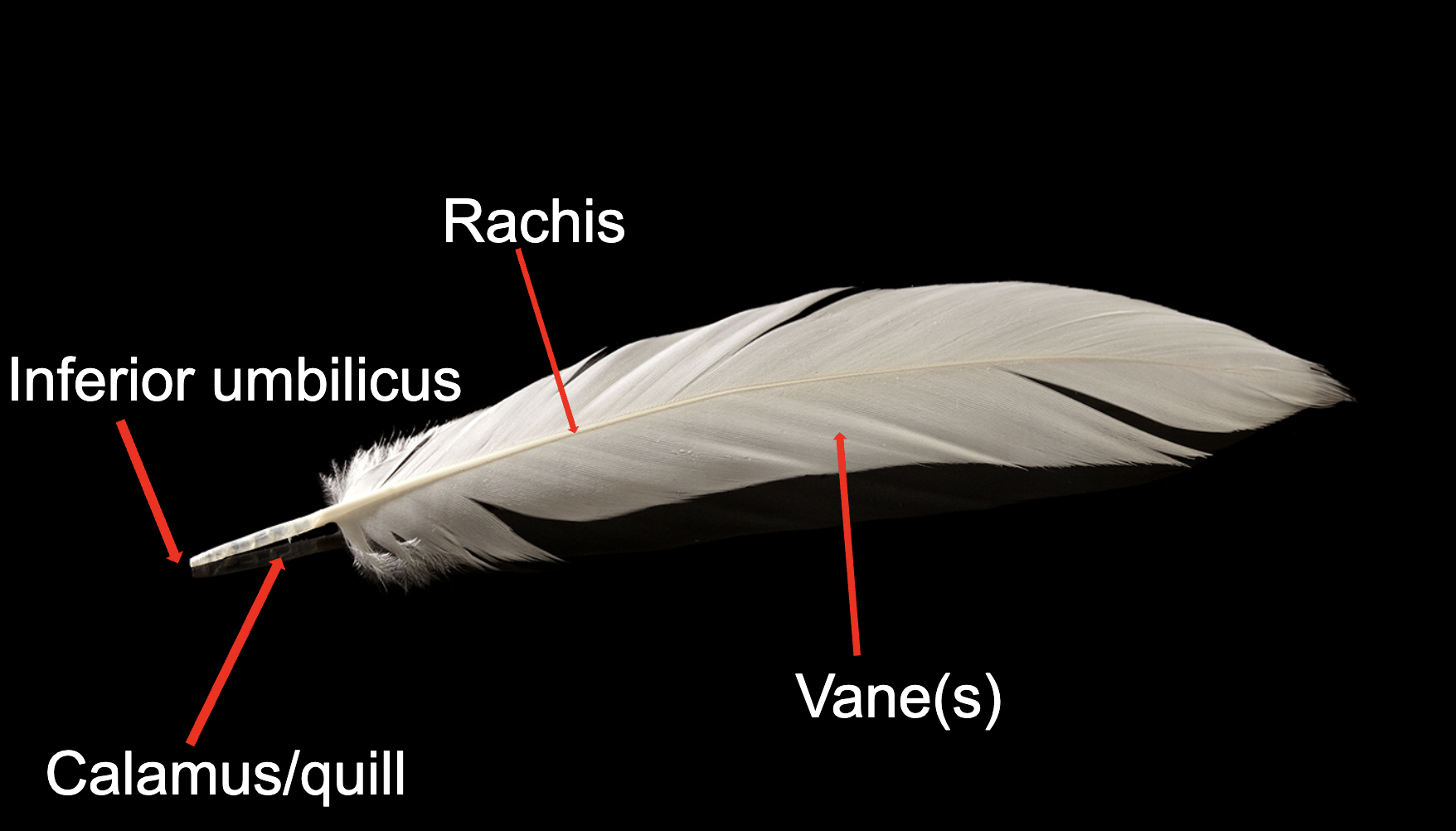
Bird trait - feathers
Basic parts
Rachis: strong middle shaft
Vanes
Calamus/quill: part of Rachis with no vein
Inferior umbilicus: the hole in the bottom of feather
Bird traits - teeth
birds do not have teeth
teeth are heavy, birds ditched that
Have bills instead of teeth
different types of bills for different specializations
All for weight reduction
Birds - walking
birds are bipedal (bipedalism)
Also Digitigrade
they walk on their toes
Femur of bird is up inside the bird
the ankle is like that joint way up where the legs bend

Traits of birds – fusion and reduction of bones of hands, head, pelvis
lots of fusion in hand, jaw, pelvis area
rigid structures do better in the area
an airplane isn’t wobbly
rigid stuff flies better
birds don’t have support via fingers like humans or bats
the rachis of birds provide the support that fingers would

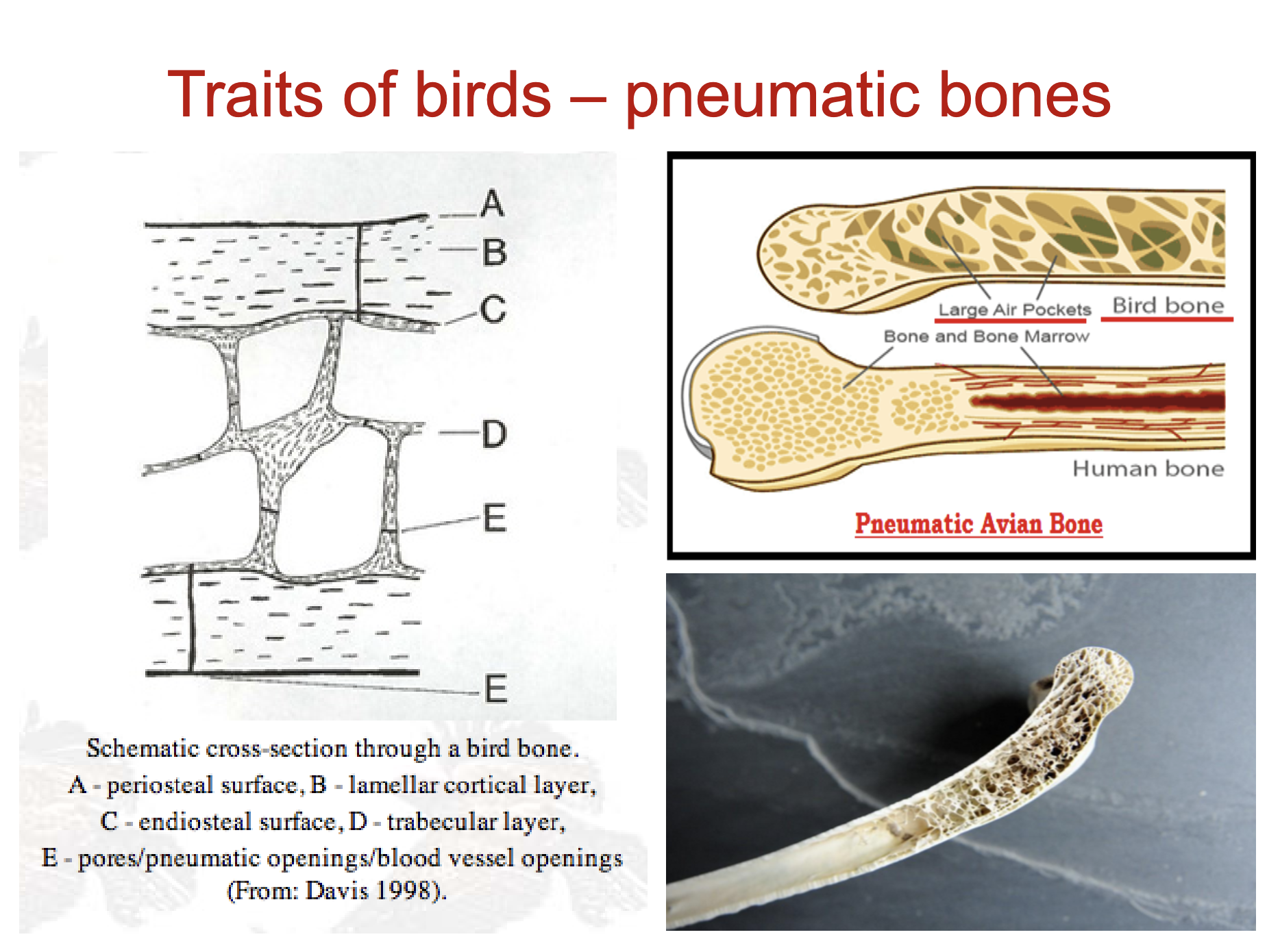
bird - bones
bird bones are hollow
they have some solid bones, like in femur
but most wing and lower leg bones are hollow
they have these pockets in bones
weight reduction and helps with avian respiratory system
don’t give dogs bird bones, they splinter and are sharp
Bone density
varies among birds
a loon vs a hawk
the loon dives and swims, so it wants more solid bones because their lifestyle requires them to be under the water
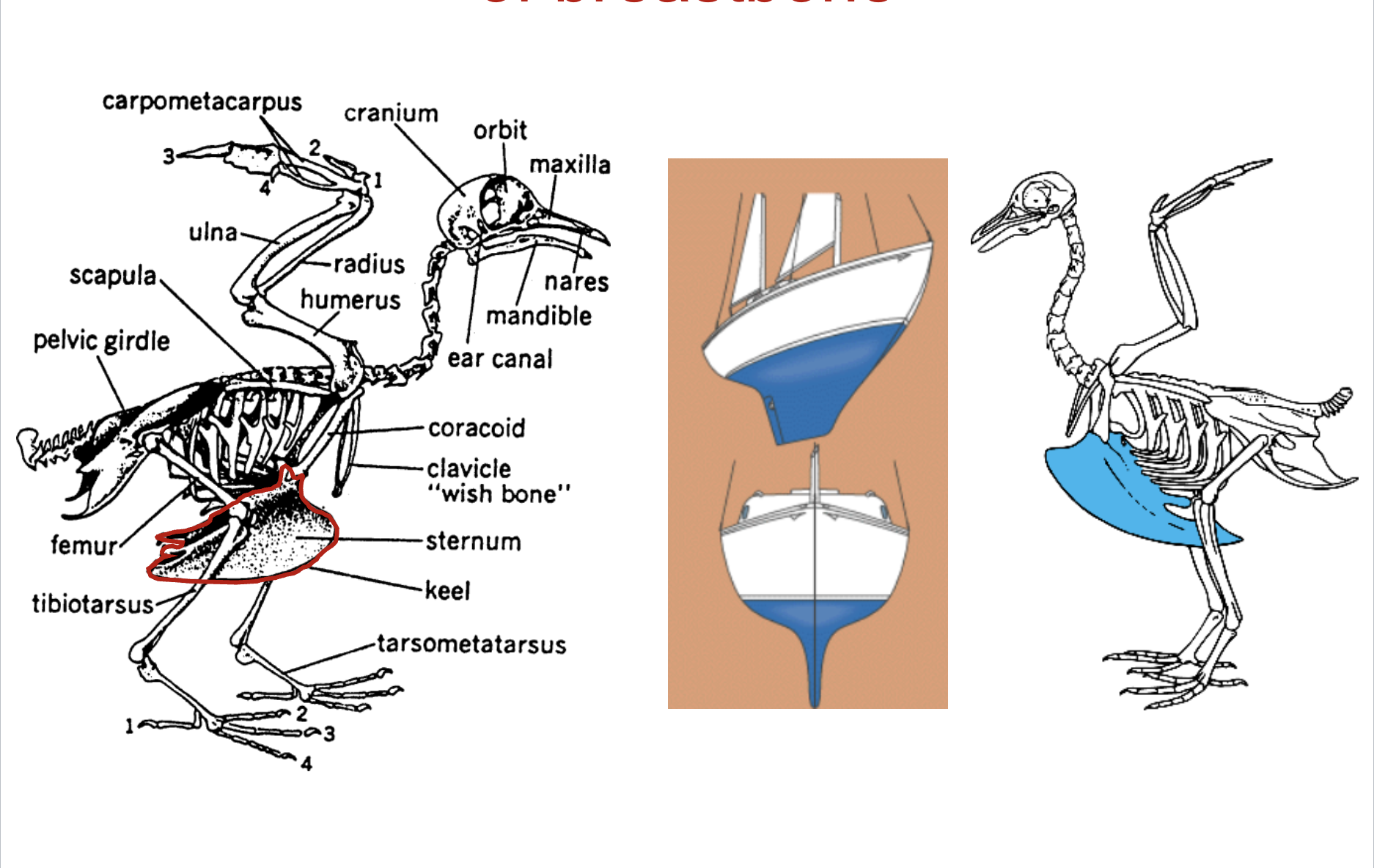
Bird trait - well developed keel of breastbone
Birds have very thick, keel breastbone
Like birds, ships have keels, because it keeps them balanced
big structure with low weight means you’re not top heavy, so balanced
Traits of birds – furcula (wishbone)
where the neck attaches is the wishbone
fused collar bones
allowed flight to become more possible
our wishbone is just our collar bones

Potential exam question, what are the unique traits of birds (what makes birds different from reptiles)
• Feathers
• Lack of teeth; bills
• Bipedalism and digitigrade feet
• Fusion and reduction of bones of hands, head,
pelvis
• Pneumatic bones
• Well-developed keel of breastbone
• Furcula (wishbone)
Other general bird traits (some birds)
Small sizes
highly developed brains and sensory systems
large, energy rich eggs
extensive parental care
crocodiles and alligators, closest reptile relative to birds also put lots of parental care
highly social
The Five Mass Extinctions
end-Ordovician
end-devonian
end-permian
90% of all species died
Preserved fossils
Silts, limestones provide some of the best substrates within a layer to detect fossils
soft and holds fossils really well
In 1860 thy found a fossil feather on Solnhofen limestone formation
rest of the fossils in this area contain fossils from the jurasic
In 1861 they unearthed the entire bird specimen

Archaeopteryx lithographica
found it in 1861
clearly has feathers
clearly has wings
found another one 3 years
held on display at an inn until the son of the physician and came to the inn and bought it from the inn keeper
fully feathered
the wing feathers were specialized into primaries and secondaries
Clavicles fused into furcula
needed for flight
partly fused metatarsals (leg bones)
Bird-like forelimb
feathers were asymmetrical
like modern feathers with a leading and trailing edge

Archaeopteryx lithographica reptile traits
small braincase
modern birds have larger
Hand bones not fully fused and had claws on its wing
pelvic bones were not fused
still so wiggliness
could fly but probably not for long distances
had a long bony tail
not like modern birds, don’t really have long tails
small cartilaginous sternum but no keel
didn’t have skeletal architecture for bones to connect correctly
Simple ribs (lacks uncinate process)
had teeth
they were little, but there

Where did birds (like Archaeopteryx) come from?
came from reptiles
two hypothesis (must be able to explain)
thecodont hypothesis: a giant reptile thingy, really old ancestors
birds are NOT dinosaurs
similarites between theropods and birds is convergent evolution
Theropod hypothesis: more recent ancestry, putting birds in the dinosaur lineage
want to get to modern birds, must walk evolutionary lineage of dinosaurs

Thomas Huxley (late 1800s)
Argued that birds evolved from theropod dinosaurs
Key differences though: no feathers, no clavicles, forelimb differed in Compsognathus

Gerhard Heilmann: Thecodont Hypothesis
thought birds evolved separately
because he didn’t enjoy the inconsistencies
wrote the book: the origin of birds
Mostly hung his hat on the act that more primitive reptiles had clavicles, and the known theropods did not
Differences in hands and fingers
Known dinosaurs did not have feathers, so maybe that took a lot of independent evolutionary time
basically being like, look birds are so different from dinosaurs how can we say they come from dinosaurs
John Ostrom: Deinonychus antirrhopus
found a transitional species Deinonychus antirrhopus
had the things that Heilmann said we needed to find
Bipedal, terrestrial theropod dinosaur
Fused clavicles
Hollow bones
Semi-lunate carpal bone in wrist which allowed rotation (bird-like)
Uncinate processes (bird-like)
16 shared traits in all!
found the missing link we needed
Thecodont vs. theropod ancestry
Birds evolved from theropods. The evidence is overwhelming.
we just hadn’t found the right species yet

Birds (Archaeopteryx) and theropods –shared characteristics
• Elongated arms and forelimbs
• 3-fingered clawed opposable grasping hands
• Large orbits (eye sockets)
could see very well
• Flexible wrist (semi-lunar carpals)
• Hollow bones
• 4 toes per foot (3 main)
modern birds is three in front, one in back, they twinning
• Bipedal digitigrade stance
walked on its toes
• Fused clavicles
• FEATHERS
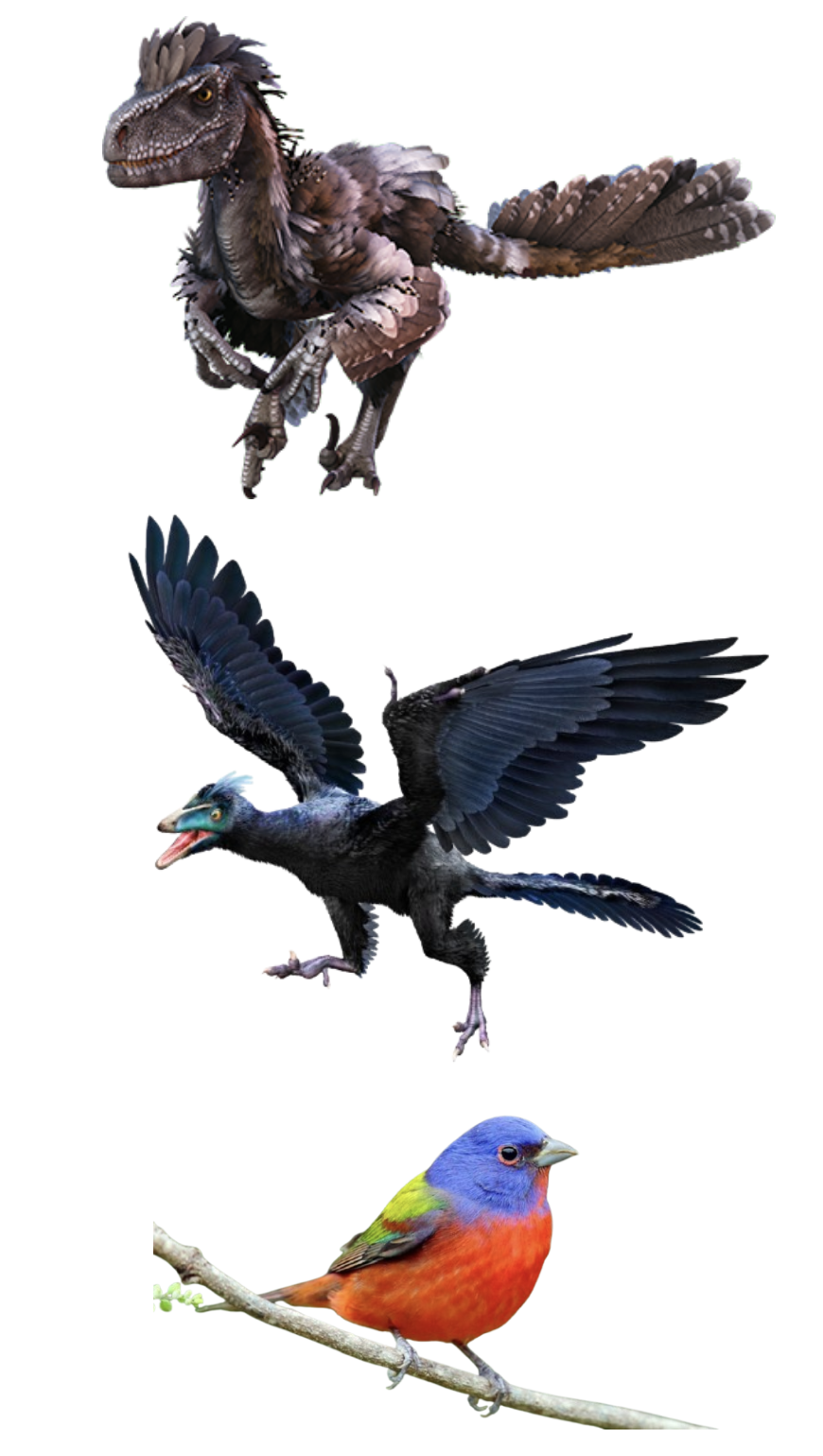
Feathered dinosaurs
There is no exact line where we went from “feathered theropod” to bird
so many forms between dinosaurs and birds
Deinonychus is certainly a feathered dinosaur
Archaeopteryx is a “transitional state”
But commonly where the bird line is drawn
Painted bunting is a bird
Timeline recap (don’t need to know dates, rather key features)
• 1860: first feather discovered
found in Germany
• 1861: Archaeopteryx discovered (dated to 150 MYA)
• 1860s: Theropod hypothesis proposed (Huxley)
thought they were from theropods
• 1920s: Thecodont hypothesis (Heilmann)
no from more basal thecodont
was able to disprove this with transitional state dinosaur found
• Argument: theropods lacked fused clavicles
• 1960s: Theropod hypothesis confirmed (Ostrom)
Deinonychus similar to Archaeopteryx
Including fused clavicles and semilunate carpals
New feathered theropod dinosaurs discovered
Liaoning Province, China
highly volcanic and great at preserving dinosaur tissues
specimens die instantly and are buried (no scavenging)
so intact skeletons
Chemical mix of ash and fine sediment helps preserve the skeleton
one of the best place to find non skeletal structures, like feather
the hotspot of where we found fossils, specifically bird
Sinosauropteryx (120-125 MYA)
small theropod dinosaur
among first feathered dinosaurs discovred (1996)
small theropod covered in fine filamentous feathers
definitely couldn’t fly
proto-feathers did not have locking barbs, no flight
structures called melanosomes were preserved (found in 2010)
first feathered dinosaur for whom we know its color
Fuzzy, with colors

Epidexipteryx (150 MYA)
• Theropod discovered in 2008
• Contemporaneous with Archaeopteryx
• Feathers with a rachis and vane, but vane was a single sheet (not barbs); body feathers also simple
not a feature we’ve found in other birds
not for flight, possibly for display
Ribbon tail

Protarchaeopteryx (125 MYA)
Theropod discovered in 1997
Was more than just fuzzy/filamentous feathers
It had vaned feathers, with barbs on either side of rachis on forelimbs and tail
Still primitive, symmetric feathers
Lived more recently than Archaeoperyx (150 MYA) but bird traits were more primitive
derived and primitive versions of birds lived all at different times, all over the place
Vaned feathers, primitive
More recent than Archae

Caudipteryx (125 MYA)
• Theropod discovered in 1998
• Also had vaned feathers, but like Protarchaeopteryx, not asymmetric and forelimbs were small (did not fly)
• Also lived more recently than Archaeopteryx (150 MYA) but bird traits more primitive
• had so many feathers and couldn’t fly, we don’t know why they had feathers
Vaned feathers, primitive
More recent than Archae

Sinovenator (130 MYA)
• Theropod discovered in 2002
• Same story: feathers, but no flight
• More recent than Archaeopteryx) but more primitive
Vaned feathers, primitive
More recent than Archae

Microraptor (120 MYA)
Theropod discovered in 2003
hindlegs are as feathered as forearm
modern birds don’t have flight feathers on their feet
way different: asymmetric feathers (needed for lift) on both forelimbs and hindlimbs
Strong claws on limbs, designed for grasping and climbing
Is a flyer/glider, but with different body plan than Archaeopteryx
Doing its own thing

Sinornis (120-110 MYA)
• Bird! (Avialae) discovered in 1992
• Modern wrist bones for tucking wings
• Chest and shoulder structures solidly indicate flight
has the structures to fly!

Hesperornis (80 MYA)
• Bird! (Avialae)
• Clearly we are in legitimate bird territory now.
• Flightless and aquatic with teeth and beak

Vegavis
basically a goose that lived with dinosaurs
bird (Avialae)
solidly an Anseriform (water-fowl)
probably honked

Importance of these transitional birds
1. The relationship between theropods and birds became incontrovertible in the 1990s.
2. Feathers evolved for things other than flight.
3. Multiple body plans evolved.
4. Primitive and derived bird traits existed simultaneously and all over the timeline.
they’re all over the time line
Origins of flight
1) Arboreal theory (trees down)
ancestors to flighted birds lived in trees and jumping/gliding in trees was the driving force that pushed for flight in these specimens
wings and feathers improve gliding, leading to powered flight
2) Cursorial theory (ground up)
Ancestors were ground-dwelling runners
Feathers = insect net, leap to catch prey?
Arboreal theory (trees down)
Strengths: most plausible with modern examples of gliders
Weaknesses: ancestors mostly cursorial, terrestria
Cursorial theory (ground up)
Strengths: cursorial ancestors
Weaknesses: speed/lift problem
Wing-assisted incline running (WAIR)
birds flap a lot to be able to get up steep surfaces
would be good for getting up trees
when young birds are growing their flight feathers, the flap before they can fly to climb to the edge of the nest
they do fluttery things to be able to learn to fly faster
So it makes the Cursorial theory plausible
Earth’s worst day (66 MYA)
asteroid travered the atmoshphere in a second, heated the air to 50,000F
explosion was equivalent to 900 billion atomic bombs going off all at once
fireball of plasma rick vapor, that expanded outwards into space
superheated air immolated all life out to a few thousand kilometeres as massive bruning ejects rainied down across the globe sparking global wildfires
most of the globe was heated as pera pizza oven
100m megatsumami
Mass extinction
a big cloud of dust surroinfed the upper atmosphere, blanketing the eath in complete darkness (and cold) for several months
followed but thousands of years of greenhouse effect
also globally widespread nitric acid rain
No tetrapods >25 kg survived
• ~75% of all species went extinct
Surviving the KT extinction
4 distinct (proto-) lineages of birds made it
Paleognathae - the ratites
galliformes - the upland game bird
Anseriformes - waterfowl
Neoaves - scattered members of the rest

Aepyornis (Elephant birds) - after meteor
Ratites – flightless birds – from Madagascar.
Weighed up to 1,000 lbs! Extinct 1000 yrs ago – probably by humans
Most closely related to the tiny New Zealand kiwi
Lays giant eggs
Diatryma - after meteor
7 ft tall, in North America
probably a strong and rapid runner
Large powerful beak, but not claws, so maybe herbivore?
Phorusrhacid (Terror Birds) - after meteor
Terror birds!! – 10 ft tall!
Flightless, carnivorous apex predators of South American (& Florida)
From the Cenozoic (just after K-Pg) until 2 MYA
Moa - after meteor
New Zealand flightless bird 9 species!
12 feet tall and over 600 lbs!
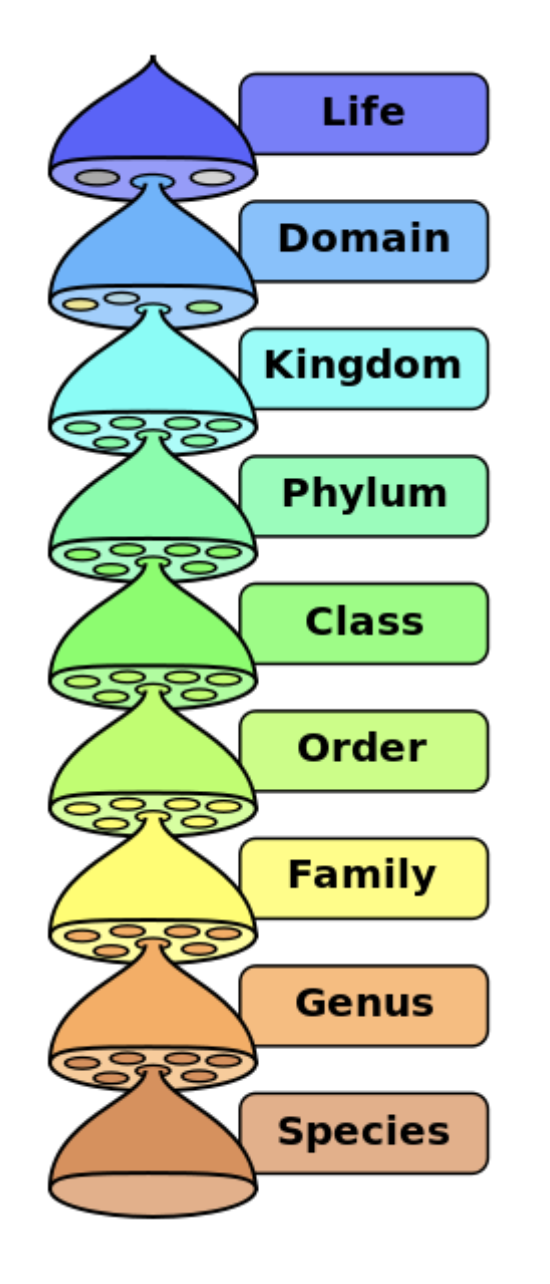
Systematics/Taxonomy/Phylogeny
Systematics: the study of diversity and relationships among organisms and their evolutionary history
Taxonomy: naming and classifying organisms
A product of systematics
Phylogeny: depiction of evolutionary tree / hypothesis of relatedness

Classification schemes – Linnaean v.s Classification schemes – evolutionary v.s Classification schemes – cladistics
Classification schemes – Linnaean
pre-Darwin no assumption of common ancestry
Grouped by “essential” characters (e.g., beak shape, food structure)
religion used to explain
Hierarchical ranks and binomial nomenclature still generally used today
Classification schemes – evolutionary
the modern synthesis
use branching genealogy but allows overrides for practical groups
like here we just put birds
Classification schemes – cladistics
Cladistics: 1950s in Germany;1970s elsewhere
Classification based on evolutionary history
Grouped by shared derived characteristics
Require monophyletic groups
can’t just carve out birds as not related to reptiles
fully resolved phylogenetic trees, where we are today
Monophyletic/Paraphyletic/Polyphyleitc
must include all common ancestors and descendent, no cut outs
contains a common ancestor and only some of its descendents, the carve out
being wrong, just grouping things together, not share a recent common ancestor

Phylogeny structural vocabulary
• Node – ancestor split point
• Clade – complete group of descendants
• Sister group – pair of closest relatives
Laysan and Hawaiian duck
• Outgroup – distant baseline comparison
ex: African black duck
Strong relationship has higher Posterior Probabilities

Resolving uncertainties – polytomies
Pre-genomics: evolutionary relationships within ratites were unresolved
didn’t understand sister taxa
Post genomics: now resoled

Bird evolution, writ large
Morphologically conservative group
unlike mammals birds are relatively similar
Recent diversification and radiation (post K-T)
Convergent evolution is rampant (flightlessness, nectivory, etc.)
ex: flightlessness has evolved multiple times
Historical avian classifications
Classification based on morphology has always been problematic. Example: Ciconiiformes – wastebasket for “long- legged wading birds”
put all the long legged birds together

Early molecular work: DNA-DNA hybridization (Sibley-Ahlquist)
• First large-scale molecular approach to bird classification (1980s-1990s)
1) Melt DNA strands of closely related species (double-helix = single strand)
can cook DNA until it splits into its two strands
as we have single DNA that cools it will refuse with another strand to reform DNA
2) Stir and let anneal
hybrid strands then bond
Homoduplex Heron/Heron are more similar and shouldn’t melt as easily as Heteroduplex (A+B) which is more crudley put together
3) Test and compare new melting temperatures

Sibley-Ahlquist (1990) book made some new groupings that were suspect.
helped move us in the right direction, get some genetic matches but then we also just threw in vultures
this also rearrabged our phylogenetic understanding of bird orders and caused some crazy confusion
this melting technique was also very inefficient

Modern genetic era
• Between 2000s and 2020s, we quickly moved to DNA sequencing
• Includes both nuclear DNA (comprehensive blueprint) and mitochondrial DNA (useful as molecular clock)
• Began with particular loci and regions, ends with whole genomes
we have a lot more techniques and technology now
• have resolved Ciconifformes, only has one family Ciconiiformes (Storks)

Class Aves: Subclass Archaeornithes
Archaeornithes
“Old birds,” Archaeopteryx and dinosaur-like things

Class Aves: Subclass Neornithes
Neornithes
“New birds,” literally everything else
Class Aves: Subclass Neornithes: Superorder Odontognathae
Odontognathae
“Toothed jaw,” all extinct; like Hesperornis
Class Aves: Subclass Neornithes: Superorder Paleognathae:
Paleognathae
“Ancient jaw,” the 5 orders of ratites, plus some extinct ones
Class Aves: Subclass Neornithes: Superorder Neognathae:
Neognathae
“New jaw,” literally everything else
Neoaves - the five major clades
Strisores
Columbaves
Gruiformes
Aequorlitornithes
Inopinaves
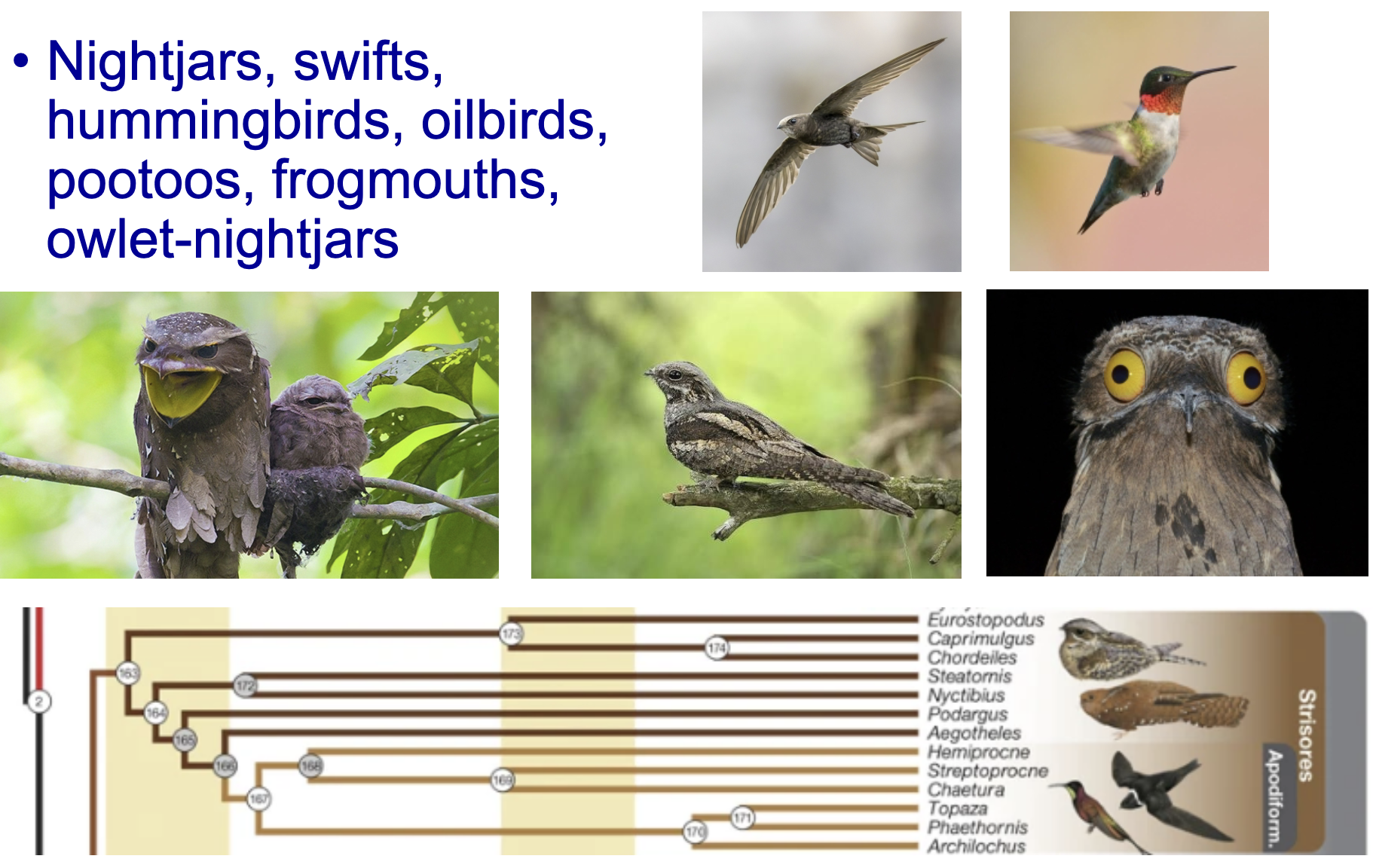
Neoaves: Strisores
Nightjars, swifts, hummingbirds, oilbirds, pootoos, frogmouths, owlet-nightjars
things that come out at night and things with small feet
Neoaves: Columbaves
Pigeons, doves, mesites, sandgrouse

Neoaves: Gruiformes
Cranes, rails, sunbittern, kago, seriemas
Neoaves: Aequorlitornithes
Flamingoes, grebes, shorebirds/gulls, loons, penguins, tubenoses, storks, cormorants/boobies, pelicans, herons, ibis
birds that get their feet wet minus ducks

Neoaves: Inopinaves
Hoatzin is the freaky outgroup of this clade
• Telluraves: “core landbirds” – all the rest
Afroaves: hawks/eagles, owls, trogons, hornbills, woodpeckers, kingfishers/roller
• Australaves: falcons, parrots, passerines

Class Aves: full systematics (MUST KNOW)
• Subclass Archaeornithes: Archaeopteryx, etc. (extinct)
• Subclass Neornithes:
Superorder Odontognathae: Hesperornis, etc. (extinct)
Superorder Paleognathae: Ratites
Superorder Neognathae:
Galloanserae: chickens and ducks
Neoaves:
Strisores: nightjars and allies, swifts, hummingbirds
Columbaves: pigeons and allies
Gruiformes: cranes, rails, and kin
Aequorlitornithes: flamingos, grebes, gulls, waterbirds, wading birds
Inopinaves:
Hoatzin
Telluraves:
Afroaves: hawks, owls, trogons, hornbills, woodpeckers, kingfishers
Australaves: falcons, parrots, passerines
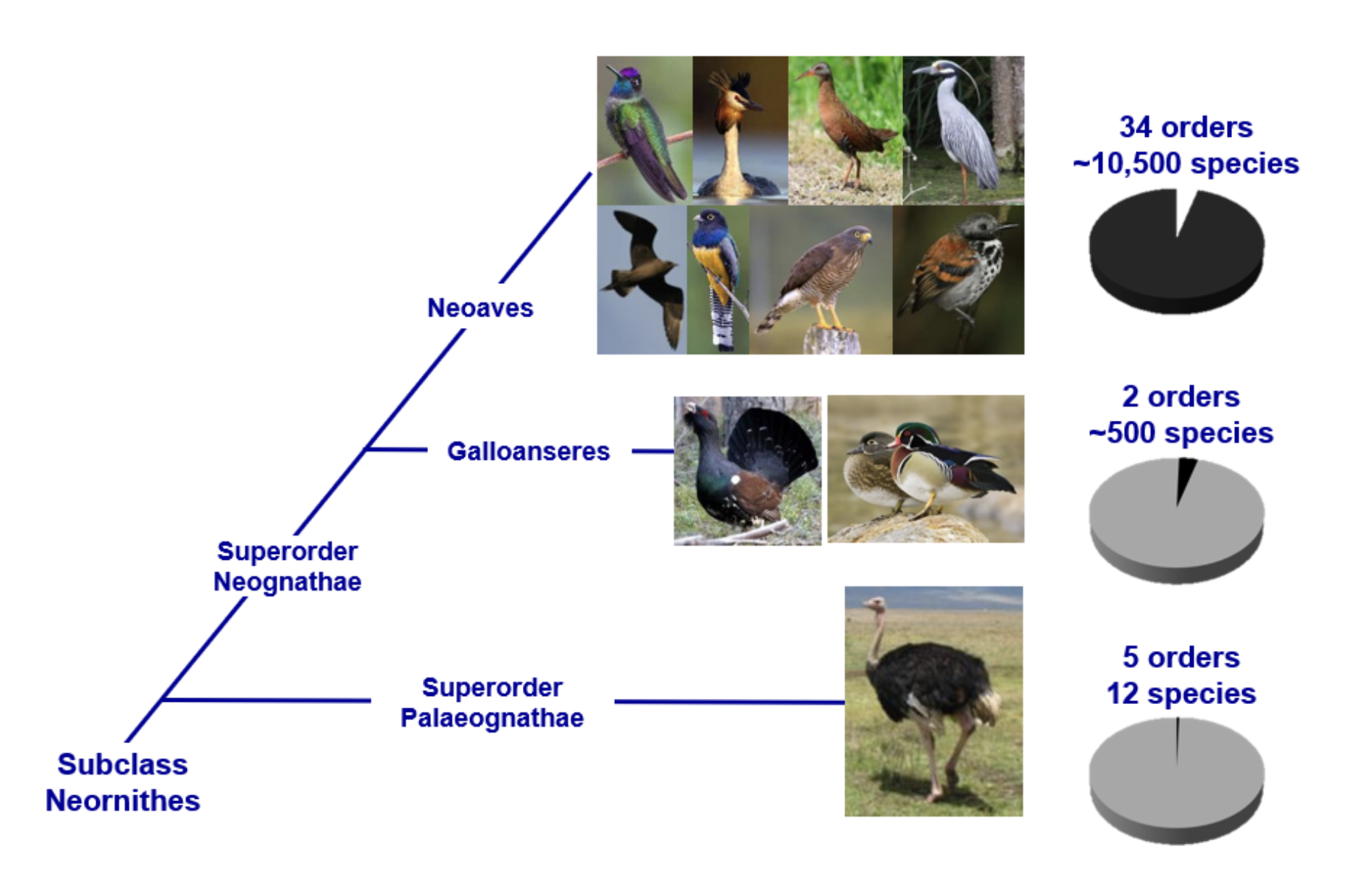
Split 1:
Paleognathae vs. Neognathae
Paleognathae is seperate clade from everyone else

Split 2:
Galloanserae vs. Neoaves
Galloanserae is separate clade from Paleognathae and all Neoaves
4 Forces of flight
lift
gravity
thrust
drag

Generating lift in birds
1) Bernoulli’s law
2) Newtons 3rd law of motion
Bernoulli’s law
we are in a fluid, surrounded by the static pressure of air
evenly distributed on us
static + dynamic pressure matter
Static pressure + dynamic pressure = constant
when moving in a medium static pressure decreases as speed increases and vice versa
static pressure below will be greater than pressure above = LIFT
Airfoil
air is faster on top so dynamic pressure is greater on top so the net force is lift
Faster air (greater dynamic pressure) leads to reduced static pressure above
Lift from static pressure underneath (Bernoulli’s Law)

Angle of attack
angle of air hitting wing
ex: hand out of car window, turn hand sideways hand goes back, hand sideways and it goes back and up
Newtons 3rd law
bird wings basically push against the air to create lift
as wing strokes down it deflects air downwards, pushing bird up
like pushing down in a pool
Flight is a drag
flow of air over an airfoil can create turbulence and as the body turns down the turbulence becomes stronger
friction between the air and wing surface = drag
Profile drag: frictional resistance of wing/body passing through the air
profile drag = friction on wing
depends largely of angle of attack
Induced drag: caused by vortices at the wing tips
air wants to move from high pressure to low pressure, can’t go through the wing so makes vortices at wing tips

Dealing with drag
Problem: profile drag – caused by frictional resistance of body passing through the air
Solutions:
Reduce surface area (like tucking wings)
Alula: helps to maintain laminar flow at low speed. The bird thumb

Dealing with drag problem 2
Problem 2: induced drag – caused by wingtip vortices
Solutions:
Reduce area of wing tip – narrow, pointed wings
Reduce area of wing tip – slots between feathers. These spaces allow for the vortices to fall through
Or fly very low to disrupt vortices, vortices smack down before hitting wing

Formation of flight
Each goose has vortices coming off wing
Angles just right you can catch the upstream of the vortices of the goose right in front of you.

How to make thrust
Just tilt the airfoil
increasing angle of attack, pushing down/both ways and generating thrust
Outer parts of the wings (primaries) produce most thrust
Bird tails and flying
• Create lift when flared
• Can also be used as an air brake to slow down
• Swallows use it to change direction quickly
Wing dimensions
• Wing span – tip to tip
• Wing area – total wing surface
• Wing chord - width
Wing loading = bird mass / wing area
ex: swallow, small wing loading v.s Swan big wing loading
Aspect ratio = wingspan2 / wing area
ex: low aspect ration, broad, wide, shortwings ex: chickens, birds that don’t fly as much
ex: high aspect ration, swallows, swifts, albatrose, long narrow wing for soaring flight

Potential exam question
put bird
