Exam 2 - 508: Osteoarthritis
 Call Kai
 Learn
 Practice Test
 Spaced Repetition
 Match
 Flashcards
 Knowt Play
1/25

There's no tags or description
Looks like no tags are added yet.
26 Terms
Learning Objectives
Describe the etiology, pathogenesis, and clinical manifestations of OA
Learn goals of therapy and general treatment strategies
Review medications used for treatment
Focus on dose, potential adverse effects, monitoring parameters, contraindications, and patient education
Understand how to monitor for efficacy/safety
Apply knowledge gained to optimize care for OA patients
What is defined as osteoarthritis?
Characterized by cartilage deterioration, synovial thickening, local pathologic bone changes inflammation, and pathologic bone changes
Most commonly affects weight bearing joints (knees, hips, spine) and hands
Causes pain, limitation of motion, deformity, progressive disability, and decreased QOL
Is osteoarthritis inflammatory or noninflammatory?
Generally thought of as non-inflammatory
Synonymous with degenerative joint disease (DJD)
Not just an“age-related disease”
Results from a complex interplay of multiple factors including: joint integrity, genetic predisposition, local inflammation, mechanical forces, and cellular and biochemical processes
Involves the entire joint, not only degeneration of cartilage
What is the presentation/characterization of osteoarthritis?
Characterized by cartilage deterioration, synovial thickening, local inflammation, and pathologic bone changes
Most commonly affects weight-bearing joints (knees, hips, spine) and hands
Causes pain, limitation of motion, deformity, progressive disability, and decreased QoL
What are risk factors for osteoarthritis?
Age OA: Risk Factors
Obesity ***most important preventable risk factor!!!
Gender
Age <45 → more common in men
Age >45 → more common in women
Occupation
Excessive mechanical stress (kneeling, squatting, lifting— esp. heavy objects, and prolonged standing)
Repetitive motion (hand OA)
Participation in certain sports (wrestling, boxing, cycling, football, baseball pitching)
Hx of joint injury or surgery
Quadriceps muscle weakness - important for joint stability
Genetic predisposition—many genes involved
Pathophysiology of OA
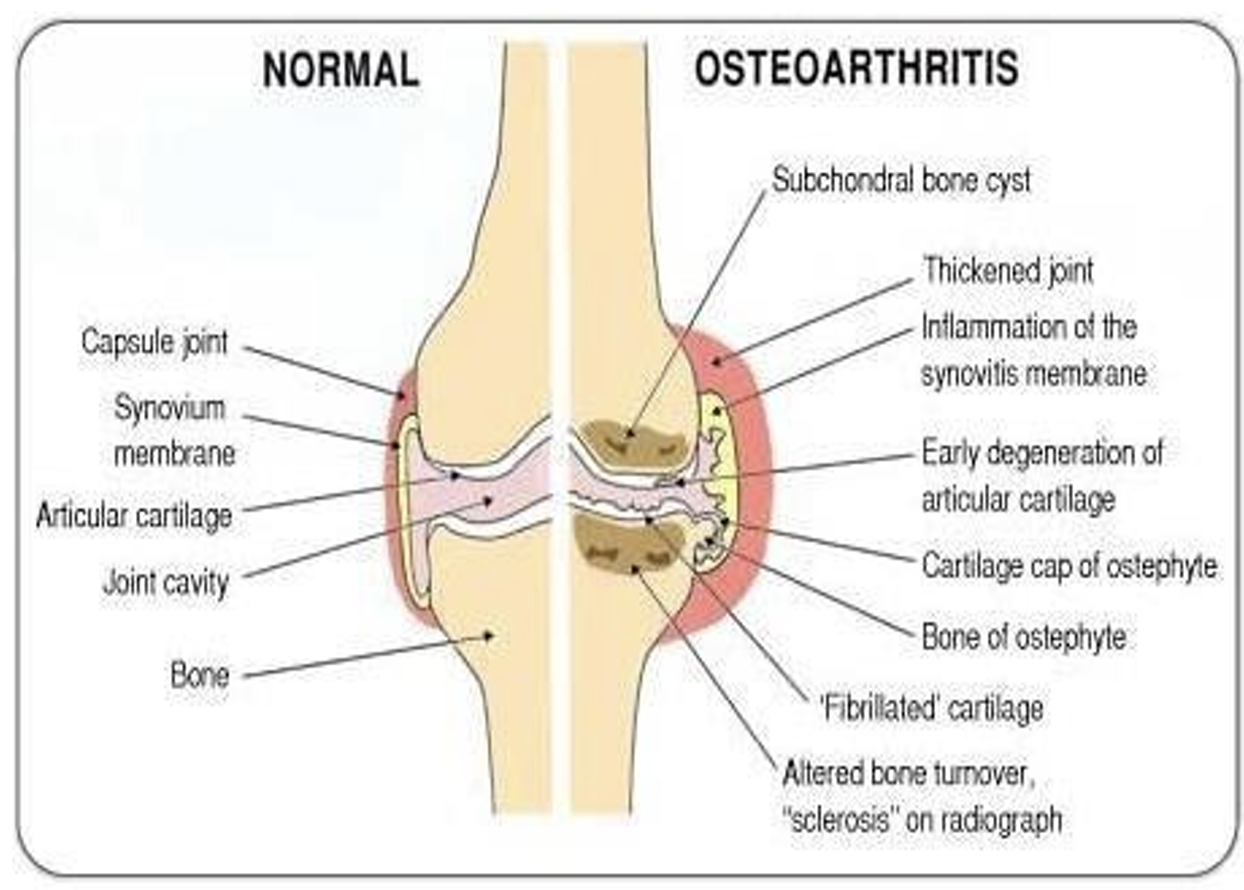
What are signs/symptoms of OA?
Pain/Tenderness
Stiffness - especially after inactivity
Crepitus
Grating, crackling or popping sounds and sensations experienced in joints
Bone spurs/osteophytes
Bony projections that develop on bone edges
Effusions
Increased fluid in joint cavity
Radiographic changes
Joint space narrowing, bone sclerosis, osteophytes
What are the two main classifications of OA?
1) Primary (idiopathic) OA → most common, no identifiable cause
2) Secondary OA
Associated with a known cause such as RA or other inflammatory arthritis, trauma, metabolic or endocrine disorders, and congenital factors
Other terms
Localized: 1 or 2 sites affected
Generalized: 3 or more sites affected
Erosive: erosions present on X-ray
What tx/therapy is the only available method shown to delay the progression of OA?
NON-PHARM THERAPY
Exercise/Education/Weight loss
What are non-pharmacologic therapies we use in OA?
Education → disease process, the extent of OA, the prognosis, and treatment options
Weight loss → ↓ weight by at least 10%
Exercise
Aerobic (low impact)
Muscle strengthening
PhysicalTherapy (PT)
Occupational Therapy (OT)
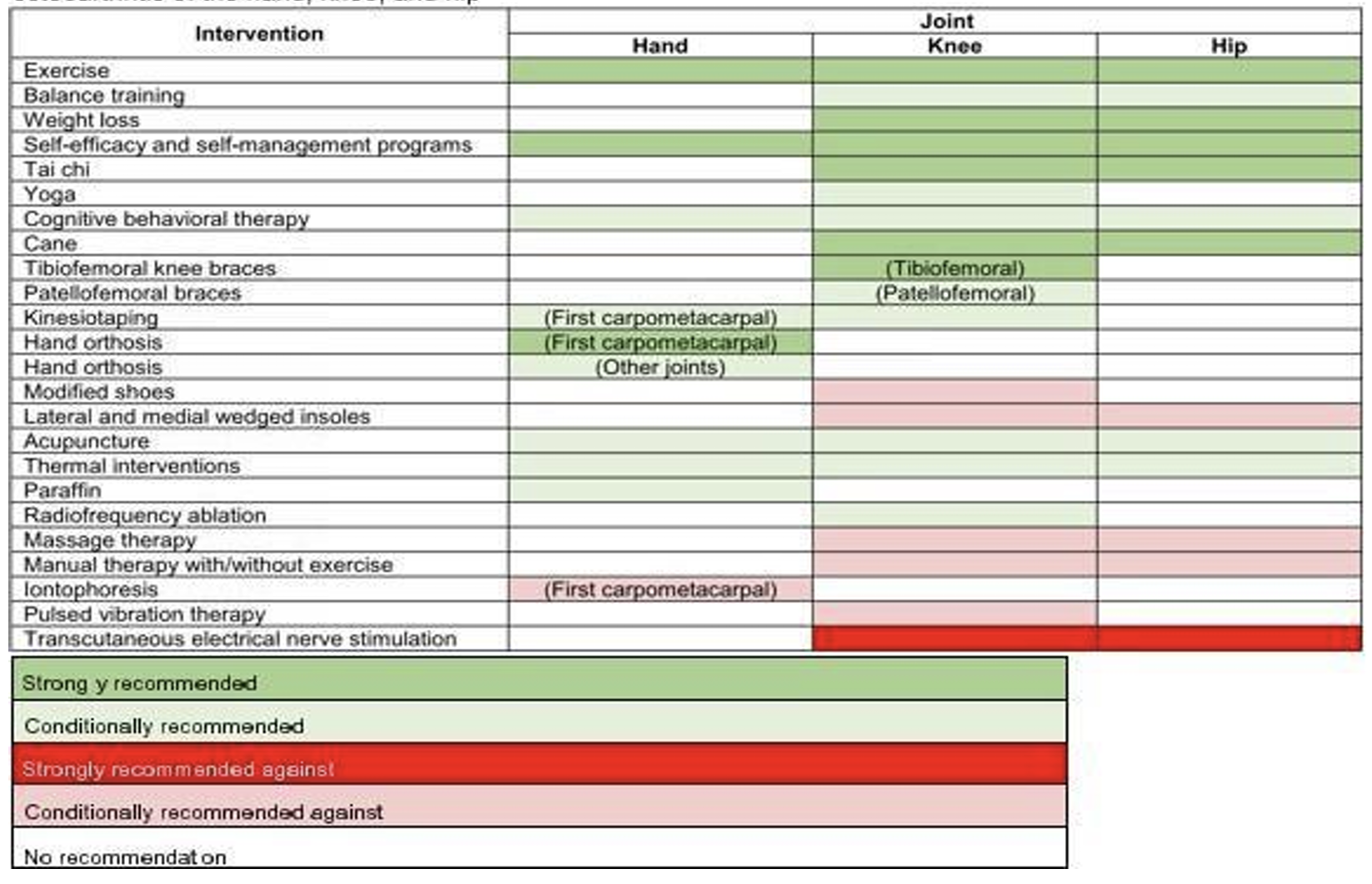
Recommendations for OA in different body parts
What are common medications used to treat OA?
Acetaminophen
OralNSAIDs
Opioid analgesics
Tramadol
Hydrocodoneproducts
Duloxetine
Glucosamine/Chondroitin
TopicalAnalgesics
Trolamine salicylate
apsaicin
NSAIDs
Intra-articular corticosteroid injections (CSI)
INJ only, no topical or PO
Intra-articular hyaluronates
Medications should be scheduled
What are clinical pearls of acetaminophen?
Analgesic and antipyretic effects
Conjugated in the liver into inactive metabolites eliminated by the kidneys
Generally well-tolerated
Occasional N/V, Constipation, Headache, pruritis
What serious ADR is associated with acetaminophen?
Serious: hepatotoxicity
Dose dependent
May be fatal
Increased risk w/ concomitant EtOH, pre-existing liver disease and/or other medications (isoniazid)
Caution with combination proucts/OTCs
Therefore, we MONITOR FOR LFTs
How do we dose APAP? Who gets lower doses?
Dose: 650 - 1000mg q4-6 hrs, MAX 4g/d
Lower MAX doses (2-3g/d) –
Elderly
Pre-existing liver disease
EtOH abuse (not recommended for those who drink ≥ 3 drinks daily)
Those who have long-term use
What are clinical pearls of NSAIDs?
Has analgesic, anti-inflammatory, antipyretic
Relieve pain and fever quickly (min-hrs)
Lower doses
As effective as ASA, less GI AEs
Individual variability in response
Does NOT alter the progression of OA
How long do you take NSAIDs until you reach peak anti-inflammatory effect?
2-3 weeks for peak anti-inflammatory response using HIGH or MAX doses
Which NSAIDs are more COX-2 selective?
Meloxicam (Mobic) and Celecoxib (Celebrex)
Which AEs can be seen with NSAID use?
HA/dizziness
Tinnitis
Rash
GI upset (take with food)
Nausea, dyspepsia, Abd pain
Ulceration
Bleeding
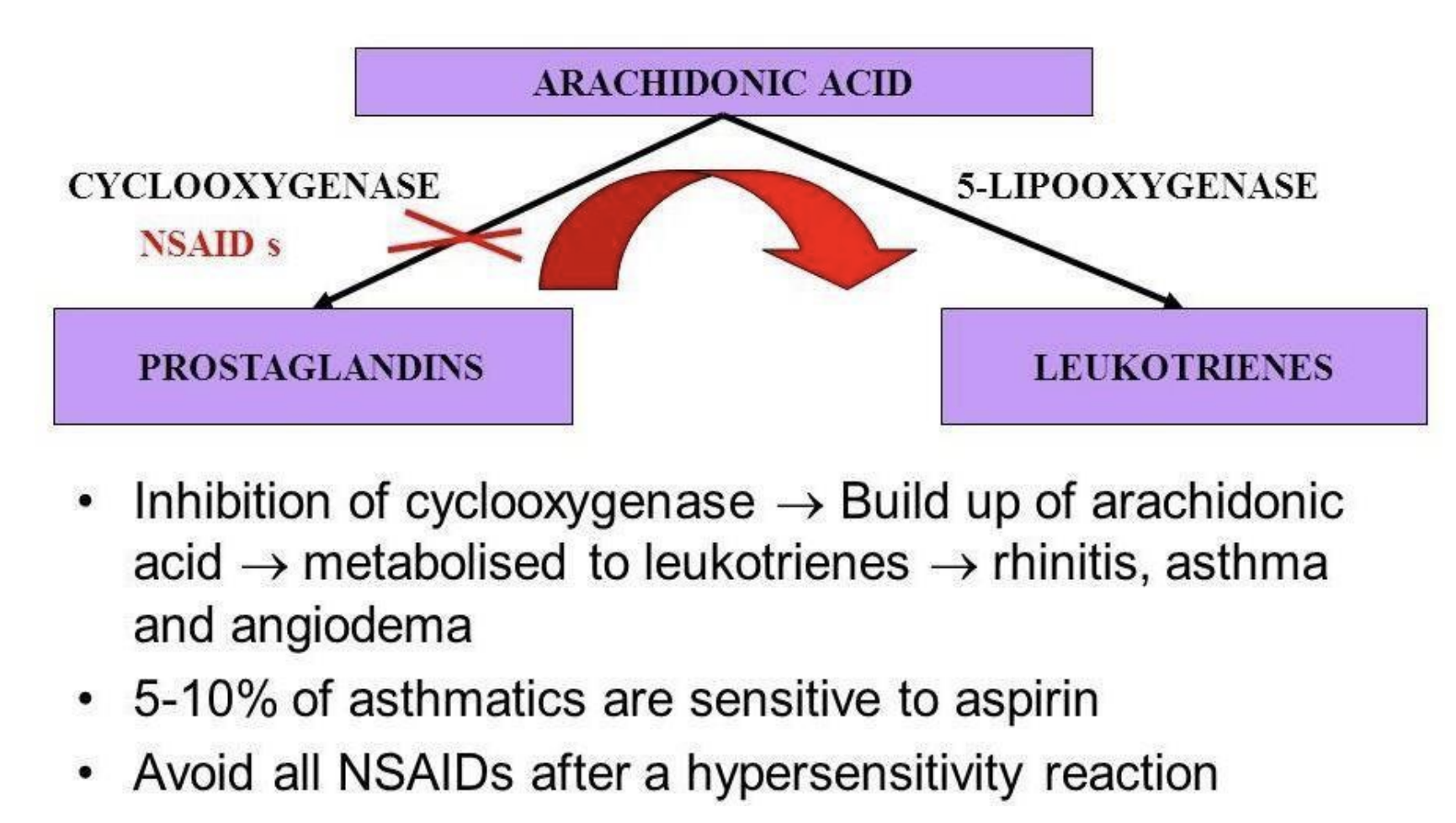
Asthma exacerbations
Cardiovascular
MI, stroke
HTN
CHF
Coagulation issues PLT effects
Reversible inhibition (effects last 1-3 days)
DI with anticoagulants
Hepatotoxicity
Renal toxicity
What should we monitor with long term NSAID use?
MONITOR
BP
CBC
sCr
LFTs
What should we consider adding to NSAIDs to reduce upper GI events?
Add PPIs when NSAID is used for chronic management of knee/hip
How do we use NSAIDs in hx of GI ulcer with no bleeding?
Recommend using either a COX-2 inhibitor or a nonselective NSAID + PPI
How do we use NSAIDs in hx of GI bleeds?
Recommend using a COX-2 inhibitor with a PPI
At what stage of CKD should NSAIDs not be used?
CKD Stage IV or V (eGFR < 30mL/min)
If a patient is taken baby aspirin for cardioprotection, how do we use NSAIDs?
Use a nonselective NSAID (other than ibuprofen) + PPI
How can aspirin cause asthma exacerbations?
Aspirin-induced hypersensitivity