organisms response to internal and external stimuli
 Call Kai
 Learn
 Practice Test
 Spaced Repetition
 Match
 Flashcards
 Knowt Play
1/68

There's no tags or description
Looks like no tags are added yet.
69 Terms
What are the two simple responses in organisms
taxis
Kinesis
What is a stimulus
A detectable changed in the environment detected by receptors
Why is it beneficial for receptors detecting change in stimulus effectively
So they have a greater chance of survival to pass on their alleles
What is taxis
Directional response in stimulus determined by direction of stimulus
What is the difference between between positive and negative taxis
positive = towards stimulus
Negative = away from stimulus
What is kinesis
Non directional response in stimulus
What two factors are affected in kinesis
The speed of movement and the frequency of turning determined by the intensity of stimulus
What happens in kinesis in less favourable conditions
higher speed
Fewer tuns
So can move away from the area
What happens in kinesis on border of unfavourable conditions and favourable
lower speed
More turns
More likely to stay in or return to area with favourable conditions
What are the benefits of taxes
allows animals to disperse and create new colonies
Avoids competition
What is the purpose of the choice chamber RP
To investigate the effect of n environmental variable such as light and humidity on the movement of an animal
What type of movement is the choice chamber showing
Taxis
How are the conditions for the choice chamber created (4)
dry = silica beads
Humid = wet filter paper = have to wait to evaporate
Dark = black paper
Why must the animals be added to the centre of the choice chamber only
To ensure they are equidistant from all the sectors with the different conditions
What are the results of the choice chamber
move to dark = hide from predators
Move to humid = prevent drying out
Why must you wait 15 minutes before recording the movement (2)
to give them time to establish the condition and so behaviour is typical to that
No longer affected by handling
How can the choice chamber be made more representative
mimicking the animals habitat so they exhibit normal behaviour in their environment
Use a larger sample size
Place animal in centre so equidistant to all sectors
Use a delay before results so animals can acclimate and have time to respond
What is a tropism
Growth of a plant in response to a directional stimulus
What are the two examples of tropisms
phototropism
Gravitropism
What are plant growth factors called that control tropisms
Indoloacetic acid (IAA)
Where are IAA produced
The tips of shoots and roots where they diffuse to other cells
What does a higher concentration of IAA mean in the shoots
IAA stimulate cell elongation
What does a high concentration of IAA in the root lead to
Inhibition of cell elongation
What tropisms do plants show under light
Shoot = positive phototropism
Root = negative phototropism
What tropisms do roots show under gravity
shoots = negative geotropism
Roots = positive geotropism
What happens during a plant if full light exposure
positive phototropism
IAA evenly distributed
Even cell elongation causes upward growth towards light
What happens to a plant if unilateral light
positive phototropism
IAA diffuse towards the shaded side of the shoot, causing a higher concentration of IAA
This stimulates cell elongation on shaded side
This causes shoot tips to bend towards light
What happens when roots grow underground
positive geotropism
IAA diffuses to the lower side of the roots so higher concentration of IAA here
This inhibits cell elongation
This causes roots to bend downward towards gravity

What does the tip removed prove
No tip means no IAA as they are produced here so no cell elongation towards the light
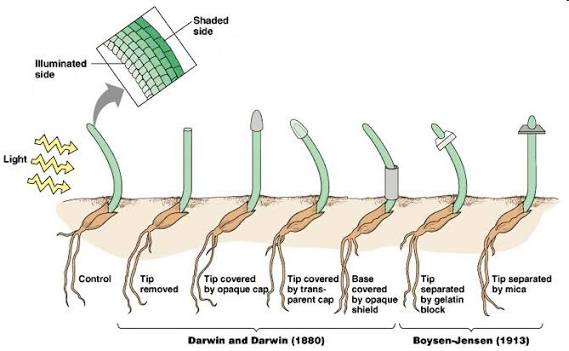
What does the tip covered by the opaque cap show
Since no light is absorbed, the IAA aren’t diffusing towards the shaded side so no cell elongation towards the light

What does the tip being covered by transparent cap show
Light still absorbed so IAA diffuse to shaded side and build up causing cell elongation towards light
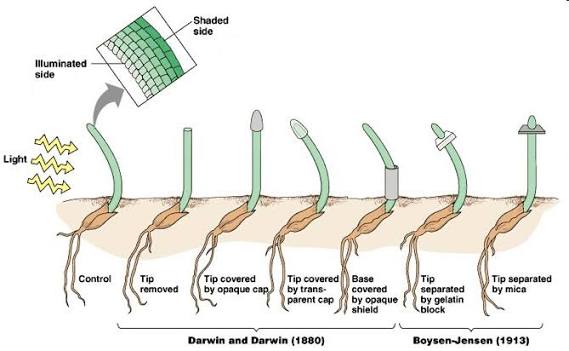
What does the base being covered by the opaque shield prove
IAA is produced in the tips as cell elongation still occurs

What does the tip being seperate by mica show
IAA can’t diffuse to shaded side so no cell elongation towards light
Describe the simple reflex arc
Stimulus → receptor → sensory → relay → motor → effector
What are the thee features of the simple reflex arc
involuntary
Short lived
Rapid (only 2 synapses)
What are the advantages of reflexes (3)
rapid
Protect against damage to body tissues
Don’t have to be learnt
What does the nervous system consist of
CNS = brain and spinal cord
PNS = connects CNS to whole body
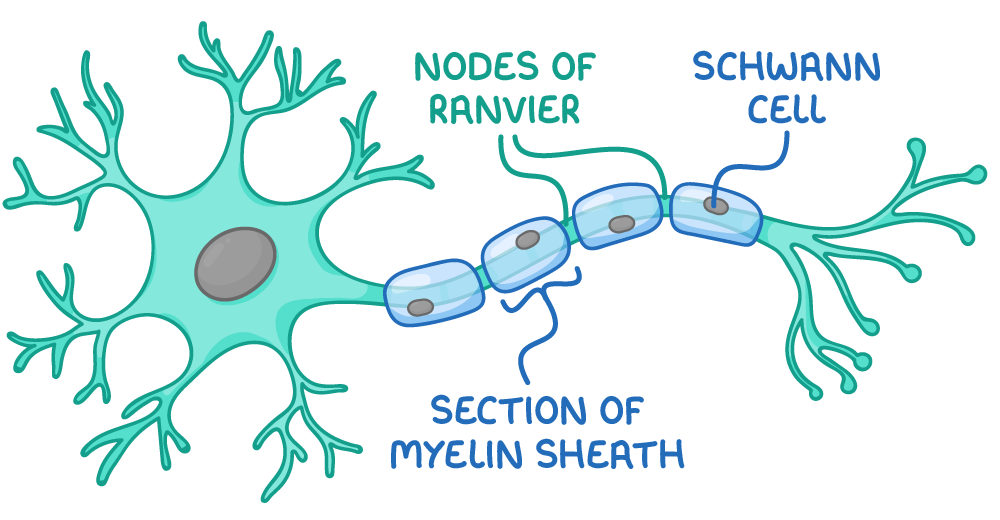
Name the features of the nerve cells
cell body
Axon
Schwann cells
Nodes of ranvier
Axon terminal
Dendrite
What is the function of the cell body
Production of proteins and neurotransmitters
What is the function of dendrites
Carries action potential to the surrounding cells
What is the function of the axon
Carries action potentials along the neurone
What are the function of Schwann cells
Forms the myelin sheath so provides electric insulation by preventing ions from passing through
What is the function of the nodes of ranvier
Where the action potentials take place
What is the definition of action potential
Self propagating wave of electric disturbance caused by the temporary reversal of potential difference across the axon
What is the resting potential caused by
The difference in charge inside and outside the neurone with the inside being more negative and the outside being more positive
How is the potential difference maintained in the resting potential
sodium potassium pumps (Carrier proteins) actively transport 3 Na+ out and 2K+ in using ATP
This creates an electrochemical gradient so some Na+ diffuses in and some K+ out
The membrane is more permeable to K+ ions as at rest, some of the voltage gated K+ ions are open but all the Na+ are closed so some K+ diffuses out
This means more negative inside and more positive outside
What triggers an action potential
Neurones voltage increasing beyond a certain point from resting potential due to a stimulus
What are the stages of an action potential
resting potential
Detection of stimulus
Threshold
Depolarisation
Repolarisation
Hyperpolarisation
Refractory period
What does a detection of a stimulus do in an action potential
Na+ voltage gated channels open at one part of neurone
Na+ diffuses into neurone so the membrane is more permeable to the Na+
This part of the membrane is now depolarised
What is depolarisation
when the depolarisation threshold is reached, more Na+ voltage gated channels open so more Na+ diffuses in so positive charge increases inside
What is repolarisation
When a certain voltage is reached inside, the voltage gated Na+ channels close whereas the K+ channels open
K+ diffuses out of neurones
What is hyper polarisation
Lots of K+ ions diffuse out so the charge inside is more negative than the resting potential
This closes the voltage gated K+ channels
Sodium potassium pumps restore the resting potential
What are failed initiations
When not enough of the voltage gated Na+ channels open so not enough depolarisation due to a weak stimulus
What is the all or nothing principle
Action potential only occurs if stimulus reaches a threshold value only if the stimulus is strong enough
What do stronger stimuli cause
a higher frequency of action potentials but the action potential amplitude always remains the same size
What is the refractory period
The period after depolarisation where no new action potential can occur as the sodium ions can’t be opened
What are the benefits of the refractory period
actions potential only travel in one direction
Each impulse is distinct
Stops too high frequency of action potentials which could damage the effectors
Why does a lower temperature lead to slower nerve impulses
Slower diffusion of sodium and potassium ions
Why do axons with larger diameters conduct impulses quicker
Ions experience less resistance as they flow through them
Why do myelinated axons conduct impulses faster than non myelinated axons
myelin provides electric insulation
So in myelinated neurones, depolarisation and action potentials can only occur in the nodes of ranvier but across the whole length of the axon in non myelinated neurones
This means the impulse jumps from one node to another via saltatory conduction
This means the action potentials doesnt have to travel across the whole length of axon
What do synapses allow
Convergence of impulses or the divergence of impulses
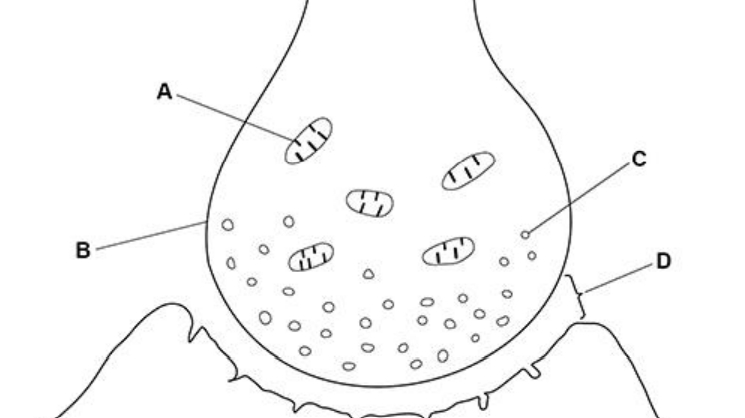
What are A,B,C and D
A = mitochondria
B = presynaptic membrane
C = Synaptic vesicles
D = synaptic vesicles
What is the cholinergic synapse
The synapse between the motor neurone and a muscle fibre
What is the neurotransmitters present in the cholinergic synapse
Acetylcholine which is broken down by the enzyme acetlycholinesterase to from acetate and choline
How are action potentials transmitted across the synapse (cholinergic)
action potential causes depolarisation of the pre synaptic membrane
This causes voltage gated Ca2+ channels to open which allows Ca2+ to diffuse in to the pre synaptic knob
This causes the synaptic vesicles to move to and fuse with the pre synaptic membrane which releases the acetylcholine
The acetylcholine diffuses across the synapse
They bind to neuroreceptors on the post synaptic membrane
This causes Na+ channels to open so Na+ diffuses in and depolarise the post synaptic membrane
If the depolarisation threshold is reached, an action potential is reached
What happens after the transmissions across the synapse
acetylcholinesterase breaks down acetylcholine to form acetate and choline which causes them to detach from the neuroreceptors and close the sodium channels
The products are actively transported to the pre synaptic knob using ATP
They are regenerated using ATP to form acetylcholine again
Why might the inhibition of acetylcholinesterase lead to muscle issues (5)
less acetylcholine being broken down to acetate and choline
This means more acetylcholine binding to neuroreceptors on post synaptic membrane
This means more Na+ channels open
This means more Na+ diffuses into the post synaptic knob so causing an action potential
This causes muscles to remain contracted
Why might neurotransmitters causing hyperpolarisation prevent synaptic transmission (2)
the hyperpolarisation causes the post synaptic membrane to be more negative and below resting potential
This means more Na+ needed to diffuse in to reach threshold and cause action potential so prevents it from doing so
How might a drug blocking calcium channels at synapses prevent transmission of pain impulses to brain (4)
no Ca2+ diffusing into pre synaptic knob due to blocked channels
This means no synaptic vessels move and fuse with presynaptic membrane so no neurotransmitter released into synapse
This means no neurotransmitter diffuses across the synapse and binds to neuroreceptors on post synaptic membrane
This means no Na+ diffuses in so no action potential to be sent to brain