ENVS 3
 Call Kai
 Learn
 Practice Test
 Spaced Repetition
 Match
 Flashcards
 Knowt Play
1/89

There's no tags or description
Looks like no tags are added yet.
90 Terms
Exponential growth
A type of growth where the rate is mathematically proportional to the current value, leading to continuous, non-linear increase of a quantity. In a population this refers to the state of increasingly accelerated growth with ecological implications for scarcity. Also, it’s expected for a smaller population or stock to grow exponentially early on, but for medium/large populations, it can be misleading, growth this year can raise the bar too high for next year, making it harder to surpass that growth.
IPAT
Developed by Ehrlich and Holdren, Impact = Population * Affluence * Technology
Absolute growth
the exact numerical change in a population
Relative growth
measures population change as a percentage relative to the population before (is the percent change/increase in the population).
Malthus
believed exponential growth in a population is a problem because it means that we will run out of resources. Also believed that environmental impact was determined solely by the population (I = P).
Ehrlich and Holdren
argued that impact was caused by population, affluence (consumption), and technology, (IPAT).
Boserup
argued that population growth drives agricultural innovation and technological advancement “necessity is the mother of innovation”. Green Revolution is an example of this.
induced intensification
questions if scarcity really is bad if it drives cultural innovation
Pesticide Treadmill
when the use of pesticides (evolutionary) selects for pesticide-resistant pests, requiring more innovation of new pesticides
Environmental Kuznets Curve graph
Predicts that environmental impacts rise during development, only to fall after an economy matures”. ONLY holds for localized pollutants (SO2 and NOx), doesn’t hold for CO2). And SOME, of the declines in emissions from rich countries resulted from the shift of industrial activities to poorer countries.

Market Response Model
A model that predicts economic responses to scarcity of a resource will lead to increases in prices that will result either in decreased demand for that resource or increased supply, or both

Externalities
Unintended side effects of an economic activity that affect uninvolved third parties
Positive Externality
Private cost, Public benefit
Negative Externality
Public cost, Private benefit
Market failure
When the free market fails to allocate environmental resources efficiently, leading to overconsumption, pollution, or depletion of the natural resource.
Cap and trade
The total amount of a pollutant is limited and tradable rights to pollute are distributed to polluters.The role of the state is to set limits and enforce contracts. Cap and trade also rewards companies based on efficiency
Cap and trade strengths and weaknesses
Is effective at reducing the amount of air pollution that occurs.
Allows for flexibility in which companies can choose how they make their production more efficient.
The money generated from the auctioning of licenses can go towards clean energy, community projects, or economic support.
Main weakness: Localized pollution hotspots/zones can develop in underserved communities since the cost of abatement is higher here, the buyers of emission permits may also be centralized in or near these communities.
Offsets
when a company is allowed to pay someone else to reduce a certain amount of pollution elsewhere. But, this is criticized for being low quality and not effective at reducing pollution because the funded projects would have happened anyway without offset money, so no extra emissions were reduced. They also delay direct cuts to emissions.
Collective Action Problems
caused by externalities, is when there’s a divergence between individual and collective interests, which leads to a worse outcome for everyone if people acted according to their own interest
Free Riding
means enjoying the benefits of a group effort or shared resource without paying the cost or sharing the risk to produce it, this makes it hard to solve CAPs
Prisoner’s dilemma
is a game theory scenario where two people acting in their own self-interest end up with a worse outcome than if they had cooperated
Nash Equilibrium
a state in a game where no player can improve their outcome by solely changing their strategy, assuming all other players keep their strategies the same
Tragedy of the commons
when people act in their own short-term self-interest and degrade a shared resource, ruining it for everyone
State vs Markets vs Communities

Ostrom’s Design Principles
Boundaries, collective choice, monitoring, sanctions, conflict resolution, proportionality, autonomy
Input Rules
Regulates the effort going in (gear restrictions, amount of effort, hours worked, needing a permit to do certain things). Input is usually easier to measure and enforce.
Output Rules
Regulates the harvest coming out (number of units caught, reports produced, limits on things). Output rules are sometimes preferred because they ensure we get the result we want.
Group size and group heterogeneity
Groups are not monolithic but are often heterogeneous. Scale (group size) can make collective action more difficult.
Upstream-Downstream Asymmetry
when the community upstream a river can do environmental harm without experiencing the consequences while the community downstream is disproportionately affected by the environmental impact from the community upstream
Gilded trap
a situation, system, or opportunity that looks wealthy, attractive, or rewarding on the surface ("gilded," or covered in gold) but actually locks people into hidden risks, dependency, or long-term harm
discount rates
determine how much future environmental benefits or damages are worth today, driving the trade-off between short-term costs and long-term incentives. They are ethical and political decisions and determine how much importance we give to future generations
Short term discount rates
Higher discount rate, Prioritize present benefits over future benefits
Long term discount rates
Lower discount rate, Gives more weight to future benefits and future generations
Roving Bandits
highly mobile, commercial resource extractors that move rapidly from one ecosystem to another, depleting valuable natural resources before local communities or governments can establish regulations to stop them
Intrinsic Value
you value something just for what it is
Extrinsic Value
you value something for what it provides: resources (food), recreation, utility
Conservation
PINCHOT: The management of a resource or system to sustain its productivity over time
Preservation
MUIR: Keeping the wilderness, managing and protecting an environment for its own sake (intrinsic value). Is against the human exploitation of nature
Origins of conservation ethic
originated from the growing recognition that nature should be protected and managed responsibly rather than exploited for unlimited human use. It developed largely in response to industrialization, deforestation, overhunting, and the depletion of natural resources.
Land ethic
Introduced by Aldo Leopold, “A thing is right when it tends to preserve the integrity, stability, and beauty of the biotic community. It is wrong when it tends otherwise” – basically expands the traditional definition of "community" to include not just humans, but the entire natural world
Moral extensionism
the principle of humans extending their moral concern (what deserves ethical consideration) beyond humans to include non-human entities (the land).
Anthropocentrism
An ethical standpoint that views humans as the central factor in considerations of right and wrong actions toward nature
Ecocentrism
An environmental ethical stance that argues that ecological concerns should be central to decisions about right and wrong action (environment is prioritized over human concerns).
Holism
the insistence that a whole system (e.g. an “ecosystem” or the Earth) takes precedence over the protection of it’s parts (e.g. individual animals).
Utilitarianism
An ethical theory that posits that the value of a good should be judged solely (or at least primarily) by its usefulness to society
Rewilding
the act of reintroducing a species to an area to restore and protect natural processes and wilderness areas
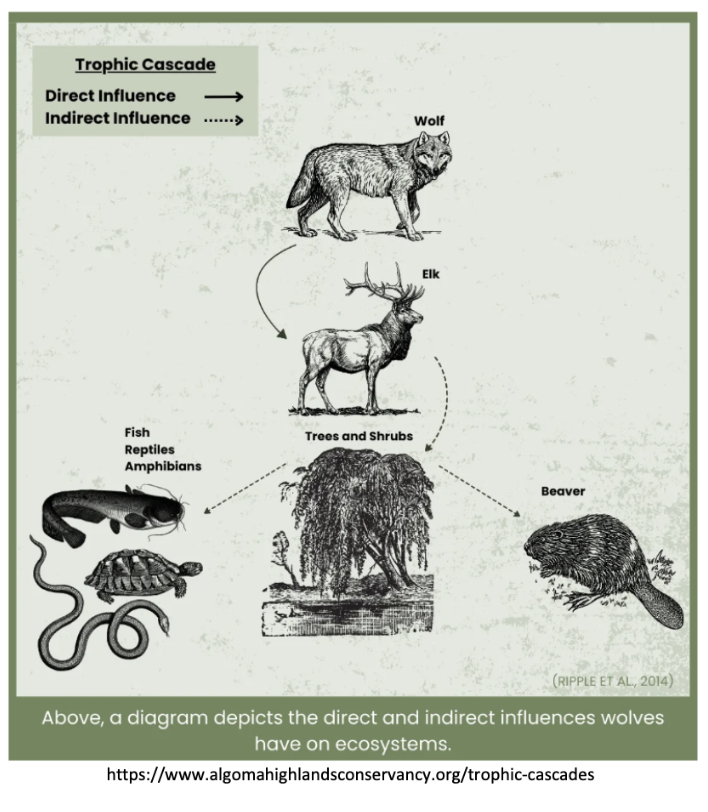
Trophic Cascades
when a change in one trophic level causes a ripple effect in the other trophic levels. It can cause one species to increase, making the following decrease, and so on…
Counterfactuals
is a hypothetical or unobserved "what-if" scenario showing what WOULD HAVE happened to an ecosystem, species, or environmental outcome without a specific policy, action, or intervention. These are compared to actual observed results and used to measure true cause-and-effect impact
Additionality
the principle that an environmental project or intervention must generate a positive environmental benefit that would not have occurred without THAT specific project or its funding.
Confounder
A variable that causes both the treatment and the outcome. It opens a noncausal path, so the raw correlation mixes the causal effect with something else.
Correlation
when X and Y move or relate together (they’re associated with having either a positive or negative relationship).
Causation
when a change in X leads to a response in Y
Simpson’s paradox
a situation in statistics and causal inference where aggregated data show one trend and disaggregated data show another
Spillover
Occurs when treating one unit changes outcomes in other units
Leakage
is harmful spillover, protection displaces clearing (or buying) somewhere else
Drivers of deforestation
roads, urban areas, population, soil suitability, agricultural activity, and proximity to agriculture
Senecah’s Trinity of Voice
access, standing, influence
Access
making participation accessible for individuals, could be through forms of communication (language), being able to access certain information to be informed about the issue, being able to attend and know where meetings are held, citizens perceive that their voices matter and will be heard
Standing
respecting a person’s opinion and actively listening to what they have to say, verbal and nonverbal communication demonstrates respect, consideration, and empathy
Influence
Citizens have the real potential to influence the decision, even if the outcome is not what they desired. Citizens have some influence over the process, and one can see their voice reflected in either the responses and/or the decision.
Elite Capture of Participatory Processes
when businesses submit comments to federal rule-making at rates many times higher than public interest groups, effectively taking over participatory procedures
NIMBYism
is a social and political attitude in which residents oppose new real estate, infrastructure, or community facilities near their homes, even when they support the broader need for those projects
Theories of participation
Some forms of public participation are:
Testimonies at public hearings
Written comments, letters, emails
Engagement through social media
Public Workshops
Field Days/Trips
Public Art
Naturalistic Fallacy
if something is natural, it must be good
Rebound effect
an increase in efficiency can lead to an increase in consumption, which can potentially reverse efficiency gains
Coase Theorem
a thesis based in neoclassical economics, holding that externalities (e.g. pollution) can be most efficiently controlled through contracts and bargaining between parties, assuming the transaction costs of reaching a bargain are not excessive
Bundle of rights
treats ownership of land and natural resources not as a single absolute claim, but as a collection of separate, transferable legal rights. These rights include: TRade (buy and sell what you own), Access, Development, Extraction
Institutions
Rules and norms governing collective action, especially referring to rules governing common property environmental resources, like rivers, oceans, or the atmosphere
California cap-and-trade Case study
The case of California’s Cap and Trade brings up an issue of equity in which sources of greenhouse gas emissions also emit local pollutants that have negative local impacts. Market policies can create “hotspots” because the cost of abatement determines where the pollution occurs and permit buyers may be concentrated in disadvantaged communities
Catch Shares Case study
Catch shares, also known as Individual Transferable Quotas (ITQs), are a fisheries management strategy designed to prevent the tragedy of the commons and overfishing. Scientists establish a total allowable catch, which is divided into individual quotas that fishermen can buy, sell, or trade. This eliminates the race to catch fish, encourages safer fishing practices, and promotes long-term economic and environmental sustainability. However, catch shares can create economic inequality by making it difficult for smaller fishermen and new generations to afford fishing quotas. The case demonstrates how market-based policies can help manage common-pool resources but must also consider social equity and ecological sustainability
Central Valley Groundwater Case study
is an example of tragedy of the commons because farmers were using up all the water for their interest and not conserving it for the interest of the community
Connecticut Citizen’s assembly on Property Taxes Case study
Is an example of a participatory process
Endangered Species Act
Makes it illegal to “take” or harm any species listed as endangered on public as well as private lands. A subsequent regulation defined harm to include destruction of critical habitat. The Trump administration is weakening this.
Fishing Game
Is an example of tragedy of the commons because we all want to serve our best interest of getting the most money but by maximizing our own fishing effort, we limit the amount of fish available for everyone else.
Global Carbon and Climate Case study
Global carbon and climate change represent a commons problem because the atmosphere serves as an unmanaged shared sink where individual actors benefit from emissions while globalizing the environmental costs
Hetch Hetchy Dam Case study
Hetch Hetchy was a valley in Yosemite National Park. The city of San Francisco wanted to dam the valley to create a large reservoir.
Pinchot → CONSERVATION, argued for the usefulness of Hetch Hetchy Valley
Muir → PRESERVATION, argued that Hetchy should be wilderness untouched by humans
Pinchot won.
Housing and Zoning Case study
is the way local governments regulate how land can be used and what can be built on it, it’s not just an economic issue—it is also an environmental policy issue, and zoning laws and environmental review can determine what gets built, where it gets built, and who gets access to housing
Housing, zoning, and environmental review are interconnected because government regulations determine where and how housing can be built. Restrictive zoning can limit housing supply, increase prices, and reinforce socioeconomic segregation, while lengthy environmental reviews can increase development costs and delay construction. Although these policies are intended to protect communities and the environment, they can unintentionally worsen housing affordability. The challenge is balancing the need for more affordable housing with environmental protection and community interests.
Environmental Review
the process of evaluating a proposed project's or policy's potential environmental impacts before approving or funding it, ensuring compliance with federal, state, and local laws. Is associated with NEPA
NEPA
the National Environmental Policy Act of 1969, requires federal agencies to assess environmental consequences, consider alternatives, and involve the public prior to taking action.
Klamath Dam Removals Case study
The Klamath River is an important river to many tribes like the Klamath Tribe. These tribes rely on the River for its salmon and other anadromous fish. They use them as food, medicine, and as part of their cultural practices. When hydroelectric dams were built, the river faced degradation and the dams blocked off the salmon’s migratory paths, preventing them from spawning new eggs, which caused the salmon to be endangered. The Klamath tribe had to stop fishing salmon, meaning they no longer could utilize them as a resource although their lifestyle heavily relied on salmon
Maine Lobster Fishery Case study
The fishery is vulnerable because they’re in a gilded trap, they lack economic and ecological diversity (making them less resilient). Institutional attributes are:
Boundaries: Strong property rights (licenses, zones and harbor gangs)
Monitoring and sanctioning
Co-management: state supports and users have internalized key rules.
Double Gauge law and minimum and maximum sizes
v-notch rule for pregnant females
Gear limits (can only use traps) and trap limits (input rules, commonly used in communities)
Lobster traps are highly selective.
Conservation ethic and intrinsic value of nature.
New England Groundfish Case study
The species biology and fishing technology present problems for groundfish management since it’s highly unselective, so all sizes and pregnant fish die. When they’re hauled to the surface, they die (their swim bladders break), a high percentage of all groundfish caught come aboard dead.
Cod is a kind of groundfish, and their collapse may have helped the lobster population since cod used to prey on lobster.
The groundfish industry has almost none of the community characteristics that would lower costs of negotiating and enforcing rules.
New Mexico Acequias Case study
Cox analyzed 51 acequia irrigation communities in New Mexico's Taos Valley. They found that water-sharing agreements and groundwater access help sustain collective action and crop production, whereas property rights fragmentation and urbanization weaken it. The collective-action problem that they face is that upstream acequias can divert scarce snowmelt-fed surface water before it reaches downstream users (worsens during droughts).
The problems that the acequia farmers face are:
Farming in a high desert environment.
Managing upstream v.s. Downstream water use conflict.
Building and maintaining irrigation infrastructure (serves as a public good).
Institutional attributes of the acequias:
Their institution is decentralized, but formal positions like commissioners exist.
Land rights are private, while water rights are common.
Water rights are expressed in units of time (not water).
Collection action vs CAP
Collective action is the coordinated effort by a group of people working together toward a shared goal, whereas a collective action problem is the obstacle that stops them from cooperating even when cooperation would benefit everyone.
Point Reyes National Seashore Case study
The conflict: Ranchers argue that sustainable cattle ranching, dairy production, local food systems, and historic ranching communities should remain part of Point Reyes.
Environmentalists' argument: Cattle contribute to manure pollution, soil erosion, ecological degradation, and competition with native wildlife, including tule elk.(The iconic tule elk, some of which were fenced in on the northern part of the peninsula to keep them from competing for grassland with cows, were dying off.)
The management decision: A 2025 settlement allowed 11 of 13 ranching families to leave, with compensation, and designated approximately 17,000 acres for conservation and ecological restoration.
The controversy: Two ranching families opposed the settlement and sued to preserve ranching, arguing that agriculture can coexist with wildlife and conservation.
The social impact: Removing ranches also affected workers, their housing, families, local food production, and the area's agricultural community.
Sacred Groves Case study
India's sacred groves demonstrate how traditional religious and cultural beliefs can promote environmental conservation. Local communities protect these forests because of their spiritual significance, unintentionally preserving biodiversity, water resources, and native ecosystems. However, urbanization, development, and declining traditional beliefs threaten their survival. Community organizations such as KRAPAVIS work with local residents to restore and protect these forests, demonstrating the importance of community-led conservation and traditional ecological knowledge.
Whaling and the shift to petroleum Case study
An example of the market response model, specifically branch B because they found an alternative source of oil.
In the mid-1800s, whaling was a major industry for oil, but whale populations were depleted due to aggressive hunting, which led to increased prices of oil. The higher prices for oil led to the search for an alternative resource. This alternative resource was petroleum, specifically kerosene, and its cheaper price made the demand for whale oil drop.
Yellowstone Wolves Case study
Wolves were reintroduced into the park via the ESA in 1995. The purpose was to restore a missing apex predator and rebalance an ecosystem damaged by decades of overgrazing by elk. Their reintroduction is controversial because the wolves also prey on livestock.
Trophic Cascade of Wolves in Yellowstone
Oostvaardersplassen Case study
a case of cattle, horse, and deer rewilding in the Netherlands to maintain an open grassland. The rewilding project helped create habitats that benefited other wildlife, but the animals’ populations grew beyond what the reserve could sustain and had no natural predators, leading to mass starvation during the winter and public outcry. The case highlights the conflict between letting nature regulate itself and the responsibility humans have to intervene and help protect animals.