PSYC 100 Exam 2 Weeks 5-10
 Call Kai
 Learn
Learn Practice Test
 Spaced Repetition
 Match
Match Flashcards
 Knowt Play
1/142

There's no tags or description
Looks like no tags are added yet.
Name | Mastery | Learn | Test | Matching | Spaced | Call with Kai | Chat |
|---|
No analytics yet
Send a link to your students to track their progress
143 Terms
sensation
detecting physical energy with our sense organs (eyes, skin, noise, tounge)
perception
the brain’s interpretation of the raw sensory information
illusion
the way we perceive a stimulus doesn’t match its physical reality
transduction
conversion of an external stimulus into a neural signal
sensory receptors
specialized cells designed to convert a certain kind of external information into a neural signal
sensory adaptation
sensory neurons adjust their sensitivity based on recent stimulu history
aftereffects
opposing sensory or perceptual distortions that occur after adaptation
describe the order of a physical stimulus to the brain to process
external stimulus>transduction by receptors>signal carried to the brain by neurons> routed through the thalamus> arrives at the appropriate location of the brain
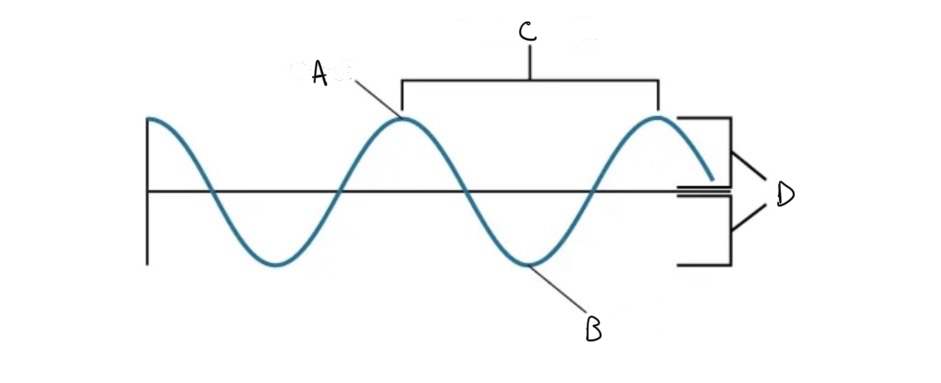
A- crest, B- trough, C- wavelength D- amplitude
for a sound wave what does the wavelength represent
pitch
for a light wave what does the wavelength represent
color
what color is high frequency
purple/violet
what color is low frequency
red
psychophysics
how the physical world (like light waves, sound levels, or weights) connects to our mental world (what we actually see, hear, or feel)
absolute threshold
the lowest level of a stimulus needed for the nervous system to detect a change 50% of the time
why is absolute threshold 50% of the time?
because human perception is not all or nothing
just noticeable difference (JND)
the smallest change in the intensity of a stimulus that we can detect 50% of the time
weber’s law
the stronger the stimulus, the bigger the change needed to detect it
does doubling a physical stimulus double your sensation
no
signal detection theory
how stimuli are detected under different conditions
what is a signal
what you are trying to detect
what is noise
similar stimuli that might compete with the signal and interfere with your ability to detect the signal
explain signal to noise ratio
difficulty detecting your signal is correlated to how much noise there is
what is a “hit” in signal detection theory
true positive, stimulus was present and you responded yes
what is a “false alarm” in signal detection theory
false postive, stimulus was absent but you still said yes
what is a “miss” in signal detection theory
false negative, stimulus was present but you said no
what is a “correct rejection” in signal detection theory
true negative, stimulus was absent and you responded no
what is a liberal in signal detection theory
says yes often
what is a conservative in signal detection theory
says yes rarely
Dichotic listening
a psychological and audiological test where two different auditory stimuli are played at the same time—one into each ear—via headphones, information is only reported through the attended ear
cocktail party effect
when important information pops out in a conversation your not attending (like your name)
inattentional blindness
you fail to notice a clear, unexpected object or event in your field of vision because your attention is focused on a primary task (gorilla experiment)
change blindness
which an observer fails to detect large or obvious alterations in a visual scene
bottom-up processing
brain interprets information, starting with raw sensory input and building up to a complete perception without relying on past memories or expectations
top-down processing
processing influenced by previous experience and knowledge
is sensation bottom up or top down
bottom up
is perception bottom up or top down
top down
perceptual sets
when expectations influence our perceptions

A- eyelid, B- pupil, C- sclera, D- iris
pupil function
where light enters
iris function
controls pupil size determining how much light is let in
cornea function
focus light, covers the iris and pupil
lens function
disc that helps blend light
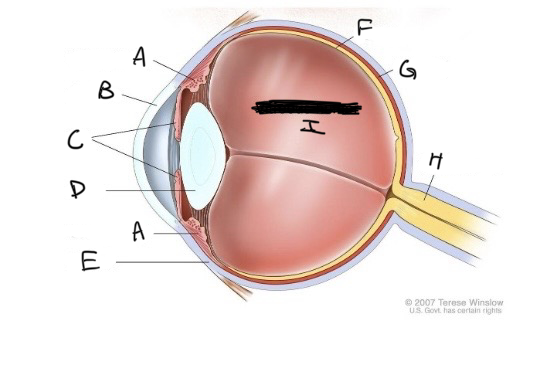
A- cillary body, B- cornea, C- iris, D- lens, E- sclera, F- retina, G- choroid, H- optic nerve, I- vitreous humor
myopia
nearsightedness
hyperopia
farsightedness
what is the retina
the membrane at the back of the eye responsible for converting light into a neural signal
what is the fovea
central portion of the retina that is responsible for sharpness of vision
what is acuity
sharpness of vision
saccades
small jerky movements of the eye that allow for rapid change focus, puts the fovea on a new location of the retina
rods
respond to low levels of light, not color sensitive, more common outside of fovea
cones
sensitive to fine detail, mostly in fovea, color sensitive
optic nerve
a bundle of axons that travel from retina to brain
blind spot
area of the retina where the optic nerve exits the eye
hue
the color of light that corresponds to wave length
trichromatic theory
color vision is based on 3 primary colors: blue green red
what are the 3 types of cones we have
a cone that likes red, one likes green and one like blue
opponent process theory
we perceive colors in terms of three pairs of opponent colors: red-green, blue-yellow, black-white
depth perception
your brain's ability to judge distance, height, width, and spatial relationships in a three-dimensional (3D) environment
Binocular depth cues
require input from both eyes working together (objects close to you)
Monocular cues
perceived using just one eye
Binocular disparity
the slight difference in the images projected onto the left and right retinas because the two human eyes sit a few inches apart on the face
Convergence
eyes converge to see near objects
list monocular depth cues
relative size, texture gradient, interposition, linear perspective, height in plane, light and shadow, and motion parallax
how are we able to process depth
The brain puts together information from multiple cues, and makes ts best guesses arrive at a 3D representation of the world. information from retina does not specify depth
shape constancy
perceived shape is constant, even though shape of the image varies
size constancy
the visual system's ability to perceive an object as the same physical size even when its distance changes and the size of its image on the retina grows or shrinks
perceptual constancy
perceive stimuli as consistent across varied conditions
color constancy
perceive color stimuli as consistent across varied conditions
figure-ground separation
your visual system automatically tries to identify figure
gestalt principles
human brain automatically organizes fragmented visual information into meaningful wholes
common fate
objects moving at the same direction and at the same speed are perceived as a group (people doing the wave)
synchrony
stimuli that are perceived to occur at the same time are perceived as part of the same event (dropping an object on the floor and the sound that occurs)
proximity
Objects that are physically close to each other are perceived as belonging to the same group or unit
similarity
Items that share similar visual characteristics (such as shape, color, or size) are grouped together, leading you to perceive vertical columns rather than a random grid
continuity
The brain prefers to perceive continuous, smooth paths or lines rather than abrupt, jagged changes in direction
closure
The mind automatically fills in missing gaps in a shape to perceive a complete, recognizable figure
common region
Elements enclosed within the same defined boundary are perceived as a single group, overriding proximity or similarity
connectedness
Elements that are physically connected by a line or explicit link are perceived as more related than elements that are unconnected
loudness on a sound wave is what?
amplitude
timbre
the unique tone quality or "tone color" of a sound that lets you tell different instruments or voices apart, even when they play the exact same pitch at the same loudness
what does middle ear do
transmit sounds from ear from to inner ear
what does inner ear do
converts sound waves into electrical signals for hearing and detects head motion and position to maintain balance
what does cochlea do
transduction accomplished by the movements hair cells on the conchlea called cilia
what is place theory
our perception of a sound's pitch depends on the specific location or place along the basilar membrane inside the cochlea that vibrates most intensely in response to that sound wave
frequency theory
neuron firing rate matches pitch
volley principle
an auditory processing concept stating that groups of neurons in the auditory system fire action potentials in staggered, alternating sequences (taking turns) so that their combined discharge rate can encode sound frequencies higher than any single neuron could manage on its own
Binaural cues
depending on having 2 ears
interaural level difference
the difference in sound intensity (loudness) and pressure level between the left and right ears
Interaural timing difference
sound from the right side reaches the right ear first (just a little)
conductive deafness
malfunctioning of the ear drum or ossicles
sensorineural hearing loss
neural signals are not transmitted from conclea
noise induced hearing loss
damage to hair cells due to loud noises
learning
change in an organism’s behavior or thoughts as a result of experience
what are the two types of learning
non-associative and associative
non-associvative learning
a form a learning that involves responding to a single stimulus
Habituation
A decreased behavioral response to a repeated, benign (harmless or irrelevant) stimulus
Sensitization
An increased behavioral response to a repeated or strong/noxious (harmful/painful) stimulus
associative learning
occurs when an organism makes connections between 2 or more stimuli/events that occur together in the environment
classical conditioning
an unconscious learning process where a neutral stimulus is repeatedly paired with a naturally occurring stimulus until the neutral stimulus triggers an automatic, learned response