Chp 3 - Biology
 Call Kai
 Learn
Learn Practice Test
 Spaced Repetition
 Match
Match Flashcards
 Knowt Play
1/131

There's no tags or description
Looks like no tags are added yet.
Name | Mastery | Learn | Test | Matching | Spaced | Call with Kai | Chat |
|---|
No analytics yet
Send a link to your students to track their progress
132 Terms
Cell
the smallest unit of living things
“Small room”
Building blocks of all living things
Microscopic
In Multicellular organisms, cells make tissues
Prokaryotic
Eukaryotic
2 different cell types
Robert Hooke
who discovered 1st cells from cork
37.2 Trillion cells
Humans have ___ in their bodies
1 millimeter (mm) to 1 micrometer (μm)
Most cells range in size from ___ in diameter
large surface area
Cells need a ____ of the plasma membrane to adequately exchange materials (oxygen, CO2, food)
small
The surface-area-to-volume ratio requires that cells be
Large cells
surface area relative to volume decreases which also decreases the efficiency of transporting materials in & out of the cell
Small cells
larger surface area to volume ratio is advantageous for exchanging molecules with environment
1 billionth of a meter
1 nm (nanometer) =
1 millionth of a meter
1 μm (micrometer) =
1 thousandth of a meter (0.1 cm)
1 mm (millimeter) =
1/100th of a meter
1 cm (centimeter) =
39.37 inches; 100 cm in a meter
1 m (meter) =
Light or Compound
microscope allow you to see 400x normally
Pass light through the specimen which passes through 2 lenses
Must be thin or translucent
Type of microscope normally found in a lab
Cell level structures
Dissecting
microscope allows you to see 20-80x
3D view
Many objects can be focused at one time
Tissue level structures
Electron Microscope
Beam electrons, not light
Highest magnification & resolution so better clarity
Much more costly
Cell theory
a unifying concept in biology
All Organisms are composed of cells
All Cells are the basic units of structure & function in organisms
All Cells come from preexisting cells b/c cells are self-reproducing
Schleiden, Schwann, Virchow
German Scientists who developed Cell Theory
Prokaryotic Cells
Bacteria & Archaea
Smaller -> 1.1 - 1.5 μm wide, 2 - 6 μm long
No nucleus or organelles
Basic shapes: spirillum / spirochete, coccus, bacillus
Nucleoid: Region is where DNA resides
DNA in the Nucleoid
Plasmids: accessory DNA

Eukaryotic Cells
Fungi, plants, animal, protists
Larger -> 10 - 100 μm
Nucleus holds DNA, organelles perform functions
DNA in the Nucleus
Specialize for specific function

Prokaryotic Cells
Lack a membrane-bound organelle
Structurally smaller & simpler than eukaryotic cells (which have a nucleus)
Two taxonomic domains
Bacteria
Archaea
Two prokaryotic domains are structurally similar but biochemically different
3 Bacterial Shapes: spirillum / spirochete, coccus, bacillus
Cell Envelope includes:
Capsule
Cell Wall
Plasma Membrane
Structure of Prokaryotes - Outer Layers
Plasma Membrane
lipid bilayer w/ embedded & peripheral proteins
Cell Wall
maintains the shape of the cell & is strengthened by peptidoglycan (a polysaccharide)
Capsule
layer of polysaccharides on the outside of the cell wall. Also called a Glycocalyx
Purpose is protection
Well organized & resistant to removal - Protection

Phospholipid Bilayer (phosphate heads & fatty acid tails)
Structure of Prokaryotes - The Plasma Membrane

Ribosome
Flagellum
Fimbriae
Nucleoid
Plasma Membrane
Cell Wall
Capsule
The Structure of Prokaryotes - A Prokaryotic Cell
Cytoplasm
Semifluid solution
Nucleoid
Plasmids
Ribosomes
Prokaryotic Cytoplasm
Cytoplasm
Function: Gel like substance b/t the nucleus & edge of the cell
Semifluid solution
Encased by plasma membrane
Contains water, inorganic & organic molecules, & enzymes
Nucleoid
a region that contains the single, circular DNA molecule
Plasmids
small accessory (extrachromosomal) small rings of DNA - often assist in antibiotic resistance
Ribosomes
tiny structures in cytoplasm that synthesize (make) proteins
Flagella
Fimbriae
Conjugation pilus
Prokaryotic External Structures
Flagella
provide motility / locomotion (ability for an organism to move independently by using metabolic energy)
Fimbriae
small, bristle like fibers on the cell surface that allow adhesion to surfaces
Conjugation pilus
rigid tubular structures used to pass DNA from bacterium to bacterium. Like a “sexual” transfer of DNA
Transfer of DNA from one bacterium to another
Membrane-bound nucleus that houses DNA
Organelles
Plasma Membrane
1st two characteristics distinguish from prokaryotic cells
much larger than prokaryotic cells
Eukaryotic Cell Background / Contain
Plasma Membrane
Eukaryotic Cell Background
Separates cell contexts from the environment
Regulates passage of materials in & out
Is composed of a phospholipid bilayer with embedded proteins
What should leave & enter the cell
Endosymbiosis Theory
Theory of how Mitochondria & Chloroplasts Evolved + Origin of Organelles
Mitochondria & chloroplasts:
SIMILAR in size to bacteria
have circular DNA like bacteria
have double membranes: outer from host membrane & inner from original prokaryote
have their own RIBOSOMES that are similar to bacterial ribosomes
Endosymbiotic Theory
Theory of Nucleus, Mitochondria, & Chloroplast Organelle Formation
Cell Wall
Ribosomes
Cytoskeleton
Organelles WITHOUT Membrames
non-membrane-bound cell organelles
both in PROKARYOTIC & EUKARYOTIC CELLS
Vacuole
Lysosome
Golgi Apparatus
Endoplasmic Reticulum
SINGLE Membrane-Bound Organelles
only in a EUKARYOTIC CELL
Nucleus
Mitochondria
Chloroplast
DOUBLE Membrane-Bound Organelles
only in a EUKARYOTIC CELL
Nucleolus
Nucleus
Chromatin
Endoplasmic Reticulum (ER)
Rough Er
Smooth Er
Ribosomes
Golgi Apparatus
Golgi Vesicule
Vacuole
Peroxisome
Lysosome
Centrosome
Mitochondria
Cytoplasm
Plasma Membrane
Cytoskeleton
Miicrofilament
Intermediate Filament
Microtubule
Eukaryotic Cell Organelles
Animal Cell

Nucleolus
Nuclear Envelope
Nuclear Pore
Nucleus
Rough ER
Smooth ER
Golgi Complex
Ribosome
Centrosome
Lysosome
Perixisome
Mitochondrion
Cytoskeleton
Microfilament
Intermediate
Microtubule
Cytoplasm
Plasma Membrane
Cilia
Flagellum
Eukaryotic Cell Organelles

Eukaryotic Cells
Animals, fungi, plants, protists (= single celled animals & plants)
two classes of organelles
Endomembrane system
Energy Related Organelles
Endomembrane system
Organelles that communicate with other another
Via membrane channels
Via small vesicles
Eukaryotic cell
Mitochondria & Chloroplasts
Independent & Self Sufficient
Energy Related Organelles
Nucleus
command center of the cell, usually near center separated from cytoplasm by nuclear envelope
Consists of double layer of membrane
Nuclear pores permit exchange b/t nucleoplasm & cytoplasm
Contains chromatin (DNA / RNA) in semifluid nucleoplasm
Dark Nucleolus
Nucleus
Function: Cell’s control center, contains DNA & genes
Chromatin
___contains nucleic acids & proteins
Condenses to form chromosomes
Chromosomes
formed during cell division
carriers of genetic information
Dark Nucleolus
creates molecules of rRNA (ribosomal RNA)
Function: Produces ribosomal subunits (ribosomes produce proteins)
Chromatin
Nucleoplasm
Nucleur Envelope
Inner Membrane
Outer Membrane
Double Membrane Phospholipid Membrane Nuclear Pores
Anatomy of the Nucleus

Ribosomes
composed of rRNA (ribosomal RNA)
Function: protein synthesis in the cell
Consist of a large subunit & a small subunit
Subunits are made in nucleolus
NOT TECHNICALLY AN ORGANELLE
Ribosomes
Located:
On the endoplasmic reticulum
Free in the cytoplasm
polyribosomes
Ribosomes either singly or in groups
DNA info copied to mRNA (transcription)
Ribosomes translate mRNA code into a sequence of amino acids to make a protein (translation)
Proteins synthesized by cytoplasmic ribosomes stay in cytoplasm; those by attached ribosomes end up in the Endoplasmic Reticulum
Ribosomes process of transcription & translation
Central dogma of molecular biology (ribosomes)
DNA-mRNA-protein sequence of events (DNA code copied by mRNA. mRNA takes that code to ribosomes in the cytoplasm. Code decoded to produce proteins)
Endomembrane System
Series of intracellular membranes that compartmentalize the cell
Restrict enzymatic reactions to specific compartments within cell
Endomembrane System
Components
Nuclear envelope
Membranes of Endoplasmic Reticulum (Rough & Smooth ER)
Golgi apparatus
Vesicles
Several types
Transport materials b/t organelles of system
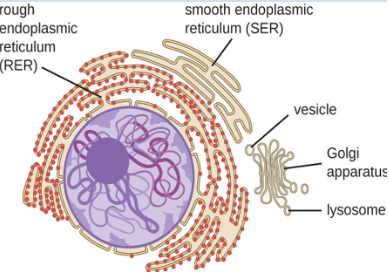
Endoplasmic Reticulum
a system of membrane channels & saccules (flattened vesicles) continuous w/ the outer membrane of the nuclear envelope
Rough ER
Studded with ribosomes on cytoplasmic side
Proteins anabolism (synthesis)
Assists in synthesizing proteins
Modifies & processes proteins
Adds sugar to protein
Results in glycoproteins
Important in cell functions
Forms transport vesicles
Substances move to Golgi apparatus
Rough ER
Function: Responsible for protein synthesis & modification & transport vesicles
Smooth ER
No ribosomes
Synthesis of lipids (= fats)
In testes, hormone testosterone is produced by smooth ER
Site of various synthetic processes, detoxification, & storage
The liver, with abundant smooth ER, detoxifies drugs
Forms transport vesicles
Substances can move to Golgi apparatus
Smooth ER
Function: Manufacture of Lipids, synthetic processes, detoxification, storage, & transport vesicles
Golgi Apparatus
function: tags proteins & fats w/ proper labels for the cell to send them to the proper places
Golgi Apparatus
Consists of flattened, curved saccules
Resembles stack of hollow pancakes
Modifies lipids & proteins with “signal” sequences (like adding an address to a package)
Golgi apparatus
Modifies proteins & fats with a signal sequence so cell knows what to do with them
Like Postal Service, FedEx, or UPS addresses packages for the cell
So the cell knows where to send each package
Lysosomes
Membrane-bound vesicles (not found in plants)
Function: Break down old cellular components
break down old cell parts for recycling
Produced by the Gogli apparatus
Contain powerful digestive enzymes & are highly acidic
Lysosomes
Digest / break down large molecules into simpler subunits
Recycle cellular resources
In white blood cells they engulf pathogens (bad bacteria)
Peroxisomes
Small round organelles that breakdown fatty & amino acids
Function: Breakdown fatty acids & amino acids; detoxify poisons in the cell
Found in the liver
Endomembrane System Summary
Proteins produced in rough ER & lipids from smooth ER are carried in vesicles to the Golgi apparatus
The Golgi apparatus modifies these products, then sorts & packages them into vesicles that go to various cell destinations
Secretory vesicles carry products to the cell membrane where exocytosis (substances leave / exit the cell) produces secretions
Lysosomes also fuse with incoming vesicles & digest macromolecules
Chloroplasts
Make Sugar from CO2 & Water
Produce food (glucose) from light
Oxygen is released as a byproduct
Function: Produces glucose from sunlight

Mitochondria
Break Down Sugar to CO2, Water & Energy
Break down sugars & other foods to produce energy
Function: Cell’s energy production center

Double Membrane -> Endosymbiotic theory
Photosynthesis occurs in the thylakoids (hollow)
Stacks of thylakoids forms granum
Chloroplast Structure
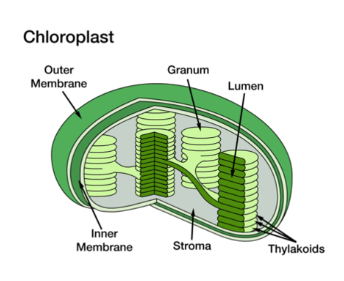
Double Membrane System
Cristae -> Folds in the inner membrane of a mitochondrion
Allows greater surface area for ATP Production
Mitochondrion Structure
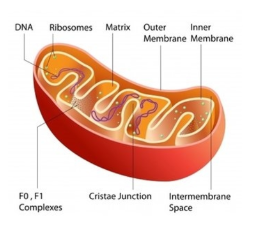
Cytoskeleton
Maintains cell shape
Assists in movement of cell & organelles
Makes internal transport possible
Three types of macromolecular fibers
Assemble & disassemble as needed
May be compared to bones & muscles of animal
Is dynamic; responds to environmental changes

Microfilament / Actin Filaments (smallest)
Intermediate filaments
Microtubules (largest)
Three types of macromolecular fibers in Cytoskeleton

Actin Filaments
Extremely thin filaments, like twisted pearl necklace
Support plasma membrane
Support for microvilli in intestinal cells
Muscle contraction

Intermediate Filaments
intermediate in size b/t actin filaments & microtubules
Rope-like assembly of fibrous polypeptides
Intermediate Filaments
Function:
Support nuclear envelope
Cell-cell junctions to keep cells in place
Keep organelles in place
Make skin tough
Form all hair
Microtubules
largest of cytoskeletal components
Function:
Separate chromosomes in cell division
Organelles travel on microtubules around cell
Formed by the ___ organizing center

The Centrosome is composed of 2 Centrioles at Right Angles to each other. Important in Cell Division
Microtubules - Centrosome & Centrioles

Microtubule Operation
Energy is needed for movement from ATP
Vesicle moves, microtubule doesnt move

Flagella
Hair-like projections from cell surface that aid in cell movement
Eukaryotic flagella
In center are two single microtubules
move like a propeller or cork screw
Ex: sperm cells in males

Cilia
much shorter than flagella (tiny hairs projecting from cells)
move in coordinated waves like oars
found in Protists (one celled organisms for movement)
Increase surface area in intestines to absorb more nutrients & water
Ex: Cells lining upper respiratory tract (in men & women), fallopian tubes in women

Intercellular Junctions
junctions connect cells in various ways
Tight junctions
Desmosomes
Gap Junctions
Plasmodesmata
Tight Junctions
stitch cells together
Skin has many __ junctions to prevent things from getting in
Line the urinary tract (you dont want urine to escape into your body)
Desmosomes
weld cells together. Keeps tissue in a sheet-like form
heart, skin, muscles
Gap junctions
keep tissues together but allow particular substances through
Ex: Heart - calcium moves from one cell to the next to make the heart beat in unison
Plasmodesmata
are in plants only
Function like gap junctions
Allow signal molecules & nutrients to transport quickly
Animal Cells
Only cell membrane
No cell wall
No defined shape
Lysosomes
Only Mitochondria, no Chloroplasts
Gap Junctions b/t some cells
Cilia & flagella present
Animal vs Plant Cell

Plant Cells
Cell Wall + Membrane
Defined cell shape
No Lysosomes
Chloroplasts & Mitochondria
Plasmodesmata (= gap junctions)
Central vacuole
No cilia or flagella
Animal vs Plant Cell

Plasma Membrane - Fluid Mosaic Model
describes the components of the membrane
in flux of patchwork of carbohydrates, proteins, cholesterol, phospholipids
Phospholipids make up the membrane
Proteins act as identifiers for the cell & gateways inside & out of the cell
Channel proteins: allows specific molecules in & out of the cell
Cholesterol acts as an antifreeze
Phosphate
How the Membrane Reacts with Water
hydrophilic (water liking)
Water inside & outside the cells interacts with the ___ heads
Hydrophilic substances cant move through the membrane easily b/c of the lipid layer
