bi203-- cell communication: second messengers
 Call Kai
 Learn
Learn Practice Test
 Spaced Repetition
 Match
Match Flashcards
 Knowt Play
1/13

There's no tags or description
Looks like no tags are added yet.
Name | Mastery | Learn | Test | Matching | Spaced | Call with Kai | Chat |
|---|
No analytics yet
Send a link to your students to track their progress
14 Terms
what are second messengers?
molecules that relay signals received at receptors on the cell surface to target molecules in the cytosol or nucleus
small ,water soluble non proteins that can easily diffuse throughout the cell (intracellular)
greatly amplify strenght of signal— binding of ligand to single receptor at cell can cause big changes in biochemical activities in the cell
amplification of second messengers explain why low extracellular concentrations of first messengers are effective
major classes of second messengers
cyclic nucleotides (cAMP and cGMP)
inositol triphosphate (IP3) and diacylglycerol (DAG)
calcium ions (Ca2+)
cAMP pathway— intro
activation of receptor by first messenger leads to activation of associated G protein (GS)
GS activates its effector protein —Adenylyl Cyclase
Adenylyl Cyclase— active site on cytosolic surface of plasma membrane and catalyses conversion of cytosolic ATP to 3’, 5’ or adenosine monophosphate (cAMP[cyclic AMP])
cAMP second messenger diffusing through cell
cAMP binds to and activates enzyme— cAMP- dependent protein kinase (kinase A)
![<ul><li><p>activation of receptor by first messenger leads to activation of associated G protein (G<sub>S</sub>)</p></li><li><p>G<sub>S</sub> activates its effector protein <strong>—Adenylyl Cyclase</strong></p></li><li><p><strong>Adenylyl Cyclase</strong>— active site on cytosolic surface of plasma membrane and catalyses conversion of cytosolic ATP to 3’, 5’ or adenosine monophosphate (cAMP[cyclic AMP])</p></li><li><p>cAMP second messenger diffusing through cell</p></li><li><p>cAMP binds to and activates enzyme— cAMP- dependent protein kinase (kinase A)</p></li></ul><p></p>](https://assets.knowt.com/user-attachments/587087b7-9313-4a87-8cee-d102da280762.png)
cAMP pathway— adenylyl cyclase (AC)
most class ||| human AC’s are transmembrane proteins with 12 transmembrane segments
protein is organised with 6 transmembrane segments, then the C1 cytoplasmic domain, and then another 6 membrane segments and a second cytoplasmic domain called C2
important parts for function: N terminus, and C1 &C2 regions
C1a and C2a subdomains homologous and form intramoelcular ‘dimer that forms active site
all classes of AC catalyse conevrsion of ATP to 3’, 5’ cAMP and pyrophosphate
cAMP produced then serves as a regulatory signal via specific cAMP binding proteins, either transcription factors or other enzymes (e.g. cAMP dependent kinases)

cAMP pathway— protein kinase A
once activated by cAMP, Protein kinase A phosphorylates other proteins in cell, activating them
activated protein brings about target cell’s ultimate response to first messenger (e.g. increased expression of particular gene or protein)
acting as intracellular second messenger, cAMP triggers a preprogrammed series of biochemical steps within the cell to bring about response dictated by first messenger
different types of cells have different proteins available for phosphorylation and modification by protein kinase A
cAMP can induce widely differing responses in different cells, depending on what proteins are modified (e.g. cAMP can modify heart rate in heart, and break down stored glucose in liver)
what does cAMP amplify
signal within the cell; allows single first messenger to generate large cellular response

variety of responses induced by cAMP dependent protein kinase
lipid breakdown
glycogen synthesis
glycogen breakdown
active transport
protein synthesis
open/close ion channels
cGMP pathway
cyclic guanosine monophosphate (cGMP) serves as a second messenger in a manner similar to that observed with cAMP
natriuretic peptides activate receptors that are associated with membrane bound guanylyl cyclase
receptor activation of guanylyl cyclase leads to conversion of GTP→cGMP
similar to cAMP, cGMP mediates most of its intracellular effects through the activation of specific cGMP dependent protein kinases (protein kinase G)
two types of guanylyl cyclases
membrane guanylyl cyclases: located in membrane, activated by sepcific extracellular peptides
soluble guanylyl cyclases : located mainly in cytosol, activated by nitric oxide

Inositol trisphosphate (IP3) and diacylglycerol (DAG)— signalling and roel in intracellualr signalling
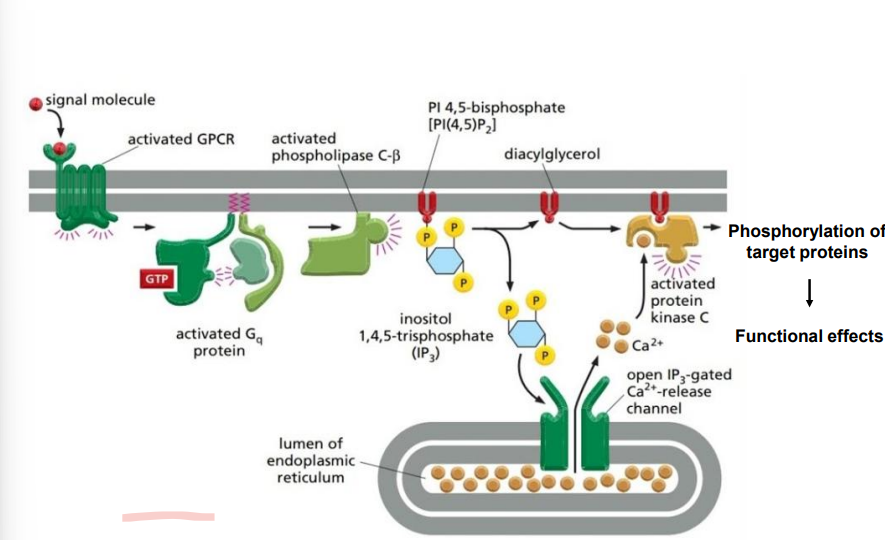
bidning of a hormone (first messenger) (e.g. TSH) to its receptor actiavtes a G protein— results ina ctivation of effector protein phospholipase C
hydrolyses phospatidyl- inositol biphosphate (PIP2) ( a component of the tails of the phospholipid molecules within the membrane)
producing IP3 and DAG
lipid soluble DAG remains in inner layer of membrane and recruits protein kinase C (PKC)
PKC is a calcium dependent enzyme and phosphorylates many other proteins (protein kinase cascade)
IP3 is water soluble and diffuses through the cell binding to the ER and causes calcium channel to open
calcium flows out of ER down its concentration gradient into the cytosol
Calcium (Ca2+)— signalling and role in intracellular signalling
more widely used than cAMP
levels of Ca2+ kept low in cytosol
increase in Ca2+ concentration causes many cellular responses including muscle contraction, secretion of certain substances and cell divisions
Ca2+ binds to and activates proteins in cell
one key protein is calmodulin (forms a Ca2+ calmodulin complex)
Ca2+ calmodulin complex can then activate other proteins (many of which are protein kinases)
many proteins have specific binding site for Ca2+ and their activity is directly dependent on CA2+ binding, the available Ca2+ concentration this directly controls activity of these proteins

cell signalling leads to regulation of transcription or cytoplasmic activites
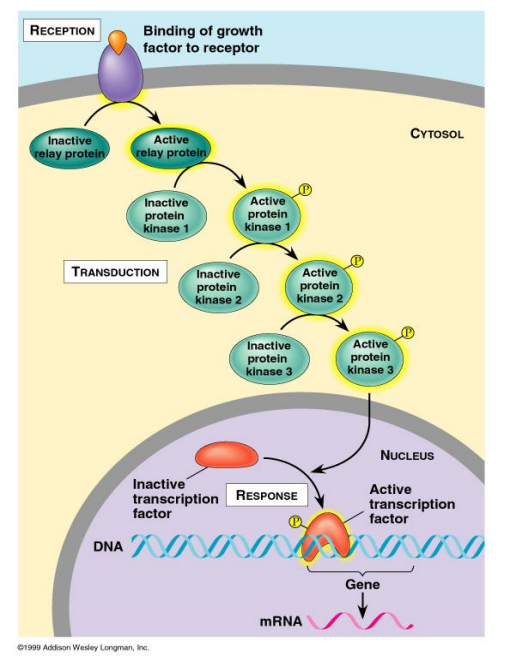
cell response to extracellular signal— output response
signal transduction pathway leads to regulation of one or more cellular activities
response can occur in cytoplasm or nucleus
many signalling pathways regulate synthesis of enzymes or other proteins, usually by turning genes on or off in nucleus
final activated molecule in signalling pathway may function as a transcription factor
some signalling pathways regulate activity of enzymes rather than their synthesis
cytoplasmic response to a signal
example: stimulation of glycogen breakdown by epinephrine
results in activation of glycogen phosphorylase, which catalyses breakdown on glycogen
alteration in the activity of a protein

nuclear response to a signal
example: binding of adrenaline to receptor results in activation of cAMP and PKA
some of the PKA enters the nucleus and activates CREB (cAMP Response Element Binding protein)
once activated, CREB binds DNA and stimulates transcription of specific genes
alteration in protein production
cessation (turning off) of signal trasnduction pathways
key event is the cessation of receptor activation
first messenger is removed
receptors are inactivated by protein phosphatases
receptors are internalised by endocytosis
second messengers such as calcium and cAMP are transient and are inactivated
Ca2+ is pumped out of cell
cAMP is inactivated by phosphodiesterases (cAMP converted to AMP)
protein phosphatases inactivate target proteins