PYB306 Psychopathology 2025
 Call Kai
 Learn
Learn Practice Test
 Spaced Repetition
 Match
Match Flashcards
 Knowt Play
1/664

There's no tags or description
Looks like no tags are added yet.
Name | Mastery | Learn | Test | Matching | Spaced | Call with Kai | Chat |
|---|
No analytics yet
Send a link to your students to track their progress
665 Terms
Week 1: Introduction
Changes in the DSM
- Steady increase in pages (947 to 1050 from 20212 to 2022)
- Major increase in cost over 70 years
- DSM increased by only 1 diagnostic category between 2012 and 2022
* Latest release in TR (Text Revision): comprehensively update the descriptive text that is provided for each DSm disorder based on reviews of the literature
What is the DSM-5 and its approach
Diagnostic and Statistical Manual for Mental Disorders, 5th edition (text revision)
Heavily reliant on the harmful consequences (either subjective distress or impairment) and utilises the notion of a syndrome (a cluster of associated features that are recognised through the evaluation of signs and/or symptoms)
Signs are observed in the 'patient' by the diagnostician
Symptoms are reported by the person to the diagnostician
DSM Imperfections
• Process criticisms (field trials, composition of task force).
• The lowering of diagnostic thresholds → pathologising human behaviour
• The introduction of new disorders without a clear scientific basis
• Failure to test/demonstrate validity of diagnostic categories
• Reification of 'disorders'
• Failure to deliver on the promise of neuroscience
• The reduced 'reliability' of many diagnoses
Why use the DSM
Widely used (ensures common language of diagnosing disorders across healthcare professionals)
Long History
An exemplar of an approach
Learning benefit from "critical acceptance and the controvery
Other classification systems
- The World Health Organisation's International Classification of Diseases
- US NIMH Research Domains Criteria
What is Pyschopathology
- Generally used as a term to describe abnormal behaviour/functioning
- The manifestation of mental disorders/conditions/illnesses
- The science or study of mental disorders
Implications of Psychopathology
Psychologists and students of psychopathology can/should function as scientist-practitioners
i.e. as users/evalautors of science, as contributors to science, via the inegration of science with practice/ to acheive practice-related/relevant objectives
7 possible indicators of psychopathology
1. statistical deviance
2. violation of social norms
3. subjective distress
4. maladaptiveness
5. social discomfort
6. irrational or unpredictable
7. dangerousness
Challanges of psychopathological indicators
1. causes subjective distress - the role of insight?
2. Many people need adjustments to perform daily tasks
3. if statistical rarity is used, how rare should it be? is a rare behaviour necessarily harmful/deviant/distressing? are common behaviours necessarily unharmful etc?
4. social and cultural values change and they require a reference point
Another view of psychopathology
That it arises from "harmful" dysfunction (Wakefield)
A physical or mental mechanism cannot perform its natural/normal function, which causes harm to the person considering the culutre in which they lives
Implies: not every such dysfunction leads to a disorder or is "harmful"... provides for cultural consideration
DSM-5 Definition
"A mental disorder is a syndrome characterised by a clinically significant disturbance in an individual's cognition, emotion regulation or behaviour that reflects a dysfunction in the psychological, biological, or developmental processes underlying mental function"
What is abnormal behaviour
"Mental disorders are usually associated with significant distress or disability in social, occupational, or other important activities"
NOT
"an expectable or culturally sanctioned response" nor the product of "social deviance or conflicts with society"
What is not DSM-5 Mental illness
- an expectable and culturally sanctioned response to a particular event (such as the death of a loved one)
- Socially deviant behaviour (such as the actions of political, religious, or sexual minorities)
- Conflicts that are between the individual and society (such as voluntary efforts to express individuality)
Epidemiology
- the scientific study of the frequency & distribution of disorders within a population
- Epidemiological data tell us which disorders are most common
Incidence definition
The number of new cases that appear in a population during a specific time period (e.g. per year)
Prevalance Definition
The number of active cases of a disorders in a population during a specific period
Lifetime Prevalence definition
Total proportion of people from a population who will have the disorder at some point in their lifetime
Other terms: point prevalence, 1-year prevalence
2007 National Survey of Mental Health & Wellbeing (Australia) findings
- 45% of all Australians aged 16-85 will experience a mental health-related disorder during their lifetimes
- Most common conditions: depresssion, anxiety, & substance use
- almost one in 5 adult Australians met criteria for a mental disorder during the 12 months prior to the survey
- More than 3 million Australians experience symptoms of a mental disorder each year

WHO Global Burden of Disease Study: findings
globally, mental illness
- causes 1% of deaths
- Accounts for 47% & 38% of disability in developed and un-(or under-) developed countries
Approaches used to gather information about mendal disorders
- Case studies
- Self-report data
- observational approaches
Lecture 1: Summary Part 1

Lecture 1: Summary Part 2

GO READ
Chapter 1, 2 & 3 Summaries
Week 2: Assessmen & Treatment Principles
Diagnosis
identification of a disease
Prognosis
a forecast of the probable course and outcome of a disease or situation
Differential Diagnosis
a list of potential diagnoses compiled early in the assessment of the patient
Provisional Diagnosis
a temporary diagnosis pending further examination or testing
Multi-axial system
- the DSM-IV organizes each psychiatric diagnosis into 5 levels or axes
Purpose(s) of Assessment
The purpose of Psychopathology assessment including how it is framed and delivered, depends to an extent on the underpinning paradigm
It may include a diagnosis:
• To determine if psychopathology is present, and if so, the type
• To help characterise (or feed into a formulation) - build
understanding of the 'problem'
• To inform treatment planning/priorities
• To establish a baseline against which 'change' might be
monitored
• To establish a shared language from which to progress
Purpose of Assessment ll
• A diagnosis may be "required" because
of contextual factors (e.g., to gain access
to the health system)
• For individuals there may be pros and
cons associated with diagnoses
• Accurate diagnosis is important and can
be difficult, and diagnoses carry different
meanings for different people
Principles of Assessment
Since symptoms in psychopathology are rarely
pathognomic, and instead, the same feature
might be common across several conditions, we
need some principles to guide diagnostic
assessments.
Psychologists may consider the reliability &
validity of
• diagnostic entities (DSM categories)
• the underpinning information (e.g., method of
assessment [self report, test, other]), and its
reliability validity)
• verification of information (e.g., corroborated,
converging, or gaps?)
• how the data are combined (e.g., checked for
biases, plausible given other the known facts,
resolving discrepancies).
Reliability
measurement consistency (e.g.,
interrater reliability or diagnostic agreement,
kappa)
Validity
degree to which a test / system measures
what it is intended to measure (e.g., convergent
validity, predictive validity)
Standardisation
a fixed procedure (or prescription)
for application of methods ensuring/increasing
measurement consistency (affects how tests are
administered, scored, and reported).
The Clinical Interview
*involves client (and if consent permits, may
include significant others)
*enables collection of:
• A wide variety of information (client's view
of problem/symptoms; subjective
distress/impairment)
• Different types of information (clinical
observations, signs, mental status - mental
status exam - may involve role playing
"show me how...")
Potentially covers
- family history/geogram
- Strengths, resources, supports
Pyschological Tests
Many feature standardisation &
normative data; have known psychometric properties,
including reliability.
Tests with normative data can be useful for assessing
severity relative to "normal" (normative comparisons)
Tests with known psychometric can be used to evaluate
for statistically significant change overtime (ipsative
comparisons)
Recent DSMs include their own "assessment tools" and
we also see "psychometric" info for some diagnoses
Overarching Factors
Assessment process can be affected by
• Human cognitive biases, personal biases, including
cultural biases
• Procedural/process/interpersonal aspects (e.g.,
time, space, organisational priority; client willingness
to be "assessed", confidentiality, rapport)
• The nature of the beast - no (or very few)
pathognomonic tests for psychopathology, and the
DSM's polythetic approach, means that there can
be different symptoms for the same diagnosis
• Accurately measuring "normal" behaviour, thoughts,
and feelings is challenging - what are our starting
assumptions about consistency of behaviour,
thoughts etc
• The available methods have strengths &
weaknesses.
• Important to understand the attributes of the
methods & appreciate that data may conflict;
judgement is needed for integration of findings and
to offset factors that can reduce accuracy (e.g.,
inaccurate data, bias, premature closure etc).
• A systematic approach for the integrative process
could improve diagnostic accuracy (e.g., a process
for diagnostic reasoning).
Treatment
The application of techniques to relieve the symptoms associated with teh disorder and provide better adaptive functioning in the individual
Paradigmatic Approaches

Psychodynamic
Goals: Increase awareness of unconscious motives and defenses
• Methods: free association, dream analysis, focus on childhood
• Treatment length: long term (yrs),
although newer variants are shorter
• Therapist role: passive,
non-directive, interpreter
(may be aloof).
Biological
• Goals: Treat physical or brain disease processes that
underpin the disorder; deliver benefit by altering biology.
• Methods: diagnosis, medications,
psychosurgery, ECT, etc
• Treatment length: brief* with some follow up visits
• Role of therapists: active, directive, diagnostician
Humanistic/ Experimental
Goal: increase emotional
awareness through techniques
such as reflective listening
• Methods: empathy, support,
opportunities for exploration of
emotions
• Length: variable, length not
typically structured
• Therapist role: passive, non-
directive supporter
Cognitive Behavioural
Goal: Change contingencies &
teach more adaptive cognitions &
skills (behaviours/responses)
• Methods: skills training, guided
learning, behavioural rehearsal
(role playing), teaching of new
cognition, problem solving
• Length: short term with booster
sessions
• Therapist role: active, directive,
non-judgemental, teacher.
Combined Therapy
Combination of biological and
psychological therapy
• E.g., medication and
psychotherapy for depression or
schizophrenia.
• Consistent with a biopsychosocial
approach (treating multiple
possible drivers?)
• Extent of "integration" with this
approach.
Eclectic Therapy
Combined across psychological
paradigms (most commonly)
• E.g., Interpersonal therapy or
multimodal therapy.
• Employs techniques from different
paradigms rather than from one
perspective only; considered more
'client-centric.'
• A 'common' answer given by
psychologists to the question:
What therapy do you use?
Potential Harm in Therapies
All therapies carry a risk of harm or negative consequences
Some examples
• Side effects/unintended/unwanted effects
- medication side effects & withdrawal challenges, memory loss in ECT
- increased discussion of weight / food in eating disorders might further narrow focus on this life aspect with detrimental effects
• Breach of trust issues
• E.g., boundary violations, breaches of confidentiality, errors of professional judgement, power dynamics
• Loss of liberties
• E.g., treatment 'against one's will'
Harmful 'Psychological' Therapies

Effectiveness of Psychotherapy
• A landmark 1977 meta-analysis supports the
Modified (abbreviated) evidence hierarchy
effectiveness of psychotherapy (.85 SD units).
Limitations of Psychotherapy
the "file drawer" problem and other limitations for meta-analyses
• pooled results might pool across "adverse" therapies, or the studies
might not have been designed or powered to detect potential harms
• individual patient outcomes cannot be predicted
Efficacy VS Effectiveness
Efficacy studies (RCTs) are tightly
controlled
• e.g. treatment versus no treatment
• High internal validity, lower external
validity
Effectiveness studies (pragmatic trials) are
correlational
• Cannot identify cause & effect
• May yield useful descriptive information
Placebo
Beliefs/expectations about treatment
efficacy play a role; some treatment
gains may be attributable to a placebo
effect
Some solutions:
• Placebo-control groups
• Double-blind studies (difficult to
conduct because the therapist knows
which therapy they are using).
• Meta-analysis
Critical focus: Look for
these features when
evaluating the literature
Common Factors
There are some aspects of treatment that may be "in common"
• These factors predict a positive response, irrespective of the
psychotherapeutic approach.
Examples of common factors
that predict a better outcome
• Assessment and treatment is offered soon
after problem identification
• Therapeutic alliance is established quickly &
used effectively
- Therapist attributes such as
warmth, support, empathy
(impacts on alliance)
• Illness attributes (severity, type etc)
• Client attributes (resources/supports)
• Client encouraged to express strong
emotions or troubling experiences
• A flexible approach is used to
choose therapeutic techniques
• Goals of therapy are limited and
specific (narrowly focused) &
therapist is directive
Prevention
Therapy for self improvement as one avenue for mental health promotion, Could
we also study high functioning people, and find out what factors contribute to this?
• Prevention can be offered via universal (primary), selective (secondary) and
indicated programs
• Prevention studies yield some positive results with primary and secondary
school groups (e.g., Durlack & Wells, 1997)
• The benefits appear greatest for the prevention of anxiety, mood, and
eating/sleep disorders
• Evidence-based preventive programs and policies are now available for
implementation or await translate/implementation (WHO, 2004)
Treatment Summary
Works for many but not all people
• The average client is better off than 80% of individuals who remain
untreated
• Two-thirds of clients improve, only one-third who do not seek therapy
improve
• Most improvement occurs in the first six months
Lecture 2 Summary
At the end of this lecture, you should
• Have a broad understanding of methods used in the
assessment of psychopathology (i.e. the sources of
information); and their pros & cons
• Have an understanding of various treatment approaches
for psychopathology - including "classic" psychological
paradigms
• Be aware of some of the limitations of our understanding
of treatment effectiveness and efficacy
• Have a general understanding of the "treatability" of
psychopathology
GO READ
Chapter 4 & 16 Summaries
Week 3: Mood Disorders
Mood
A pervasive and sustained emotional response
Euthymia
'Normal' mood
Dysphoria/Dysthymia
Experience of an unpleasant (usually low) mood
Depression
Pervasive and sustained low mood and related behaviours & symptoms
Mania
Elavated mood, inflated self-esteem and associated symptoms
Hypomania
Increased energy but less severe features than mania
Euphoria
Intense feeling of well-being, excitement, over-confidence & over optimism
Mood Disorders: Impacted domains

Distinguishing Depression from 'normal' sadness
- Presence of "sad, empty or irritable mood, accompanied by somatic and cognitive changes". What differs is their duration, timing, severity and presumed aetiology
- Mood change is pervasive and persistent (does not improve, even temporarily
- Mood change may occur without precipitating event or it may appear disproportionate for the circumstances
- Mood is impacting (reducing) the ability to function day to day
- Mood change is accompanied by the additional cognitive, somatic, and behavioural signs and symptoms (mood change alone may not warrent diagnosis)
- Nature or quality of mood chamge may be different than whats experienced with normal sadness
DSM 4 to 5 categoisation of depression and bipolar
DSM-IV (4)
- Mood disorders = depressive + bipolar disorders (formerly known as manic-depressive disorder)
DSM-5
- Two different categories: Depressive Disorders, Bipolar and related disorders
DSM-5 Overview of Depressive Disorders
Added:
- Disruptive Mood Dysregulation Disorder
- Premenstrual Dysphoric Disorder
- (DSM-5-TR added Unspecified Mood Disorder)
Retained 'classic' condition
- Major Depressive Disorder (including MDE)
Merged (i think?)
- Persistent Depressive Disorder WITH
- Depressive disorder due to other medical condition; substance-or medication-induced
Removed
- 'Bereavement Exclusion'

DSM-5 Diagnosis Criteria for Major Depressive Episode (MDE) / Major Depressive Disorder (MDD)
1 Major episode in the absence of any history of manic episodes
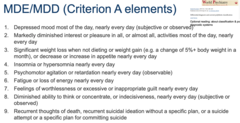
A. An episode is >5 of 9 symptoms indicative of change over a 2-week period *Including either (1) depressed mood, or (2) loss of interest or pleasure
PLUS
B. cause significant distress or impairment
C. Not attributable to other disorders/substances
DSM-5 Diagnosis Criterion A elements for MDE/ MDD
DSM-IV's exludement of Bereavement
(i.e. for major depression episodes following the death of a loved one in the 2 months; do not = MDE/MDD
Exluded bereavement because it does not typically result in MDE/MDD. - Very highly disagreed/ talked about change
Persistent Depressive Disorder (PDD; "Dysthymia")
- A more chronic, mild presentation
- Over a period of >2 years, exhibit a dperessed mood for most of the day, more days than not
>2 symptoms of 6 Symptoms
poor appetite or overeating
insomnia/hypersomnia
low energy or fatigue
low self-esteem
poor concentration/ decision making
feelings of hopelessness
Would NOT diagnose PDD if
- symptoms absent for more than 2 months at a time during 2-year period
- if at any time during first 2 years meets criteria for MDE/MDD, then given MDD diagnosis
- Presence of manic episode
Disruptive Mood Dysregulation Disorder
- Children 6-18 years old
- Chronic, severe, persistent irritability and frequent episodes of extremely out-of-control behaviour
*Allen Frances named this new diagnosis and the worst change to the DSM 5 as it will "turn temper tantrums into a mental disorder"
Premenstrual Dysphoric Disorder (PMDD)
- Moved from DSM IV 'Further study criteria' to a recognised condition in the DSM 5
- Severe form of PMS, characterised by mood lability, irritability, dysphoria, anxiety, difficulty concentrating, changes in appetite and sleep, pain, etc.
Bipolar Disorders: DSM-5 Overview

Bipolar I
At least one manic episode + Depressive episode
Bipolar II
- Depressive episode
- hypomania: episodes of increased energy, not severe enough to qualify manic episodes
- severity and duration
Cyclothymia
Chronic, but less severe form of bipolar disorder
-Symptoms of mani and depression rather than episodes
Manic Episode
A. At least a week of (or any period of time if hospilatisation due to) abnormally & persistenly elevated, expansive, or irritable mood and persistently increased goal-directed activity/energy: feature is present for most of the day, nearly every day of this period
B. ≥3 of 7 signs/symptoms (≥4 if mood is irritable)
C. Sufficiently severe to cause marked impairment in functioning, OR to necessitate hospitalisation, OR with psychotic features
D. Not attributable to effects of a substance or due to another medical condition
Manic Episode (Criterion B Elements)
3 or more of these symptoms (or 4 if mood is 'irritable)
1. inflated self-esteem or grandiosity
2. decreased need for sleep
3. increased talkativeness or pressure of speech
4. Flight of ideas or racing thoughts
5. Distractibility
6. Increased goal-directed activity / psychomotor agitation
7. Excessive involvement in activities with high potential for painful consequences
Hypomanic Episode
Same symptoms as manic episode (3 or more) except:
- Lasts at least 4 consecutive days
- unequivocal change in function but not severe enough to cause 'marked impairment' in function or trigger hospitalisation
Cyclothymic Disorder
- Chronic, fluctuating mood disturbance for 2 years or more
- Numerous periods of hypomanic & depressive symptoms (not enough to meet criteria for episodes)
- Never symptom-free for more than 2 months
- Onset usually in adolescnece or early adulthood
Specifiers (Bipolar example)
with...
Anxious distress
mixed features
melancholic features
atypical features
mood-congruent psychotic features
mood-incongruent psychotic features
catatonic features
peripartum onset
with seasonal pattern
with rapid cycling (BP I/II)
Reification
- a general criticism of DSWM, applicable for many disorders
- That the criteria are mistakenly taken for the conditi0on, when they are not. The criteria merely describe the condition, but it is not the condition. A description of something is not the same as the thing itself
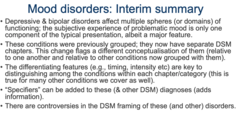
Mood Disorders: Interim Summary
Prevalnce of Depressive Disorders
- one of the most commonf orms of psychopathology
-Mean (age of onset) = 32 years
-Comorbidities: anxiety, substance abuse (and 'physical' illness)
Course & outcome of depressive disorders

Cuurse & outcome of Bipolar

Prevalence of Depression & Bipolar**
Australia
43% had a lifetime mental disorder
21% had a 12-month mental disorder
- 17 anxiety disorders ( most common)
- 7.5% "affective" [mood] disorder
- 4.9% depressive episode
- 1.5% dysthymia
- 2% bipolar I/II
for "affective" disorders [and anxiety too] figures show
- women > men *for some BP-related conditions
- Younger > older
Health economics of depression in Australia
- $12.6B in costs per year
- 6 million working days of lost productivitry
- accounts for approximaterly 10% of all disability
- 80% odf suicides preceded by a mood disorder
Factors in depressive disorder
- Negative/stressful life events:
- interpersonal loss
- loss of "social roles"
- feelings of entrapment, humiliation, defeat
- stress generation: increase prevalence of stressful life events
or specific groups, there may be additional significant social influences such as dispossession, cultural genocide, displacement, segregation, "stolen generation"
Psychological factors in depresive disorders
Cognitive vulnerability, Maladaptive schemas
1. assign global, personal meaning to failures
2. overgeneralise conclusions about self from events
3. drawing arbitrary inferences about oneself without supporting evidence
4. selective recall of events with consequences
Psychological factors in depresive disorders (cont.)
Causal attributions
- Depressogenic attribution style: internal, stable, global
Response styles:
- ruminative style
- distracting style
Goal attainment
- generalised goals
- pessimistic attitude
Psychological (behavioural) theories of depression
depressed people experience
- less positive reinforcement (verbal, social)
- more negative events
- reduced behaviour
Psychological factors in bipolar
Precipitating factors
- schedule-disrupting events
- goal attainment events
Social factors can influence recovery/relapse
- emotional climate within families
- social support
Biological Factors (depression and bipolar)
Genetics
- Monozygotic (MZ) twims = high concordance rates than Dizygotic
- genetic contribution especially influential in bipolar 1 disorder [approx. 8-10% of first-degree relatives of a person with Bipolar 1 will develop this condition, compared to the 1% risk for the general population]
![<p>Genetics</p><p>- Monozygotic (MZ) twims = high concordance rates than Dizygotic</p><p>- genetic contribution especially influential in bipolar 1 disorder [approx. 8-10% of first-degree relatives of a person with Bipolar 1 will develop this condition, compared to the 1% risk for the general population]</p>](https://assets.knowt.com/user-attachments/c825097a-4553-41b6-aa2f-8904f3fd9036.png)
Depressive Disorders Approaches (therapies)

Bipolar Disorders Approaches
Mood 'stabilizers'
- Lithium carbonate
- Anticonvulsant medications
Psychotherapy
- Cognitive therapy
Interpersonal and social rhythm therapy