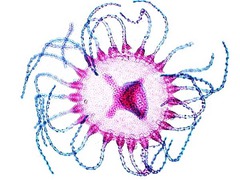
Porifera and Cnidarians Lab
 Call Kai
 Learn
Learn Practice Test
 Spaced Repetition
 Match
Match Flashcards
 Knowt Play
1/23

There's no tags or description
Looks like no tags are added yet.
Name | Mastery | Learn | Test | Matching | Spaced | Call with Kai | Chat |
|---|
No analytics yet
Send a link to your students to track their progress
24 Terms
Phylum Porifera - The sponges
Scypha -cross section
Radial Symmetry
Body Shape: Cylindrical
Asexual and Sexual Reproduction

Phylum: Porifera
Class: Calcarea (=Calcispongiae)
Scypha (=Grantia) sp.
Spicules - note the single - and 3-rayed calcareous spicules
Skeleton: Composed of needle-like calcium carbonate spicules (calcite)
Body Plan: Exhibits a Syconoid canal system.

Euplectella aspergillum - Venus' Flower Basket
Observe: section of skeleton, you can move the section and/or change magnification if you want to

Phylum Cnidaria
Class Hydrozoa
Hydra sp. - model
Cnidocytes containing nematocysts (stinging organelles), triggered by a hair-like cnidocil.

Phylum: Cnidaria
Class: Hydrozoa
Hydra sp.
Female Cross Section
Observe ovaries that appear as distinct tissues between the mesoglea and the epidermis

Phylum: Cnidaria
Class: Hydrozoa
Hydra sp.
Male Cross Section
Observe: Testes (Distinct regions in epidermis)

Phylum: Cnidaria
Class: Hydrozoa
Obelia sp. - a colonial hydroid
Exhibits alternation of generations (metagenesis), cycling between a sessile benthic polyp colony and a free-swimming sexual medusa stage.

Phylum: Cnidaria
Class: Hydrozoa
Physalia physalia
Portuguese man-of-war: a floating marine colony made of specialized individual animals that drift together on the ocean surface

Phylum: Cnidaria
Class: Scyphozoa
Aurelia sp.
Planula Larva
The planula larva of the moon jellyfish (Aurelia) is a tiny, oval, and ciliated free-swimming stage that forms shortly after fertilization in the life cycle of true jellyfish in the class Scyphozoa

Phylum: Cnidaria
Class: Scyphozoa
Aurelia sp.
Observe: scyphistoma larva (polyp stage)
oral tentacles
body tube
basal disc
Reproductive stage: Asexual
Next stage in life cycle: Ephyra

Phylum: Cnidaria
Class: Scyphozoa
Aurelia sp.
Observe: Strobila Larva
A critical asexual reproductive stage where a polyp transforms to produce young motile medusae

Phylum: Cnidaria
Class: Scyphozoa
Aurelia sp. - young medusa
A tiny, free-swimming larval jellyfish released during the asexual strobilation phase of a benthic polyp

Phylum: Cnidaria
Class: Scyphozoa
Aurelia sp. - Moon jellyfish
Preserved specimen
displays a translucent, saucer-shaped bell and four characteristic horseshoe-shaped gonads

Phylum: Cnidaria
Class: Anthozoa
Collection (museum box) of horny and stony corals
Exclusive marine organisms that exist solely as sessile polyps, lacking any free-swimming medusa stage in their life cycle
Exhibits only the polyp stage, reproducing sexually via broadcast spawning or brooding, and asexually through budding or fragmentation.

What is the basic difference between Horny Corals and Stony Corals?
Stony corals: build hard calcium carbonate skeletons
Horny corals: build flexible skeletons made of a protein called gorgonin, often reinforced with microscopic bone-like structures called sclerites.
Phylum: Cnidaria
Class: Anthozoa
Stony Corals - Various types
Observe: Various types of calcareous exoskeletal structures secreted by different species of corals cups or sockets in which animals are located.
Habitat: shallow, warm, tropical marine waters

Scypha sp. longitudinal section
Cuts vertically down the length of its vase-like body.
This perspective reveals a syconoid canal system structured to pump water and trap food.

Leucosoloenia sp. whole mount
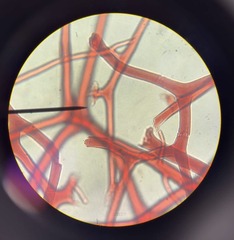
An entire, intact specimen of the simple marine tube sponge

Spongin Skeleton
Fibrous protein similar to collagen that forms the flexible internal skeleton of many sea sponges
Phylum: Porifera
Spongilla sp. - gemmules
Internal survival pods that allow freshwater sponges to stay alive through harsh conditions like freezing cold or dry drought

Hydra oligactis - whole mount
Brown hydra
The entire intact structure of this tiny freshwater polyp

Hydra oligactis
Brown hydra - cross-section turtox
Highlights the classic diploblastic body plan of a cnidarian polyp.
Under a microscope, this section looks like a ring or donut of cells surrounding a central hollow space

Live hydra
A tiny, predatory freshwater animal related to jellyfish that can regenerate its entire body and shows no natural signs of aging
Habitat: Freshwater, slow-moving streams

Obelia
Class: Hydrozoa
Phylum: Cnidaria
Asexual Reproduction (polyp form)