The Adaptive Immune System - B cells & Antibodies
 Call Kai
 Learn
Learn Practice Test
 Spaced Repetition
 Match
Match Flashcards
 Knowt Play
1/19

There's no tags or description
Looks like no tags are added yet.
Name | Mastery | Learn | Test | Matching | Spaced | Call with Kai | Chat |
|---|
No analytics yet
Send a link to your students to track their progress
20 Terms
What is the definition of the adaptive immune system?
Individual response to specific antigen exposure. It’s capable of change during the response (adapting)

Where do B cells mature?
In the bone marrow
Which antibodies do B-lymphocytes express?
IgM
IgD
They act as B-cell receptors for antigens
How do B cells recognise and present an antigen?
The B-cell receptor (IgM or IgD) binds the antigen
The B-cell takes it into the cell and displays an antigen fragment on its surface for recognition by a T-helper cell
What are the steps involved in B-cell activation?
The B-cell receptor binds the antigen (first signal).
A T-helper cell provides co-stimulatory signals (second signal).
Complement can strengthen B-cell activation by binding to the B-cell complement coreceptor.
What is the role of T-helper cells in B-cell activation?
They recognise antigen fragments presented by B cells and provide co-stimulatory signals that fully activate the B-cells, allowing antibody production
What happens after a B cell is activated?
It produces antigen-specific antibodies and can undergo class switching (e.g. IgM to IgA) and somatic hypermutation, which can produce antibodies with higher antigen affinity
How is B-cell activation downregulated by antibodies?
When sufficient antibodies are present, they bind the antigen and engage the B cell’s inhibitory Fc coreceptor, reducing B-cell activation and further antibody production.
What are antibodies (a.k.a immunoglobulins)?
Antibodies are proteins produced by B cells that specifically recognise antigens
They bind to microbes and toxins, helping phagocytes recognise and engulf circulating pathogens
Active immunity VS Passive immunity
Active immunity: Vaccination stimulates the body’s own B cells to produce antibodies and memory cells
Passive immunity: Antibodies are ejected directly into the patient, providing immediate but temporary protection
What is the antibody structure?
There are 5 classes of antibodies (IgA, IgD, IgE, IgG, IgM)
Antibodies can be secreted or membrane bound
The basic unit consists of 2 heavy chains and 2 light chains. The light chains can either be κ (kappa) or λ (lambda).
The chains are joined by disulphide bonds
What are hypervariable regions?
Hypervariable regions determine which antigen an antibody specifically recognises
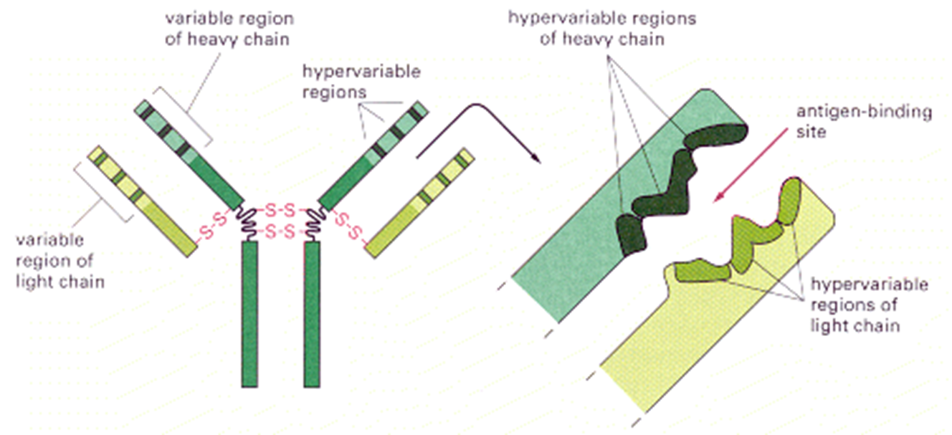
How does somatic hypermutation improve the antibody response?
Somatic hypermutation introduces changes to these regions, which can increase or decrease antigen binding affinity
B cells producing higher affinity antibodies are selected to survive, strengthening the immune response on repeat exposure
What is antibody typing?
Identifying the five classes of antibodies (immunoglobulins) and their functions:
IgM = First to be produced
IgD = Naive B cell
IgA = Epithelial / mucosal immunity
IgE = Helminthic parasites and immediate hypersensitivity = Allergy
IgG = Secondary exposure = GI tract
What are Fc-mediated effects?
Immune responses triggered by the antibody's Fc region, including opsonisation, ADCC, complement activation and mast cell activation.
How are antibodies used in diagnosis, laboratory testing and treatment?
Laboratory detection: Detect proteins using immunoblotting, ELISA, IHC, IF and FACS; determine blood groups.
Diagnosis: Detect antibodies in patient serum to identify infections or autoimmune diseases.
Prevention and treatment: Vaccinations stimulate antibody production; antibody-based therapies include trastuzumab (Herceptin) and infliximab.
What are monoclonal antibodies?
Identical antibodies produced by a single clone of B cells that recognise and bind to one specific antigen (epitope). They can be used to diagnose and treat diseases
Why are murine monoclonal antibodies humanised?
Murine (mouse-derived) antibody sequences can trigger immune reactions in humans.
Humanisation replaces most mouse amino acid sequences with human sequences while retaining the antigen specificity of the hypervariable regions.
What are the benefits of antibody based therapies?
Highly specific
Low in side effects
What are the challenges of antibody-based therapies?
Antibodies can be developed relatively quickly but are expensive to produce and require injection because they are proteins.
Target mutations can cause resistance and reduce effectiveness over time.
Antibodies are a form of immunotherapy. The issue with immunotherapies is that they can dramatically alter immune function and cause serious adverse effects, including anaphylactic shock.