Assessment Final Review
 Call Kai
 Learn
 Practice Test
 Spaced Repetition
 Match
 Flashcards
 Knowt Play
1/96

There's no tags or description
Looks like no tags are added yet.
97 Terms
The gold standard of every audiolgoical evaluation is
Pure tones

What type of hearing loss is this?
Sensorineural
What are the critical frequencies for speech
300-3000

What type of hearing loss is this?
Mixed
What is the dB range for a slight hearing loss for a child?
16-25
What is the dB range for profound hearing loss in adults?
90+

What type of hearing loss is this?
Conductive
The patient responds when there is no sound
False positive
T or F: When doing bone you place the oscillator on the better ear
False
When doing ABR’s the most important wave for hearing is
Wave V
This type of OAE is more sensitive to hearing loss
Transient Evoked OAE
AC crossover occurs in inserts when there is a ____ dB difference between ears
60-70
AC crossover occurs in headphones when there is a ___ dB difference between ears
40-50
To achieve the plateau method you need to have __ consective increases of the masking noise
3
__ has a chromosomal abnormality of chromosome 21
Down syndrome
For age 6 to 24 months the most appropriate test method for testing would be
VRA
You will usually find wave(s) ___ to be distinct on ABR
Wave I, III, and V
One test that can be used for hyperacusis is the stenger test
False
How many hearing impaired children have multiple disabilities
1/3
Auditory neuropathy normally presents with present OAE’s and abnormal ABR
True
Which ear do we add masking to?
Non test ear
We must consider the occlusion effect when masking for
Bone thresholds
Tactile responses are likely to occur at the following frequency(s) for bone
250 and 500
For bone ANSI standards are based on __ placement
Mastoid
T or F: Spontaneous OAE’s are used clinically
False
T or F: OAE’s can be impacted by middle ear issues
True
Which of the following is NOT a common characteristic of Down syndrome
Downward slanting eyes
Who discovered the existence of Otoacoustic emissions
David Kemp
T or F: OAEs reflect the integrity of the IHC function
False
Spontaneous are absent in ___ of ears with normal hearing
50%
TEOAEs are most sensitive to the following frequency(s)
1000
DPOAEs are most sensitive to the following frequency(s)
4000-6000
When comparing the air and bone thresholds we can classify the ___ of hearing loss
Type
IA varies based on
Frequency
Skull thickness
Transducer used
Which stimuli can be used for masking noise
Narrowband noise
Broadband noise
Speech noise
For ages 2-5 years the most appropriate testing protocol is
Conditioned play
When testing a young child we are getting
Minimum response level
T or F: Children respond the best to pure tone stimuli
False
Infants begin to turn their head around
4-7 months
T or F: Infants in the age range of 25-30 months are the hardest to test
True
A non progressive disorder of motion and posture due to brain injury under the age of 3
Cerebral palsy
ADHD has __ subtypes
3
Pseudohypacusis is commonly seen in
10-12 year old females
Industrial settings
Children experiencing hardship in family life
T or F: Cross check principle is using multiple tests in order to get a better idea of what is going on and check booth results
True
T or F: Suprathreshold hyperacusis is having discomfort to sounds above 65 dB when they have normal hearing
True
ABR is recorded in this time frame
0-15 ms
T or F: When masking for air we must account for the occlusion effect
False

T or F: We should mask for 2k-8k air thresholds if using headphones
True
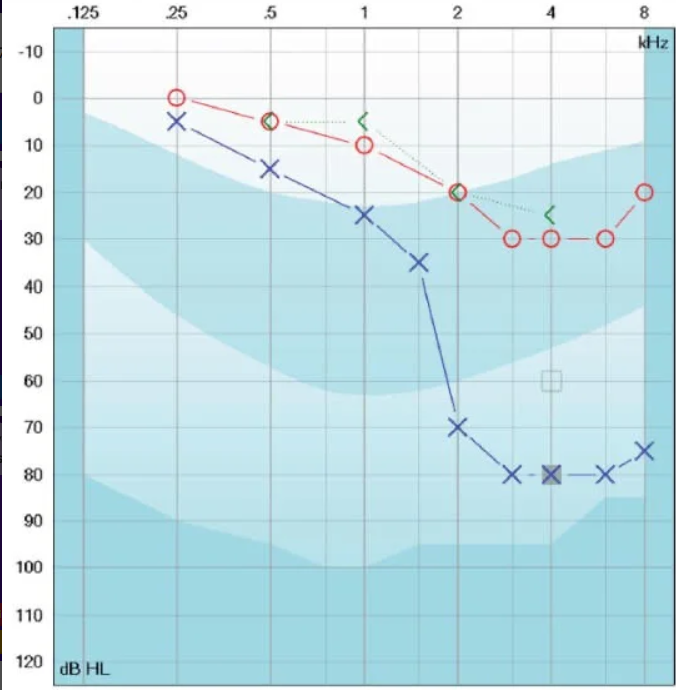
What would be our starting mask dB at 3k for air thresholds? (if we were using headphones)
40 dB mask in right ear

What would be starting mask threshold for 4k bone thresholds?
40 dB in the right ear
Explain the general procedure used in Evidence Based Practice
Integration of the best research evidence with clinical expertise and patient values
Involves a process by which the effectiveness of clincial practice is validated through study and analysis
General procedures include:
Framing the clinical question
Finding the evidence
Assessing the evidence
Making the decision
Why do we use FM signals in the sound field
To avoid standing waves
Individuals with hearing loss that can identify enough of the distinguishing features of speech through hearing alone to permit at least partial recognition of spoken language
Hard of Hearing
Represents little or no static admittance in the system (most abnormal tymp)
Type B
Represents normal static admittance but abnormal negative pressure in the middle ear
Type C
Which frequencies do you use to calculate PTA? Explain how to calculate PTA?
500 Hz, 1000 Hz, and 2000 Hz. You add up the thresholds for each ear at 500 Hz, 1000 Hz, and 2000 Hz and then divide by 3. This gives us the pure-tone average.
How many classical Bekesy patterns are there?
5
The intensity range from weakest to most intense phoneme is
30-65 dB
Limitation on function imposed by the hearing loss:
Hearing disability
The ease with which acoustic energy is transmitted
Admittance
Describe in detail the pathway otherwise known as the Acoustic Reflex Arc for both the ipsilateral side and the contralateral side.
Ipsilateral: The acoustic reflex arc begins as sound enters the ear and makes its way to the middle ear. The signal is sent to the inner ear at the cochlea, then to the cochlear nerve and up the the brainstem towards the superior olivary complex and VII nucleus. It makes its way back to the middle ear and sends the reflex signal back, hitting the stapedius muscle which contracts and in turn makes the ossicular chain stiffen.
Contralateral: For contralateral reflexes, the sound travels from one side (lefft or right) to the other. It begins by passing through the outer and middle ear and towards the inner ear and cochlea. The signal is sent to the cochelar nerve and up the brainstem towards the opposing ear. This is where sound “crosses” and travels to the opposite superior olivary complex and VII nucleus. Finally, the signal is sent back out to the other tympanic membrane as the stapedius muscle contracts and hit the ossicular chain.
The patient responds in the absence of the stimulus
False positive
This tuning fork test assesses bone conduction via mastoid placement and alternative opening/closing of tragus
Bing
Name the 2 professional organizations that have developed the scope of practice statements for audiology.
ASHA: American Speech-Language-Hearing Association
AAA: American Academy of Audiology
Why do we do daily listening checks?
To ensure that equipment is calibrated and functioning properply before testing patients. This ensures patients results are accurate and reliable.
This tuning fork test assesses bone conduction providing feedback about the location of sound via forehead placement of tuning fork
Weber
Acoustic Reflex Decay is assessed using which frequencies?
500 Hz, 1000 Hz
Explain rollover. What can this suggest?
Rollover is intensity is increased, but speech recognition decreases. This can suggest retrocochlear pathologies, neuropathy, or middle ear dysfunction.
Used to measure the output of an electronic device
Voltmeter
Define descrimination
Patient detects a change in the acoustic stimulus
Define awareness
Patient indicates a sound was detected
Define comprehension
Patient attaches a meaning to a stimulus by answering questions
Define indentification/recogntion
Patient attaches a label to a stimulus
Write 4 configurations you may see in an audiogram
Sloping: Low frequency thresholds are better then high frequencies. Thresholds are higher in the low frequencies and lower in the lower frequencies.
Rising: Low frequencies thresholds are worse than high frequencies. Thresholds are lower in the low frequencies and higher in the high frequencies.
Flat: Thresholds at all frequencies are equal.
Trough Shaped: Thresholds at mid frequencies are worse than low and high frequencies. Thresholds are better in the low and high frequencies and worse in the mid frequencies.
Name two types of audiometers, what are their purposes?
Pure-tone audiometer: This is the standard audiometer that allows us to test patients thresholds up to 8000 Hz.
Extended high frequency audiometers: Presents tones greater than 8000 Hz. This allows us to test patients thresholds at extended high frequencies.
When an acoustic stimulus is delivered to the ear canal the ___ muscle contracts and creates the acoustic reflex
Stapedius
____ are the gold standard of every audiological evaluation
pure tones
A measure of the ability of a test to detect the disorder for which it was designed
Validity
When doing acoustic reflexes for the ipsilateral side the highest intensity you will go to is?
100 dB
The inverse of stiffness as it relates to the ease of acoustic energy transmission
Compliance
Which frequencies are critical for the perception of speech?
300-3000 Hz
When doing acoustic reflexes for the contralateral side the highest intensity you will go to is?
105 dB
Who makes the standards in which our audiometers, acoustic immittance instruments and environment should comply to?
ANSI: American National Standards Institute
Accuracy in correctly rejecting patients without a disorder
Specificity
Write the degrees of hearing loss classification for children
Norm: 0-15 dB
Mild: 16-25 dB
Moderate: 26-30 dB
Moderate-Severe: 31-50 dB
Severe: 51-70 dB
Profound: 71+ dB
T or F: Middle ear measures assess hearing and provide objective information on the mechanical transfer of sound through the ear pathway.
False
Describe in detail the modified Hughson- Westlake Technique
When a patient responds to a sound presented, you decrease the dB level by 10. When a patient does not respond to a sound presented, you increase the dB level by 5. You can mark the patients threshold on the second time ascending. (Down 10 dB and up 5 dB)
The opposition to the flow of energy
Impedance
T or F: Threshold Tone Decay tests (TTD) provide differential diagnostic information regarding cochlear vs Retrocochlear pathology
True
Write the degrees of hearing loss classification for adults
Normal: 0-25 dB
Mild: 26-40 dB
Moderate: 41-55 dB
Moderate-Severe: 56-70 dB
Severe: 70-90 dB
Profound: 91+
Represents abnormally high static admittance
Type Ad
Standardized devices used for measuring the output of transducers
Coupler
Accuracy in correctly identifying disordered subjects
Sensitivity
SRT scores are generally _____ than the SDT.
10-12 dB greater
When running Tymps on babies age birth to 6 months we use which probe tone frequencies?
660-1000 Hz
Extended High frequency Audiometers use Circumaural headphones rather than supra-aural earphones
True
PTA should be within _____
5-10 dB