History and Measurement
 Call Kai
 Learn
 Practice Test
 Spaced Repetition
 Match
 Flashcards
 Knowt Play
1/22

There's no tags or description
Looks like no tags are added yet.
23 Terms
Which accounts of individual differences were provided before the formalisation of psychology as a science?
Throphrastus of Lesbos (4th century BC)
“…why it is that, while all Greece lies under the same sky + all the Greek are educated alike, it has befallen us to have characters so variously constituted”
Galen (216)
Alighieri (1321)
Chaucer (1387
Aquinas (1485)
Machiavelli (1532)
De Cervantes (1605)
Hume (1740)
Name some early personality psychologists
Allport
Lewin
Murray
Thurstone
Fiske
Norman
Digman
Goldberg
What did early personality psychologists develop?
The lexical hypothesis
The idea that personality is encoded in language through traits
What was the person-situation debate?
What is responsible for behaviour: personality traits or situations
Trait theory was out of fashion for a few decades after Mischel (1968)
What did Francis Galton and Karl Pearson argue about psychological attributes?
They can be measured + analysed
Are inherited
How else did Francis Galton and Karl Person contribute to differential psychology?
Many statistics used today:
Correlations
p-values
Chi-square test
How did Charles Spearman (1904) contribute to differential psychology?
Factor analysis
Reliability
Generate factor ability
How did Alfred Binet (1905) contribute to differential psychology?
Introduction of IQ test
How are unobservable constructs operationalised?
Observe patterns of behaviour/performance → make assumptions about hidden psychological characteristics that could be causing them
What are the basic ideas behind measurement?
Typically requires a ground truth (real fixed quantity) that we can derive measurement units from
E.g. height → cm
These often use ratio scales which have scalar units
Start at 0 (total absence)
Each unit spans the same amount
Psychological measurement depends on inferences (not direct observations) → must create our own measures
What does it mean to measure something well?
Should be consistent over time + in line with theory (doesn’t change with context)
Where does error in psychological measurement come from?
Impacts of stochastic (random) + systematic processes that deviate scores away from the true patterns (e.g. social desirability bias)
Interpretive disagreements about the scale among creators + users (e.g. cultural/age differences in questionnaire language)
What are some problems with who should make observations about individual differences?
Individuals are the only ones who have direct access to internal psychological characteristics
Are we the best judges?
Other individuals may be better judges of how we appear + how our internal experiences compare to others
Are they the best judges?
What is the key difference between errors/bias and noise?
Errors/bias = mistakes in something objective, a systematic distortion away from the true value
If we understand the sources of bias, we can minimise them (deductive)
Noise = aggregations of errors (stochastic + systematic) that produce temporary deviations from overall patterns
If we examine the impacts of noise, we can learn more about the processes that underlie them (inductive)
What is classical test theory?
The foundation of psychometrics (but alternative approaches are available today)
Key idea: observed score = true score + error
True score can include test + individual item components
Error can include (non)systematic influences
Better measurement → less error in calculation of observed score (closer to truth)
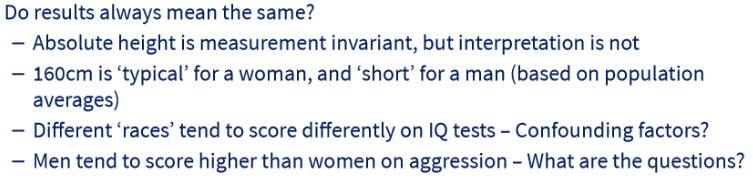
What factors need to be considered before drawing conclusions from test results (interpretation)?
Test content
Population
Etc
What are psychometrics?
The science of measuring psychological characteristics (e.g. used for voting intentions, job performance, clinical diagnosis)
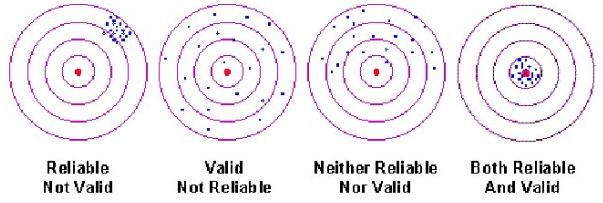
What are the 2 main criteria by which we judge psychometrics?
Reliability = consistency of measurement
Different forms of the same test (e.g. internal consistency, parallel forms)
Test-retest reliability
Cross-rate agreement
Validity = does our test measure what it is supposed to
Content + construct validity (test capturing its target construct)
Face validity (make sense + look right)
Convergent + discriminant validity (appropriate correlation with other tests)
Criterion + predictive validity (predict relevant outcomes)
How are the structure of our tests determined?
Categorise test items (e.g. behaviours) using theory + observations
How is test structure defined and how do we create it?
A priori → creating sub-tests within a test (e.g. gregariousness)
A posteriori → factor analysis (patterns of correlations within a test)
What is the difference between correlations and factor analysis?
Correlation = measure of association between 2 variables
Factor analysis = measure of association between many variables
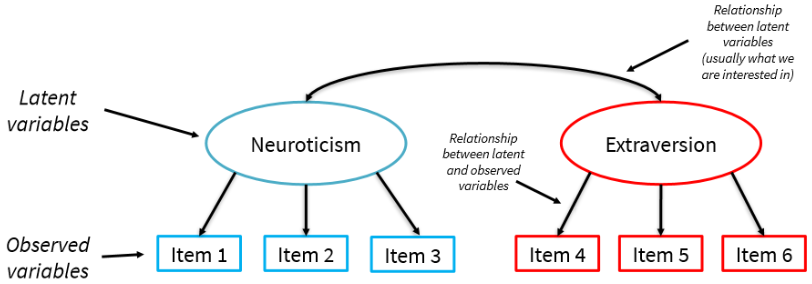
Looking for interpretable patterns of associations among observed variables that might be caused by latent variables (why do people who score highly on 1 item score highly on similar items)
Why is factor analysis initially atheoretical?
Factors emerge from data (not the other way around) BUT a theoretical structure can still be imposed on data
What does a factor model look like?