Animal Behavior Exam 2
 Call Kai
 Learn
 Practice Test
 Spaced Repetition
 Match
 Flashcards
 Knowt Play
1/74

There's no tags or description
Looks like no tags are added yet.
75 Terms
First order selection
Describes the geographic range of a species
Second order selection
The home range of an individual or group
Third order selection
Habitat use within the home range
Fourth order selection
Selection of specific resources at specific sites (e.g. berries from a bush)
Reproduction in kingdom Animalia asexually
Asexual reproduction in some animals (such as budding in sponges)
Parthenogenesis, or “virgin birth” (e.g. some sharks, reptiles (whiptail lizard), daphnia “water fleas”) - unfertilized egg develops into embryo
Reproduction in kingdom Animalia sexually
Sexual reproduction - combination of sperm and eggs
Androgenesis - rare, embryo develops using only genetic material from sperm (e.g. asian clams)
Most animal
Ansiogamy
Gametes differ in size and morphology
Sperm (small): selected for motility, rapid production, mate competition
Eggs (large): selected for nutrient investment and zygote viability
Creates inherent asymmetry in parental investment between sexes
Ansiogamy vs isogamy
Ansiogamy reversals toward isogamy possible via post-copulatory sexual selection
Ansiogamy is the fusion of gametes in dissimilar sizes. Males and female gametes are present.
Isogamy is the fusion of gametes in similar size. Male and female gametes are not distinguishable.
Fisherian runway
Intersexual selection, female mate choice here, leads to positive feedback loop.
Selected, conspicuous traits (e.g. tail length and bouncing behavior in long-tailed widowbird) increases in frequency
Leads to an increase in preference for the conspicuous trait (and in the frequency of alleles associated with this preference), greater sexual dimorphism and the evolution of seemingly maladaptive traits (typically in males, but some exceptions such as two spotted gobies, dance flies, pipefish)
Feedback loop continues until counterselection is strong enough to stop it (tails become so conspicuous and long that survival drops too low)
Female genetic preference ←> male trait becomes genetically correlated
Drives extreme trait elaboration
Intrasexual selection
competition over access to mates among same sex
pre-cop: contests, weapons, body size
e.g. beetle horns, elephant seal battles, female jacana territory defense
post-cop: sperm competition, mating plugs, mate guarding
Intersexual selection
mate choice by opposite sex
pre-cop: ornaments, courtship displays
e.g. manakin dances, bird song
post-cop: cryptic female choice, differential sperm storage or fertilization
Sexual conflict
Coevolution of antagonistic behaviors/structures that increase fitness of one sex while reducing fitness of the other sex
Ex: Muscovy duck genital coevolution - male corkscrew phallus vs. female counter-clockwise vaginal tract
Monogamy
1 female + 1 male (may occur when offspring requires both parents, high degree of parental care)
> 90% of birds
<10% of mammals
Social monogamy is not a good predictor of genetic monogamy
Monogamy H1 Mate assistance
Male care essential (canids)
Monogamy H2 Mate guarding
females scarce/dispersed (harlequin shrimp post-molt)
Monogamy H3 Female enforced
Female prevents her mate from mating with other females
Polyandry
> 1 male per female
Occurs where resources are patchy and briefly available, or predation is high
Sequential polyandry - female clutch size is limited (phalaropes)
Simultaneous polyandry - females defend males from other females, clutch size less restrictive (african tree frog, jacana)
Polyandry H1 Fertility insurance (genetic benefit)
Maximizing the number of female eggs fertilized
Polyandry H2 good genes (genetic benefit)
Mating with a male of higher social status or greater number of attractive features
Polyandry H3 genetic compatibility (genetic benefit)
Greater chance of some offspring having a superior combination of genes
Polyandry H4 more resources (material benefit)
Nuptial gifts or extensive male parental care
Polyandry H5 increased protection (material benefit)
Protection from harassment from other males
Polyandry H6 Infanticide reduction (material benefit)
Greater confusion about paternity of female’s offspring and lower rates of male killing their kids
Polygyny
> 1 female per male
> 90% of mammals
Males defend females when they can
Males disperse further, presumably to find a female group
In some birds males defend food or nesting sites (oropendolas, grouse)
Polygyny H1 female defense
Males defend harems directly
Polygyny H2 resource defense
Males defend essential resources
Polygyny threshold model
Female pairs with already-mated male on high-quality territory if fitness > unmated male on poor territory
Mating system determined by differences in resource value of male territories
Scramble competition polygyny
Males compete indirectly for fertilizations by spawning (releasing sperm) near spawning females (releasing eggs)
Lekking polygyny
Males compete directly for mating by displaying for multiple females; do not defend resources
Hypothesis for Lekking - hotspot
Males cluster because females tend to travel along particular routes that intersect
Hypothesis for Lekking - hotshot
Males cluster around highly attractive males in order to encounter more females
Hypothesis for Lekking - female preference
Males cluster anywhere because females are attracted to the largest aggregation of males
Which mating system is most common?
Polygynandry (promiscuity) is most common among all animals with both males and females mating with multiple partners
Within vertebrates, polygyny is most common
Within birds, social monogamy is far most common (around 90% bird species)
R strategists (many small offspring)
Allocate energy into many small offspring
Investing minimum into each one
Have very little or no parental care (exceptions exist)
K strategists (few large offspring)
Invest more into each offspring
Far more likely to have HIGH parental care
Amount of care varies greatly, can include: increased gestation, incubation of eggs, nest or young defense, young provisioning, etc)
continuous iteroparity reproductive strategy
Do not have set breeding seasons and may reproduce at any time of year (e.g. humans)
seasonal iteroparity reproductive strategy
Reproduce periodically
semelparity reproductive strategy
Reproduce once before death (like salmon and Antechinus males)
Patterns by taxon
Patterns by Taxon
Mammals: 100% maternal care, <5% paternal
Birds: >90% biparental care
Fish: ~25% show care; paternal > maternal (mouth brooding, egg aeration)
Amphibians/Reptiles: <20% show care (croc nest protection, frog transport)
Investment hypothesis (maternal care) + counterargument
Females invest more in gamete production so are less likely to abandon them
Concorde fallacy. Parental care should depend on expected benefits not on whether past investment will be wasted.
Not supported.
Paternal uncertainty hypothesis (maternal care)
Males unsure of paternity
Not supported (or weak)
Gamete order hypothesis (maternal care)
Females are usually the last with gametes so are stuck with them
Some support (most fish with simultaneous gamete release have paternal care ONLY)
Association hypothesis (maternal care)
Females are usually the sex nearest offspring when care is needed, so are more likely to be the caregiver
Also supported (doesn’t explain fish with simultaneous gamete release since both are nearest fertilized egg)
Parent/offspring conflict
Selection operates differently on parents vs offspring
Young - maximize their own parental care
Parents - distribute total resources equally among all offspring (lifetime offspring)
Direct costs - physical costs. mouth brooding fish can’t eat while caring
Indirect costs - current offspring care comes at expense of care for future young
Precocial/precocious offspring
More mobile and able to fend for themselves at birth
Altricial/altricious offspring
More reliant on parents for survival, less mobile
How to reduce costs of parenting?
Sneaker males (e.g. cuttlefish)
Extra pair copulations in birds
Brood parasitism: cuckoos lay eggs in host nests - evolved multiple times independently
The sender
An individual that transmits a signal
The receiver
An individual whose probability of behaving a certain way is altered by the signal
The channel
The medium through which the signal is transmitted (visual, chemical, tactile, auditory, electrical)
The signal
The behavior of the sender (posture, display, vocalization)
Context
The setting in which the signal is transmitted and received
Noise
Background activity in the channel which is irrelevant to the signal being transmitted
Signal-to-noise-ratio
How easy the signal is to detect in the environment
Functions of signals (IDIAD)
Identification (species, sex, position)
Directions (food location, navigation)
Intention (probable actions or state)
Advertisements (mate attraction, dominance displays)
Deceptions (false information)
Signals versus cues
Signals evolved/intentional
Cues influence behavior without being evolved to do so (unintentional)
Message versus meaning
Message = sender’s encoding
Meaning = receiver’s interpretation
Arbitrary versus nonarbitrary signals
Arbitrary = no structural link
Non-arbitrary = physical link (pitch ←> body size)
Discrete versus graded signals
Discrete = signals operate in an on/off manner
Graded = transmitted with varying intensity
Complex versus simple signals
Complex signals use multiple channels or convey multiple messages
What are rituals and steps in their evolution (SESR)
Rituals are complex communication behaviors
Originate from other functions: thermoregulation, maintenance behaviors, etc
Simplification (reduction in # of components)
Exaggeration of remaining components (as in peacocks)
Stereotype (behavior becomes invariable)
Repetition of signal
When do rituals arise?
Often in conflict situations (threat, territoriality, reproduction)
Reduces ambiguity of signal → message is standardized, efficient
e.g. piloerection (goosebumps) originally for thermoregulation, co-opted for communication
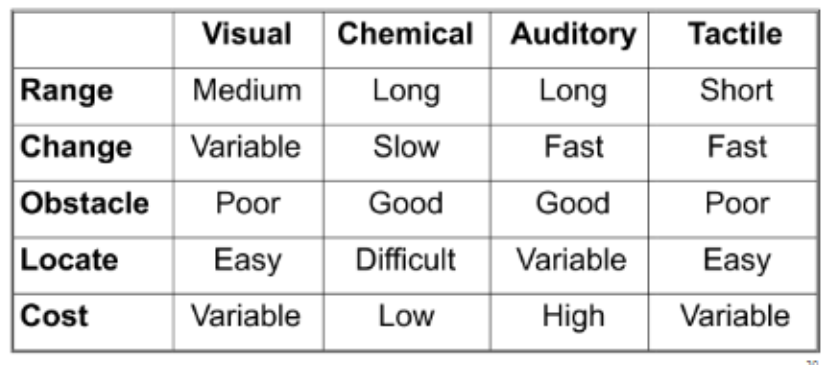
Properties of channels (RCOLC)
Range: how far will the signal carry?
Change: how much does the signal degrade or change from the point of release?
Obstacle: how well does the signal move around obstacles?
Locate: how easy is it for the receiver to find the signaler?
Cost: how much does it cost to produce the signal?
Auditory channel (acoustic communication)
Advantages
long distance, works at night, rapid starting/stopping
Disadvantages
attenuation in vegetation, eavesdroppers, environmental masking
Mechanics of acoustic communication
Stridulation (running two body parts together, crickets)
Tymbal organ (cicada)
Vocal organ (larynx, syrinx) (mammals)
Swim bladder (toadfish)
Other more complex ones (rattlesnakes)
Chemical channel (scent + taste)
Advantages
long distances via wind or water, works at night, low energy to produce, persists in environment
Disadvantages
can be difficult to locate, old messages may linger, causing confusion or alerting predators, few messages can be conveyed
Mechanics of chemical communication
Oldest form evolutionarily
Pheromones - most common, intraspecific (female armyworm calling)
Allomones - defensive chemicals that benefit sender, harm receiver, interspecific (bombardier beetle)
Kairomones - chemical eavesdropping, benefit receiver, harm sender, inter or intra specific (tracking in wolves)
Synomones - mutualistic attraction signals. Plant/pollinators.
When are signals likely to be dishonest?
If signaler and receiver have different goals
Ex: Begging calls of baby birds are usually honest, but chicks can sometimes try to manipulate to get more than their share of food
If signal is costly to assess or to challenge
Ex: Stomatopods bluffing after molting
Zahavi’s honest signaling hypothesis (handicap principle)
Signals are reliable because they are costly to produce and maintain. Only high quality males can bear the cost
There should be a direct link between signal design and the quality being signaled (honest signals should be nonarbitrary)
Conspicuous displays/weapons = reliable quality indicators
Tactile channel
Advantages
Increasing privacy/avoiding inadvertent receivers, helpful at night, instantaneous feedback
Disadvantages
Signals can’t travel very far, in a group signal has to be repeated, limits spatial awareness increasing risk of predation
Mechanics of tactile communication
All animals but sponges which rely on cilia, diff receptors diff tactile signals
Vibrissae (whiskers) are stiff hairs in mammals used for sensing textures, detecting changes in air currents.
Antennae (combo touch and chemical) in insects and many arthropod with rhythmic touching for direction, identify, resource info
Substrate/seismic receptors. Lateral lines in fish, corpuscles in elephants which are low range due to adaption for detecting low frequency vibrations)
Bat mating and sociality
Most bat species are polygynous (through the spectral bat is monogamous)
They form complex social groups displaying fission-fusion dynamics
Unique communal care - young are left behind in creches while adults forage (sometimes a “nanny bat” remains behind to babysit)
Bat foraging strategies (via echolocating)
Aerial hawking - catching prey mid flight
Trawling - picking insects off the surface of water
Gleaning - picking insects off of other surfaces (active = echolocating, passive = listening)
Reciprocal altruism
Bats will regurgitate blood and share with non-kin. However, they preferentially share with those who have donated blood to them in the past. This is similar to the long term optimal solution to the ultimatum game as the behavior is based on trust built of repeated interactions
Bat behavior
Chiropteran powered flight: elongated phalanges + patagium membranes
Echolocation: high-frequency ultrasonic vocalizations (distance calculated via echo delay, target size via frequency modulation and doppler shifts)